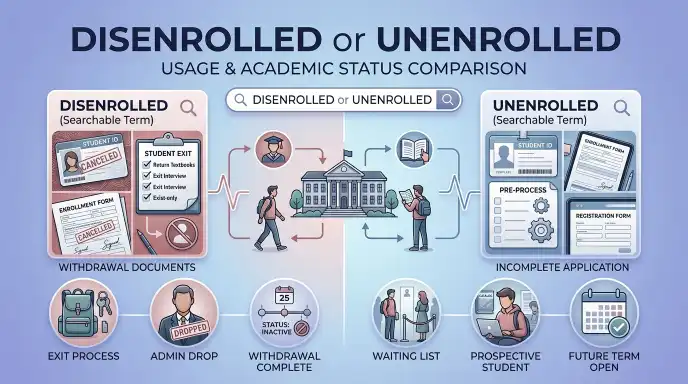
Disenrolled and unenrolled can both describe the end of enrollment, but they do not always focus on the same action.
Disenrolled often means that an organization removed someone from a program, while unenrolled often means that someone left or no longer belongs to a course, program, or list.
People often search for “disenrolled or unenrolled” because the two words look and sound very similar. Both words relate to enrollment, so the difference can feel unclear. The confusion becomes stronger in schools, online courses, memberships, healthcare plans, and other programs.
Consider these two examples:
The university disenrolled the student.
The student was not enrolled in the course.
The first sentence focuses on the university’s action. The second focuses on the student’s action.
Regional spelling can also cause confusion. American English uses enroll, while British English usually uses enrol. This difference creates forms such as disenroll/disenrol and unenroll/unenrol.
This guide explains both words in simple English. It covers their meanings, spelling, common mistakes, examples, and the best choice for different types of writing.
Disenrolled or Unenrolled: Quick Answer
Both disenrolled and unenrolled can be correct. The best choice depends on the meaning and context.
- Disenrolled often means an organization removed someone from enrollment.
- Unenrolled often means someone ended their enrollment or now has no enrollment.
- Disenroll is common in formal and administrative writing.
- Unenroll often appears in online courses and user instructions.
- British English may use disenrol and unenrol.
Simple Examples
The school disenrolled the student.
The school took action.
Maria unenrolled from the online class.
Maria took action.
He is currently unenrolled.
This sentence describes his current status.
The meanings can overlap. Always check the context before choosing a word.
Definition and Meaning of Disenrolled or Unenrolled
What Does Disenrolled Mean?
Disenrolled comes from the verb disenroll.
It usually means removed from an enrollment list, course, program, plan, or membership.
For example:
The college disenrolled the student after several missed payments.
The college took action and removed the student from the program.
You may see disenrolled in:
- Schools
- Universities
- Training programs
- Healthcare plans
- Membership programs
- Government programs
- Online services
The word often has a formal or administrative tone.
What Does Unenrolled Mean?
Unenrolled comes from the verb unenroll.
It can mean no longer enrolled. It can also describe the action of ending enrollment.
For example:
She was not enrolled in the course.
Here, the sentence focuses on her choice to leave the course.
Another example is:
He is currently unenrolled.
This sentence focuses on his current status.
What Is the Main Difference?
The easiest way to remember the difference is:
Disenrolled = removed from enrollment
Unenrolled = no longer enrolled or ended enrollment
The distinction does not always stay strict. Many organizations use their own terminology.
The Origin of Disenrolled or Unenrolled

Both words come from enroll.
The verb enroll means to enter someone’s name on a list, register, or official record.
The Origin of Disenroll
The word disenroll combines dis- with enroll.
The prefix dis- can express removal, separation, or reversal. Therefore, disenrolling naturally suggests removing someone from enrollment.
The past form is:
disenroll → disenrolled
For example:
The program disenrolled several members.
British English can use disenrol. However, this form has limited modern use, and some dictionaries mark it as obsolete.
The Origin of Unenroll
The word unenroll combines un- with enroll.
The prefix un- often shows the reversal of an action.
For example:
- lock → unlock
- tie → untie
- plug → unplug
- enroll → unenroll
This pattern makes unenroll easy to understand.
Why Do Different Spellings Exist?
The main difference comes from British and American spelling.
American English usually writes:
enroll
British English usually writes:
enrol
That difference affects related forms.
| American English | British English |
| enroll | enrol |
| disenroll | disenrol |
| unenroll | unenrol |
The past form enrolled uses two ls in both major varieties of English.
British English vs American English Spelling
The biggest difference comes from the base word enroll/enrol.
| Meaning | British English | American English | Example |
| Join a course | enrol | enroll | She will enrol/enroll today. |
| Past form | enrolled | enrolled | She enrolled yesterday. |
| Leave enrollment | unenrol | unenroll | You can unenrol/unenroll anytime. |
| Remove from enrollment | disenrol | disenroll | The system may disenroll/disenroll users. |
| Past form | disenrolled | disenrolled | The school disenrolled the student. |
| Current status | unenrolled | unenrolled | He is currently unenrolled. |
British English
British English usually prefers enrol.
For example:
Students can enroll in the course online.
You may also see unenrol in British writing.
American English
American English usually prefers to enroll.
For example:
Students can enroll in the course online.
The forms disenroll and unenroll also fit American spelling.
One Important Point
Spelling alone does not determine the meaning.
Disenrolled and unenrolled can describe similar situations. The writer must also consider the action, context, and audience.
Which Spelling Should You Use?
Your audience should guide your choice.
United States
Use disenroll and unenroll in American English.
For formal removal, write:
The school disenrolled the student.
For a user action, write:
You can unenroll from the course.
United Kingdom
Use enrol instead of enroll.
You may also see:
- disenrol
- unenrol
However, modern usage can vary. Follow the style of your organization when one exists.
Canada
Canadian English uses both British and American influences.
For professional writing, check the terminology used by the relevant school, company, government body, or publication.
Australia
Australian English often follows British spelling patterns.
You may therefore see enrol and unenrol. Institutional style can still vary.
International Writing
Choose the form that your target audience expects.
For a mixed audience, you can avoid confusion by using a simpler phrase.
For example:
The student left the course.
Or:
The school removed the student from the program.
Academic Writing
Follow your university or publication style guide.
If the exact enrollment terminology matters, use the official term from the institution.
Business Writing
Consistency matters most.
If your company users enroll in its software, keep that form throughout your documents.
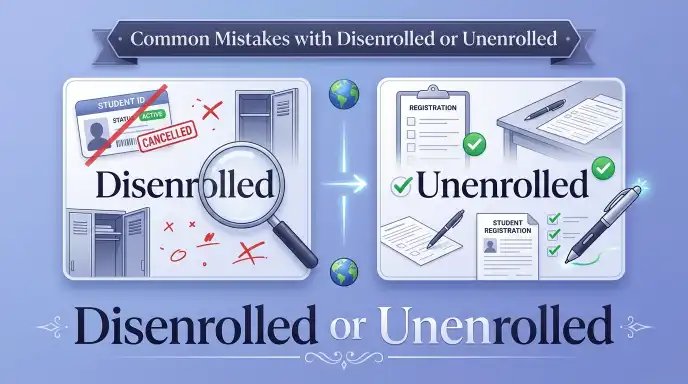
Common Mistakes with Disenrolled or Unenrolled
Treating Both Words as Completely Different
Incorrect:
Disenrolled and unenrolled always have completely different meanings.
Better:
Disenrolled and unenrolled can overlap in meaning.
Explanation:
Both words can describe the end of enrollment.
Memory Tip:
Think disenrolled = removal and unenrolled = no longer enrolled.
Using Disenrolled for the Wrong Action
Incorrect:
I disenrolled from the course because I changed my schedule.
Better:
I unenrolled from the course because I changed my schedule.
The second version clearly shows that the student chose to leave.
Assuming Unenrolled Always Means Voluntary
Incorrect:
Unenrolled always means that the person chose to leave.
Better:
Unenrolled can describe someone who no longer has enrollment.
The word itself does not always explain why enrollment ended.
Confusing Disenrolled With Expelled
Incorrect:
The school disenrolled him, so it expelled him.
Better:
The school expelled him.
Disenrolled does not automatically mean expelled.
Expulsion often involves disciplinary action. Disenrollment only tells us that enrollment ended.
Confusing Enrollment With Withdrawal
Incorrect:
Every disenrolled student has withdrawn voluntarily.
Better:
A student may leave a course voluntarily, or an institution may remove the student.
Words such as withdraw, drop, and disenroll can describe different situations.
Using the Wrong Regional Spelling
Incorrect for standard American English:
Students can enroll online.
Better:
Students can enroll online.
For British English, enrol is the usual form.
Disenrolled or Unenrolled in Everyday Examples
These words appear in education, business, healthcare, memberships, online learning, and administrative writing.
In an Email
Your account has been disenrolled from the training program.
This wording suits an official message from an organization.
In Business Writing
Members who do not renew their plans may become unenrolled.
The sentence focuses on membership status.
In a News Article
The university disenrolled several students after they failed to meet the program rules.
The active form makes the sentence direct.
In a Blog
You can unenroll from the course if you no longer need it.
This style works well for online learning instructions.
In Social Media
Need a break from the class? You can unenroll from the course at any time.
The wording sounds simple and user-friendly.
In Academic Writing
The university may disenroll students who fail to complete the required registration steps.
This formal style fits an academic policy.
In Daily Conversation
I didn’t register from the class because the schedule did not work for me.
A casual speaker may also say:
I dropped the class.
Both sentences can communicate the same basic idea.
Disenrolled or Unenrolled: Google Trends & Usage Data
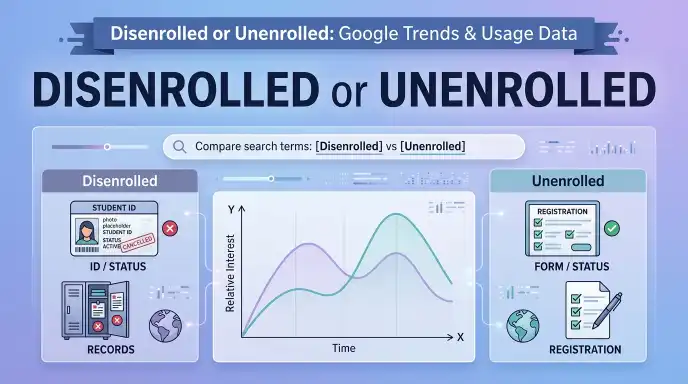
People search for “disenrolled or unenrolled” when they want to check word choice, spelling, or meaning.
Common searches include:
- Is disenrolled a word?
- Is unenrolled correct?
- What does disenrolled mean?
- What does unenrolled mean?
- Should I say disenrolled from?
- Should I say unenrolled from?
- Is British English?
- What is the opposite of enrolled?
Search interest can also vary by context.
Disenrolled often appears in formal settings. Schools, healthcare programs, government services, and membership systems may use the word.
Unenrolled often appears in education and online learning. Users may see it in course platforms and account settings.
Exact Google Trends numbers can change by country and date. Without a fixed location and time range, exact search-volume claims would not be reliable.
The main search intent remains clear: users want to know which word sounds correct and what each word means.
For modern writing, context matters more than choosing one word for every situation.
Quick Comparison Table
| Word | Basic Meaning | Common Use | Example |
| Disenrolled | Removed from enrollment | Formal or administrative writing | The school disenrolled the student. |
| Unenrolled | No longer enrolled | General, education, and digital contexts | The student is unenrolled. |
| Disenroll | Remove someone from enrollment | American English | The program may disenroll users. |
| Unenroll | End enrollment | American English | You can unenroll from the course. |
| Disenrol | British form of disenroll | British English | The system may disenroll a user. |
| Unenrol | British form of unenroll | British English | Students can unenrol online. |
| Withdraw | Leave a course or program | Education | She withdrew from the course. |
| Drop | Leave a class or course | Casual education language | He dropped the class. |
Key Takeaways
- Disenrolled often means someone was removed from enrollment.
- Unenrolled often means someone is no longer enrolled.
- Both words can overlap in meaning.
- Disenroll is common in American English.
- Unenroll is also common in American English.
- British English usually uses disenrol and unenrol.
- The reason for leaving should not be assumed from either word.
- Always follow your organization’s preferred terminology.
FAQs About Disenrolled or Unenrolled
Q1. Is “disenrolled” a correct word?
Yes. Disenrolled is the past form of disenroll. It usually means that an organization removed someone from a course, program, plan, or membership. The word often appears in formal or administrative writing.
Q2. Is “unenrolled” a correct word?
Yes. Unenrolled is a standard form of unenroll. It can describe someone who no longer has enrollment. It can also relate to the action of ending enrollment, especially in online courses and other user-facing systems.
Q3. What is the difference between disenrolled and unenrolled?
Disenrolled often focuses on removal from enrollment. Unenrolled often focuses on the person no longer having enrollment or ending enrollment. The two meanings can overlap, so the sentence and context should guide your choice.
Q4. Should I say “disenrolled from” or “unenrolled from”?
Both forms can work. Disenrolled often sounds more formal and administrative. Unenrolled from can sound more natural when someone leaves an online course or program. The organization’s preferred wording should come first.
Q5. Is it British English?
Disenrol is a British English form of disenroll. However, modern usage varies. Some dictionaries give the word limited or obsolete status. Writers should check the style used by their organization before choosing it.
Q6. Is unenroll American English?
Unenroll fits American spelling because American English uses enroll. British English usually uses unenrol because British English normally uses enrol.
Q7. Does disenrolled mean expelled?
No. Disenrolled only tells you that enrollment ended or that an organization removed someone from enrollment. Expelled usually carries a disciplinary meaning. A writer should not assume that disenrollment means expulsion.
Q8. Which word should I use for a school notice?
Use disenrolled when the school wants to describe its action of removing a student. Use unenrolled when the notice describes a student’s current status. The school’s official terminology should always take priority.
Q9. Can I use “dropped” instead of disenrolled?
Sometimes. Dropped sounds more casual and common in American education. Disenrolled sounds more formal. Choose dropped for casual conversation and disenrolled when an official or administrative tone fits better.
Q10. What is the opposite of enrolled?
The opposite depends on the context. Unenrolled can describe someone who no longer has enrollment. Other useful phrases include not enrolled, withdrawn, or removed from the program.
Conclusion:
Disenrolled and unenrolled both relate to the end of enrollment, but each word can highlight a different part of the situation. Disenrolled often focuses on an institution removing someone from a course, program, or plan. Unenrolled often describes someone who no longer has enrollment or who ends their own enrollment.
Regional spelling adds another layer. American English uses enroll, disenroll, and unenroll. British English usually uses enrol, disenrol, and unenrol. Actual usage can vary, so an organization’s style guide should guide formal writing.
For school notices and administrative documents, disenrolled can clearly describe institutional action. For online courses and user instructions, unenroll can sound more direct.
The most useful memory rule is simple: disenrolled often points to removal, while unenrolled often points to the end of enrollment.
When you write for a specific audience, check the local spelling and the organization’s preferred terminology. That small step can make your writing clearer and more professional.

I’m Nora Ellis, an English language writer passionate about making grammar, spelling, and confusing words easy to understand. I share clear explanations and practical examples to help readers improve their English and use words with confidence.



16 thoughts on “Disenrolled or Unenrolled: Meaning, Usage & Examples ”