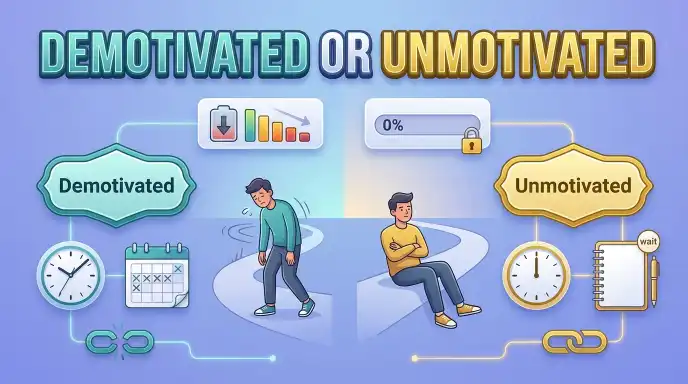
Demotivated and unmotivated both describe a lack of motivation, but they are not always used in the same way. Demotivated usually suggests that someone has lost motivation, often after a setback, criticism, failure, or other experience.
Unmotivated usually describes someone who lacks motivation or interest in doing something. People often search for demotivated or unmotivated because the two words look almost interchangeable. Both can describe a student who does not want to study or an employee who has little interest in work.
The key difference is often the change in motivation. A person can be unmotivated without saying that they were motivated before. Someone who becomes demotivated has usually experienced a drop in motivation.
This distinction is useful in everyday English, workplace writing, education, and formal communication. For example, you can say, “The students seem unmotivated,” when you are simply describing their current state. If poor results caused their motivation to fall, “The students became demotivated” may express the situation more clearly.
In this guide, you will learn the meaning, origin, usage, spelling, common mistakes, and practical differences between these two words.
Demotivated or Unmotivated : Featured Snippet & AI Overview
Demotivated usually means that someone has lost motivation, while unmotivated means that someone currently lacks motivation or interest. For example, a student may be unmotivated to study, while repeated poor results may leave that student demotivated. The meanings overlap, so context often determines which word sounds more natural.
Demotivated or Unmotivated : Quick Answer
Use unmotivated when you want to describe a general lack of motivation.
Use demotivated when you want to show that motivation has decreased or been lost.
Simple examples
- Unmotivated: She is unmotivated to study.
- Demotivated: She became demotivated after failing the exam.
- Unmotivated: The new employee seems unmotivated.
- Demotivated: Constant criticism left the employee demotivated.
A useful memory rule is:
Unmotivated = lacking motivation.
Demotivated = motivation has gone down.
This is a useful distinction, but it is not an absolute grammar rule. Both words can overlap in real English. Cambridge defines unmotivated as not wanting to do something or not wanting to do it well. Oxford defines demotivated as feeling less keen to work or study.
What Does Demotivated or Unmotivated Mean?
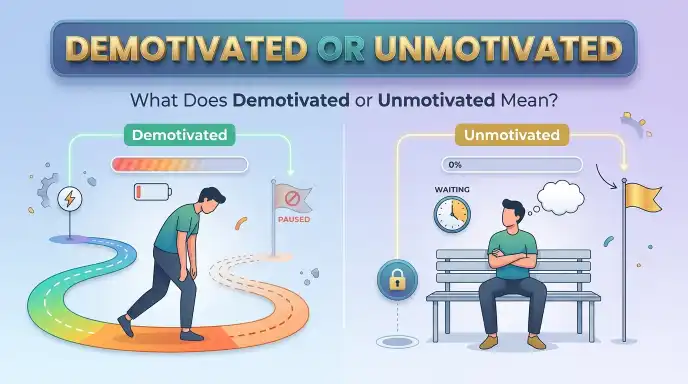
What Does Demotivated Mean?
Demotivated is an adjective formed from the verb demotivate. It describes someone whose motivation has decreased or who has been made less enthusiastic about something.
Cambridge defines demotivate as making someone less enthusiastic about a job. Oxford similarly defines demotivated as feeling less keen to work or study.
The word often appears when there is a clear reason for the change.
For example:
The student felt demotivated after receiving a low grade.
The student may have wanted to study before. The poor result then reduced that motivation.
Other common causes can include:
- repeated failure
- negative feedback
- lack of progress
- unfair treatment
- workplace problems
- criticism
- disappointment
What Does Unmotivated Mean?
Unmotivated means lacking motivation. It can describe a person’s current attitude without saying if that person was motivated before.
Cambridge gives the example of unmotivated students. Oxford also uses the word for people who lack interest or enthusiasm, especially in work or study.
For example:
The student seems unmotivated this semester.
This sentence describes the student’s current state. It does not tell us if something caused the change.
The Main Difference
The easiest way to understand the difference is to focus on change.
| Word | Main idea | Example |
| Unmotivated | Lacking motivation | She feels unmotivated to exercise. |
| Demotivated | Having less motivation than before | She became demotivated after several setbacks. |
The difference can be small. In many everyday situations, either word may work.
The Origin of Demotivated or Unmotivated
Both words come from motivate, but they use different prefixes.
The verb motivate dates to the 19th century. Etymonline traces it to 1863, from motive plus the suffix -ate. The word motive is linked to the idea of something that moves or drives a person to act.
The Origin of Demotivated
Demotivated comes from de- + motivate.
The verb demotivate is recorded from 1974. It means to cause someone to lose motivation or to remove an incentive to continue.
The prefix de- can express ideas such as removal, reversal, or reduction. In demotivate, it helps create the idea of reducing or taking away motivation.
The Origin of Unmotivated
Unmotivated comes from un- + motivated.
Etymonline dates the adjective unmotivated to 1905, with the sense “lacking in motivation.” The prefix un- is a common English negative prefix meaning “not.”
This gives us a simple word-building pattern:
motivated → unmotivated
motivated → demotivated
The words look similar because they are built from the same base. Their prefixes add different shades of meaning.
British English vs American English
There is no standard British-American spelling difference between demotivated and unmotivated.
Both words are spelled the same in British English and American English.
| Term | British English | American English | Example |
| Demotivated | demotivated | demotivated | She felt demotivated after the setback. |
| Unmotivated | unmotivated | unmotivated | He seems unmotivated at work. |
| Demotivate | demotivate | demotivate | Poor feedback can demotivate workers. |
| Motivated | motivated | motivated | The team is highly motivated. |
Pronunciation can vary slightly between British and American English. The spelling does not.
The bigger difference is often usage preference, not spelling. Some English speakers, especially in certain US contexts, may prefer unmotivated or not motivated where another speaker might use demotivated. Older learner discussions also show regional differences in how natural the word demotivated sounds to individual speakers. These are usage preferences, not spelling rules.
Which Version Should You Use?
Choosing between these words depends more on meaning and context than on country.
United States
Unmotivated is a clear choice when you simply mean that someone lacks motivation.
The students seem unmotivated.
Demotivated is also an established English word, especially when you want to describe a loss of motivation. Cambridge lists it as a standard verb and Oxford lists demotivated as an adjective.
United Kingdom
Both words are used.
Use unmotivated for a general lack of motivation.
Use demotivated when something has reduced a person’s motivation.
The long delays left the team demotivated.
Canada
The same basic distinction works well in Canadian English.
Choose unmotivated for a current lack of motivation. Choose demotivated when the context highlights a decline in motivation.
Australia
Both forms can be understood and used.
The surrounding sentence should guide your choice. If there is a clear change in motivation, demotivated can express that change.
International Writing
For international readers, unmotivated can be very clear when you simply mean “lacking motivation.”
Use demotivated when the idea of losing motivation matters.
Academic Writing
In academic writing, choose the word that matches your evidence.
The students were unmotivated to complete the task.
This states their condition.
The students became demotivated after repeated failures.
This shows a change.
Business Writing
Both words can work in workplace communication.
However, precise writing is important. Explain the cause when you use demotivated.
The repeated changes left staff demotivated.
This is clearer than using the word without context.
Common Mistakes with Demotivated or Unmotivated
Treating Them as Exact Synonyms
Incorrect idea: The two words always mean exactly the same thing.
Better: They overlap, but demotivated often highlights a reduction in motivation.
Memory tip: Think de- = down or away.
Using Demotivated Without a Clear Change
The student was demotivated from birth.
This sounds unusual because demotivated often suggests a loss or reduction in motivation.
A clearer option may be:
The student was unmotivated.
The second sentence simply describes the student’s state.
Assuming Unmotivated Means “Never Motivated”
Unmotivated does not prove that a person was never motivated.
It simply describes a lack of motivation at the time being discussed.
I feel unmotivated today.
The sentence does not tell us how motivated the speaker was yesterday.
Using “De-motivated”
The standard spelling is demotivated, not de-motivated.
Correct: She felt demotivated.
Incorrect: She felt de-motivated.
The closed form demotivated is the normal spelling used in modern dictionaries.
Confusing Demotivated With Discouraged
The words can overlap, but discouraged focuses more on losing confidence, hope, or determination.
Demotivated focuses on reduced motivation.
For example:
The failed project left him discouraged.
The failed project left him demotivated.
Both can work, but the focus is slightly different.
Demotivated or Unmotivated in Everyday Examples
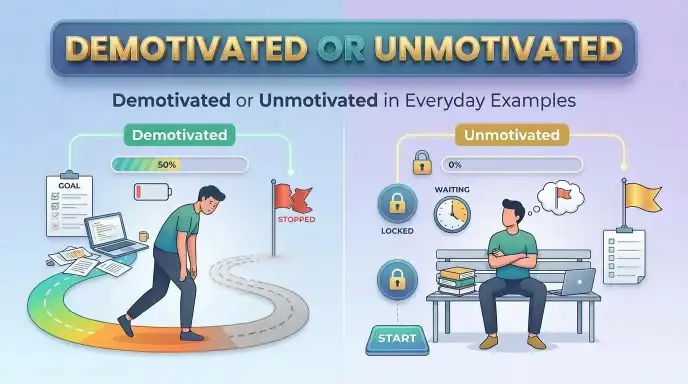
These words appear often in conversations about school, work, goals, exercise, and personal effort.
In Emails
A manager might write:
The team seems unmotivated after the recent changes.
A follow-up email could say:
Several employees became demotivated after the project was delayed.
The second example suggests a change caused by the situation.
In Business Writing
Low sales can leave a team demotivated.
Here, the sentence connects the situation with a drop in motivation.
In News Headlines
A news report about education might use:
Unmotivated students struggle to stay engaged.
A workplace report might use:
Staff feel demotivated after repeated changes.
These examples show how each word can fit a different focus.
In Blogs
A blog about study habits may say:
You may feel unmotivated when a task seems too difficult.
A workplace article could say:
Constant criticism can make employees feel demotivated.
In Social Media
A short post might say:
Feeling unmotivated today? Start with one small task.
Another post could say:
Repeated setbacks can leave you feeling demotivated.
Both forms are natural when the context supports the meaning.
In Academic Writing
Students may become demotivated when they see little progress.
Or:
Some students remain unmotivated throughout the course.
The first sentence focuses on a change. The second describes a general condition.
In Daily Conversation
I feel unmotivated today.
This is a natural way to describe your current state.
You could also say:
I felt demotivated after my application was rejected.
The cause is clear, so demotivated fits well.
Demotivated or Unmotivated : Google Trends & Modern Usage

Search interest for demotivated and unmotivated can vary by country, topic, and time. Google Trends reports relative search interest, not a fixed number of searches, so any comparison should use a specific location and date range.
The two words are commonly connected with searches about:
- motivation
- work motivation
- student motivation
- study motivation
- lack of motivation
- employee motivation
- feeling unmotivated
- losing motivation
Modern dictionary sources confirm that both forms remain established English vocabulary. Cambridge defines unmotivated as lacking the desire to do something and demotivate as making someone less enthusiastic. Oxford lists unmotivated with meanings related to lacking interest or having no motive, while its learner dictionary lists demotivated for feeling less keen to work or study.
Usage can also depend on the field. Unmotivated is common when discussing students, workers, or people who lack interest. Demotivated often appears when writers discuss a change in motivation, especially after setbacks or negative experiences.
Older English-learning discussions also show that speakers differ in how natural demotivated sounds, particularly in American English. Such discussions are useful for showing variation, but they are not a substitute for current dictionary evidence.
So, avoid claims such as “one word is always more popular worldwide” unless you have current, location-specific data to support them.
Quick Comparison Table
| Version | Meaning | Correct? | Region | Example |
| Unmotivated | Lacking motivation | Yes | International | She feels unmotivated to study. |
| Demotivated | Having reduced or lost motivation | Yes | International | She became demotivated after the failure. |
| Not motivated | Having no current motivation | Yes | International | He is not motivated to continue. |
| Discouraged | Having less confidence or hope | Yes | International | He felt discouraged after the rejection. |
| Motivated | Having a reason or desire to act | Yes | International | The students are motivated to learn. |
The first two words are the main focus of this comparison. Not motivated can be a useful plain-English alternative, while discouraged has a related but slightly different meaning.
Key Takeaways
- Unmotivated means lacking motivation or interest.
- Demotivated usually suggests that motivation has decreased or been lost.
- Both words are correct English.
- Neither word is a special British or American spelling.
- Use unmotivated for a general lack of motivation.
- Use demotivated when a setback or experience has reduced motivation.
- The two words can overlap in everyday English.
- Always choose the word that best matches the context and intended meaning.
FAQs About Demotivated or Unmotivated
Q1. Is it better to say demotivated or unmotivated?
Neither word is always better. Unmotivated works well when you mean that someone lacks motivation. Demotivated is useful when you want to show that the person’s motivation has decreased. Both are standard English words, so the context should guide your choice.
Q2. What is the main difference between demotivated and unmotivated?
Unmotivated describes a lack of motivation. Demotivated often describes a loss or reduction in motivation. For example, “She is unmotivated to study” describes her current state. “She became demotivated after failing the exam” suggests that the failure affected her motivation.
Q3. Can I use demotivated and unmotivated interchangeably?
Sometimes, yes. Both words can describe someone who does not feel motivated. However, demotivated often adds the idea that motivation has fallen because of an event or experience. Unmotivated is broader and can describe a general lack of motivation.
Q4. Is demotivated a correct English word?
Yes. Demotivated is a recognized English adjective and the past participle of demotivate. Cambridge defines demotivate as making someone less enthusiastic, while Oxford lists demotivated as meaning less keen to work or study.
Q5. Is unmotivated the same as lazy?
No. Unmotivated and lazy do not have exactly the same meaning. Unmotivated describes a lack of motivation or desire to act. Laziness can suggest an unwillingness to make an effort. Calling someone unmotivated does not automatically mean that the person is lazy.
Q6. Can I say “I am demotivated”?
Yes. The sentence is grammatically correct. It is especially useful when something has reduced your motivation.
I felt demotivated after receiving negative feedback.
If you simply want to describe your current state, you can also say:
I feel unmotivated today.
Q7. Which word is better for students?
Both can be correct. Use unmotivated when describing students who currently lack interest or drive. Use is demotivated when students have lost motivation because of something such as repeated failure, poor results, or a lack of progress.
Q8. Is “demotivated” British English?
Demotivated is used in British English, but it is not a British-only word. It is also recognized in American English and other varieties of English. The main difference is not spelling. Individual speakers may have different preferences about how natural the word sounds.
Q9. What is the opposite of unmotivated?
The direct opposite is generally motivated. For example:
She was unmotivated at first.
She became motivated after setting a clear goal.
Demotivated can also be contrasted with motivated, especially when discussing a change in motivation.
Q10. What is another way to say demotivated?
Depending on the context, you can say less motivated, discouraged, disheartened, or uninspired. These words are not exact replacements in every sentence. Choose one based on the meaning you want to express.
Conclusion:
Demotivated and unmotivated are both correct words, but they can express different shades of meaning. Unmotivated usually describes a person who lacks motivation, interest, or enthusiasm. Demotivation often suggests that motivation has decreased after a setback, problem, criticism, or other experience.
The easiest way to remember the difference is to focus on change. If you are describing a general state, unmotivated is often the natural choice. If you are describing a drop from a previous level of motivation, demotivated can be more precise.
There is no British-American spelling issue here. Both words keep the same spelling in both varieties of English. Your choice should depend on meaning, context, and the situation you are describing.
For school writing, business communication, blogs, and everyday speech, clear context matters more than choosing one word every time. When in doubt, ask yourself one simple question: Am I describing a lack of motivation, or a loss of motivation?
That question will usually point you to the right word.

I’m Nora Ellis, an English language writer passionate about making grammar, spelling, and confusing words easy to understand. I share clear explanations and practical examples to help readers improve their English and use words with confidence.




4 thoughts on “Demotivated or Unmotivated: Meaning, Usage & Examples ”