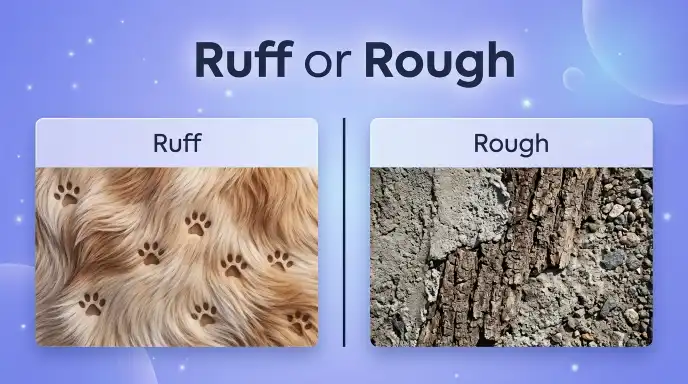
The correct word depends on what you mean. Rough is the common word for something uneven, difficult, harsh, or not exact. Ruff is a different word. It can mean a stiff, folded collar or a ring of hair or feathers around an animal’s neck. Both words are pronounced /rʌf/, so it is easy to confuse their spelling.
Many people search for ruff or rough because the words sound exactly the same in standard English. However, they do not have the same meaning. Rough is common in everyday English.
You may use it to describe a rough road, rough skin, rough weather, or a rough estimate. Ruff appears in more specific contexts, such as history, clothing, animals, and some specialist uses.
This guide explains the difference between ruff and rough in simple terms. You will learn their meanings, origins, common uses, spelling rules, and examples. You will also see when each word fits in modern English.
Ruff or Rough: Quick Answer
Rough is the word you usually need. It can describe something that is not smooth, difficult, harsh, violent, or approximate. For example, you can say rough road, rough weather, or rough estimate.
Ruff is a separate word. It can refer to a large, stiff collar with folds. It can also mean a circle of hair or feathers around an animal’s neck.
Quick examples
- The road was rough.
- She gave me a rough estimate.
- The bird has a large neck ruff.
- The man wore a historical ruff around his neck.
The key point is simple: rough is the common everyday word, while ruff has specific meanings.
What Does Ruff or Rough Mean?
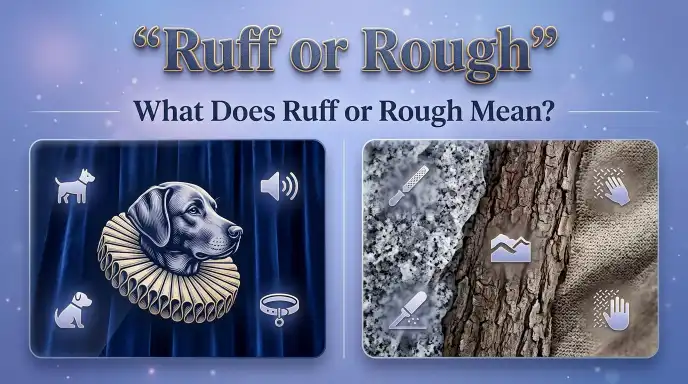
Meaning of Rough
Rough has several common meanings.
It can describe a surface that is not smooth or even. A road with stones and holes can be rough. Skin can also feel rough when it is dry or damaged.
The word can also describe something difficult or unpleasant.
For example:
It was a rough day at work.
Here, rough does not describe a physical surface. It means the day was difficult.
Rough can also mean approximate or not exact.
For example:
Can you give me a rough estimate?
A rough estimate gives a general number. It does not give an exact figure. Cambridge also lists rough draft, rough figures, and rough guide among common uses.
Meaning of Ruff
Ruff has a much narrower meaning.
One meaning is a large, stiff collar with many folds. These collars were worn in Europe during the 16th and 17th centuries.
Another meaning describes a circle of hair or feathers around the neck of a bird or animal.
For example:
The bird has a white neck ruff.
The word ruff can therefore appear in discussions about historical clothing and animal features.
Why Do People Confuse Them?
The main reason is pronunciation.
Ruff and rough are both pronounced /rʌf/ in standard British and American English.
When people hear the word, they cannot see its spelling. Context tells them which word makes sense.
The Origin of Ruff or Rough
The two words have different histories.
Origin of Ruff
The clothing word ruff dates to the 16th century. Etymonline traces the noun to the 1520s and connects it with ruffle. It was used for a type of large band or frill. The collar sense became established in the following decades.
The word later gained a related animal meaning. By the 1690s, ruff was used for distinctive feathers around the neck of birds.
There are also other historical uses of ruff, including a card-playing term. That use is separate from the clothing and animal meanings.
Origin of Rough
Rough is much older.
Etymonline traces it to Middle English forms such as rough, rouhe, rouwe, and roghe. These forms came from Old English ruh, meaning something like coarse, shaggy, hairy, or not smooth.
The word developed many meanings over time.
It came to describe rough surfaces and rough land. Later, it also described stormy weather, harsh language, difficult situations, and things that were not finished or exact.
So, ruff and rough did not develop as two spellings of the same word. They have separate histories.
British English vs American English
There is no major British-American spelling difference between ruff and rough. Both forms are used in British and American English.
| Word | British English | American English | Example |
| rough | rough | rough | The road is rough. |
| ruff | ruff | ruff | The bird has a neck ruff. |
The pronunciation is also the same in both major varieties: /rʌf/.
The difference is therefore about meaning and context, not regional spelling.
For general writing, use rough when you mean uneven, difficult, harsh, or approximate.
Use ruff when your subject is the historical collar or a ring of feathers or hair around an animal’s neck.
Which Version Should You Use?
The right choice depends on your meaning.
United States
Use rough for common meanings such as:
- rough road
- rough surface
- rough weather
- rough day
- rough estimate
- rough draft
Use ruff for its specific dictionary meanings, such as a historical collar or an animal’s neck feathers.
United Kingdom
The same rule applies in British English.
Rough is the normal everyday word. Ruff has specific meanings related to clothing, animals, and other specialized contexts.
Canada
Canadian English also uses rough in its normal English meanings. Ruff remains a separate word with its own meanings.
Australia
Australian English follows the same basic distinction. The spelling should match the meaning rather than the country.
International Writing
For international readers, context is especially important.
If you mean something uneven or difficult, choose rough.
If you mean a historical collar or a ring of animal feathers or hair, choose ruff.
Academic Writing
Use the exact word that matches your subject.
For example:
The portrait shows a man wearing a ruff.
But:
The study used a rough estimate.
Business Writing
Rough is common in business English.
You may see:
- rough estimate
- rough figures
- rough draft
- rough guide
Cambridge lists these uses in its Business English definition.
Ruff is uncommon in normal business writing unless the topic itself requires the word.
Common Mistakes With Ruff or Rough
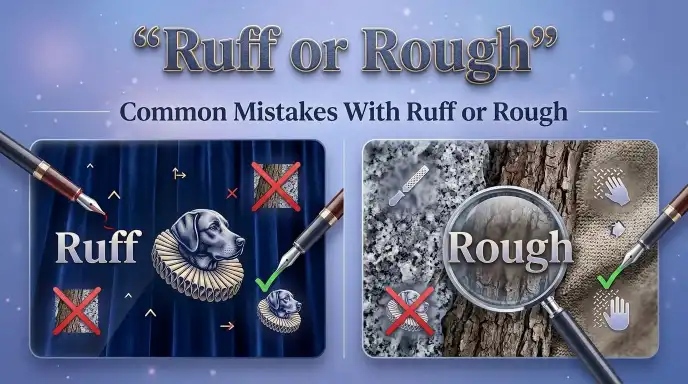
The biggest mistake is treating ruff as a misspelling of rough.
It is not.
Mistake 1
Incorrect for the intended meaning:
The road was ruff.
Correct:
The road was rough.
Why?
The sentence describes an uneven or difficult road.
Memory tip: Think of rough roads and rough surfaces.
Mistake: 2
Incorrect for the intended meaning:
The bird has a rough neck.
Correct:
The bird has a neck ruff.
Why?
Here, ruff refers to a circle of hair or feathers around the neck.
Memory tip: Think ruff = ring of feathers.
Mistake: 3
Incorrect:
He wore a historical uniform.
Correct:
He wore a historical ruff.
Why?
A ruff can be a stiff, folded collar worn in earlier European history.
Memory tip: Think ruff = old-fashioned collar.
Everyday Examples
The word rough appears much more often in everyday English.
Emails
I have attached a rough draft of the report.
Here, rough means the draft is not final.
Business Writing
We need a rough estimate before we begin.
The estimate is approximate, not exact.
News Headlines
Rough weather delays coastal travel.
Here, rough describes difficult or stormy conditions.
Blogs
The hikers faced a rough road on the way to the village.
The road is uneven or difficult to travel on.
Social Media
Today was a rough day, but tomorrow will be better.
Here, rough means difficult or unpleasant.
Academic Writing
The researchers used a rough estimate for the first stage.
The word means approximate.
Daily Conversation
My hands feel rough in winter.
Here, rough describes a surface that is not smooth.
Historical Writing
The portrait shows a man wearing a large ruff.
The word refers to the folded collar used in historical clothing.
Animal Description
The bird has a dark ruff around its neck.
Here, ruff describes feathers around the neck.
Ruff or Rough: Google Trends & Modern Usage
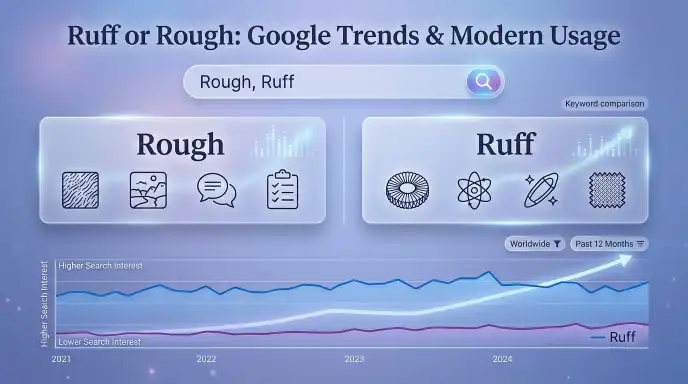
People often search for ruff or rough because the words have the same pronunciation but different spellings.
The confusion is strongest when someone hears a word but does not see it written. This can happen in conversation, videos, podcasts, classrooms, and voice searches.
In modern everyday English, rough has a much wider range of uses. Cambridge lists meanings connected with uneven surfaces, difficult situations, violence or storms, approximate information, and unfinished work.
Ruff is more specialized. Its common dictionary meanings relate to historical collars and hair or feathers around an animal’s neck.
Exact search-volume data is not included here because search popularity can change by country, platform, and date. The useful distinction remains clear: rough is the everyday word, while ruff is used in specific contexts.
Quick Comparison Table
| Version | Meaning | Correct? | Region | Example |
| rough | Not smooth or even | Yes | British and American English | The road is rough. |
| rough | Difficult or unpleasant | Yes | British and American English | It was a rough day. |
| rough | Approximate or not exact | Yes | British and American English | Give me a rough estimate. |
| ruff | Historical folded collar | Yes | British and American English | He wore a ruff. |
| ruff | Hair or feathers around an animal’s neck | Yes | British and American English | The bird has a neck ruff. |
Ruff vs Rough at a Glance
| Question | Ruff | Rough |
| Is it a real English word? | Yes | Yes |
| Pronunciation | /rʌf/ | /rʌf/ |
| Common everyday word? | No | Yes |
| Can it describe a surface? | No | Yes |
| Can it mean difficult? | No | Yes |
| Can it mean approximate? | No | Yes |
| Can it describe a historical collar? | Yes | No |
| Can it describe animal neck feathers? | Yes | No |
Key Takeaways
- Ruff and rough are both correct English words.
- They have different meanings.
- Both words are pronounced /rʌf/.
- Rough is the common word for uneven surfaces.
- Rough can also mean difficult, harsh, or approximate.
- Ruff can mean a historical folded collar.
- Ruff can also describe hair or feathers around an animal’s neck.
- The spelling does not change between British and American English.
FAQs
Q1. Is ruff or rough correct?
Both ruff and rough are correct words. They have different meanings. Rough is the common word for something uneven, difficult, harsh, or approximate. Ruff can mean a historical folded collar or a circle of hair or feathers around an animal’s neck.
Q2. Is ruff a misspelling of rough?
No. Ruff is not a misspelling of rough. It is a separate English word with its own meanings. A ruff can be a stiff historical collar. It can also describe hair or feathers around an animal’s neck.
Q3. Why do ruff and rough sound the same?
Ruff and rough have the same standard pronunciation, /rʌf/. Their spellings are different because the words have different histories. This same pronunciation often causes confusion when people hear the word but do not see it written.
Q4. What does rough mean?
Rough has several meanings. It can describe something that is not smooth or even. It can also mean difficult, unpleasant, violent, stormy, approximate, or unfinished. Examples include rough road, rough weather, rough estimate, and rough draft.
Q5. What does ruff mean?
Ruff can mean a large, stiff collar with many folds. Such collars were worn in Europe during the 16th and 17th centuries. The word can also describe a circle of hair or feathers around the neck of a bird or animal.
Q6. Should I write about rough roads or ruff road?
The correct phrase is rough road. A rough road is uneven or difficult to travel on. Ruff road would not have this meaning. Remember that rough is the word used for uneven surfaces and difficult conditions.
Q7. Should I write a rough estimate or ruff estimate?
The correct phrase is a rough estimate. It means an approximate estimate that is not exact. Ruff estimate is incorrect for this meaning. Cambridge also lists rough estimates as a standard use of the word rough.
Q8. Is ruff used for birds?
Yes. Ruff can describe a circle of feathers around the neck of a bird or animal. It is also the name of a particular shorebird, so the word can appear in bird-related writing.
Q9. Is rough the more common word?
Yes, rough has a much wider range of everyday uses. People use it to talk about surfaces, roads, weather, difficult experiences, estimates, drafts, and more. Ruff has more specific meanings and appears less often in ordinary conversation.
Q10. How can I remember ruff and rough?
Use rough for common descriptions such as rough road, rough skin, rough weather, and rough estimate. Think of ruff when you see a historical collar or feathers around an animal’s neck. Both words sound the same, so their meanings provide the best clue.
Conclusion:
Ruff and rough are both correct words, but they are not interchangeable. The word you need depends on the meaning.
Use rough in most everyday situations. It can describe something that is not smooth, such as a rough road or rough skin. It can also describe a difficult experience, stormy conditions, or an approximate figure.
Use ruff for its more specific meanings. A ruff can be a large, folded collar from historical European clothing. It can also describe a circle of hair or feathers around an animal’s neck.
The main reason for the confusion is pronunciation. Both words are pronounced /rʌf/, but their spellings and meanings are different.
For most everyday writing, rough will be the word you want. If your context involves historical clothing or animal features, ruff may be correct.
Remember: rough describes many everyday conditions, while ruff has specific meanings.

I’m Nora Ellis, an English language writer passionate about making grammar, spelling, and confusing words easy to understand. I share clear explanations and practical examples to help readers improve their English and use words with confidence.






10 thoughts on “Ruff or Rough: Meaning, Spelling & Usage Explained ”