The correct spelling is mischievous, not mischievious. The word means playful, naughty, or likely to cause minor trouble.
Many people search for “mischievous or mischievious” because the word is often pronounced in a way that makes an extra i seem natural. This creates a common spelling mistake, especially when writing quickly.
The confusion comes from the letters in the middle of the word. Mischievous has the sequence -iev-, while the incorrect form mischievious adds an extra i. Although the incorrect spelling may look familiar, it is not the standard spelling in modern English.
You can use mischievous words in everyday speech and writing. It can describe a child who likes playing harmless tricks, a person with a playful nature, or an action that causes minor trouble. It can also describe a playful smile, look, or expression.
Learning the correct spelling is useful for students, writers, professionals, and anyone who wants to avoid spelling errors in formal or casual English.
Mischievous or Mischievious : Quick Answer
Mischievous is the correct spelling.
Mischievious is an incorrect spelling and should be avoided in standard English.
Correct:
- The mischievous child hid his sister’s shoes.
- She gave me a mischievous smile.
- The puppy looked mischievous.
Incorrect:
- The mischievious child hid his sister’s shoes.
- She gave me a mischievious smile.
Easy tip: Remember mischievous as mischief + ous.
Definition and Meaning of Mischievous or Mischievious
Mischievous is an adjective. It describes someone or something that causes, or is likely to cause, minor trouble in a playful way.
Simple Meaning
Mischievous means:
- Playfully naughty
- Troublesome in a harmless way
- Likely to cause minor trouble
- Enjoying playful tricks or pranks
For example:
The mischievous boy put a toy on his teacher’s desk.
The boy is not necessarily harmful. He is simply doing something naughty or playful.
Different Uses of Mischievous
The word can describe a person:
The mischievous child kept hiding his brother’s toys.
It can describe an animal:
The mischievous puppy chewed my shoe.
It can describe a look or expression:
She had a mischievous smile on her face.
It can also describe an action or idea:
He had a mischievous plan to surprise his friends.
In most situations, mischievous suggests something playful rather than seriously harmful.
The Origin of Mischievous or Mischievious
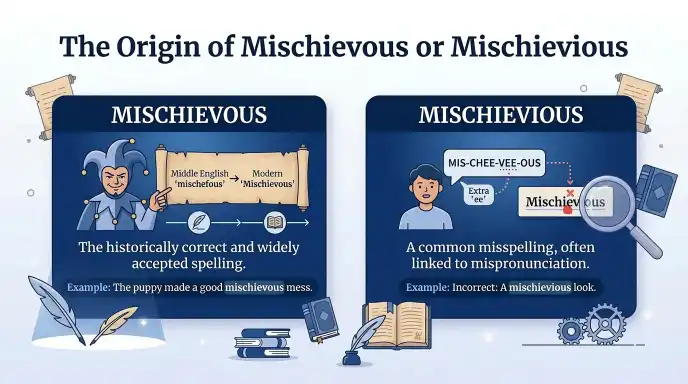
The word mischievous comes from mischief.
Mischief entered English through Old French, from the word meschief, which referred to misfortune, harm, or trouble. Over time, its meaning developed into the idea of playful trouble or troublesome behavior.
The adjective mischievous developed from this word.
The spelling confusion happens because mischievous contains several vowels close together:
m i s c h i e v o u s
People sometimes add another i and write:
m i s c h i e v i o u s
This produces mischievious, but that spelling is not standard.
The correct form is:
Mischievous
A useful way to remember it is:
mischief → mischievous
British English vs American English Spelling
There is no major British-American spelling difference for this word.
Both British English and American English use:
mischievous
The incorrect spelling mischievious is not the standard spelling in either variety.
| English Variety | Correct Spelling | Incorrect Spelling |
| British English | mischievous | mischievious |
| American English | mischievous | mischievious |
| Canadian English | mischievous | mischievious |
| Australian English | mischievous | mischievious |
| International English | mischievous | mischievious |
Examples
British English:
The mischievous child was laughing.
American English:
The mischievous child was laughing.
The spelling remains the same.
Which Spelling Should You Use?
Use mischievous in all standard English writing.
For American English
Use:
mischievous
This is the standard spelling for school, work, websites, emails, and other writing.
For British and Commonwealth English
Use:
mischievous
The same spelling is standard in British English and other major varieties of English.
For International English
If you write for an international audience, mischievous is the safest choice.
You do not need to change the spelling based on if your reader is from the US, UK, Canada, or Australia.
Professional advice: If you are unsure, remember that mischievous is correct everywhere in standard English.
Common Mistakes with Mischievous or Mischievious
The most common mistake is adding an extra i.
| Incorrect | Correct | Why? |
| mischievious | mischievous | Extra i is added |
| mischivous | mischievous | Missing ie |
| mischivious | mischievous | Incorrect vowel pattern |
| mischieviousness | mischievousness | Incorrect base spelling |
Adding an Extra I
❌ She is very mischievious.
✅ She is very mischievous.
Changing the Middle Letters
❌ He gave me a mischivous look.
✅ He gave me a mischievous look.
Spelling It the Way It Sounds
Pronunciation can make spelling difficult. The word does not always sound exactly like its written form.
The best approach is to remember the written form:
mischievous
Mischievous or Mischievious in Everyday Examples
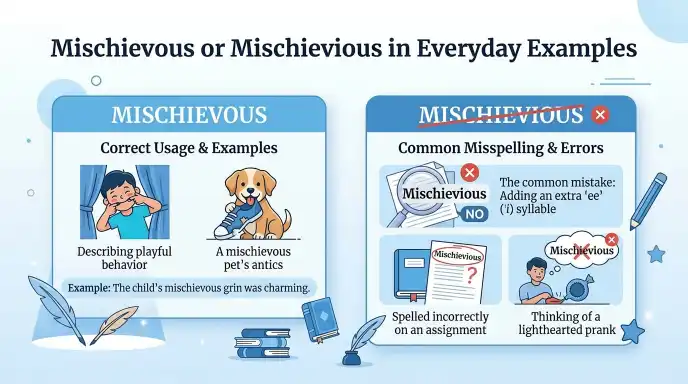
The correct word appears in many types of writing.
In Everyday Conversation
My little brother is very mischievous.
The dog looks mischievous today.
In Emails
Tom has been a little mischievous today, but everyone enjoyed his joke.
In Social Media
That mischievous smile says everything! 😄
In News Writing
The mischievous child surprised the crowd with a harmless prank.
In Formal Writing
The character is presented as a mischievous but intelligent young person.
In School Writing
The mischievous student played a harmless joke on his friends.
These examples show that mischievous can work in both casual and formal contexts.
Mischievous or Mischievious : Google Trends & Usage Data
Searches for “mischievous or mischievious” usually come from people who are unsure about the spelling of the word.
The confusion is easy to understand because the incorrect form looks close to the correct one. The extra i can also seem natural when people spell the word based on how they hear it.
Usage can vary by context:
- Students may search for the correct spelling when doing schoolwork.
- Writers may check the word before publishing.
- ESL learners may find the vowel sequence difficult.
- Professionals may verify the spelling before using it in formal writing.
- General users may encounter the word in books, articles, or social media.
There is no need to use a different spelling for British or American readers. Standard English uses mischievous in both varieties.
Because search interest changes over time, exact Google Trends numbers should be checked for a specific date range and country rather than treated as permanent statistics.
Mischievous or Mischievious: Spelling Comparison
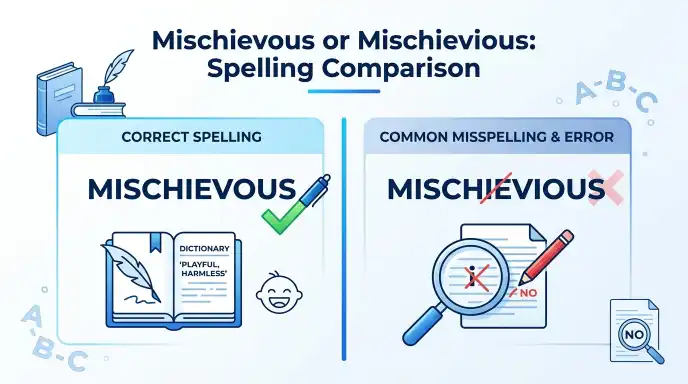
| Variation | Status | Example |
| mischievous | Correct | He has a mischievous smile. |
| mischievious | Incorrect | He has a mischievious smile. |
| mischivous | Incorrect | The mischivous child laughed. |
| mischivious | Incorrect | She gave a mischivious look. |
The main form to remember is:
Mischievous = correct
Mischievious = incorrect
FAQs About Mischievous or Mischievious
Q1. Is mischievous or mischievious correct?
Mischievous is correct. Mischievious is an incorrect spelling. The standard word contains -iev-, not -ievi-.
Q2. How do you spell mischievous?
The correct spelling is:
M-I-S-C-H-I-E-V-O-U-S
It is spelled mischievous.
Q3. Is mischievous spelled the same in British and American English?
Yes. Both British and American English use mischievous. There is no standard spelling difference between the two varieties.
Q4. What does mischievous mean?
Mischievous means playful, naughty, or likely to cause minor trouble. It often describes harmless behavior, jokes, tricks, or playful actions.
Q5. Why do people spell mischievous as mischievious?
People often add an extra i because of the word’s pronunciation and its unusual vowel sequence. The spelling mischievious is understandable as a mistake, but it is not standard.
Q6. Is mischievous a positive or negative word?
It can be positive, negative, or playful, depending on the context. It often describes harmless naughty behavior, such as a child’s playful trick.
Q7. What is an easy way to remember mischievous?
Connect it with mischief:
mischief → mischievous
Remember that mischievous does not have an extra i before ous.
Conclusion:
The correct spelling is mischievous, while mischievious is incorrect in standard English. This spelling causes confusion because the word contains several vowels close together, and people may add an extra i when writing it.
Mischievous means playful, naughty, or likely to cause minor trouble. It can describe people, animals, actions, plans, smiles, and other expressions. The word is common in both casual and formal writing.
There is also no British English versus American English spelling difference for this word. Writers in the US, UK, Canada, Australia, and international English contexts should use mischievous.
The easiest way to remember the spelling is to connect it with mischief. Once you remember mischief → mischievous, the extra i in mischievious becomes easier to avoid.
For schoolwork, professional writing, emails, articles, and everyday communication, always choose mischievous.

I’m Nora Ellis, an English language writer passionate about making grammar, spelling, and confusing words easy to understand. I share clear explanations and practical examples to help readers improve their English and use words with confidence.