Good or Well: Good is an adjective meaning great, nice, or positive, while well is usually an adverb meaning correctly, properly, or skillfully. Good and well look simple, but even strong English writers sometimes mix them up.
The basic rule is clear: good is usually an adjective, while well is usually an adverb. However, some verbs, especially feel, look, smell, taste, and seem, can make the choice less obvious.
People often search for good or well because both words can describe how something seems or happens. For example, you may wonder if to say, “I feel good” or “I feel well,” or if “She sings good” is correct. The answer depends on the role of the word in the sentence.
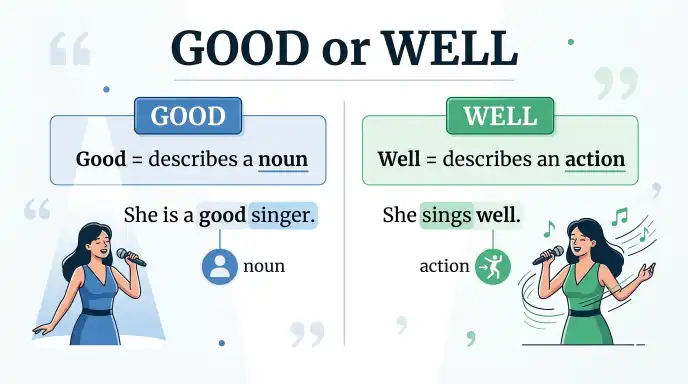
Good usually describes a person, thing, place, idea, or experience. Well usually tells us how someone performs an action. For example, “He is a good writer” describes the writer, while “He writes well” describes his writing ability.
This guide explains the difference in simple terms. You will learn the main grammar rules, special cases, common mistakes, everyday examples, regional usage, and easy ways to remember when to use good or well.
Good or Well: Featured Snippet and AI Overview
Good is usually an adjective, while well is usually an adverb. Use good to describe a person, thing, or state: “She is a good teacher.” Use well to describe an action: “She teaches well.” After linking verbs such as feel and look, good often describes a state, while well can refer to health.
Good or Well : Quick Answer
The easiest rule is:
- Good usually describes a noun or pronoun.
- Well usually describes a verb or action.
- Good is an adjective.
- Well is usually an adverb.
Example 1
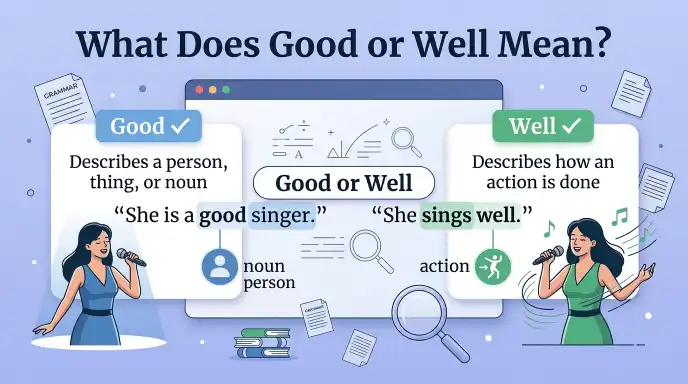
She is a good singer.
Here, good description of the singer.
She sings well.
Here, well describes the songs well.
Example 2
That was a good performance.
Good describes the performance.
The band performed well.
Well describes how the band performed.
Example 3
He is a good student.
He studies well.
A useful memory rule is:
Good describes a thing. Well describes an action.
There are some important exceptions, which we will cover below.
What Does Good or Well Mean?
What Does Good Mean?
Good is an adjective. It describes a noun or pronoun.
It can mean high quality, pleasant, useful, correct, kind, skilled, or satisfactory, depending on the sentence.
Examples:
She is a good teacher.
This is a good book.
We had a good meal.
He gave me some good advice.
In each example, good tells us something about a person, thing, experience, or idea.
What Does Well Mean?
Well is usually an adverb. It explains how someone performs an action.
Examples:
She writes well.
He speaks English well.
They worked well together.
The machine works well.
In these sentences, it tells us how an action happens.
Good as a Noun
In some contexts, good can also work as a noun.
We should focus on the good.
Here, good means positive things or benefits.
Well as an Adjective
Well can also work as an adjective when it means healthy.
I am well now.
She does not feel well today.
This use creates much of the confusion between good or well.
The Origin of Good or Well
Good and well have long histories in English, and both words come from Old English.
Good developed from the Old English word gōd, which referred to qualities such as being good, valuable, suitable, or virtuous.
Well developed from Old English wel, which expressed ideas such as being in a good way, properly, or satisfactorily.
Over time, English developed a strong grammatical difference between the two words. Good became widely used as an adjective, while well became the usual adverbial form related to good.
This difference still guides standard English today.
The pattern is similar to other adjective and adverb pairs:
- quick → quickly
- careful → carefully
- slow → slowly
- good → well
However, good → well does not follow the simple -ly pattern. That makes it important to learn as a separate pair.
Good or Well : British English vs American English
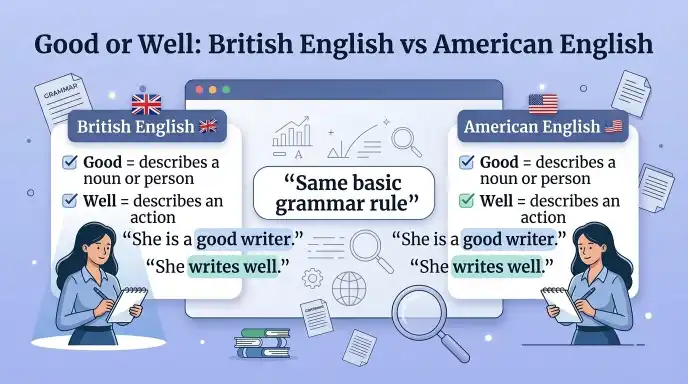
British English and American English follow the same basic grammar rule for good and well.
Both varieties use good mainly as an adjective and well mainly as an adverb.
| Situation | British English | American English | Example |
| Describing a noun | good | good | She is a good writer. |
| Describing an action | well | well | She writes well. |
| Describing health | well | well | I feel well today. |
| Describing a state with feel | good is common | good is common | I feel good. |
| Formal description of health | well | well | He is well after treatment. |
| Describing quality | good | good | It was a good movie. |
| Describing performance | well | well | They performed well. |
There is no major British-American spelling difference here.
The main difference appears in style and context, especially with sentences such as “I feel good.” Both British and American speakers use this expression.
Which Version Should You Use?
The right choice depends on what you want to describe.
United States
Use good as an adjective and well as an adverb.
She is a good manager.
She manages the team well.
In everyday American English, “I feel good” is very common.
United Kingdom
The same basic rule applies.
He is a good student.
He studies well.
British speakers also use “I feel good” in many situations.
Canada
Canadian English follows the same general distinction.
She did a good job.
She did the job well.
Australia
Australian English also follows the standard adjective-adverb distinction.
That is a good idea.
You explained it well.
International Writing
For international readers, keep the distinction simple:
Good = describes a person or thing.
Well = describes an action.
This approach works clearly across major English varieties.
Academic Writing
Academic writing often needs precise grammar.
Use good before nouns:
The study provides a good example.
Use well to describe actions:
The researchers explained the results well.
Business Writing
Professional writing follows the same rule.
She is a good leader.
She leads the team well.
Common Mistakes with Good or Well
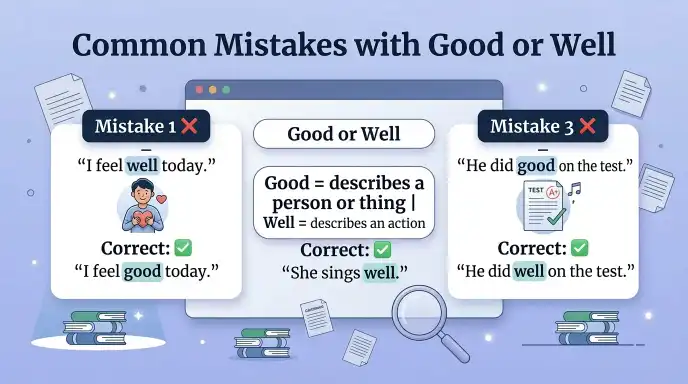
The most common mistake happens when writers use good to describe an action.
“She sings good.”
❌ She sings good.
✅ She sings well.
Why?
Well describes the action.
“He did well on the test.”
In informal speech, you may hear this often. In standard formal English, use:
✅ He did well on the test.
Why?
Well describes how he performed.
“She is a good student.”
❌ She is a well student.
✅ She is a good student.
Why?
Good describes the noun student.
“He writes well.”
❌ He writes good.
✅ He writes well.
Why?
The word describes the action.
“I feel well” vs “I feel good”
Both can be correct, but the meaning can differ.
I feel good.
This usually describes your general emotional or physical state.
I feel well.
This often focuses on being healthy or not being ill.
Easy Memory Tip
Ask:
Am I describing a thing or a person?
Use good.
Am I describing an action?
Use it well.
Everyday Examples
Emails
I hope you are doing well.
Thank you for your good work.
You explained the issue well.
Business Writing
She is a good manager.
She manages the department well.
The team performed well during the meeting.
News Headlines
Local Team Starts Season Well
Company Reports Good Results
News writing may use both words depending on the sentence structure and meaning.
Blogs
A good headline can attract readers.
A writer should explain ideas well.
Social Media
That looks good!
You did well!
Feeling good today.
These short forms are common in casual online communication.
Academic Writing
The article presents a good example of clear writing.
The researchers explained the method well.
Daily Conversation
You look good today.
You look well today.
The first sentence often comments on appearance or overall condition. The second can focus more on health, although everyday speakers may use the two forms differently depending on context.
After Feel
This is one of the most important special cases.
I feel good.
I feel well.
Both sentences can be correct.
I feel good usually describes your state or how you feel emotionally or physically.
I feel well usually emphasizes health.
Google Trends & Modern Usage
People search for good or well because the two words can perform different grammatical jobs, but some sentences allow more than one interpretation.
The question often appears in searches such as:
- Is it good or well?
- Should I say feel good or feel well?
- Did I do good or well?
- Good vs well grammar
- How do I use good and well?
- What is the difference between good and well?
Modern English also includes many informal expressions that do not always follow formal grammar rules. For example, people may say “You did good” in casual conversation. Standard edited English usually prefers “You did well.”
Search behavior can vary by country and context. However, without a specific Google Trends dataset and date range, exact country rankings or search-volume figures should not be claimed.
The broad usage pattern is clear:
Good remains common before nouns and after linking verbs.
Well remains common when speakers describe how an action happens.
The growing use of casual digital language can also make the distinction seem less strict in everyday conversation. Formal writing still benefits from following the traditional grammar rule.
Quick Comparison Table
| Version | Meaning | Correct? | Region | Example |
| good | Describes a person or thing | ✅ Yes | All major varieties | She is a good writer. |
| well | Describes an action | ✅ Yes | All major varieties | She writes well. |
| good after feel | Describes a state | ✅ Yes | Widely used | I feel good. |
| well after feel | Describes health | ✅ Yes | Widely used | I feel well. |
| good after an action verb | Usually incorrect in formal English | ⚠️ Usually no | Informal use exists | He did good. |
| well after an action verb | Describes performance | ✅ Yes | All major varieties | He did well. |
Key Takeaways
- Good is usually an adjective.
- Well is usually an adverb.
- Use good to describe a person, thing, quality, or state.
- Use well to describe how someone performs an action.
- “She is a good singer” is correct.
- “She sings well” is correct.
- “I feel good” can describe your general state.
- “I feel well” can emphasize your health.
- In formal writing, “did well” is usually better than “did good.”
FAQs About Good or Well
Q1. What is the main difference between good and well?
Good is usually an adjective, so it describes a noun or pronoun. Well is usually an adverb, so it describes an action or verb. For example, “She is a good teacher” describes the teacher, while “She teaches well” describes how she teaches.
Q2. Should I say “I feel good” or “I feel well”?
Both can be correct. I feel good often describes your general state or feelings. I usually focus on health. For example, someone recovering from an illness may say, “I feel well now.” In everyday conversation, “I feel good” is also very common.
Q3. Is “I did good” grammatically correct?
In standard formal English, “I did well” is the preferred form when you mean that you performed successfully. Good is an adjective, while well normally describes the action. However, “did good” can appear in informal speech when good means something beneficial or positive.
Q4. Is “She sings good” or “She sings well” correct?
She sings well is the standard form. The word well describes how she performs the action of singing. Good describes a noun, as in “She is a good singer.” This is one of the easiest examples for remembering the difference between the two words.
Q5. Is “You look good” correct?
Yes. You look good is correct when good describes someone’s appearance or general condition. The verb look can work as a linking verb here. You look well can also be correct, especially when the speaker means that the person appears healthy.
Q6. Is “He writes good” correct English?
In standard English, use “He writes well.” The word well describes the action of writing. You can use good if you describe the writer instead: “He is a good writer.” Both sentences express a similar idea, but they use different grammatical structures.
Q7. Can well be an adjective?
Yes. Well can work as an adjective when it means healthy. For example, “She is well” means that she is in good health. This special use explains why sentences such as “I feel well” can be correct even though well usually works as an adverb.
Q8. Do British and American English use good and well differently?
The basic grammar rule remains the same in both varieties. Good usually works as an adjective, while well usually works as an adverb. Both British and American speakers use expressions such as “I feel good” and “I feel well,” depending on the intended meaning and context.
Q9. Is “good” always an adjective?
No. Good can also function as a noun in certain expressions. For example, “We should focus on the good” uses good as a noun meaning positive things. However, its most common grammatical role is as an adjective.
Q10. How can I remember good vs well?
Use this simple rule: good describes a thing, person, or state, while well describes an action. Think of “a good writer” and “writes well.” When you see an action verb, ask if you are explaining how the action happens. If so, well will often be the right choice.
Conclusion:
The difference between good or well becomes much easier once you know their main grammatical roles. Good usually works as an adjective and describes a person, thing, quality, or state. Well usually works as an adverb and tells us how someone performs an action.
For example, “She is a good writer” describes the writer, while “She writes well” describes her writing. This simple pattern works in British English, American English, Canadian English, Australian English, and international English.
Some sentences need extra attention. With verbs such as feel, look, smell, taste, and seem, good can describe a state or condition. Well can also work as an adjective when it means healthy, as in “I am well.”
For formal writing, remember the basic rule and check the role of the word in the sentence. When you describe a thing or person, good is often right. When you describe an action, well is usually the better choice.
Remember: Good describes what something is like; well describes how something happens.

I’m Nora Ellis, an English language writer passionate about making grammar, spelling, and confusing words easy to understand. I share clear explanations and practical examples to help readers improve their English and use words with confidence.