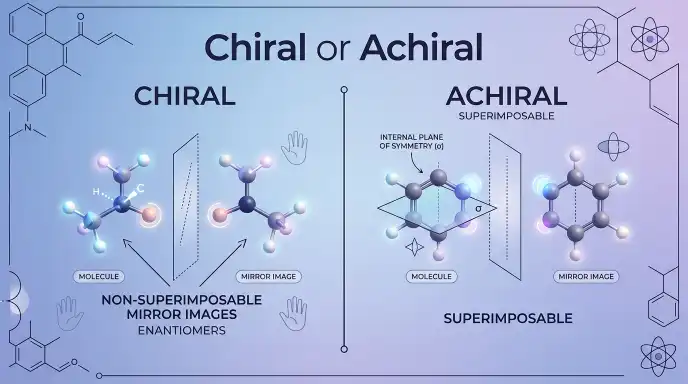
Imagine holding your left hand next to your right hand. They look like mirror images, but you cannot place one perfectly on top of the other. This simple idea explains the difference between chiral or achiral objects and molecules.
A chiral molecule cannot be superimposed on its mirror image. An achiral molecule can be superimposed on its mirror image. In chemistry, this difference is important when studying stereochemistry, molecular structure, enantiomers, and chiral centers.
People often search for chiral or achiral because the terms can be difficult to remember. Students may also confuse chirality with the presence of a chiral center. However, a molecule can have more than one stereogenic feature, and overall chirality depends on the three-dimensional structure.
This guide explains the difference in simple language. You will learn what chiral and achiral mean, where the words come from, how to identify them, and how to use them correctly in chemistry.
Chiral or Achiral : Quick Answer
Chiral means that an object or molecule is not superimposable on its mirror image.
Achiral means that an object or molecule is superimposable on its mirror image.
A simple comparison is:
- Chiral: mirror image cannot be perfectly matched.
- Achiral: mirror image can be perfectly matched.
- Chirality: the property that causes this difference.
- Enantiomers: non-superimposable mirror-image forms of a chiral structure.
For example, the left and right hands are chiral. They are mirror images, but they cannot be placed on top of each other so that every part matches.
A simple symmetric object, such as a plain ball, is achiral because its mirror image can be matched to it.
In chemistry, the same idea applies to molecules. Their three-dimensional arrangement determines if they are chiral or achiral.
What Does Chiral or Achiral Mean?
The terms chiral and achiral describe the spatial arrangement of an object or molecule.
What Does Chiral Mean?
A chiral molecule is one that cannot be superimposed on its mirror image.
The word superimposable means that two objects can be placed together so that all corresponding parts match.
If the mirror image cannot match the original molecule, the molecule is chiral. IUPAC defines chirality as the property of a structure that is not superimposable on its mirror image.
A common example is a molecule with a carbon atom attached to four different groups. Such an arrangement can create a chiral center.
However, having a chiral center is not the only way chirality can occur. IUPAC also recognizes chiral axes and chiral planes as forms of chirality.
What Does Achiral Mean?
An achiral molecule can be superimposed on its mirror image.
In simple terms, the molecule and its mirror image are effectively the same three-dimensional structure.
Symmetry can help identify an achiral molecule. A plane of symmetry can make a structure achiral, although symmetry is not the only concept used when analyzing complex structures.
Chiral vs Achiral in Simple Language
Think of two gloves.
A left-hand glove and a right-hand glove are mirror-related but do not fit the same hand. This is a useful model for chirality.
Now imagine a simple round object. Its mirror image can match it without creating a different handed form. That gives you a basic idea of an achiral object.
The key question is:
Can the object or molecule be placed on its mirror image so that they match exactly?
- No → chiral
- Yes → achiral
The Origin of Chiral or Achiral
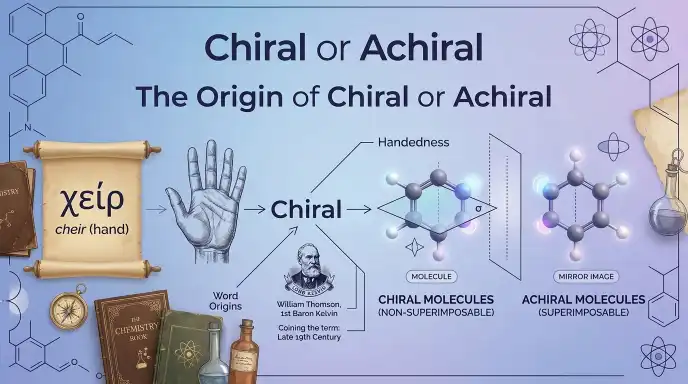
The word chiral comes from the Greek word cheir, meaning hand. The connection is easy to understand because human hands are classic examples of non-superimposable mirror images.
The term became important in the development of stereochemistry, the branch of chemistry that studies the three-dimensional arrangement of atoms.
The word achiral uses the prefix a-, which indicates the absence of something. Therefore:
- chiral = having chirality
- achiral = lacking chirality
There is no British-American spelling change here. The terms remain chiral and achiral in both forms of English.
The scientific meaning also remains stable. Modern IUPAC terminology defines chirality through the relationship between a structure and its mirror image.
Why Is the Hand Example So Important?
Hands provide a natural model for molecular chirality.
Your left hand and right hand have similar parts in a reversed arrangement. Yet one cannot be turned and placed directly over the other without becoming a different handed form.
Chemists use this idea to understand mirror-image molecules called enantiomers.
British English vs American English
There is no spelling difference between British English and American English for chiral and achiral.
Both forms use the same spellings:
| Term | British English | American English | Example |
| One with chirality | chiral | chiral | The molecule is chiral. |
| Without chirality | achiral | achiral | The structure is achiral. |
| Property | chirality | chirality | Chirality affects molecular behavior. |
| Mirror-image pair | enantiomer | enantiomer | The two molecules are enantiomers. |
| Stereogenic location | chiral centre | chiral center | The molecule has a chiral center. |
The main regional difference appears in centre/center, not in chiral/achiral.
British English
British scientific writing commonly uses chiral centers.
Example:
The molecule contains a chiral centre.
American English
American scientific writing commonly uses a chiral center.
Example:
The molecule contains a chiral center.
The words chiral, achiral, chirality, and enantiomer stay the same.
For academic work, it is best to follow the spelling style used by your university, publisher, or style guide.
Which Version Should You Use?
There is no need to choose between chiral and achiral based on location. The correct term depends on the molecular structure you are describing.
United States
Use chiral for a structure that is not superimposable on its mirror image.
Use achiral when the structure is superimposable on its mirror image.
American writers may use chiral centers.
United Kingdom
The same scientific terms apply.
British writers may use chiral centers rather than chiral centers.
The terms chiral and achiral do not change.
Canada
Canadian scientific writing may follow either British or American conventions, depending on the institution or publication.
The important point is to use the same style consistently.
Australia
Australian academic writing commonly uses British-style spelling in many contexts.
You may therefore see the chiral centre.
Again, chiral and achiral remain unchanged.
International Writing
For international readers, use chiral and achiral as standard scientific terms.
Explain the meaning when writing for beginners.
For example:
A chiral molecule cannot be superimposed on its mirror image.
This sentence is clear to readers who may not know the term.
Academic Writing
Use the exact scientific term that matches the structure.
Avoid replacing chiral with vague words such as “different” or “uneven.” Those words do not express the technical meaning.
Business or General Writing
These terms are mainly used in scientific and technical contexts.
If a general audience needs the information, define the term first.
Common Mistakes with Chiral or Achiral
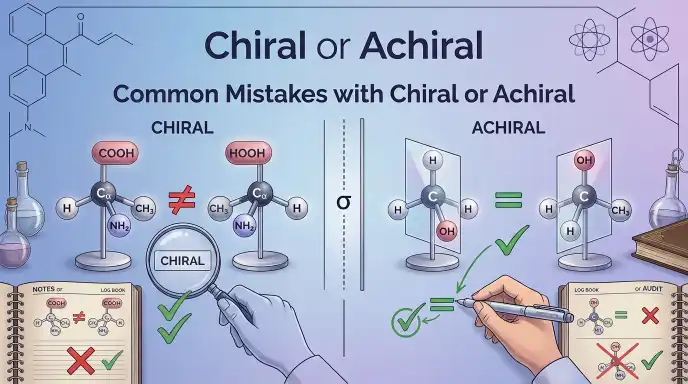
Understanding a few common errors can make this topic much easier.
| Incorrect | Correct | Explanation | Memory Tip |
| The molecule is chiral because it looks unusual. | The molecule is chiral because it is not superimposable on its mirror image. | Appearance alone does not define chirality. | Think of a mirror image. |
| Achiral means the molecule has no atoms. | Achiral means the molecule is superimposable on its mirror image. | Achiral describes spatial structure. | A- = without chirality. |
| Chiral and achiral are spelling variants. | Chiral and achiral have different meanings. | They describe opposite structural properties. | Chiral ≠ achiral. |
| Every molecule with a chiral center is automatically described without checking the whole structure. | Check the complete molecular structure. | Overall chirality depends on the full three-dimensional arrangement. | Look at the whole molecule. |
| Chiral means chemically active. | Chiral describes spatial arrangement. | Chirality is not simply a synonym for chemical activity. | Focus on 3D shape. |
A Useful Memory Trick
Remember the hands.
Chiral = like left and right hands.
Achiral = can match its mirror image.
This simple image can help students remember the core difference.
Everyday Examples of Chiral or Achiral
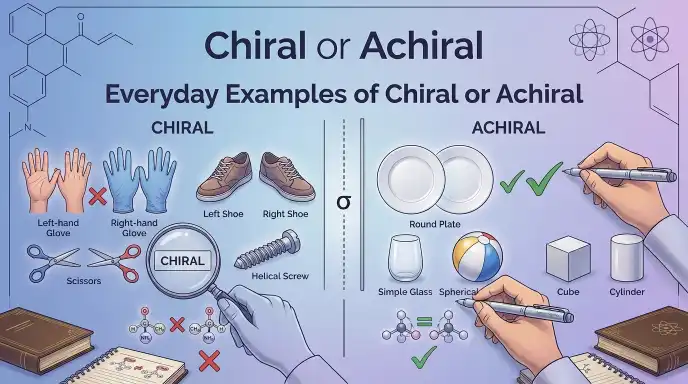
The terms chiral and achiral are most common in chemistry and science writing. You may still encounter them in different types of communication.
In an Email
A chemistry student might write:
Could you explain why this molecule is chiral?
Another example is:
I reviewed the structure and found that it is achiral.
In Business or Technical Writing
A scientific company may describe a product or compound using terms such as:
The compound contains a chiral center.
Technical documents often use precise language because molecular structure matters.
In News Headlines
A science article may use wording such as:
Scientists Study Chiral Molecules and Their Mirror Images
The headline introduces chirality without using complex terminology.
In a Blog
A chemistry blog could explain the concept this way:
Your hands are a simple example of chirality. The left and right hands are mirror images that cannot be perfectly superimposed.
This comparison helps beginners understand the idea.
On Social Media
A short educational post might say:
Chiral: cannot match its mirror image.
Achiral: can match its mirror image.
The short format works well for quick revision.
In Academic Writing
A formal chemistry paper might state:
The compound is chiral because its structure is not superimposable on its mirror image.
Academic writing should use the scientific definition rather than relying only on visual descriptions.
In Daily Conversation
These words are uncommon in ordinary conversation.
Someone may use chiral when discussing chemistry, pharmaceuticals, molecular biology, or stereochemistry. In casual speech, people are more likely to use the hand analogy than the technical terms.
Chiral or Achiral: Google Trends & Modern Usage
Search interest in chiral or achiral is closely tied to educational and scientific topics.
Students may search the phrase when they are learning about:
- Stereochemistry
- Chirality
- Chiral molecules
- Achiral molecules
- Enantiomers
- Chiral centers
- Mirror-image molecules
- Organic chemistry
- Three-dimensional molecular structure
The phrase also appears in questions such as “How do you know if a molecule is chiral?” and “What is the difference between chiral and achiral?”
Exact Google Trends numbers should be checked for a specific country and date range before making a numerical claim. Search interest changes over time, and Google Trends reports relative interest rather than a fixed number of searches.
The strongest modern search intent is educational. Many users want a fast definition first. They then need an example, a test for chirality, and a clear explanation of mirror images.
For that reason, content about chiral or achiral should answer the basic question early. A simple hand analogy can make the technical idea easier to understand.
Quick Comparison Table
| Version | Meaning | Correct? | Region | Example |
| Chiral | Not superimposable on its mirror image | Yes | Worldwide | The molecule is chiral. |
| Achiral | Superimposable on its mirror image | Yes | Worldwide | The molecule is achiral. |
| Chirality | Property of being chiral | Yes | Worldwide | The structure shows chirality. |
| Chiral center | An atom with an arrangement that contributes to chirality | Yes | US and some international writing | The compound has a chiral center. |
| Chiral centre | British spelling of chiral center | Yes | UK and some Commonwealth writing | The compound has a chiral centre. |
| Chirality center | Current IUPAC terminology | Yes | Scientific usage | The structure contains a chirality centre. |
IUPAC notes that chirality centre is the preferred modern term in its terminology, while chiral centre is identified as a superseded term in the cited glossary.
Key Takeaways
- Chiral means a structure is not superimposable on its mirror image.
- Achiral means a structure is superimposable on its mirror image.
- Human hands are a useful everyday example of chirality.
- Chiral and achiral are not British and American spelling variants.
- The word chiral comes from the Greek word for hand.
- A chiral center can contribute to molecular chirality, but chirality can also arise from other structural features.
- Enantiomers are non-superimposable mirror-image forms of a chiral structure.
- The best way to identify chirality is to examine the three-dimensional structure and its mirror image.
FAQs About Chiral or Achiral
Q1. What is the difference between chiral and achiral?
A chiral molecule cannot be superimposed on its mirror image. An achiral molecule can be superimposed on its mirror image. This is the main difference.
The terms describe the three-dimensional arrangement of a molecule, not its spelling, size, or general chemical appearance.
Q2. Is chiral the same as achiral?
No. Chiral and achiral describe opposite outcomes when a structure is compared with its mirror image. A chiral structure cannot be matched to its mirror image, while an achiral structure can. The two words should not be used as interchangeable terms.
Q3. What is an easy example of chirality?
Your left and right hands are a classic example. They are mirror images, but they cannot be perfectly superimposed. This idea is used as a simple model for molecular chirality in chemistry. The word chiral itself comes from the Greek word for hand.
Q4. How can you tell if a molecule is chiral?
Compare the molecule with its mirror image. If the two structures cannot be superimposed without breaking or changing bonds, the molecule is chiral. Molecular symmetry can also help.
A plane of symmetry may indicate that a structure is achiral, but complex molecules require a full three-dimensional analysis.
Q5. Does every chiral molecule have a chiral carbon?
No. Chirality is not limited to carbon atoms. IUPAC recognizes different chirality elements, including chirality centres, axes, and planes. Some chiral molecules therefore do not depend on a traditional tetrahedral carbon with four different groups.
Q6. What is the meaning of achiral in chemistry?
In chemistry, achiral describes a structure that is superimposable on its mirror image. Such a structure does not have overall chirality. Symmetry can be an important clue when identifying an achiral molecule.
Q7. Are chiral and achiral different spellings in British and American English?
No. Both varieties of English use chiral and achiral with the same spelling. A regional difference can appear in center and centre, as in chiral center and chiral centre. The main terms themselves do not change.
Q8. What are enantiomers?
Enantiomers are molecules that are mirror images of one another but cannot be superimposed. They are closely linked to chirality. IUPAC explains that enantiomeric molecules are non-superimposable mirror images and can have different behavior when interacting with chiral environments.
Q9. Is a molecule with a plane of symmetry achiral?
A genuine plane of symmetry is strong evidence that a molecule is achiral because the structure can be matched to its mirror image.
However, molecular symmetry can be complex, so identifying chirality should consider the complete three-dimensional structure rather than relying on one visual feature alone.
Conclusion:
The difference between chiral or achiral becomes much easier once you focus on the mirror image. A chiral molecule cannot be superimposed on its mirror image. An achiral molecule can be superimposed on its mirror image.
The idea is often introduced with the example of human hands. Your left and right hands are mirror images, yet they cannot be perfectly matched. This gives a simple way to understand molecular chirality.
The terms are also not British and American spelling alternatives. Both forms of English use chiral and achiral. A small regional spelling difference can appear in related terminology, such as center and centre.
When studying chemistry, avoid judging chirality only by how a molecule looks on paper. The key test is the three-dimensional relationship between the structure and its mirror image.
Remember: chiral means “cannot match the mirror image,” while achiral means “can match it.”
Use this mirror-image test whenever you need to decide if a molecular structure is chiral or achiral.

I’m Nora Ellis, an English language writer passionate about making grammar, spelling, and confusing words easy to understand. I share clear explanations and practical examples to help readers improve their English and use words with confidence.






3 thoughts on “Chiral or Achiral: Meaning, Structure & Key Differences ”