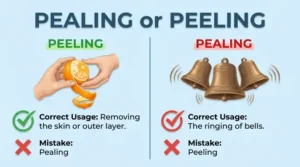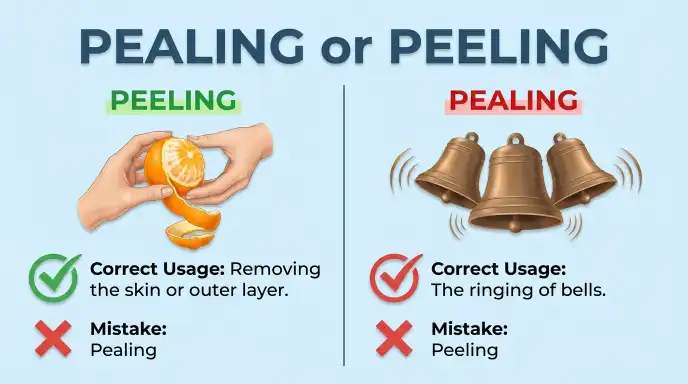
Have you ever wondered if to write pealing or peeling? Both words are correct, but they have very different meanings. Pealing refers to a loud, ringing sound, such as bells ringing across a town.
Peeling usually means removing the outer skin or layer of something, such as peeling an orange or peeling paint from a wall. These words sound alike, which makes them easy to confuse. However, using the wrong one can change the meaning of your sentence.
A writer who describes church bells as “peeling” may mean the bells are ringing, but the correct word is pealing. On the other hand, someone who removes the skin from an apple is peeling it, not pealing it.
Understanding the difference will help you write clearly in school assignments, emails, articles, and everyday conversations. This guide explains the meanings, word origins, British and American usage, common mistakes, and practical examples of both words. You will also learn how to choose the right spelling and remember it with a simple tip.
Pealing or Peeling: Quick Answer
The difference between pealing and peeling is their meaning and use.
- Pealing: The act of ringing loudly or producing a series of clear, loud sounds. Example: The bells were pealing at noon.
- Peeling: The act of removing a skin or outer layer. Example: He is peeling a potato.
- Peeling: The process of an outer layer coming loose. Example: The wallpaper is peeling away.
Memory tip: Bells peal, while fruit and vegetables peel. Both spellings are correct, but they are not interchangeable.
What Does Pealing or Peeling Mean?
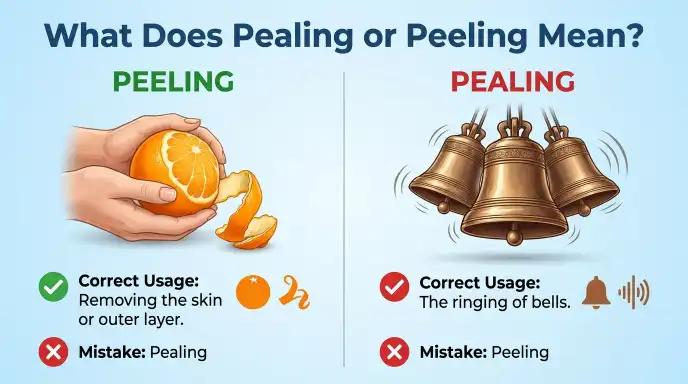
Although pealing and peeling sound similar, they come from different verbs and describe different actions.
What Does Pealing Mean?
Pealing is the present participle of the verb peal. It means producing a loud, clear, repeated sound. The word often appears when people describe bells, church towers, celebrations, or other ringing sounds.
A peal may be a single burst or a series of sounds. For example, a peal of bells can fill the air during a wedding or a special event.
Examples of pealing:
- The bells were pealing to celebrate the wedding.
- Laughter was pealing through the hall.
- Church bells began pealing early in the morning.
The word can describe sounds other than bells, too. A phrase such as “peals of laughter” describes loud, clear bursts of laughter.
What Does Peeling Mean?
Peeling is the present participle of the verb peel. It usually means removing the outer skin, covering, or layer of something.
It can also describe a surface that is separating or coming away from the material beneath it.
Examples of peeling:
- She is peeling a banana.
- He spent the morning peeling potatoes.
- The paint is peeling off the window frame.
- Her skin began peeling after a sunburn.
In the first two examples, someone removes an outer layer. In the last two, a layer comes away from a surface or body.
Are Pealing and Peeling Verbs?
Yes. Both words are forms of verbs.
- Peal: To ring loudly or produce a clear, ringing sound.
- Peal + ing: Pealing.
- Peel: To remove an outer layer or for a layer to come away.
- Peel + ing: Peeling.
Both words can also act as participles in longer sentences.
For example, “The pealing bells woke the town” uses the word to describe the bells. “The peeling paint made the house look old” uses the word to describe the paint.
Can Peeling Be a Noun?
Yes. Peeling can refer to the act or process of removing an outer layer.
For example:
- Peeling vegetables takes time.
- The peeling of the wallpaper began near the window.
It can also appear in the phrase peeling skin, which describes skin that is coming away in thin layers.
Pealing, by contrast, is commonly used to describe an ongoing ringing sound or to modify a noun, as in “pealing bells.”
The Origin of Pealing or Peeling
The words pealing and peeling have separate histories, even though their pronunciation is similar.
The Origin of Pealing
Pealing comes from the verb peal, which has long been associated with loud, clear, ringing sounds. English speakers often use it to describe bells that ring in a series of strong tones.
Over time, the word also became common in expressions such as peals of laughter and peals of thunder. These expressions describe sounds that are loud, sudden, or repeated.
The ending -ing shows that the sound is happening or that the action is continuing.
Example: The bells were pealing as the crowd gathered.
The Origin of Peeling
Peeling comes from the verb peel, which means to remove an outer covering or layer. It has roots in older Germanic language forms and is related to words used for stripping or removing a surface.
The word became useful in many everyday contexts. People peel fruit, vegetables, bark, and other coverings. Paint, wallpaper, and skin can also peel when their outer layers begin to come away.
Adding -ing to peel gives peeling, with the double e retained.
Example: He was peeling an apple when the phone rang.
Why Are the Words Confused?
The main reason is pronunciation. In many English accents, pealing and peeling sound the same or very similar. This makes them easy to mix up when writing from memory.
Their spelling reflects different base words, not different regional spelling rules.
- Peal relates to sound.
- Peel relates to an outer layer.
Remembering these base words is the easiest way to choose the correct form.
British English vs American English
There is no major British and American spelling difference between pealing and peeling. Both varieties use the same spellings and meanings.
The choice depends on the action or idea you want to express.
| Word | British English | American English | Example |
| Peal | Correct | Correct | The bells peal at noon. |
| Pealing | Correct | Correct | The bells are pealing. |
| Peel | Correct | Correct | Please peel the apple. |
| Peeling | Correct | Correct | She is peeling an orange. |
| Peals of laughter | Correct | Correct | Peals of laughter filled the room. |
| Peeling paint | Correct | Correct | The peeling paint needs repair. |
Regional Differences
British and American writers use both words in the same way. There is no need to change pealing to another spelling for a US audience or change peeling for a UK audience.
The words may appear more often in certain contexts. For example, pealing is common in descriptions of church bells, ceremonies, and literary writing. Peeling is common in recipes, home repair, gardening, and descriptions of skin.
These differences reflect the topic, not a national spelling rule.
What About Style Guides?
General English style guides do not normally treat these words as regional alternatives. Instead, they expect writers to select the word that fits the meaning.
For academic, business, and professional writing, check the sentence carefully. If you are describing a sound, choose pealing. If you mean removing or losing an outer layer, choose peeling.
Which Version Should You Use?
The right spelling is the same in the United States, the United Kingdom, Canada, Australia, and international English. Choose based on meaning rather than location.
United States
Use pealing for ringing sounds and peeling for removing or losing a layer.
- The bells were pealing across the city.
- She was peeling a fresh orange.
United Kingdom
The same rule applies in British English.
- Church bells were pealing at dawn.
- He was peeling the potatoes.
Canada
Canadian English uses both words with the same meanings.
- The bells were pealing during the ceremony.
- The paint was peeling near the door.
Australia
Australian English also follows the same distinction.
- The bells were pealing across the town.
- She was peeling vegetables for dinner.
International Writing
For an international audience, use the standard spelling that matches your intended meaning. Neither word needs a regional alternative.
If your readers may be unfamiliar with pealing, make the context clear by mentioning bells, ringing, or laughter.
Academic Writing
Use pealing in literary analysis or descriptions of sound. Use peeling when discussing the removal of layers, physical surfaces, or a process.
Examples:
- The poet describes the pealing of bells as a sign of celebration.
- The study examined the peeling of thin material layers.
Business Writing
In business communication, peeling may appear in repair reports, product descriptions, or maintenance notes. Pealing is less common, but it may appear in event reports or descriptions of ceremonial bells.
Examples:
- The report notes peeling paint in the storage room.
- The town’s bells were pealing during the opening ceremony.
Common Mistakes with Pealing or Peeling
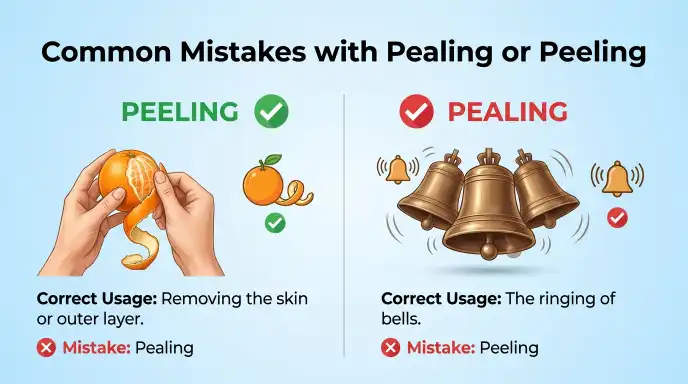
These words are easy to confuse, but a few simple checks can help you avoid errors.
Writing Peeling When You Mean Ringing
Incorrect: The church bells were peeling loudly.
Correct: The church bells were pealing loudly.
Explanation: Bells produce a peal. The correct verb is peal, so the ongoing action is pealing.
Writing Pealing When You Mean Removing Skin
Incorrect: She was pealing a potato.
Correct: She was peeling a potato.
Explanation: You peel fruit and vegetables to remove their skin or outer layer.
Confusing Pealing Paint with Peeling Paint
Incorrect: The wall has pealing paint.
Correct: The wall has peeling paint.
Explanation: Paint peels when it separates from the surface beneath it. It does not produce a peal of sound.
Using the Wrong Word for Laughter
Incorrect: The room was filled with peeling laughter.
Correct: The room was filled with peals of laughter.
Explanation: A peal of laughter is a burst of loud laughter. You can also say that laughter was pealing through the room.
Assuming One Spelling Is British
Incorrect assumption: Pealing is British English, while peeling is American English.
Correct understanding: Both words are standard in both varieties of English.
Explanation: The difference is meaning, not location.
An Easy Memory Tip
Remember these two short rules:
- Peal = sound. Bells peal.
- Peel = skin or layer. You peel an orange.
If the sentence is about ringing, use pealing. If it is about removing or losing a layer, use peeling.
Pealing or Peeling in Everyday Examples
The best way to learn the difference is to see both words in common situations.
In Emails
Pealing:
Subject: Town Celebration
Hello everyone,
The church bells will be pealing at noon to mark the start of the celebration.
Best regards,
Alex
Peeling:
Subject: Room Maintenance
Hello Team,
The paint is peeling near the main entrance. Please arrange an inspection and plan the necessary repairs.
Thank you,
Alex
In Business Writing
- The maintenance team found peeling paint in the hallway.
- The opening ceremony began as bells were pealing outside the venue.
- Staff must remove the fruit skins by peeling them before preparation.
These examples show that the correct word depends on the work being described.
In News Headlines
- Church Bells Pealing Across the City for a Historic Celebration
- Peeling Paint Raises Concerns About an Old Building
- Volunteers Spend the Day Peeling Fruit for a Community Event
The word pealing helps describe a sound, while peeling describes a surface or an action.
In Blog Posts
Pealing example:
The sound of bells pealing across the village created a joyful mood. People gathered in the square to celebrate the special occasion.
Peeling example:
When paint starts peeling, the surface may need cleaning, preparation, and a fresh coat of paint. Removing loose paint first can help create a smoother finish.
On Social Media
- Nothing feels more festive than church bells pealing on a sunny morning.
- I spent the afternoon peeling apples for a homemade pie.
- The old garden shed has peeling paint, so it is time for a makeover.
These short examples are useful for posts, captions, and casual messages.
In Academic Writing
- The poem uses the image of pealing bells to suggest joy and celebration.
- The experiment measured the force needed to begin peeling one material layer from another.
- The sound of bells pealing provides an important detail in the passage.
Academic writers should select the word that accurately describes the sound, process, or image being studied.
In Daily Conversation
- “Can you hear the bells pealing?”
- “Please finish peeling the potatoes.”
- “Why is the paint peeling off the wall?”
- “We heard peals of laughter from the next room.”
These sentences reflect the way the words appear in ordinary conversation.
Pealing or Peeling: Google Trends and Modern Usage
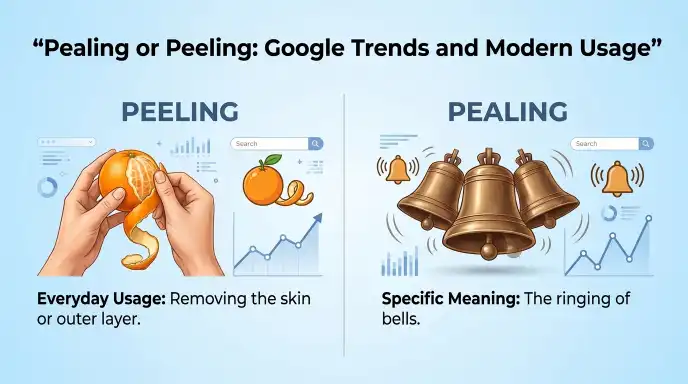
People search for pealing or peeling because the words sound alike but have different meanings. Writers may hear a sentence and struggle to choose the correct spelling. Students may also encounter both words in reading exercises or spelling tests.
Why Do People Search for These Words?
Common search needs include:
- Checking if pealing or peeling is correct.
- Learning the difference between peal and peel.
- Finding examples of pealing bells.
- Checking the spelling of peeling paint or peeling skin.
- Understanding the phrase peals of laughter.
Regional Popularity
Both words are used in the United States, United Kingdom, Canada, Australia, and other English-speaking regions. There is no reliable basis here for claiming that one spelling is more popular in a particular country.
The words appear in different subjects. Pealing is more closely linked to bells, sound, and descriptive writing. Peeling appears in everyday tasks, cooking, building maintenance, and descriptions of surfaces or skin.
What Can Google Trends Tell You?
Google Trends can compare the relative search interest for pealing and peeling over a selected period and in different regions. Its figures represent normalized interest, not exact search counts.
Without a current comparison of the two search terms, exact rankings, percentages, and country-level popularity claims should not be stated as facts.
For a fair comparison, enter both terms in Google Trends, choose the same date range, and compare the same countries or regions. You can also examine related searches to understand if people are looking for spelling help, cooking advice, or information about ringing bells.
Takeaway: Answer the spelling question directly, define both words, and include clear examples. This meets the needs of readers who want a quick answer and those who need a fuller explanation.
Pealing vs Peeling: Quick Comparison Table
| Version | Meaning | Correct? | Region | Example |
| Pealing | Producing a ringing sound | Yes | All English varieties | Bells are pealing. |
| Peeling | Removing an outer layer | Yes | All English varieties | She is peeling an apple. |
| Peeling | An outer layer coming away | Yes | All English varieties | The paint is peeling. |
| Peal | To ring loudly | Yes | All English varieties | The bells peal at noon. |
| Peel | To remove a skin or layer | Yes | All English varieties | Peel the orange first. |
| Peals of laughter | Loud bursts of laughter | Yes | All English varieties | Peals of laughter filled the room. |
Key Takeaways
- Pealing means ringing loudly or producing a clear, repeated sound.
- Peeling means removing an outer layer or describes a layer that is coming away.
- Both words are correct in British and American English.
- Use pealing bells when describing ringing sounds.
- Use peeling fruit, peeling skin, and peeling paint when describing layers.
- The words sound alike in many accents, which explains the common spelling confusion.
- Remember: peal = sound, while peel = outer layer.
FAQs About Pealing or Peeling
Q1. Is Pealing or Peeling Correct?
Both pealing and peeling are correct English words. Pealing means producing a loud, ringing sound, while peeling means removing an outer layer or describing a layer that is coming away. The correct spelling depends on what you want to say.
Q2. What Is the Difference Between Pealing and Peeling?
Pealing comes from the verb peal, which means to ring loudly or produce a clear sound. Peeling comes from peel, which means to remove a skin or outer layer. Church bells are pealing, but someone preparing an apple is peeling it.
Q3. Is Pealing a Real Word?
Yes. Pealing is the present participle of peal. It often describes bells that ring loudly, but it can also describe other sounds. For example, “The bells were pealing across the town” describes bells producing a clear, ringing sound.
Q4. Is Peeling a Real Word?
Yes. Peeling is the present participle of peel and can also function as a noun. It describes removing an outer layer or a surface that comes away. Examples include peeling an orange, peeling paint, and peeling skin.
Q5. Is Pealing British or American English?
Pealing is standard in both British and American English. The same is true of peeling. Their spellings do not change between these varieties. Always choose the word that matches the sound or action you want to describe.
Q6. What Does Pealing Bells Mean?
Pealing bells are bells that ring loudly, often in a series of clear tones. The phrase may describe church bells during a wedding, public celebration, or special ceremony. For example, “The pealing bells welcomed the new year” describes bells ringing to mark the occasion.
Q7. Is It Pealing Paint or Peeling Paint?
The correct phrase is peeling paint. It describes paint that is coming loose from a wall, door, or other surface. Pealing paint is incorrect when you mean that the paint is separating from the surface. Remember that peal refers to sound, while peel refers to a layer.
Q8. How Can I Remember the Difference Between Pealing and Peeling?
Use a simple memory trick: peal is linked to sound, while peel is linked to skin or a layer. Bells peal, and people peel oranges. If the sentence describes ringing, choose pealing. If it describes removing or losing a layer, choose peeling.
Conclusion:
The difference between pealing or peeling comes down to meaning. Both words are correct, but each belongs in a different context. Pealing describes a ringing sound, often made by bells, and can also describe loud bursts of laughter. Peeling refers to removing an outer layer or to a layer that is coming away from a surface.
You can use both words in British English, American English, Canadian English, Australian English, and international writing. No regional spelling change is needed. Instead, focus on the action you want to describe and choose the matching verb.
For example, write “The bells were pealing across the town” when describing a sound. Write “The paint was peeling from the wall” when describing a damaged surface. These examples show why the two spellings cannot replace each other.
When you are unsure, return to the base words: peal means to ring, and peel means to remove a layer. This small distinction can prevent common errors in schoolwork, business writing, articles, and everyday messages.
Remember: bells peal, but fruit and paint peel. Use this simple rule whenever you write, and share it with anyone who finds these words confusing.

I’m Nora Ellis, an English language writer passionate about making grammar, spelling, and confusing words easy to understand. I share clear explanations and practical examples to help readers improve their English and use words with confidence.