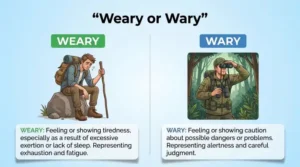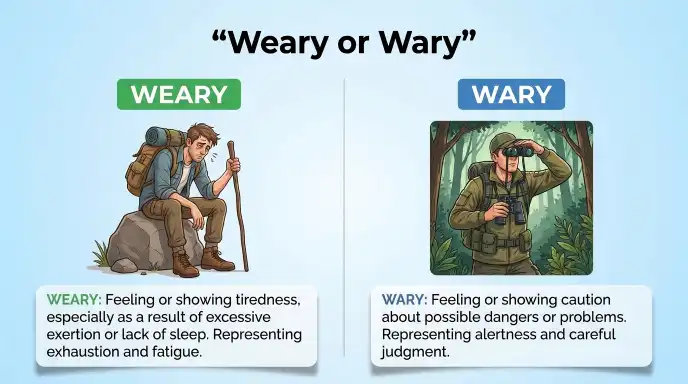
Weary or wary? The correct word depends on what you want to say. Weary means tired or worn out, while wary means careful or cautious because something may be risky. Both words are correct, but they have very different meanings.
These words often confuse readers because they look alike and sound similar. A single letter changes the meaning of a sentence. For example, “I am weary of walking” suggests that walking has made you tired. “I am wary of walking alone at night” means you feel cautious about your safety.
Knowing the difference helps you write clear emails, school assignments, reports, blog posts, and everyday messages. It also helps you avoid mistakes that can change the meaning of what you want to say. Although both words can describe how a person feels, weary focuses on tiredness, while wary focuses on caution or distrust.
In this guide, you will learn the definitions, origins, spelling rules, and common uses of weary or wary. You will also find examples, practical writing tips, regional guidance, and answers to common questions. By the end, you will know which word fits your sentence.
Featured Snippet: What Is the Difference Between Weary and Wary?
Weary means tired, exhausted, or worn out after effort, stress, or a long period of time. Wary means cautious, alert, or careful because of a possible danger or problem. For example, “I feel weary after work” means you are tired. “I am wary of strangers” means you are cautious around them.
Weary or Wary: Quick Answer
Both weary and wary are correct English words. The right choice depends on the meaning of your sentence.
- Weary: Tired in your body or mind.
- Wary: Careful because you suspect a risk or problem.
Examples of Weary
- I feel weary after a long day at work.
- The weary travelers rested at the hotel.
- She grew weary of the endless delays.
Examples of Wary
- Be wary of emails from unknown senders.
- He was wary of making a quick decision.
- The dog remained wary around strangers.
Easy memory tip: Weary has an extra “e,” just like exhausted. Wary means you are watching out for trouble.
What Does Weary or Wary Mean?
The words weary and wary describe different feelings and responses. One relates to tiredness, while the other relates to caution.
What Does Weary Mean?
Weary is an adjective that means tired, exhausted, or lacking energy. It can describe physical tiredness after work or exercise. It can also describe mental fatigue caused by stress, worry, or repeated problems.
The word may also mean that someone has lost patience with something that continues for too long.
Examples:
- After walking for five hours, we felt weary.
- She gave a weary smile after another busy day.
- I am weary of hearing the same excuse.
- The workers looked weary after their long shift.
In the last example, the workers look tired. In the third example, the speaker feels fed up with repeated excuses.
What Does Wary Mean?
Wary is an adjective that means cautious, alert, or careful because you think something may be dangerous, dishonest, or unpleasant.
A wary person does not always feel afraid. They may simply want to avoid a mistake or make sure a situation is safe.
Examples:
- Be wary of offers that sound too good to be true.
- She was wary of sharing her personal details.
- The cat stayed wary of the unfamiliar dog.
- Investors remained wary after the sudden market change.
In each example, the person or animal acts with care because of a possible risk.
Weary vs. Wary: The Main Difference
| Feature | Weary | Wary |
| Part of speech | Adjective | Adjective |
| Main meaning | Tired or worn out | Cautious or alert |
| Common cause | Work, effort, stress, or repetition | Risk, danger, doubt, or uncertainty |
| Common phrase | Weary of | Wary of |
| Similar words | Tired, exhausted, fatigued | Cautious, careful, watchful |
| Example | I am weary after the trip. | I am wary of the road. |
Can Weary and Wary Both Describe Feelings?
Yes, but they describe different states of mind.
A weary person may need rest. A wary person may need more information before acting.
For example:
- “She felt weary before the interview.” She was tired.
- “She felt wary before the interview.” She was cautious or uncertain about the situation.
The context tells the reader which meaning you intend.
The Origin of Weary or Wary

The words weary and wary have different histories, even though their spellings look similar.
The Origin of Weary
Weary comes from Old English wērig, which meant tired or exhausted. The word has been used for centuries to describe a lack of energy, strength, or patience.
Over time, its meaning expanded beyond physical tiredness. Today, a person can feel weary after hard work, emotional stress, a long journey, or repeated disappointment.
For example, “I am weary of these delays” describes frustration and a loss of patience rather than simple physical tiredness.
The Origin of Wary
Wary developed from Middle English and is linked to the idea of being watchful or cautious. Its history connects with older Germanic word forms associated with awareness and careful attention.
The modern word describes a person who pays close attention because they expect a possible problem or danger.
For example, “The buyer was wary of the seller’s claims” means the buyer did not trust those claims without checking them.
Why Are Weary and Wary So Similar?
English contains many words that look or sound alike but have different meanings. Weary and wary are one such pair.
Their similar spellings can make them hard to remember, especially for students and people learning English. However, they do not have the same meaning or origin.
You do not need to memorize their full history to use them correctly. Remember their main ideas:
- Weary = tired.
- Wary = cautious.
These simple meanings will help you choose the right word in most situations.
British English vs American English
There is no major spelling difference between weary and wary in British and American English. Both countries use the same spellings and meanings.
The difference may appear in the surrounding sentence, tone, or choice of related words, but the two main words remain the same.
British English vs American English Comparison Table
| British English | American English | Example |
| Weary | Weary | She felt weary after work. |
| Wary | Wary | He was wary of the offer. |
| Weary of | Weary of | They grew weary of the delays. |
| Wary of | Wary of | She was wary of the stranger. |
| Weary traveler | Weary traveler | The weary traveler sat down. |
| Wary customer | Wary customer | The wary customer checked the price. |
The words traveler and traveller show a common regional spelling difference. American English usually uses traveler, while British English often uses traveler. However, both varieties still spell the target words weary and wary.
Do Style Guides Prefer One Word?
No standard British or American style guide changes the basic meanings of these words. Writers should use weary for tiredness and wary for caution.
Publishers, schools, and businesses may have their own style rules for spelling and punctuation. Those rules do not make weary and wary interchangeable.
The best approach is to check the meaning first, then follow the spelling and style rules required by your audience.
Which Version Should You Use?
The good news is that you do not need to choose between British and American spellings for these words. Weary and wary are standard in both varieties.
However, you still need to select the word that matches your meaning.
United States
Use weary when you mean tired, exhausted, or fed up. Use wary when you mean cautious or suspicious.
- Correct: I am weary after the long drive.
- Correct: I am wary of the unusual offer.
United Kingdom
The same rules apply in British English.
- Correct: The workers looked weary.
- Correct: The residents were wary of the changes.
You do not need to alter either word to follow British spelling.
Canada
Canadian English uses both words with the same meanings.
Choose weary for tiredness and wary for caution. Follow any local institutional or professional style guide for the rest of your writing.
Australia
Australian English also uses weary and wary in the same way as British and American English.
For example, “The hikers were weary after the climb” describes tired hikers. “The hikers were wary of the approaching storm” describes their caution.
International Writing
For a global audience, use simple sentences that make the meaning clear.
Instead of writing, “He was weary of the offer,” when you mean that he did not trust it, write, “He was wary of the offer.”
The second sentence clearly expresses caution.
Academic Writing
Use the words accurately in essays, research papers, and reports.
- The participants appeared weary after the long session.
- Researchers should be wary of conclusions based on limited data.
The first sentence describes tiredness. The second advises caution.
Business Writing
Use weary to describe fatigue or frustration. Use wary to describe careful judgment or concern about a risk.
- The team grew weary of repeated delays.
- The company was wary of signing the contract without reviewing the terms.
This distinction helps your writing stay clear and professional.
Common Mistakes with Weary or Wary
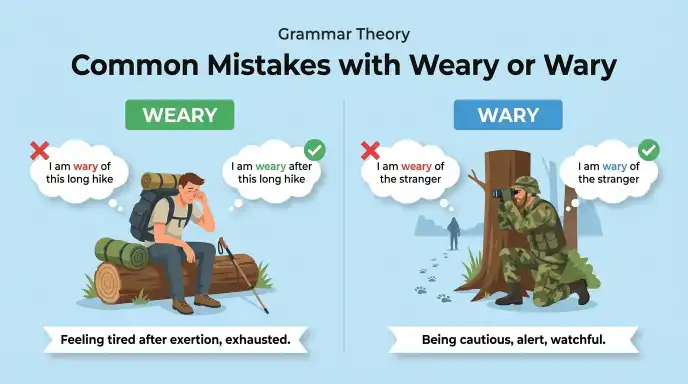
The most common mistake is using weary when you mean wary, or using wary when you mean weary. These errors can change the meaning of your sentence.
Using Weary for Caution
Incorrect: Be weary of online scams.
Correct: Be wary of online scams.
Explanation: The sentence warns people to be careful. It does not mean they should feel tired.
Using Wary for Tiredness
Incorrect: I feel wary after working all day.
Correct: I feel weary after working all day.
Explanation: Working all day can make you tired. Therefore, weary is the right word.
Confusing “Weary Of” and “Wary Of”
Both expressions are correct, but their meanings differ.
- Weary of: Tired of something or no longer patient with it.
- Wary of: Careful around something because it may cause trouble.
Examples:
- I am weary of these constant complaints.
- I am wary of the stranger’s intentions.
Thinking Wary Always Means Afraid
Incorrect assumption: A wary person is always scared.
Correct understanding: A wary person is careful or alert. They may feel concern without feeling fear.
Example: She was wary of the offer and asked for more details.
Treating One Word as a Misspelling
Incorrect assumption: Wary is a misspelling of weary.
Correct understanding: Both are valid English words with different meanings.
Example: The weary guard was still wary of strangers.
This sentence uses both words correctly. The guard is tired but remains cautious.
A Simple Memory Tip
Remember these two short rules:
- Weary = Worn out.
- Wary = Watchful.
Both pairs begin with the same letter, which makes them easier to remember. If you can replace the word with tired, choose weary. If you can replace it with caution, choose wisely.
Weary or Wary in Everyday Examples
Real examples help you see how these words work in different settings. Both can describe people, but the reason for the feeling is different.
In Emails
Weary:
“After several rounds of revisions, our team is growing weary of the delays. Could we agree on a final deadline?”
Wary:
“I am wary of the proposed payment method. Could you please confirm the details before we proceed?”
The first email describes frustration. The second expresses caution.
In Business Writing
- The staff felt weary after a demanding week.
- The manager was wary of approving the deal without a review.
- Customers grew weary of repeated service problems.
- Investors remained wary of sudden changes in the market.
In professional writing, weary often describes fatigue or frustration, whereas wary shows caution about possible risks. For example, a tired employee may feel weary after a long shift, while a careful manager may be wary of signing an uncertain contract.
In News Headlines
News writers may use these words to describe public mood or reactions.
- Weary Workers Call for Better Conditions
- Wary Buyers Delay Major Purchases
- Weary Residents Seek Relief After Months of Disruption
- Wary Officials Review the New Proposal
These are illustrative headline examples, not reports of actual events.
In Blog Posts
Weary example:
“Long workdays and poor sleep can leave you feeling weary. Take breaks and give yourself enough time to rest.”
Wary example:
“Be wary of websites that promise instant results but provide no clear evidence.”
The first example discusses tiredness. The second warns readers to be careful.
On Social Media
- Feeling weary after a long week. Time for a little rest!
- Stay wary of messages asking for your passwords.
- I am weary of the same old excuses.
- She was wary of sharing personal details online.
These examples show how the words fit casual posts and everyday conversations.
In Academic Writing
- Students may become weary during long examinations.
- Researchers should be wary of drawing conclusions from a small sample.
- The repeated tasks left the participants feeling weary.
- Readers should be wary of claims that lack strong evidence.
Academic writing benefits from this distinction because the words describe different things: fatigue and caution.
In Daily Conversation
Person A: You look tired. Are you okay?
Person B: I am just weary after a long day.
Another example:
Person A: Why have you not replied to that offer?
Person B: I am wary of it. Something does not seem right.
In the first conversation, the speaker needs rest. In the second, the speaker wants to avoid a possible risk.
Weary or Wary: Google Trends & Modern Usage
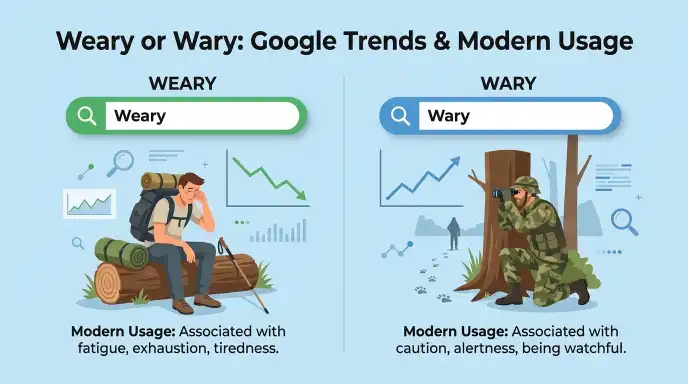
People search for weary or wary because the two words look similar but express different ideas. Students, writers, editors, and English learners often want to know which word fits a sentence.
Why Do People Search for These Words?
Common reasons include:
- Spelling confusion: The words differ by only one letter.
- Meaning questions: Readers want to know if a sentence describes tiredness or caution.
- Grammar checks: Writers want to use the correct word in essays, reports, and emails.
- Phrase confusion: Expressions such as weary of and wary of can be difficult to distinguish.
- Professional writing: Editors want to avoid errors that change a sentence’s meaning.
Regional Popularity
Both words are established in British, American, Canadian, and Australian English. There is no major regional spelling difference between them.
Search interest may vary by country and over time. However, without a current, verified Google Trends comparison, it would not be accurate to claim that one word receives more searches in a particular country or to provide exact search percentages.
How to Check Google Trends
To compare interest in these words:
- Open Google Trends.
- Enter weary as one search term.
- Add wary as the second term.
- Select the country or region you want to study.
- Choose the same time period for both terms.
- Compare the results and related queries.
Google Trends shows relative search interest, not the exact number of searches. Results can also change based on the selected country, period, and search settings.
Modern Usage
Both words remain useful in modern writing.
Weary often appears in discussions about long workdays, stress, travel, repeated problems, and emotional fatigue.
Wary often appears in advice about scams, online privacy, business risks, health claims, and uncertain decisions.
The best word is not the one that seems more popular. It is the one that communicates your meaning clearly.
Quick Comparison Table: Weary vs Wary
| Version | Meaning | Correct? | Region | Example |
| Weary | Tired or exhausted | Yes | All major English varieties | I feel weary after work. |
| Wary | Careful or cautious | Yes | All major English varieties | Be wary of scams. |
| Weary of | Tired of or fed up with | Yes | All major English varieties | She grew weary of waiting. |
| Wary of | Cautious about or distrustful of | Yes | All major English varieties | He was wary of the offer. |
| Weary traveler | A tired traveler | Yes | All major English varieties | The weary traveler rested. |
| Wary traveler | A cautious traveler | Yes | All major English varieties | The wary traveler checked the route. |
Key Takeaways
- Weary means tired, exhausted, or worn out.
- Wary means cautious, careful, or alert to possible danger.
- Both words are correct in British and American English.
- Use weary of when you mean tired of something.
- Use wary of when you mean cautious about something.
- Neither word is a spelling variation of the other.
- Remember weary = worn out and wary = watchful.
FAQs About Weary or Wary
Q1. What Is the Difference Between Weary and Wary?
Weary means tired or worn out, while wary means careful or cautious. A weary person may need rest after a long day. A wary person may avoid a risky choice because they suspect a problem. Both words are correct, but they cannot replace each other without changing the meaning.
Q2. Is It Weary or Wary of Something?
Both phrases are correct, but they mean different things. Weary of means tired of something or fed up with it. Wary of means cautious about something or someone. For example, “I am weary of waiting” expresses frustration, while “I am wary of the offer” expresses doubt or caution.
Q3. Does Wary Mean Tired?
No. Wary means cautious, alert, or careful because of a possible risk. It does not mean tired. For example, a person may be wary of a stranger because they do not know if the stranger can be trusted. If the person feels exhausted after a long walk, the correct word is weary.
Q4. Does Weary Mean Cautious?
No. Weary usually means tired, exhausted, or worn out. It can also mean being fed up with repeated problems. For example, “She felt weary after working late” describes fatigue. If she is careful because she suspects a problem, use wary instead.
Q5. Are Weary and Wary Pronounced the Same Way?
No. Their pronunciation is similar, but the vowel sounds differ. Weary is commonly pronounced “WEER-ee,” while wary is often pronounced “WAIR-ee” in American English. Pronunciation can vary by accent, so listening to both words in a reliable dictionary can help you hear the difference.
Q6. Is Weary a Positive or Negative Word?
Weary is usually neutral or negative. It describes tiredness, exhaustion, or a loss of patience. For example, “The weary nurse needed a break” describes fatigue, not a personal weakness. The word can also express frustration, as in “I am weary of these repeated delays.”
Q7. Can Wary Be Used in a Positive Way?
Yes. Being wary can be sensible and helpful when a situation involves uncertainty or risk. For example, “She was wary of sharing private information online” describes careful judgment. The word may suggest distrust, but it does not always imply that a person is fearful or unreasonable.
Q8. What Is a Synonym for Weary and Wary?
Synonyms for weary include tired, exhausted, fatigued, and worn out. Synonyms for wary include cautious, careful, watchful, and guarded. These words may not fit every sentence in exactly the same way, so check the meaning and tone before replacing one.
Conclusion:
The difference between weary or wary comes down to two simple ideas. Weary means tired, exhausted, or fed up with something. Wary means cautious, careful, or alert to a possible risk. Although the words look similar, they express different feelings and should not be used interchangeably.
Use weary when you describe a person who needs rest after hard work, a long trip, or repeated stress. Use wary when you describe someone who takes care because a person, offer, or situation may not be safe or trustworthy.
These rules apply in British English, American English, Canadian English, Australian English, and international writing. You do not need to learn different regional spellings for this pair. You only need to understand the meaning you want to express.
When editing your work, read the sentence and replace the word with tired or cautious. The word that keeps your intended meaning is the right choice.
Remember: A weary person needs rest, but a wary person watches out for risk. Keep this simple rule in mind, and use it in your next email, essay, or everyday conversation to make your writing clearer.

I’m Nora Ellis, an English language writer passionate about making grammar, spelling, and confusing words easy to understand. I share clear explanations and practical examples to help readers improve their English and use words with confidence.