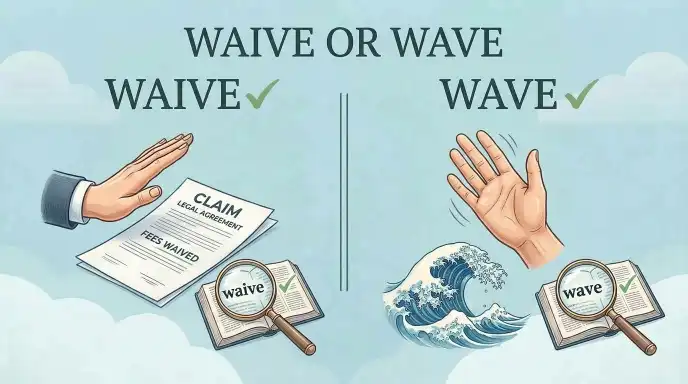
Waive or wave? The correct word depends on your meaning: waive means to give up or cancel a right, fee, or rule, while wave means to move your hand or something back and forth. These words sound alike, but they have different spellings and meanings.
People often search for waive or wave because both words are pronounced the same in standard English. This makes them easy to mix up in writing. The confusion becomes common in emails, school work, business messages, and everyday conversations.
For example, a company may waive a fee, but a person may wave goodbye. You cannot normally replace one word with the other because the meaning changes completely.
Learning the difference is simple. Think of waive as giving something up, such as a fee or right. Think of a wave as a hand movement, a moving shape, or a rise and fall such as a wave in the sea.
This guide explains the meanings, origins, spelling, common mistakes, and everyday uses of waive or wave.
Waive or Wave : Quick Answer
Waive means to give up, remove, or choose not to enforce something.
Wave means to move something from side to side or refers to a moving swell, signal, or pattern.
Examples
- The bank agreed to waive the service fee.
- She waved goodbye to her friend.
- The teacher may waive the late penalty.
- He gave me a friendly wave.
Quick rule: If you mean give up or cancel, use waive. If you mean move from side to side or a moving swell, use waves.
Definition and Meaning of Waive or Wave
What Does Waive Mean?
Waive is a verb. It means to voluntarily give up a right, claim, requirement, fee, or rule.
For example:
- The company will waive the delivery fee.
- She decided to waive her right to a refund.
- The school may waive the application fee.
The word often appears in legal, business, financial, and formal contexts.
What Does Wave Mean?
Wave can be a noun or a verb.
As a verb, it means to move your hand or another object from side to side.
- She waved at me.
- He waved goodbye.
- The child waved a flag.
As a noun, wave can mean a moving swell of water.
- A large wave hit the boat.
It can also describe a movement, signal, or sudden increase.
- There was a new wave of interest in the product.
The Main Difference
| Word | Meaning | Example |
| Waive | Give up, remove, or cancel a right or requirement | They waived the fee. |
| Wave | Move from side to side | She waved to me. |
| Wave | A swell of water or movement | A large wave reached the shore. |
The Origin of Waive or Wave
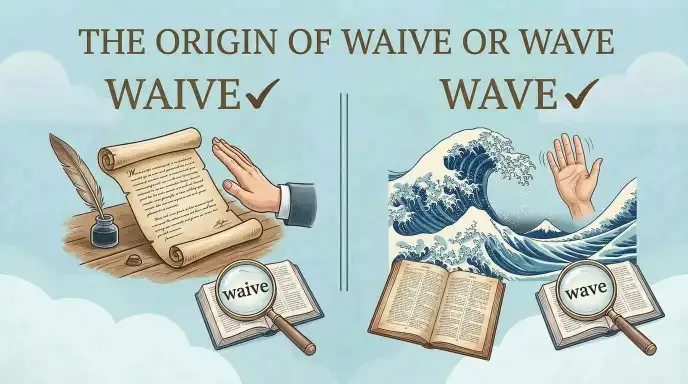
The two words have different histories, even though they sound alike.
Waive comes from an older legal and French-influenced history. It developed from Middle English forms related to the idea of abandoning, surrendering, or giving something up. Over time, waive became strongly connected with giving up a right, claim, rule, or requirement.
Wave has a different history. As a verb, it developed from Old English and related Germanic words connected with movement. The noun wave also developed from this idea of a moving swell or motion.
The spelling difference exists because these words come from different historical roots. English spelling often keeps these differences even when two words later become pronounced alike.
This makes waive and wave a pair of homophones. Homophones are words that sound the same but have different meanings and spellings.
British English vs American English Spelling
There is no major British-American spelling difference between waive and wave.
Both forms are spelled the same in British English and American English.
| Meaning | British English | American English | Example |
| Give up a right or fee | waive | waive | They will waive the fee. |
| Move the hand | wave | wave | She waved goodbye. |
| Moving swell of water | wave | wave | A big wave came toward us. |
The main challenge is not regional spelling. It is choosing the correct word for the meaning.
British English Examples
- The company agreed to waive the charge.
- She waved to her neighbour.
American English Examples
- The company agreed to waive the charge.
- She waved to her neighbor.
Notice that the spelling of waive and wave does not change. Other words in the sentence may follow different British or American conventions, but these two words remain the same.
Which Spelling Should You Use?
Choose the word based on meaning, not on your country.
Use Waive When You Mean:
- Give up a right
- Remove a fee
- Cancel a requirement
- Give up a claim
- Choose not to enforce a rule
Example:
The hotel agreed to waive the cancellation fee.
Use Wave When You Mean:
- Move your hand
- Move something from side to side
- Signal with your hand
- A swell of water
- A movement or rising pattern
Example:
She waved to her parents from the window.
For Global English
The same rule works for readers in the US, UK, Canada, Australia, and other English-speaking regions.
Remember:
Waive = give up
Wave = move or swell
Common Mistakes with Waive or Wave
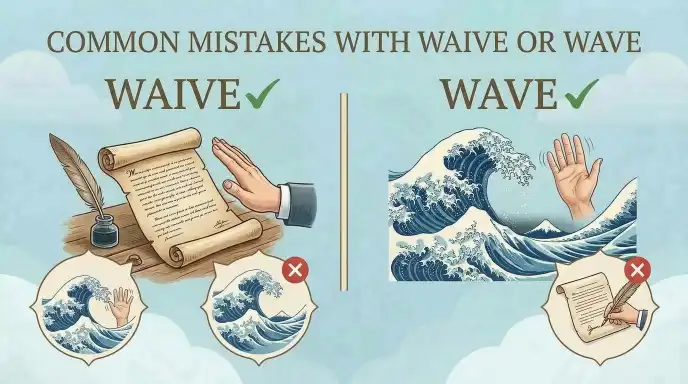
Because the words sound alike, writers sometimes choose the wrong spelling.
| Incorrect | Correct | Why |
| Please wave the fee. | Please waive the fee. | A fee can be given up or removed. |
| She waived goodbye. | She waved goodbye. | A person waves goodbye. |
| The company will wave the charge. | The company will waive the charge. | A charge can be removed. |
| He waived at me. | He waved at me. | You wave at someone. |
| They waived their hands. | They waved their hands. | Hand movement uses wave. |
| The bank waved the penalty. | The bank waived the penalty. | A penalty can be given up. |
Easy Memory Trick
Use waive when something is given up.
Waive = give up
Use wave when something moves.
Wave = move
This simple connection can help prevent most spelling mistakes.
Waive or Wave in Everyday Examples
Both words appear often in everyday English, but they appear in different situations.
In Emails
Waive:
Could you please waive the additional fee?
Wave:
I saw you wave at me outside the office.
In Business Writing
Waive:
The company agreed to waive the processing charge.
Wave:
The manager gave a quick wave before leaving.
In News Writing
Waive:
The organization decided to waive the registration fee.
Wave:
A powerful wave damaged several boats.
On Social Media
Waive:
The company may waive the fee for new customers.
Wave:
Just a quick wave to everyone watching!
In Formal Writing
Waive:
The applicant may request that the requirement be waived.
Wave:
The researchers observed a new wave of activity.
Waive or Wave : Google Trends & Usage Data
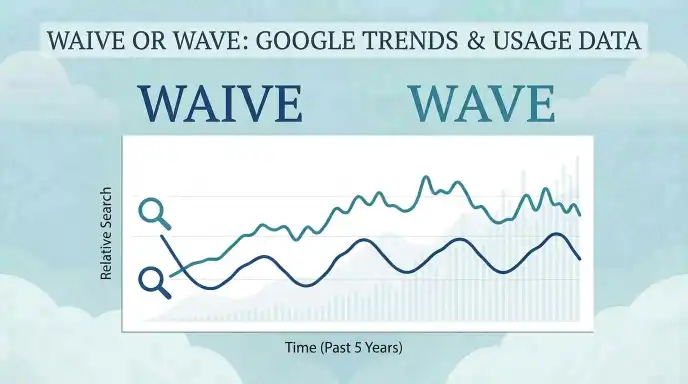
Search interest for waive and wave can vary because the two words serve very different purposes.
Wave has a broad range of meanings. It can describe ocean waves, hand movements, signals, scientific patterns, and social or cultural trends. Because of these many meanings, searches for waves can come from many different contexts.
Waive is more specific. Searches often relate to fees, legal rights, requirements, contracts, applications, and financial charges.
Google Trends can show how search interest changes by country, time period, and search context. However, search volume does not directly measure how often a word is used in normal conversation or writing.
The safest way to interpret trends is to compare the words for a specific country and time period. For example, searches for waivers may be connected to questions about fees or legal terms, while waves may be connected to weather, science, sports, or everyday gestures.
Because search interest changes over time, current Google Trends results should be checked for the exact region and date range being studied.
Waive or Wave : Comparison Table
| Feature | Waive | Wave |
| Part of speech | Verb | Noun and verb |
| Main meaning | Give up or remove | Move from side to side |
| Common context | Fees, rights, rules, requirements | Greetings, water, movement |
| Example | They waived the fee. | She waved at me. |
| Past tense | Waived | Waved |
| Pronunciation | Same as wave | Same as waive |
| British spelling | Waive | Wave |
| American spelling | Waive | Wave |
| Common error | Using wave for a fee | Using waive for a hand movement |
FAQs About Waive or Wave
Q1. What is the difference between waive and wave?
Waive means to give up, remove, or not enforce something. Wave means to move from side to side or refers to a swell, movement, or signal.
Q2. Is it waive a fee or wave a fee?
The correct phrase is waive a fee. It means to remove or cancel the fee.
Example: The company agreed to waive the fee.
Q3. Is it wave goodbye or waive goodbye?
The correct phrase is wave goodbye.
Example: She waved goodbye before getting into the car.
Q4. Are waive and wave pronounced the same?
Yes. In standard English, waive and wave are generally pronounced the same. They are homophones.
Q5. Is waived the past tense of waive?
Yes. The past tense and past participle of waive is waived.
Example: The bank waived the service charge.
Q6. What is the past tense of wave?
The past tense of wave is waved.
Example: He waved to his friend.
Q7. Do British and American English spelling waive differently?
No. Both British and American English use waive. They also both use waves. The difference is based on meaning, not regional spelling.
Conclusion:
Waive and wave sound the same, but they have different meanings and spellings. Waive is used when someone gives up, removes, or chooses not to enforce something. You can waive a fee, waive a right, waive a requirement, or waive a penalty.
Wave is used for movement, signals, and swells. You can wave goodbye, wave at someone, wave a flag, or watch a wave in the ocean.
There is no British-American spelling difference between these two words. Both varieties of English use waive for giving something up and wave for movement or a swell.
The easiest way to remember the difference is simple: waive means give up, while wave means move. When you understand the meaning you want, choosing the correct spelling becomes easy.
If you are writing an email, school assignment, business document, social media post, or formal text, this rule will help you use waive or wave correctly.

I’m Nora Ellis, an English language writer passionate about making grammar, spelling, and confusing words easy to understand. I share clear explanations and practical examples to help readers improve their English and use words with confidence.