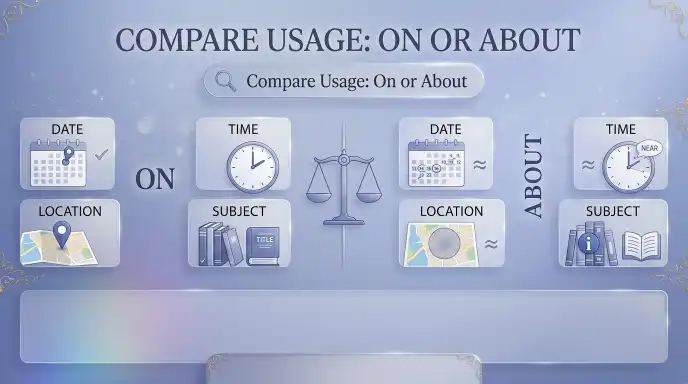
“On or about” means approximately or around a stated time or place. The phrase is especially common in legal writing, where it allows a date or location to remain slightly flexible instead of giving an exact detail.
For example, “The contract was signed on or about June 10” means the signing happened around June 10, but the exact date may not be known or may not be important.
People often search for “on or about” because the phrase can feel unusual in everyday English. Some readers see it in contracts, court documents, notices, or formal letters and wonder what it really means. Others are unsure if on or about is grammatically correct or if they should simply write about, around, or approximately.
The phrase can refer to both time and location. In legal documents, its meaning can be more precise than casual speech. It may indicate that something happened near a particular date or place without claiming that the detail is exact.
This guide explains the meaning, history, regional usage, common mistakes, examples, and practical rules for using on or about correctly.
On or About : Quick Answer
On or about means approximately, around, or near a particular time or place.
It is especially common in legal and formal writing.
Examples
- The meeting will take place on or about May 15.
- The package should arrive on or about Friday.
- The incident happened on or about March 3.
- The property is located on or about the main road.
When the phrase refers to a date, it usually means that the event happened close to that date.
When it refers to a place, it can mean near or in the general area of that place. Legal Information Institute explains that the phrase is used in both civil and criminal law for approximate dates or locations.
Definition and Meaning of On or About
What Does On or About Mean?
On or about is a phrase used to show that something is close to a stated time or place but not necessarily exact.
For example:
The company opened its new office on or about January 5.
The sentence does not promise that January 5 was the exact opening date. It gives January 5 as an approximate reference point.
On or About for Dates
This is the most common formal use.
The payment is due on or about June 1.
The phrase suggests that the payment is expected around that date. The exact amount of flexibility depends on the context.
Legal sources note that on or about can give reasonable flexibility around a stated date. Courts do not always treat the phrase as a fixed number of days before or after the date. The meaning can depend on the document and the circumstances.
On or About for Places
The phrase can also describe a general location.
The damage occurred on or about the property.
Here, on or about can mean on, near, or in the general vicinity of the property.
Is On or About Only a Legal Phrase?
No. The expression can appear outside law, too.
For example:
We expect the repairs to finish on or about Friday.
However, the phrase has a strong formal and legal tone. In everyday conversation, people often choose simpler expressions such as around, about, or approximately.
The Origin of On or About

On or about does not come from a single special word. It is a combination of ordinary English words that developed into a fixed phrase.
The preposition on has long been used for dates and points in time. About can express approximation or nearness. Together, the words create the idea of something happening at or near a stated point.
The phrase became strongly associated with legal language because legal documents often need to identify dates and places without making an unnecessarily exact statement.
Historical legal dictionaries show that on or about was used when describing the date of an event or document while avoiding the need to be bound to an exact date. An older edition of Black’s Law Dictionary gives this function directly.
The phrase also appears in older legal dictionaries as a way to avoid problems caused by an incorrect exact date.
Why Does the Phrase Sound Formal?
Legal writing often keeps traditional expressions that have developed a specific function over time.
On or about is one example.
In ordinary conversation, a person might say:
The meeting is around June 10.
A formal document might say:
The meeting occurred on or about June 10.
Both communicate approximations, but the second sounds more formal.
British English vs American English Spelling
There is no British-American spelling difference for on or about.
The phrase is written with three separate words in both varieties:
on + or + about
It is not normally written as one word or hyphenated.
| Form | British English | American English | Example |
| on or about | Correct | Correct | The event occurred on or about June 10. |
| on-or-about | Not standard | Not standard | ❌ Avoid this form. |
| onorabout | Incorrect | Incorrect | ❌ Do not combine the words. |
| about June 10 | Correct | Correct | The event happened about June 10. |
| around June 10 | Correct | Correct | The event happened around June 10. |
Regional Differences
The phrase is used in both British and American legal English.
LexisNexis UK notes that on or about is routinely found in legal work across England and Wales, Scotland, Northern Ireland, and Ireland. It is used when the exact timing is unknown, unimportant, or reasonably subject to slight variation.
In American legal English, the phrase is also well established. The U.S. Legal Information Institute describes its use in both civil and criminal law.
So, this is not a case like colour/color or centre/center.
The phrase stays the same.
Which Version of On or About Should You Use?

Because on or about is not a spelling choice, the main question is if the phrase fits your context.
United States
Use on or about when writing a formal document, contract, legal statement, or other text where an approximate date or location needs to be stated.
For casual writing, around may sound more natural.
United Kingdom
British English also uses on or about, especially in legal and formal contexts.
Canada
Canadian writers can use on or about in formal contexts. For simple everyday writing, around or approximately may be clearer.
Australia
Australian English can also use the phrase in formal or legal writing. Choose a simpler expression when the formal tone is unnecessary.
International Writing
For international readers, consider the audience.
If the document is legal or contractual, on or about may be appropriate. If the document is for general readers, around or approximately can make the meaning easier to understand.
Academic Writing
Academic writers usually do not need the phrase unless they are discussing a legal document or a date that is genuinely uncertain.
Instead of:
The survey was completed on or about April 20.
You could write:
The survey was completed around April 20.
Business Writing
Business writing depends on the situation.
For a formal contract:
Delivery is expected on or about July 1.
For a simple email:
Delivery is expected around July 1.
The second version is usually more direct for everyday business communication.
Common Mistakes with On or About
Treating It as an Exact Date
❌ The meeting on or about June 10 means the meeting definitely happened on June 10.
✅ On or about June 10 indicates an approximate date.
The phrase deliberately avoids claiming exactness.
Using It When an Exact Date Matters
If an exact date is important, use the actual date.
❌ Payment must be made on or about June 10, when the contract requires payment specifically on June 10.
✅ Payment must be made on June 10.
Legal sources note that the flexibility of on or about does not remove the importance of context. Exact timing can matter in situations such as legal deadlines or limitation periods.
Writing It as One Word
❌ onorabout
✅ on or about
The phrase contains three separate words.
Adding Unnecessary Hyphens
❌ on-or-about June 10
✅ on or about June 10
The normal phrase does not require hyphens.
Using It in Very Casual Speech
The phrase is not grammatically wrong in casual speech, but it can sound formal.
Instead of:
I will arrive on or about 6 p.m.
A natural everyday version is:
I will arrive around 6 p.m.
Memory Tip
Think:
On or about = close to, but not exact.
That simple idea covers most uses.
On or About in Everyday Examples

The phrase appears most often in formal contexts. Still, you may see it in emails, business documents, news reports, and general writing.
In Emails
We expect the new equipment to arrive on or about Monday.
For a less formal email, you could write:
We expect the new equipment to arrive around Monday.
In Business Writing
The project is expected to finish on or about September 30.
This wording gives the expected date while allowing some flexibility.
In News Headlines
Company Opens New Facility on or About June 1
A news writer may use the phrase when the exact date is uncertain.
In Blogs
The tradition began on or about the 18th century.
However, this sentence is better written as:
The tradition began around the 18th century.
For general readers, around is usually clearer.
In Social Media
The new collection arrives on or about Friday.
A more natural social media version would be:
The new collection arrives around Friday.
In Formal Writing
The agreement was signed on or about March 15.
This style is common in formal documents.
In Legal Writing
The defendant entered the property on or about May 12.
Legal documents commonly use the phrase when the exact date cannot be stated with certainty.
In Daily Conversation
We should arrive around noon.
Most speakers would choose around instead of on or about in ordinary conversation.
On or About : Google Trends & Usage Data
Searches for on or about are likely driven by questions about meaning, grammar, legal language, and formal usage.
The phrase has a special role in legal writing. Legal Information Institute identifies it as a phrase used for approximate dates and locations in both civil and criminal law.
Why Do People Search This Phrase?
Common search reasons include:
- Understanding a legal document
- Reading a contract
- Checking the meaning of a court phrase
- Writing a formal letter
- Understanding an approximate date
- Comparing on or about with around
- Learning if the phrase is grammatically correct
Modern Usage
The phrase remains active in modern legal writing in both the United States and the United Kingdom.
LexisNexis UK describes it as a routine expression in contracts, pleadings, indictments, and witness statements across several UK and Irish jurisdictions.
In the United States, the Legal Information Institute also describes its use in civil and criminal law.
Google Trends Data
Exact Google Trends popularity depends on the country, date range, language, and search category selected. Without a fixed comparison and date range, giving exact search volumes or country rankings would be misleading.
The broader usage pattern is clear: on or about has a strong connection with legal and formal language.
For general readers, the simpler alternatives around and approximately are often easier to understand.
On or About : Quick Comparison Table
| Version | Meaning | Correct? | Region | Example |
| on or about | Approximately or near a stated time/place | ✅ Yes | US, UK, Canada, Australia, International | The event occurred on or about June 10. |
| around | Approximately or near | ✅ Yes | All major English varieties | The event happened around June 10. |
| approximately | Close to an exact time, amount, or number | ✅ Yes | All major English varieties | The event happened approximately on June 10. |
| about | Approximately or roughly | ✅ Yes | All major English varieties | The event happened about June 10. |
| on-or-about | Same intended meaning | ❌ Usually avoid | All | ❌ Write on or about. |
| onorabout | No standard meaning | ❌ No | All | ❌ Do not combine the words. |
Note: The exact choice depends on context. In formal or legal writing, on or about may have a useful established function. In ordinary writing, around or approximately can be simpler.
Key Takeaways
- On or about means approximately or near a stated time or place.
- The phrase is especially common in legal and formal writing.
- It can describe an approximate date or general location.
- There is no British-American spelling difference.
- Always write it as three words: on or about.
- The phrase does not normally mean that the date is exact.
- Around and approximately are useful alternatives in general writing.
- Use on or about when its formal or legal tone fits the context.
FAQs About On or About
Q1. What does “on or about” mean?
On or about means approximately, around, or near a stated time or place. For example, “on or about July 10” means around July 10 rather than necessarily on that exact day. In legal writing, the phrase can provide reasonable flexibility when the exact date or location is uncertain or not material.
Q2. Is “on or about” grammatically correct?
Yes. On or about is a standard English phrase. It is especially common in legal and formal writing. In casual conversation, however, expressions such as around, about, or approximately may sound more natural and direct.
Q3. What does “on or about June 10” mean?
On or about June 10 means around June 10. It does not necessarily mean that the event happened exactly on June 10. The amount of flexibility depends on the context. In legal documents, the phrase is often used when the precise date is uncertain.
Q4. Is “on or about” a legal term?
It is strongly associated with legal language. Legal documents use it to describe an approximate date or location. It appears in areas such as contracts, pleadings, and criminal proceedings. The phrase is also used outside law, but its formal tone makes it especially common in legal writing.
Q5. Is “on or about” the same as “approximately”?
They are similar, but the style can differ. Approximately is a general word for something that is close to an exact value. On or about is a fixed phrase that is especially common when referring to a date or location in formal and legal contexts.
Q6. Is “on or about” used in British English?
Yes. On or about is used in British legal English. LexisNexis UK notes its use in contracts, pleadings, indictments, and witness statements across England and Wales, Scotland, Northern Ireland, and Ireland.
Q7. Should I use “around” instead of “on or about”?
Use around when you want a simple and natural style. Choose on or about when the formal tone fits the document, especially in legal or contractual writing. For example, “around June 10” sounds more conversational, while “on or about June 10” sounds more formal.
Conclusion:
On or about is a standard English phrase that means approximately, around, or near a stated time or place. It is especially common in legal documents, contracts, pleadings, and other formal writing. Legal sources in both the United States and the United Kingdom describe the phrase as a way to give reasonable flexibility when an exact date or location is uncertain or not essential.
The phrase is not a British or American spelling difference. Both varieties use the same three-word form: on or about. The main issue is not spelling. It is choosing the right level of formality.
For everyday writing, around or approximately may be clearer. A sentence such as “The meeting is around June 10” feels simple and natural. In a formal document, “The meeting will take place on or about June 10” may be more suitable.
Remember the core meaning: on or about = close to, but not necessarily exact. Use it when you need to express an approximate time or place without claiming unnecessary precision.
Meta Description: On or about explained: learn its meaning, legal use, examples, mistakes, British and American usage, and when to use it correctly.

I’m Nora Ellis, an English language writer passionate about making grammar, spelling, and confusing words easy to understand. I share clear explanations and practical examples to help readers improve their English and use words with confidence.






3 thoughts on “On or About: Meaning, Usage, Examples, and Context Guide ”