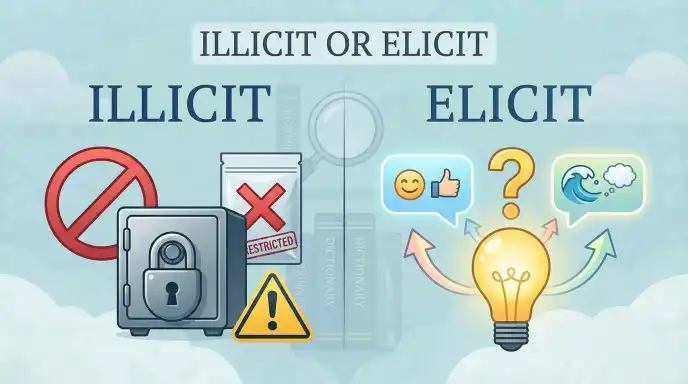
Illicit or elicit are easy to confuse because they look and sound similar, but they have completely different meanings. Illicit means illegal or not allowed, while elicit means to draw out a response, reaction, answer, or information.
People often search for illicit or elicit because both words begin with “ilici/elici” sounds and appear in formal English. The confusion is especially common in academic writing, news reports, business communication, and ESL writing.
For example, illicit drugs are illegal drugs, while a question can elicit a response. You would not say that a question “illicits” a response. Likewise, something illegal is illicit, not “elicit.”
This guide explains the meanings, origins, regional usage, common mistakes, and practical examples. It also shows you a simple way to remember which word to use.
Illicit or Elicit: Featured Snippet & AI Overview
Illicit means illegal, forbidden, or not permitted by law or accepted rules. Elicit means to draw out or bring forth a response, reaction, answer, or information. Use illicit for something prohibited and elicit when someone causes a response or information to come out.
Illicit or Elicit : Quick Answer
The difference is simple:
- Illicit = illegal, forbidden, or unauthorized.
- Elicit = to draw out or obtain a response, answer, reaction, or information.
Examples of Illicit
- Police seized illicit drugs.
- The report described an illicit trade.
- The company was accused of making an illicit payment.
Examples of Elicit
- The teacher asked a question to elicit an answer.
- Her story elicited strong reactions.
- The interview helped elicit useful information.
Easy Rule
Think:
Illicit = illegal
Elicit = extract a response
This distinction works in most everyday and formal writing.
What Does Illicit or Elicit Mean?
What Does Illicit Mean?
Illicit is an adjective. It describes something that is illegal, forbidden, unauthorized, or not permitted.
The word often appears in legal, political, business, financial, and news contexts.
Common phrases include:
- illicit drugs
- illicit trade
- illicit activity
- illicit payment
- illicit goods
- illicit behavior
- illicit trafficking
For example:
Authorities investigated an illicit trade network.
Here, illicit tells us that the trade is not legally permitted.
However, illicit does not always mean strictly illegal in every context. It can also describe something that is forbidden or socially unacceptable.
What Does Elicit Mean?
Elicit is a verb. It means to draw out, bring forth, or obtain something such as a response, reaction, answer, or information.
For example:
The question elicited an honest answer.
The question caused the answer to come out.
Other examples include:
- The joke elicited laughter.
- The survey elicited useful feedback.
- The interview elicited new information.
- Her speech elicited applause.
Elicit usually involves something being drawn out from a person or situation.
Illicit vs Elicit at a Glance
| Word | Part of Speech | Meaning | Example |
| Illicit | Adjective | Illegal, forbidden, or unauthorized | The police found illicit goods. |
| Elicit | Verb | Draw out a response or information | The question elicited an answer. |
The Origin of Illicit or Elicit
Although illicit and elicit look similar, they come from different Latin roots.
Origin of Illicit
Illicit comes from the Latin illicitus, meaning “not allowed” or “unlawful.” It is related to the Latin verb licēre, meaning “to be allowed” or “to be permitted.”
The word entered English through French and developed its modern meaning of something that is not permitted or lawful.
This history helps explain why illicit drugs are closely connected with rules, permission, and legality.
Origin of Elicit
Elicit comes from the Latin verb elicere, meaning “to draw out” or “to bring forth.”
The word entered English through Latin and French-related forms. Its modern meaning still reflects this original idea of drawing something out.
For example:
The interviewer tried to elicit more information.
The interviewer was trying to draw information from the person.
Why Are They Confused?
The words are easy to mix up because they:
- They look very similar.
- Begin with similar sounds.
- Appears often in formal English.
- Both occur in academic and professional writing.
Their meanings, however, are very different.
Illicit concerns permission or legality.
Elicit concerns drawing something out.
Illicit or Elicit : British English vs American English
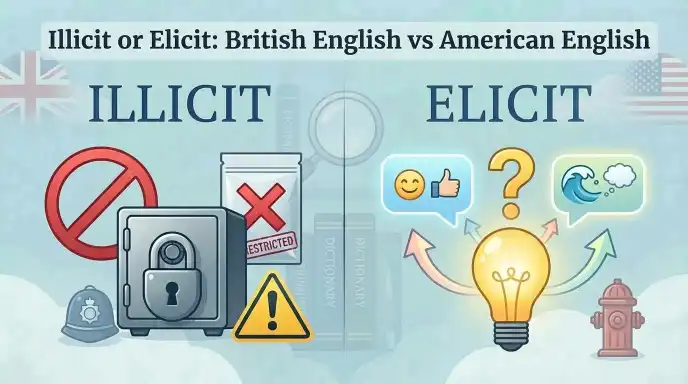
There is no major spelling difference between British and American English for illicit and elicit.
Both forms use the same spelling.
| Word | British English | American English | Example |
| Illicit | illicit | illicit | Police investigated illicit activity. |
| Elicit | elicit | elicit | The question elicited a response. |
| Past form | elicited | elicited | The interview elicited useful information. |
| Noun | elicitation | elicitation | The study used careful elicitation methods. |
Regional Differences
Unlike words such as colour/color or organise/organize, these two words do not normally change spelling between British and American English.
The main issue is meaning, not regional spelling.
Style Guides
Academic and professional style guides generally expect writers to use the standard spellings illicit and elicit.
If you are writing for a particular publication, university, or organization, follow its house style. But the basic spelling of these words remains the same in both major varieties of English.
Which Version Should You Use?
The answer depends on what you want to say, not where your readers live.
United States
Use illicit for something illegal or forbidden.
Use elicit when something draws out a response or information.
United Kingdom
The same distinction applies.
- Illicit activity
- Elicit a response
Canada
Canadian English also uses the standard forms illicit and elicit.
Australia
Australian English follows the same basic distinction.
International Writing
For international readers, the safest approach is to focus on the meaning.
Ask yourself:
Am I describing something forbidden?
Use illicit.
Am I describing something being drawn out?
Use elicit.
Academic Writing
Both words can appear in academic writing.
The study examined illicit financial activity.
The researchers used interviews to elicit detailed responses.
Business Writing
Both words can also appear in professional communication.
The company introduced controls against illicit payments.
The survey was designed to elicit customer feedback.
Common Mistakes with Illicit or Elicit
The most common error is using one word when the other is needed.
| Incorrect | Correct | Explanation |
| The interview illicited a response. | The interview elicited a response. | A response is drawn out, so use elicit. |
| Police discovered elicit goods. | Police discovered illicit goods. | The goods are described as illegal or unauthorized. |
| The question illicited laughter. | The question elicited laughter. | Laughter was brought out by the question. |
| They investigated elicit payments. | They investigated illicit payments. | The payments were unauthorized or unlawful. |
| Her answer illicited concern. | Her answer elicited concern. | The answer caused a reaction. |
Memory Tip
Use this simple connection:
Illicit → illegal
Both begin with il and relate to something not allowed.
Elicit → extract
Both suggest drawing something out.
So:
Illicit = not allowed
Elicit = draw out
This is one of the easiest ways to keep the words separate.
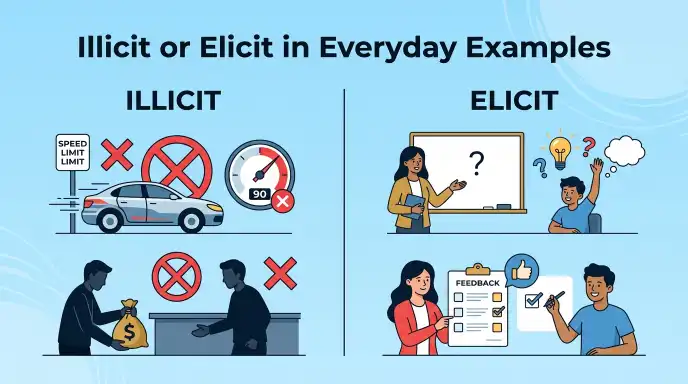
Illicit or Elicit in Everyday Examples
In Emails
Illicit:
The audit found evidence of illicit payments.
Elicit:
We would like to elicit your feedback on the new policy.
In Business Writing
Illicit:
The company has strict controls against illicit transactions.
Elicit:
The survey aims to elicit customer opinions.
In News Headlines
Illicit:
Authorities Target Illicit Trade Network
Elicit:
New Study Questions Elicit Strong Public Response
The first describes prohibited activity. The second uses elicit to describe bringing out a reaction.
In Blogs
The article examines the effects of illicit online activity.
The author uses questions to elicit comments from readers.
On Social Media
The post elicited hundreds of comments.
Here, elicited means the post brought out or caused comments.
You could also write:
Authorities are working to stop illicit online sales.
Here, illicit describes sales that are not permitted.
In Academic Writing
The researchers designed interviews to elicit detailed responses.
The paper examines the impact of illicit financial activity.
In Daily Conversation
That question elicited an interesting answer.
The police were investigating illicit activity.
Elicit is somewhat more formal than everyday alternatives such as get or draw out, while illicit is common in formal descriptions of prohibited activity.
Illicit or Elicit : Google Trends & Modern Usage

People search for illicit or elicit mainly because these words look similar and are easy to confuse when writing.
The confusion is especially relevant to:
- Students
- ESL learners
- Writers
- Editors
- Professionals
- People preparing formal documents
There is no single reliable statistic that can show exactly how often each word is used across every country and context. Google Trends measures search interest, not total word usage.
The two words also appear in different contexts.
Illicit is common in discussions involving:
- Law
- Crime
- Drugs
- Trade
- Finance
- Regulations
- Unauthorized activity
Elicit is common in discussions involving:
- Research
- Interviews
- Education
- Surveys
- Psychology
- Communication
- Customer feedback
Search interest can vary by country and by topic. A search for illicit may be connected to legal or news content, while a search for elicit may come from someone checking a word choice or studying vocabulary.
Because trends change over time, exact popularity claims should be based on a specific Google Trends region and date range rather than assumed from general usage.
Illicit or Elicit : Quick Comparison Table
| Version | Meaning | Correct? | Region | Example |
| Illicit | Illegal or forbidden | Yes | US, UK, Canada, Australia, International | Illicit goods were seized. |
| Elicit | Draw out a response or information | Yes | US, UK, Canada, Australia, International | The question elicited an answer. |
| Illicited | Incorrect form when meaning “drew out” | No | All regions | ❌ The question illicited a response. |
| Elicit for illegal | Wrong word for this meaning | No | All regions | ❌ Elicit drugs |
| Illicit for a response | Wrong word for this meaning | No | All regions | ❌ Illicit a response |
Key Takeaways
- Illicit is an adjective meaning illegal, forbidden, or unauthorized.
- Elicit is a verb meaning to draw out a response, reaction, answer, or information.
- Illicit drugs are correct.
- Elicit a response is correct.
- British and American English use the same spellings.
- Do not write illicited when you mean “drawn out.”
- Remember illicit = illegal and elicit = extract.
FAQs About Illicit or Elicit
Q1. What is the difference between illicit and elicit?
Illicit means illegal, forbidden, or unauthorized. Elicit means to draw out a response, answer, reaction, or information. For example, illicit drugs are prohibited, while a question can elicit an answer.
Q2. Is it illicit or elicit a response?
The correct phrase elicits a response. The verb elicit means to bring out or draw out a response. For example, “The teacher asked a question to elicit a response from the students.”
Q3. Is it illicit or elicit drugs?
The correct phrase is illicit drugs. Illicit describes something illegal or not legally permitted. Elicit drugs is incorrect because elicit means to draw something out.
Q4. Is “illicited” a word?
When you mean “drew out,” the correct word is elicited, not “illicited.” For example, “The question elicited a strong reaction.” This mistake happens because illicit and elicit look very similar.
Q5. How can I remember illicit vs elicit?
Use this simple memory trick: illicit = illegal and elicit = extract. Illicit relates to something not allowed, while elicit means to draw something out, such as a response or information.
Q6. Are illicit and elicit homophones?
No. They are not exact homophones in standard English. Their spellings and sounds are similar, which makes them easy to confuse, but they have different pronunciations, meanings, and grammatical uses.
Q7. Is illicit always related to crime?
No. Illicit can describe something illegal, forbidden, or unauthorized. It often appears in discussions of crime, drugs, trade, and finance, but its meaning depends on the context in which it is used.
Q8. What does elicit mean in academic writing?
In academic writing, elicit means to obtain or draw out information, opinions, answers, or responses. For example, “The researchers used interviews to elicit detailed responses from participants.”
Conclusion:
Illicit and elicit have different meanings, even though their spellings are very similar. Illicit is an adjective that describes something illegal, forbidden, or unauthorized. Elicit is a verb that means to draw out a response, reaction, answer, or information.
Use illicit in phrases such as illicit drugs, illicit trade, illicit payments, and illicit activity. Use elicit in phrases such as elicit a response, elicit information, elicit feedback, and elicit laughter.
The spelling does not change between British and American English, so regional preference does not create the confusion. The key is to focus on the meaning and grammatical role of the word.
When you are unsure, remember the simplest rule: illicit relates to what is not allowed, while elicit means to draw something out.
Once you connect each word with its meaning, this commonly confused pair becomes much easier to use correctly. Think “illegal” for illicit and “extract” for elicit.

I’m Nora Ellis, an English language writer passionate about making grammar, spelling, and confusing words easy to understand. I share clear explanations and practical examples to help readers improve their English and use words with confidence.