Choosing between supper or dinner can be confusing because both words often refer to the evening meal. However, their meanings can change with the country, region, family, and time of day.
In some homes, supper is a light meal eaten late in the evening. In others, supper is simply the usual name for dinner. Both words are correct English. Neither is always better than the other. The main difference is how people use them in daily life.
Dinner often refers to the main meal of the day, while supper often refers to an evening meal. Yet many people use both words to mean the same thing.
This difference can also depend on where you live. In some parts of the United States, people say supper for their evening meal. In other places, dinner is the usual word. British English also uses both terms, though their meanings can vary by household and context.
In this guide, you will learn the meanings of supper and dinner, their history, regional differences, and correct usage. You will also find simple examples, common mistakes, and practical tips to help you choose the right word.
Supper or Dinner: Featured Snippet Answer
Supper and dinner both refer to meals, often eaten in the evening. Dinner usually means the main meal of the day, while supper can mean an evening meal or a lighter meal eaten later. In the United States, the United Kingdom, Canada, and Australia, usage varies by region and family. Both words are correct.
Supper or Dinner: Quick Answer
The choice between supper and dinner depends on the meal, local habits, and family tradition.
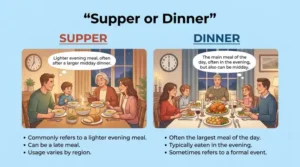
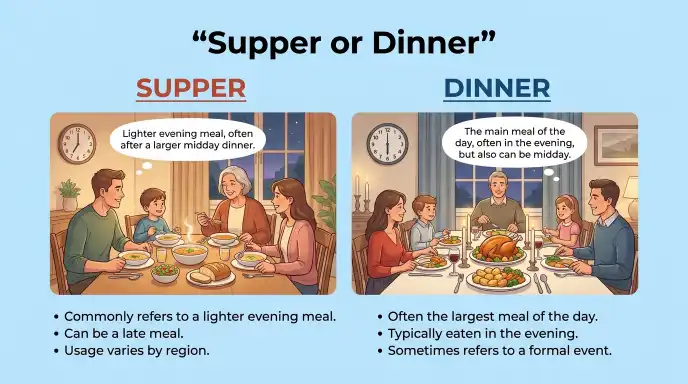
- Dinner: Often the main meal of the day. It may be eaten at noon or in the evening.
- Supper: Often an evening meal. In some homes, it means a light meal eaten later at night.
- Both: Many people use these words to mean the same evening meal.
Examples
- “What are we having for dinner tonight?”
- “We had soup and bread for supper.”
- “The children eat dinner at school, then have a light meal at home.”
All three sentences are correct. The best choice depends on what the speaker means and what sounds natural in their community.
Easy rule: Use dinner for the main meal if you are unsure. Use supper when it matches your local or family usage.
What Does Supper or Dinner Mean?
Although supper and dinner can describe the same meal, they do not always carry the same meaning.
What Does Dinner Mean?
Dinner is usually the main meal of the day. It may take place in the afternoon or evening.
Many people eat dinner in the evening after work or school. Others use the word for a large midday meal, especially in places where lunch is lighter.
Dinner can be a simple meal at home or a formal meal at a restaurant. The word does not always mean an expensive meal or a special event.
Examples:
- We are having dinner at seven.
- The family enjoyed a large Sunday dinner.
- The school serves dinner at noon.
In the last example, dinner means the main meal served at midday.
What Does Supper Mean?
Supper is a meal often eaten in the evening. Depending on local usage, it may be the main evening meal or a lighter meal eaten later.
Some families use supper every day. Others use it only for a small meal before bed or for an informal evening meal at home.
Examples:
- We had supper after the children came home.
- She made a light supper of toast and tea.
- Would you like to stay for supper?
The word often sounds informal and home-focused, but it can also appear in social invitations and traditional settings.
What Is the Main Difference?
The main difference is not a strict rule about the clock. It is the way people use the words.
| Feature | Dinner | Supper |
| Main meaning | Often the main meal of the day | Often an evening meal |
| Time | Noon or evening | Usually evening or later |
| Meal size | Can be light or large | Can be light or large |
| Formality | Can be casual or formal | Often casual, but not always |
| Regional use | Common in many English-speaking regions | More common in some regions and households |
| Can it mean the same meal? | Yes | Yes |
The words overlap, so context matters more than a fixed definition.
The Origin of Supper or Dinner
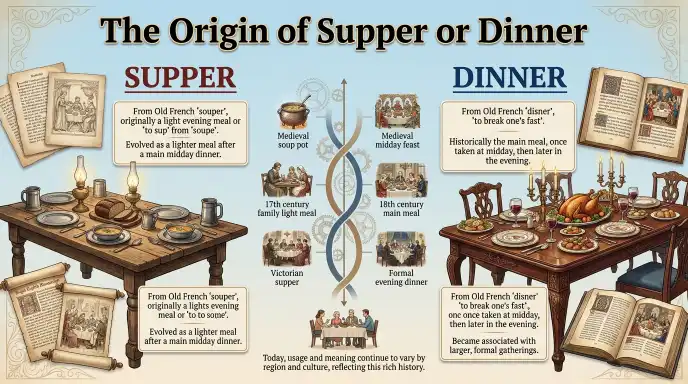
The words supper and dinner have different histories, even though both now refer to meals.
Where Does Supper Come From?
Supper entered English through French. It is linked to the French word souper, which referred to eating a meal or having soup. The word is also related to soup.
Over time, supper became a common name for an evening meal. In some communities, it came to mean the main meal eaten at home. In others, it referred to a lighter meal eaten later at night.
This history helps explain why the word can suggest a simple, relaxed meal in some settings. However, the word does not always mean a small meal today.
Where Does Dinner Come From?
Dinner came into English through Old French disner, which originally referred to breaking a fast or eating a meal. The word’s meaning and meal time changed over the centuries.
In earlier periods, dinner could refer to the main meal eaten earlier in the day. As eating habits changed, many people began using it for the main evening meal.
Today, dinner can mean the main meal at almost any time of day. The exact meaning depends on local customs and the speaker’s habits.
Why Do the Words Overlap?
Meal times have changed across families, regions, and generations. Work schedules, school hours, local customs, and daily routines have all shaped how people name their meals.
As a result, one person may call the evening meal dinner, while another calls the same meal supper. Neither person is wrong.
Remember: The history of these words explains their different uses, but modern usage is not fixed by their original meanings.
British English vs American English
Both British and American English use supper and dinner. The difference lies mainly in regional habits and the meal each word describes.
In both varieties, dinner often means the main meal. Supper often refers to an evening meal, but it can also mean a lighter meal later at night.
British English vs American English Comparison
| Context | British English | American English | Example |
| Main evening meal | Dinner is common | Dinner is common | We are having dinner at six. |
| Light meal later at night | Supper may be used | Supper may be used | I had a small supper before bed. |
| Main midday meal | Dinner is used in some homes and settings | Dinner is used in some regions and communities | Sunday dinner is at noon. |
| Evening meal at home | Dinner or supper | Dinner or supper | What is for supper tonight? |
| Formal meal or event | Dinner is common | Dinner is common | They hosted a charity dinner. |
| School meal at midday | School dinner is a familiar term | School lunch is more common in general usage | The children ate at school. |
These are broad patterns, not rules for every speaker.
How British English Uses Supper and Dinner
In the United Kingdom, dinner often refers to the main meal, which may be eaten at midday or in the evening. Some people use tea for an evening meal, especially in certain regions and households.
Supper can mean a light meal eaten late in the evening. However, some British families use it as another name for their main evening meal.
Examples:
- “We are having dinner at a restaurant tonight.”
- “The children had a snack for supper before bed.”
How American English Uses Supper and Dinner
In the United States, dinner is a common name for the evening meal. It can also mean the main midday meal in some communities, especially in parts of the South and Midwest.
Supper is also used in many American homes and regional traditions. For some speakers, supper and dinner mean the same thing. For others, dinner is the main meal and supper is a lighter evening meal.
Examples:
- “What time is dinner?”
- “Come over for supper on Sunday.”
What About Style Guides?
Most general English writing does not require you to choose one word over the other. The right choice depends on the intended meaning and audience.
For schoolwork, publishing, business writing, and formal documents, use the term that fits the context. If you are writing dialogue, keep the speaker’s regional voice natural. If you are writing for a broad audience, dinner is often the clearest word for the main evening meal.
Which Version Should You Use?
There is no single word that everyone must use. Choose the one that matches your meaning and audience.
United States
Use dinner for the main evening meal if you want a widely understood choice. Use supper if it is the natural word in your family or region.
For example: “We are having dinner at seven.”
United Kingdom
Both words are correct. Use dinner for the main meal and supper for a lighter late meal when that matches your intended meaning. Remember that regional habits vary.
Canada
Dinner is widely understood as the main evening meal. Supper is also used in some communities and households. Follow the local usage of your audience.
Australia
Dinner is a common term for the evening meal. Supper may refer to a light meal or a snack later at night, though some speakers use it differently.
International Writing
For readers from many countries, use dinner when you mean the main evening meal. If you mean a small meal before bed, say a light late-night meal when clarity matters.
Academic Writing
Use the word that describes the meal accurately. If your research discusses cultural food habits, explain how the terms are used in the community you are studying.
Business Writing
For invitations, events, and schedules, be specific about the time and purpose.
For example, “The team dinner begins at 7 p.m.” is clear. If you write “supper,” make sure it fits the audience and event.
Best advice: Do not treat supper as wrong or dinner as the only correct choice. Both are standard words.
Common Mistakes with Supper or Dinner
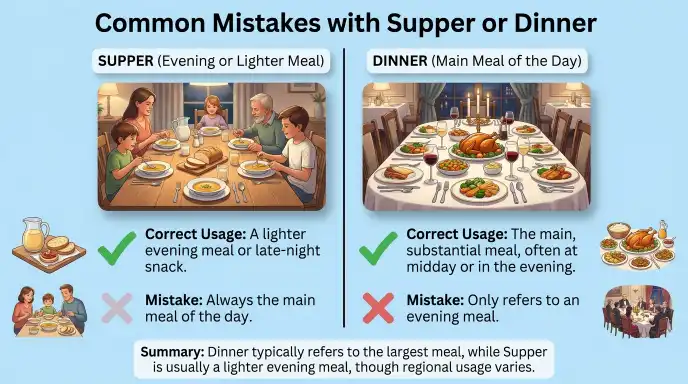
People often assume these words have one fixed meaning. That can lead to confusion, especially when speaking with people from another region.
Thinking Supper Is Incorrect
Incorrect claim: “Supper is not a proper English word.”
Correct: “We are having supper at home.”
Explanation: Supper is a standard English word. It is used in several English-speaking regions.
Memory tip: If a dictionary lists a word and people use it naturally, do not reject it just because it is less common in your area.
Assuming Dinner Always Means an Evening Meal
Incorrect claim: “Dinner can only happen at night.”
Correct: “The family eats dinner at noon.”
Explanation: Dinner can refer to the main meal of the day, including a midday meal.
Memory tip: Think of dinner as the main meal, not a meal with a fixed time.
Assuming Supper Must Be Small
Incorrect claim: “A large evening meal cannot be called supper.”
Correct: “We had a large supper with the whole family.”
Explanation: Supper can refer to a large or small meal, depending on the speaker’s habits.
Memory tip: Supper often means an evening meal, but size is not a strict rule.
Correcting Someone’s Regional Usage
Incorrect: “You should say dinner, not supper.”
Better: “In my area, we usually call that meal dinner.”
Explanation: Both words are correct. People may use different terms for the same meal.
Memory tip: Regional difference does not automatically mean a spelling or grammar error.
Using Vague Meal Times in Invitations
Unclear: “Come over for supper sometime.”
Clearer: “Come over for supper at 7 p.m. on Saturday.”
Explanation: The word may be understood differently by different readers. A time and date make an invitation clear.
Memory tip: When the timing matters, state the time instead of relying on the meal name alone.
Supper or Dinner in Everyday Examples
These examples show how both words work in daily communication.
Emails
Subject: Family Visit
Hi Sarah,
Would you like to join us for dinner on Friday at 7 p.m.? We are planning a simple meal at home.
Best,
Emma
Using supper:
Hi James,
Would you like to come over for supper this evening? We will eat around 6:30 p.m.
Best,
Alex
Both emails are correct. The choice depends on the writer’s usual word and the intended audience.
Business Writing
- The company will host a formal dinner for its guests.
- The team will meet for dinner after the conference.
- The family business serves a traditional Sunday supper.
For business events, dinner is often the clearest and most familiar choice. However, supper is suitable when it matches the event’s style or local tradition.
News Headlines
- Local Families Gather for a Community Dinner
- Town Residents Share a Traditional Sunday Supper
- Charity Dinner Raises Funds for School Projects
News writers choose the word that best describes the event. A formal fundraiser often uses dinner, while a local community event may use supper as part of its traditional name.
Blogs
- “Five Easy Ideas for a Family Dinner”
- “How to Prepare a Simple Supper After a Busy Day”
- “Dinner or Supper? What Different Families Call Their Evening Meal”
Food bloggers can use either word. The recipe, audience, and meaning should guide the choice.
Social Media
- “Nothing beats a warm dinner with family.”
- “Sunday supper at Grandma’s house is a tradition I love.”
- “What are you having for dinner tonight?”
These examples sound natural in casual posts. A speaker’s region and family traditions often shape their choice.
Academic Writing
- The participants ate their main meal at noon, which they called dinner.
- The survey asked if respondents used the term supper for their evening meal.
- Meal names vary across regions and social groups.
In academic work, define the terms if your study compares language or food customs. Do not assume every participant uses the words in the same way.
Daily Conversation
- “What’s for dinner?”
- “Would you like to stay for supper?”
- “We had dinner at noon, so we will eat a light meal later.”
- “My family calls the evening meal supper.”
These sentences are all correct. The best word is the one that communicates your meaning naturally.
Supper or Dinner: Google Trends and Modern Usage
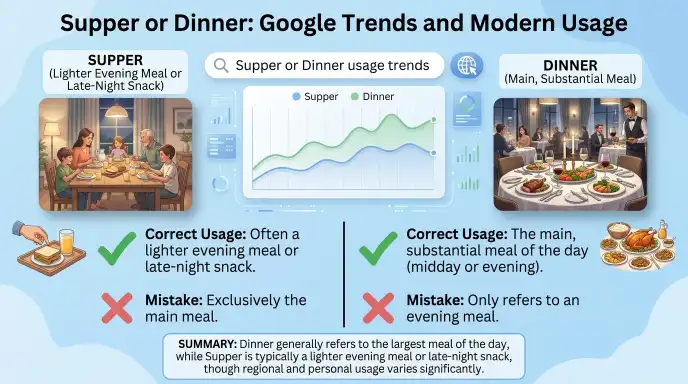
People search for supper or dinner because the words overlap, yet their use differs across communities. A reader may hear one word at home and another at school, work, or while traveling.
Why Do People Search for This Difference?
Common reasons include:
- They want to know if supper and dinner mean the same thing.
- They are learning British or American English.
- They want to use the right word in an invitation.
- They have heard supper used for a meal at a different time.
- They are writing about food, family traditions, or regional customs.
Regional Popularity and Modern Usage
Both words remain in modern English. Dinner is widely understood across English-speaking countries, while supper may be more common in certain regions, families, and traditions.
In some parts of the United States, supper is strongly linked to the evening meal. In other places, dinner is more common. British usage also varies, and words such as tea may refer to an evening meal in some communities.
These are general usage patterns. They do not mean that every person in a country follows the same rule.
What Does Google Trends Tell Us?
Google Trends can compare interest in search terms such as supper or dinner, meaning of supper, and difference between supper and dinner. It shows relative search interest over a selected time and region, not the exact number of searches.
No verified, current Trends figures are provided here. Therefore, it would not be accurate to claim that one word has a specific search advantage or a fixed popularity percentage.
For a reliable comparison, choose the same time period and compare the terms in the countries you want to study.
Key point: Search interest can show what people want to learn, but it does not decide which word is correct. Meaning, context, and local usage matter most.
Supper or Dinner: Quick Comparison Table
| Version | Meaning | Correct? | Region | Example |
| Dinner | Main meal of the day | Yes | International | We eat dinner at seven. |
| Supper | Evening meal | Yes | International | We had supper at home. |
| Dinner | Main midday meal | Yes | Some regions and households | Sunday dinner is at noon. |
| Supper | Light meal late in the evening | Yes | Varies by region | I had a small supper before bed. |
| Formal dinner | Organized meal or event | Yes | Widely used | The school held a charity dinner. |
| Family supper | Informal family meal | Yes | Varies by region | The family gathered for supper. |
The table shows that both words are correct. Their meanings depend on the meal and the speaker’s usage.
Key Takeaways
- Dinner often means the main meal of the day.
- Supper often means an evening meal or a light meal eaten later.
- Both words are correct in British and American English.
- Dinner can refer to a midday meal in some regions and households.
- Supper can be a large meal or a small one.
- Regional habits and family traditions affect which word people prefer.
- Use dinner for the main evening meal when writing for a broad audience.
- Give a clear time and date when meal names might confuse your readers.
FAQs About Supper or Dinner
Q1. Are Supper and Dinner the Same Thing?
Sometimes. Both words can refer to the evening meal, and many families use them interchangeably. However, dinner often means the main meal of the day, while supper may mean a lighter meal eaten later. The exact meaning depends on local habits, family tradition, and context.
Q2. Is Supper More British or American?
Supper is used in both British and American English. In the United States, it is common in some regions and families, especially for the evening meal. In the United Kingdom, it can mean a light meal eaten late or another name for an evening meal. Usage varies within both countries.
Q3. Is Dinner at Noon or at Night?
Dinner can be eaten at either time. Many people use it for the evening meal, but some families and communities use it for the main meal at midday. The word refers mainly to the role of the meal, not a fixed time on the clock.
Q4. Why Do Some People Say Supper Instead of Dinner?
People often follow the language habits they learned from family and community. In some areas, supper is the usual word for the evening meal. Other people use dinner for the same meal. Neither choice is wrong, and the difference often reflects regional tradition.
Q5. Is Supper a Formal or Informal Word?
Supper often sounds informal and is linked to meals at home or with family. However, it can also appear in community events, traditional gatherings, and social invitations. Dinner is more common for many formal events, such as business dinners and charity dinners, but context matters.
Q6. Which Word Should I Use in American English?
Dinner is a safe choice when you mean the main evening meal and want to be understood across the United States. Supper is also correct if it matches your region or intended meaning. If you are inviting people to a meal, include the time to avoid confusion.
Q7. Which Word Should I Use in British English?
Both words are correct in British English. Dinner often refers to the main meal, while supper can refer to a light meal eaten later in the evening. Some people use supper for their main evening meal. Choose the word that matches your meaning and audience.
Q8. Can Supper Be a Large Meal?
Yes. Supper does not always mean a small meal. Some families use it for a full evening meal, while others use it for a light snack later at night. The size of the meal depends on local and personal habits, not a strict rule about the word.
Conclusion:
The difference between supper or dinner comes down to meaning, local usage, and personal habit. Both words are correct, and neither one is always the better choice. Dinner often refers to the main meal of the day, while supper often refers to an evening meal or a lighter meal eaten later.
In the United States, the United Kingdom, Canada, and Australia, people may use these words in different ways. Some call their main evening meal dinner. Others call it supper. Some use dinner for a midday meal, especially when it is the main meal of the day.
For everyday writing, use the word that best fits your meaning. Dinner is often a clear choice for the main evening meal when writing for an international audience. Use supper when it fits your audience, family tradition, or intended meaning. If the exact time matters, include it in your invitation or message.
Language changes across regions, and meal names are a good example of that change. You do not need to correct someone simply because they use a different word.
Remember: dinner often names the main meal, supper often names an evening meal, and both are correct. Keep learning these small differences, and use the word that makes your meaning clear.

I’m Nora Ellis, an English language writer passionate about making grammar, spelling, and confusing words easy to understand. I share clear explanations and practical examples to help readers improve their English and use words with confidence.