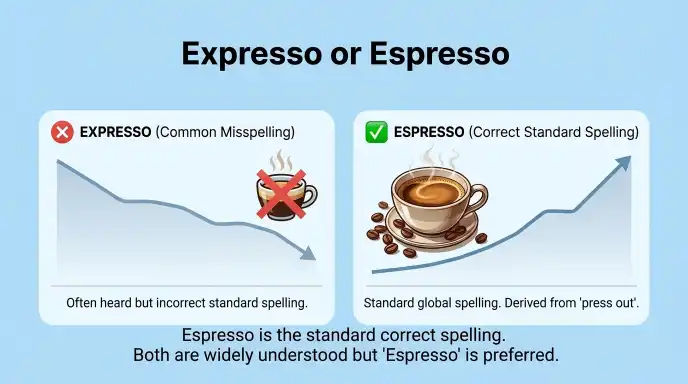
Espresso is the correct spelling for the strong coffee made by forcing hot water through finely ground coffee beans. Expresso is a common misspelling of this word, although some people use it when speaking.
If you want to order coffee, write a menu, or talk about your favorite drink, espresso is the spelling you should choose. Many people search for expresso or espresso because both words sound similar in everyday speech. The extra x in expresso can make the incorrect form seem natural.
You may also hear people say expresso in cafés, at home, or in casual conversations. However, the standard English word for this coffee drink is espresso. Knowing the correct spelling helps you write better emails, menus, blog posts, and school assignments. It also helps you understand why dictionaries and coffee experts prefer one form over the other.
In this guide, you will learn the meaning, origin, pronunciation, regional usage, and common mistakes linked to these words. You will also find practical examples and simple tips to help you remember the correct form.
Expresso or Espresso: Quick Answer
The difference between expresso and espresso is mainly spelling. Espresso is the accepted standard word for the coffee drink in English. Expresso is widely recognized as a spelling mistake, though it may appear in informal speech or writing.
Use espresso when referring to a single shot of coffee, a double shot, or coffee drinks made with espresso, such as lattes and cappuccinos.
The word is used in both British and American English. There is no standard US or UK spelling rule that makes expresso the preferred form.
What Does Espresso Mean?
Espresso is a concentrated coffee drink prepared by pushing hot water through finely ground coffee at high pressure. It usually has a rich flavor, a small serving size, and a layer of foam called crema on top.
People often drink espresso on its own. They also use it as the base for many popular coffee drinks.
Meaning of Espresso
In simple terms, espresso is strong, concentrated coffee made with a special brewing method.
For example:
- A single espresso is one shot of espresso coffee.
- A double espresso contains two shots.
- An espresso-based latte combines espresso with steamed milk.
Espresso is not a type of coffee bean. Coffee beans used for espresso can come from different regions and blends. The term mainly refers to the way the coffee is prepared and served.
What Does Expresso Mean?
Expresso is a common alternative spelling that is not recommended in standard English writing when referring to the coffee drink.
People may use it because the word sounds as if it begins with ex. The spelling may also seem familiar because English has words such as express and expression.
However, the accepted spelling remains espresso.
Espresso in Everyday Life
You may see the word espresso in several settings:
- Cafés: Order an espresso or a double espresso.
- Recipes: Add one shot of espresso to the mixture.
- Menus: Espresso, cappuccino, latte, and macchiato.
- Coffee machines: Espresso machines heat water and push it through ground coffee.
- Daily conversation: She drinks espresso every morning.
In each case, espresso is the correct spelling.
The Origin of Espresso
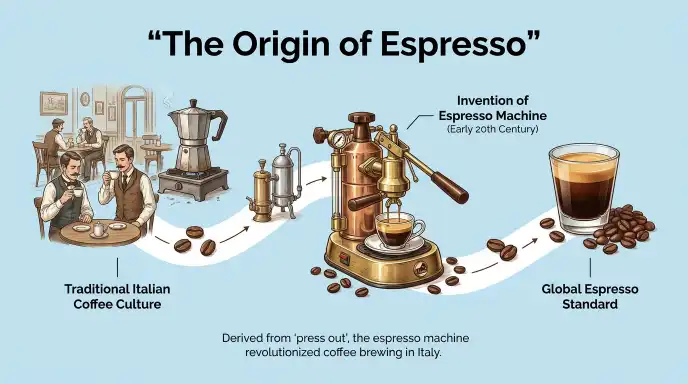
The word espresso comes from Italian. It is linked to the Italian verb esprimere, which means “to express” or “to press out.” The name is commonly associated with coffee prepared quickly by forcing water through ground coffee.
The word entered English through the development and spread of Italian coffee culture. Espresso became popular as espresso machines and cafés spread beyond Italy.
The spelling espresso reflects the Italian word. The alternative expresso likely developed because speakers connect the sound with the familiar English word express. This is a form of spelling confusion: people hear a word and write it in a way that seems more familiar.
It is important not to assume that expresso is correct simply because people use it in conversation. Spoken habits and standard written forms do not always match.
The key point: Espresso is the established spelling, and expresso is a common variant that standard English writing generally avoids.
British English vs American English
The spelling of espresso is the same in British and American English. Both varieties use espresso for the coffee drink.
Unlike pairs such as colour and color, this word does not have separate standard British and American spellings.
| British English | American English | Example |
| Espresso | Espresso | I ordered an espresso. |
| Double espresso | Double espresso | He asked for a double espresso. |
| Espresso machine | Espresso machine | The café bought a new espresso machine. |
| Espresso-based drink | Espresso-based drink | She made an espresso-based latte. |
| Expresso is nonstandard | Expresso is nonstandard | Write espresso instead. |
Regional Differences
British and American speakers may differ in their accents and pronunciation. However, these differences do not change the standard spelling.
A person in the UK may pronounce the word differently from a person in the US. Both should still write espresso.
What About Canada and Australia?
Canadian and Australian English also use espresso. The spelling remains the same across these English-speaking regions.
What Do Dictionaries and Style Guides Prefer?
Standard English dictionaries recognize espresso as the word for the coffee drink. General writing guides also favor this spelling.
If you are writing for a café, restaurant, newspaper, school, or business, use espresso. If you are editing a quote that contains expresso, preserve the original wording when necessary, but use the standard spelling in your own text.
Writing tip: Do not treat expresso as an American or British spelling. It is not the standard regional alternative.
Expresso or Espresso: Which Version Should You Use?
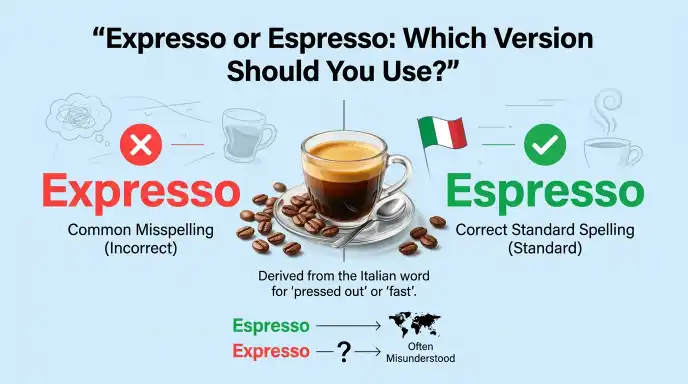
The answer is simple: use espresso in almost every situation.
United States
Use espresso in menus, articles, emails, recipes, and conversations that you write down.
Example: This coffee shop serves a rich espresso.
United Kingdom
Use espresso as well. British English does not require the spelling expresso.
Example: Would you like an espresso after lunch?
Canada
Use espresso in both formal and informal writing.
Example: The café offers espresso and fresh pastries.
Australia
Use espresso for coffee orders, menus, and articles.
Example: I bought an espresso before work.
International Writing
If your readers come from different countries, espresso is the safest and clearest choice. It is the standard form across major English varieties.
Academic Writing
Use espresso in essays, reports, food studies, and research papers. If the word appears in a quotation, follow the rules for quoting the original text.
Business Writing
Use espresso on café menus, product descriptions, advertisements, training documents, and business websites.
For example:
- Correct: Our new espresso blend has a rich flavor.
- Incorrect: Our new expresso blend has a rich flavor.
Final advice: You do not need to choose between British and American spelling. Choose espresso for both.
Common Mistakes with Expresso or Espresso
The extra x is the main source of confusion. Here are the mistakes to avoid.
Writing Expresso on a Menu
Incorrect: Try our fresh expresso today.
Correct: Try our fresh espresso today.
Explanation: Espresso is the standard spelling of the drink.
Using Expresso in a Recipe
Incorrect: Add one shot of expresso to the cake mixture.
Correct: Add one shot of espresso to the cake mixture.
Explanation: Recipes should use the accepted spelling so readers can identify the ingredient easily.
Assuming Expresso Is American English
Incorrect assumption: Americans write expresso, while British people write espresso.
Correct: Both American and British English use espresso.
Explanation: The difference is not a standard regional spelling rule.
Confusing Espresso with Express
Incorrect reasoning: Espresso must contain an x because it is made quickly.
Correct understanding: The accepted word comes from Italian and is spelled espresso.
Explanation: Similar sounds or meanings do not always mean words share the same spelling or origin.
Using Expresso in Professional Content
Incorrect: Our espresso machine makes the perfect expresso.
Correct: Our espresso machine makes the perfect espresso.
Explanation: Correct spelling helps menus, product pages, and marketing materials look professional.
Easy Memory Tip
Think of espresso as the word you see on a coffee menu in Italy. It has no x.
You can also remember this short rule:
Espresso has an S. Expresso has an extra X. Choose espresso.
Espresso in Everyday Examples
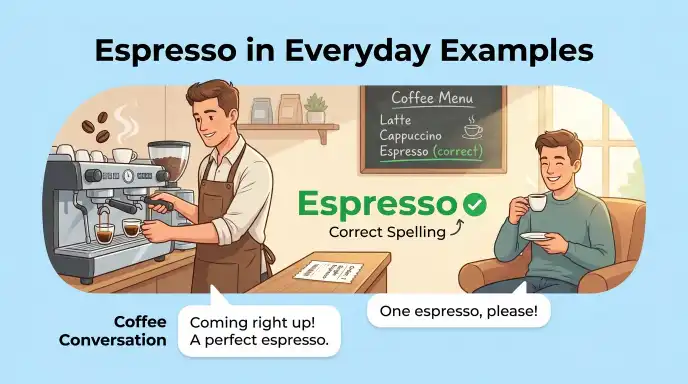
These examples show how to use espresso naturally in different types of writing.
Emails
Subject: Coffee Meeting
Hi Sarah,
Would you like to meet at the café tomorrow morning? I can get an espresso before we start our discussion.
Best,
Alex
Business Writing
Our café uses freshly ground coffee to prepare each espresso. Customers can order a single shot, a double shot, or an espresso-based drink.
News Headlines
- Local Café Introduces a New Espresso Menu
- Why Espresso Is a Popular Choice for Coffee Lovers
- New Espresso Machine Opens More Options for Customers
Blogs
Espresso is a popular choice for people who enjoy rich, concentrated coffee. You can drink it on its own or use it to make a latte, cappuccino, or flat white.
Social Media
Starting the morning with a fresh espresso makes the day feel better. Are you a fan of espresso, or do you prefer a latte?
Academic Writing
Espresso is prepared by forcing hot water through finely ground coffee under pressure. Its taste and texture can vary with the coffee blend, grind size, water temperature, and brewing method.
Daily Conversation
- “Can I have a double espresso, please?”
- “Would you like an espresso after dinner?”
- “This espresso has a rich, strong flavor.”
- “I need to clean the espresso machine.”
In every example, espresso is the standard spelling.
Google Trends & Modern Usage
The phrase expresso or espresso reflects a common spelling question. People often search for both forms when they want to check a menu, write about coffee, or learn which spelling is correct.
Why Do People Search for This Keyword?
There are several likely reasons:
- Similar pronunciation: The two forms can sound alike in everyday speech.
- Familiar English words: People may connect expresso with express.
- Coffee culture: Espresso appears on café menus and in recipes worldwide.
- Writing and editing: Students, bloggers, and business owners want to avoid spelling errors.
- Regional uncertainty: Some writers assume the two forms follow British and American spelling rules.
Which Spelling Is More Common?
Espresso is the standard written form in English. It is the spelling used for the coffee drink in established dictionaries and professional coffee contexts.
Without a current, verified Google Trends comparison, it would not be accurate to give exact search volumes, country rankings, or percentages for the two spellings.
Google Trends can help you compare search interest for espresso and expresso by country and over time. Its results show relative interest, not the total number of searches. Results can also change based on the selected location, date range, and search category.
Quick Comparison Table: Expresso vs Espresso
| Version | Meaning | Correct? | Region | Example |
| Espresso | A concentrated coffee drink | Yes | Worldwide | I ordered an espresso. |
| Expresso | A common misspelling of espresso | Not recommended in standard writing | No standard regional preference | Write espresso instead. |
| Double espresso | Two shots of espresso | Yes | Worldwide | She ordered a double espresso. |
| Espresso machine | A machine used to prepare espresso | Yes | Worldwide | The espresso machine is ready. |
| Espresso-based drink | A drink made with espresso | Yes | Worldwide | A latte is an espresso-based drink. |
This table confirms that espresso is the correct spelling in standard English, regardless of the country or context.
Key Takeaways
- Espresso is the correct standard spelling for the coffee drink.
- Expresso is a common spelling mistake and is not recommended in formal writing.
- British and American English both use espresso.
- The word comes from Italian and is linked to the idea of expressing or pressing out.
- Espresso can be served alone or used to make drinks such as lattes and cappuccinos.
- Use espresso in menus, emails, recipes, blogs, and academic work.
- Search trends can show interest in both spellings, but they do not determine which form is correct.
FAQs: Expresso or Espresso
Q1. Is It Expresso or Espresso?
Espresso is the correct standard spelling for the coffee drink. Expresso is a common misspelling that occurs because both words sound similar in everyday speech. Use espresso when ordering coffee, writing a recipe, creating a café menu, or publishing an article.
Q2. Why Do People Say Expresso Instead of Espresso?
Some people say expresso because they connect the word with the familiar English word express. Others learn the pronunciation by hearing it in conversation.
However, the standard spelling remains espresso, which you should use in professional and formal writing.
Q3. Is Expresso Ever Correct?
Expresso appears in informal speech and writing, but it is not the recommended standard spelling for the coffee drink. In normal English writing, choose espresso. If you quote someone who used expresso, you may preserve the original wording when an exact quotation is needed.
Q4. Is Espresso British or American English?
Espresso is correct in both British and American English. There is no standard regional rule that requires British writers to use espresso and American writers to use expresso. Writers in both countries should use the same spelling.
Q5. How Do You Spell Espresso Correctly?
Spell it e-s-p-r-e-s-s-o. The word begins with es, not ex. A useful memory tip is to remember the two s letters in the middle. When writing about coffee, always use espresso rather than expresso.
Q6. What Is the Difference Between Espresso and Expresso Coffee?
There is no standard difference between two types of coffee called espresso and expresso. Espresso is the established name for the drink. Expresso is generally a spelling error, not a separate brewing method or a distinct coffee style.
Q7. Is Espresso Spelled the Same in the UK and the US?
Yes. Both British and American English use espresso. The spelling does not change between these regions. The same form is also standard in countries such as Canada and Australia, making it a safe choice for international writing.
Q8. How Do You Pronounce Espresso?
In English, espresso is commonly pronounced es-PRESS-oh, although the exact vowel sounds can vary by accent. The word does not begin with an ex sound in its standard pronunciation. Reliable dictionary audio can help you learn the usual pronunciation.
Conclusion:
When choosing between expresso or espresso, the correct answer is espresso. This is the standard spelling used in British English, American English, and other major varieties of English. Although some people say or write expresso, it is not the recommended form for the coffee drink.
Espresso is a concentrated coffee prepared by forcing hot water through finely ground coffee under pressure. It can be served as a single or double shot and is also used to make popular drinks such as lattes and cappuccinos.
The spelling does not change by country. You should use espresso in school assignments, emails, café menus, business documents, recipes, and online articles. If you see expresso in informal writing, remember that it usually refers to the same drink rather than a different kind of coffee.
For writers and editors, the best approach is simple: use the standard spelling, keep it consistent, and check reliable dictionaries when a word seems uncertain.
Remember this simple rule: espresso is the correct spelling, wherever you write. If you found this guide helpful, use the rule in your next piece of writing and share it with anyone who has the same spelling question.

I’m Nora Ellis, an English language writer passionate about making grammar, spelling, and confusing words easy to understand. I share clear explanations and practical examples to help readers improve their English and use words with confidence.