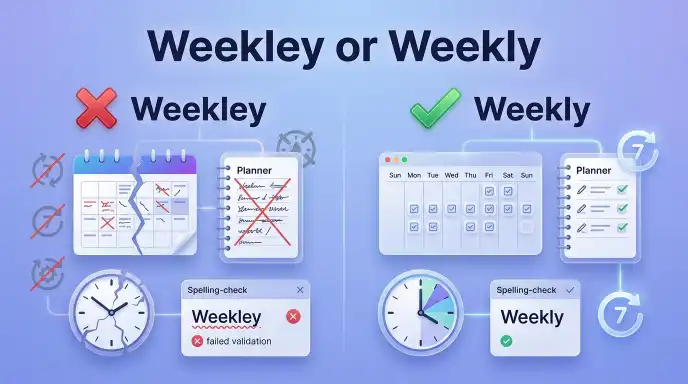
Weekly is the correct word when you mean “every week” or “once a week.” Weekley is usually a proper name, such as a surname or place name. This small spelling difference can cause confusion because both words are pronounced almost the same.
People often search for weekley or weekly when they are unsure how to spell the word for something that happens every week. The confusion is easy to understand. The extra e in Weekley makes it look like it could be another form of weekly. In standard English, however, the two forms have different uses.
The word weekly is common in everyday English. You can use it for meetings, reports, payments, magazines, routines, and events. For example, you can say, “We have a weekly meeting.” You can also say, “The team meets weekly.” Dictionaries define weekly as something that happens once a week or every week.
Weekley, on the other hand, is mainly found as a surname or a place name. It is also associated with the English etymologist Ernest Weekley.
This guide explains the difference, common mistakes, regional usage, examples, and the easiest way to remember which form to use.
Weekley or Weekly : Featured Snippet & AI Overview
Weekly is the correct spelling when you mean once a week or every week. Weekley is generally a proper name, especially a surname or the name of a place in England. Use weekly for phrases such as “weekly meeting,” “weekly report,” and “paid weekly.” Use Weekley only when referring to a specific name or place.
Weekley or Weekly : Quick Answer
The correct choice depends on what you mean.
- Weekly = happening once a week or every week.
- Weekley = usually a surname or place name.
- Weekly is the normal word for everyday English.
- Weekley should keep its capital W when it is a proper name.
Examples of Weekly
- We have a weekly meeting.
- She receives a weekly report.
- The newsletter is published weekly.
- I get paid weekly.
Examples of Weekley
- Mr. Weekley joined the meeting.
- They visited Weekley, a village in Northamptonshire.
- Ernest Weekley was an English etymologist.
The key point is simple: use weekly for time and Weekley for a proper name.
What Does Weekley or Weekly Mean?
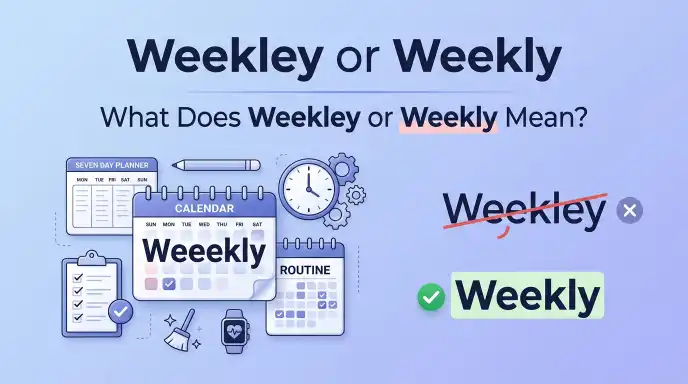
What Does Weekly Mean?
Weekly is an adjective and an adverb.
As an adjective, it describes something that happens or appears every week.
Examples:
- a weekly meeting
- a weekly report
- a weekly payment
- a weekly magazine
- a weekly schedule
As an adverb, weekly tells us how often something happens.
Examples:
- The team meets weekly.
- We check the system weekly.
- She visits her family weekly.
Cambridge Dictionary defines weekly as something that happens once a week or every week. It also lists weekly as a noun for a newspaper or magazine published once a week.
What Does Weekley Mean?
Weekley is not the normal spelling of the time-related word weekly.
It is mainly used as a proper noun. For example, Weekley can be a surname. It is also the name of a village and civil parish in Northamptonshire, England.
The surname Weekley is associated with a place called Weekley in Northamptonshire. Family-name sources describe it as an English habitational name.
So, compare these sentences:
We have a weekly meeting.
Here, weekly means every week.
Sarah Weekley joined the meeting.
Here, Weekley is a surname.
This difference is the main reason the two forms should not be treated as interchangeable.
The Origin of Weekley or Weekly
The history of the two spellings is different.
Origin of Weekly
Weekly is formed from the noun week and the suffix -ly.
The suffix -ly can form an adjective or adverb that describes a connection or manner. In weekly, it gives the sense of relating to a week or happening every week.
Collins traces weekly to Middle English usage and gives its origin as week + -ly.
The word has been used for many years in phrases connected with time, payment, publications, and regular events.
Origin of Weekley
Weekley has a different history.
It is associated with the English place name Weekley in Northamptonshire. Family-name sources explain the surname as a habitational name, meaning a surname derived from a place.
Sources connect the place name with Old English elements relating to a dwelling or settlement and a woodland clearing.
This explains why Weekley should not be treated as a spelling variation of weekly. The two forms have different histories and meanings.
Why Do People Confuse Them?
The confusion comes from their similar spelling and pronunciation.
Weekly has one e after the w:
weekly
Weekley contains an extra e:
Weekley
The capital letter in Weekley is also an important clue when it is used as a surname or place name.
British English vs American English
There is no British-American spelling difference between weekly and Weekley.
The word weekly is spelled the same in both British and American English. Major dictionaries show the same spelling in both varieties.
Weekley is also spelled the same when it refers to the surname or place name.
| Form | British English | American English | Example |
| weekly | weekly | weekly | We have a weekly meeting. |
| Weekley | Weekley | Weekley | Mr. Weekley called today. |
| weekly as an adverb | weekly | weekly | The team meets weekly. |
| weekly as a noun | weekly | weekly | She reads a local weekly. |
Does the Pronunciation Change?
The pronunciation is very similar.
Cambridge gives weekly as /ˈwiː.kli/ in both British and American English. It gives the same basic pronunciation for Weekley.
The main difference is therefore meaning and spelling, not regional pronunciation.
What About Style Guides?
Style guides generally do not change weekly to weekley. If you mean every week, standard English uses weekly.
Proper names are different. A person’s surname should be written exactly as that person uses it. The same rule applies to place names.
Which Version Should You Use?
Choosing between these words is easy once you identify the meaning.
United States
Use weekly when you mean something that happens every week.
The company sends a weekly update.
Use Weekley only when it is part of a specific name.
Dr. Weekley spoke at the event.
United Kingdom
The same rule applies in British English.
We hold a weekly meeting.
Do not replace weekly with weekley simply because you are writing for a British audience.
Canada
Canadian English also uses weekly for events, schedules, reports, and other things connected with each week.
The newspaper publishes a weekly edition.
A proper surname such as Weekley should keep its original spelling.
Australia
Use weekly when describing something that occurs every week.
The club has a weekly training session.
Use Weekley only when it is a name.
International Writing
For global readers, weekly is the safest standard form when you mean every week.
Avoid weekley as a spelling of weekly. If Weekley is someone’s actual surname, keep the proper spelling.
Academic Writing
Academic writing is often used weekly in research schedules and reports.
Participants completed a weekly survey.
The word is clear and standard.
Business Writing
Business English commonly uses weekly with words such as:
- weekly report
- weekly meeting
- weekly payment
- weekly sales
- weekly schedule
- weekly update
These are standard phrases in professional writing. Cambridge’s Business English Dictionary also gives examples such as weekly budget, weekly meeting, and weekly payment.
Common Mistakes with Weekley or Weekly
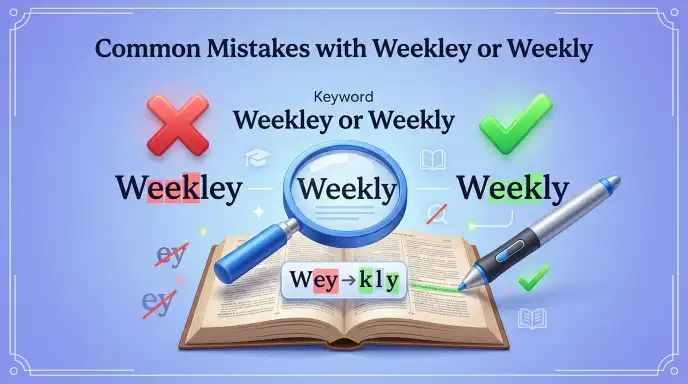
Using Weekley for Every Week
Incorrect:
We have a weekley meeting.
Correct:
We have a weekly meeting.
Explanation:
The standard word for something that happens every week is weekly.
Memory tip:
Think week + ly = weekly.
Writing Weekley in a Normal Sentence
Incorrect:
I submit my report Weekley.
Correct:
I submit my report weekly.
Explanation:
The capital W and extra e are not needed for the ordinary time word.
Changing a Surname to Weekly
Incorrect:
Mr. Weekly sent the letter.
Correct:
Mr. Weekley sent the letter.
Explanation:
If the person’s surname is Weekley, changing the spelling changes the name.
Assuming Weekley Is a British Form
Incorrect idea:
“Weekley is British English, while weekly is American English.”
Correct idea:
Weekly is used in both British and American English. Weekley is mainly a proper name.
Forgetting the Capital Letter
When Weekley is used as a surname or place name, it normally begins with a capital letter.
Weekley is a surname.
But:
The service is provided weekly.
The capital letter helps separate the proper name from the ordinary word.
Everyday Examples of Weekley or Weekly
The word weekly appears in many types of writing. Weekley appears mainly when a specific name is involved.
Emails
Please send the weekly report by Friday.
This is a normal business use of weekly.
Business Writing
Our team has a weekly meeting every Monday.
Here, weekly describes the meeting schedule.
News Headlines
Local Group Launches Weekly Community Event
A news writer may use weekly to show that the event happens every week.
Blogs
Here are five simple ideas for your weekly meal plan.
The word works naturally in lifestyle and advice content.
Social Media
Our new weekly update is now live.
Social posts often use weekly for recurring content.
Academic Writing
Students completed a weekly reading task during the course.
The word is useful for describing repeated academic activities.
Daily Conversation
I go shopping weekly.
Or:
We have a weekly family dinner.
Both examples are natural.
Using Weekley in Context
A proper name needs a different sentence:
Mr. Weekley will speak at the meeting.
Another example is:
They visited Weekley in Northamptonshire.
In these examples, the word is not describing a weekly event. It identifies a person or place.
Weekley or Weekly : Google Trends & Modern Usage

Searches for weekley or weekly are usually driven by spelling confusion. A writer may know the pronunciation but feel unsure about the written form.
The modern English word weekly is widely used in schedules, work, education, publishing, finance, and everyday routines. Dictionaries list it as an adjective and adverb. They also recognize a noun meaning a publication that appears once a week.
The form Weekley has a much narrower use. It appears mainly as a surname and as a place name. It can also appear when people search for individuals who have that surname, including the English philologist and etymologist Ernest Weekley.
Exact Google Trends numbers can change by country, date range, and search category. For that reason, it would be misleading to give fixed search-volume figures without specifying a current Trends comparison.
The general usage pattern is clear:
- weekly has broad everyday use.
- Weekley has proper-name use.
- Spelling questions often arise because the words sound similar.
- Business and academic writing are frequently used weekly.
- Name searches may lead to Weekley.
For most spelling questions, the intended word is weekly.
Weekley or Weekly : Quick Comparison Table
| Version | Meaning | Correct? | Region | Example |
| weekly | Every week or once a week | Yes | Worldwide English | We have a weekly meeting. |
| Weekley | A surname | Yes, as a proper name | English-speaking regions | Weekley is her surname. |
| Weekley | A place name | Yes, as a proper name | England | They visited Weekley. |
| weekley | Intended to mean every week | No | Standard English | Use weekly instead. |
The key difference is function. Weekly describes frequency. Weekley identifies a proper name.
Key Takeaways
- Weekly is the standard word for every week or once a week.
- Weekley is usually a surname or place name.
- There is no British-American spelling difference between the two.
- Use weekly meeting, not weekley meeting.
- Use weekly report, not weekley report.
- Keep Weekley capitalized when it is a proper name.
- Do not change someone’s surname from Weekley to Weekly.
- The simple memory rule is week + ly = weekly.
FAQs About Weekley or Weekly
Q1. Is it weekly or weekley?
The correct spelling is weekly when you mean every week or once a week. For example, “We have a weekly meeting.” Weekley is generally used as a proper name, such as a surname or place name.
Q2. Is Weekley a correct word?
Weekley is a correct form when it is used as a proper name. It can be a surname and is also the name of a village in Northamptonshire, England. It is not the standard spelling of the ordinary word meaning “every week.”
Q3. What does weekly mean?
Weekly means happening once a week or every week. It can work as an adjective or adverb. Examples include “a weekly report” and “The team meets weekly.” It can also be a noun for a newspaper or magazine that is published once a week.
Q4. Is weekly the same in British and American English?
Yes. Weekly has the same spelling in British and American English. The pronunciation can have small regional differences, but the spelling and basic meaning remain the same. Writers in both varieties can use weekly for something that happens every week.
Q5. How do you remember the spelling of weekly?
A simple memory trick is week + ly = weekly. Start with the word week and add -ly. This is weekly. The spelling weekley adds an extra e, so it should not be used for the normal time-related word.
Q6. What is the difference between Weekley and weekly?
Weekly describes frequency. It means something happens every week. Weekley is normally a proper name, such as a person’s surname or a place name. For example, “a weekly report” describes a report, while “Mr. Weekley” refers to a person.
Q7. Should I write “weekly meeting” or “weekley meeting”?
Write weekly meeting. The phrase means a meeting that happens every week. Weekley meeting is not the standard spelling unless Weekley is part of a specific proper name.
Q8. Is Weekley a surname?
Yes. Weekley is an English surname. Family-history sources describe it as a habitational surname linked to the place called Weekley in Northamptonshire. The name also appears in historical and modern records.
Q9. Can weekly be a noun?
Yes. Weekly can be a noun when it refers to a newspaper or magazine published once a week. For example, “She reads a local weekly.” This use is listed in major English dictionaries.
Q10. Is “weekley” ever correct?
Weekley can be correct when it is a proper name. The lowercase form weekley is not the standard spelling for “every week.” In ordinary writing, use weekly for that meaning.
Conclusion:
The difference between Weekley and weekly is simple once you focus on meaning. Weekly is the standard English word for something that happens every week or once a week. It works in everyday speech, business writing, academic work, news, blogs, and many other settings.
Weekley has a different role. It is mainly used as a proper name, especially a surname. It is also the name of a village in Northamptonshire, England. Because proper names keep their established spelling, you should write Weekley when that is the person’s or place’s actual name.
There is no British or American spelling rule that changes weekly into weekley. Both major varieties of English use weekly for the frequency meaning.
If you are writing about a weekly meeting, weekly report, weekly payment, or weekly schedule, choose weekly. If you are referring to someone named Weekley, keep the capital letter and the original spelling.
Remember: every week means weekly, while a name may be Weekley.

I’m Nora Ellis, an English language writer passionate about making grammar, spelling, and confusing words easy to understand. I share clear explanations and practical examples to help readers improve their English and use words with confidence.





8 thoughts on “Weekley or Weekly: Correct Spelling, Meaning & Usage”