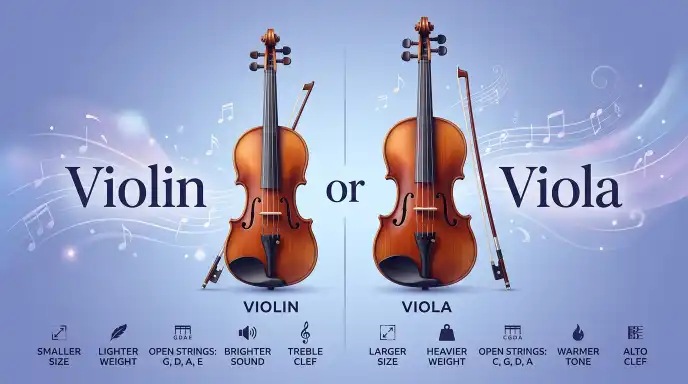
A violin is smaller and higher-pitched, while a viola is larger and has a lower, warmer sound. Both are four-stringed instruments in the same musical family. However, they are different instruments with different sizes, tunings, ranges, and roles.
People often search for violin or viola because the two instruments look very similar. Both have four strings. Both are played with a bow. Also, both are held under the chin. Because of these similarities, beginners may think they are simply two names for the same instrument.
The main difference becomes clear when you compare their sound and tuning. A violin is tuned G-D-A-E from low to high. In contrast, a viola is tuned C-G-D-A. Therefore, the viola can play lower notes than the violin.
The words themselves can also cause confusion. Violin and viola are related words, but they do not have the same meaning. In fact, violin comes from the Italian violino, meaning a small viola.
This guide explains the difference in simple terms. You will learn their meanings, origins, spelling, common mistakes, examples, and modern usage.
Violin or Viola : Quick Answer
A violin and a viola are both bowed string instruments. However, their size, tuning, pitch, and sound are different.
- Violin: Smaller and higher-pitched.
- Viola: Larger and lower-pitched.
- Violin tuning: G-D-A-E.
- Viola tuning: C-G-D-A.
- Violin player: Violinist.
- Viola player: Violist.
For example:
She plays the violin in the school orchestra.
In contrast:
He plays the viola in the school orchestra.
The two words are therefore not alternative spellings. They refer to two related but different instruments.
Definition and Meaning of Violin or Viola
What Does Violin Mean?
A violin is a four-stringed instrument that is usually played with a bow. It is the smaller and higher-pitched member of the violin family.
The standard violin tuning is G-D-A-E. As a result, the instrument can produce a wide range of high notes.
Violin music often carries melodies. For example, violins may play the main musical theme in an orchestra or concerto.
Common phrases include:
- violin lesson
- violin player
- violin music
- violin solo
- violin concerto
- violin section
The word fiddle can also refer to a violin. However, fiddle is more common in folk and traditional music.
What Does Viola Mean?
A viola is another four-stringed bowed instrument. It looks much like a violin. However, it is generally larger and has a lower musical range.
The standard viola tuning is C-G-D-A. Therefore, its lowest string is lower than the violin’s lowest string.
The viola often plays middle-range parts in an orchestra or chamber group. Its sound is often described as warm, rich, mellow, or dark.
Common phrases include:
- viola player
- viola lesson
- viola music
- viola section
- viola solo
- viola concerto
Violin and Viola at a Glance
| Feature | Violin | Viola |
| Size | Smaller | Larger |
| Pitch | Higher | Lower |
| Sound | Bright and clear | Warm and mellow |
| Tuning | G-D-A-E | C-G-D-A |
| Strings | 4 | 4 |
| Common clef | Treble | Alto |
| Player | Violinist | Violist |
| Main role | High lines and melody | Middle range and harmony |
So, although the instruments look similar, they have important musical differences.
The Origin of Violin or Viola
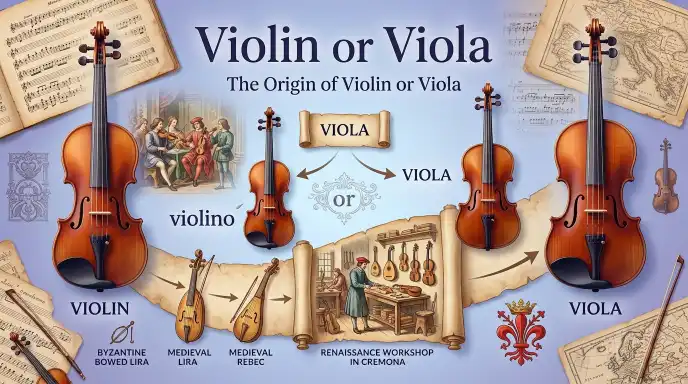
The words violin and viola have a shared history. However, their development was not exactly the same.
Origin of Violin
The word violin comes from the Italian violino. This word is a diminutive form of viola. In simple terms, violino carried the idea of a small viola.
The English word appeared in the late 16th century. Over time, violin became the common English name for the smaller instrument.
This history explains why the words violin and viola look so similar today.
Origin of Viola
The word viola has a much older history. It passed through Italian and earlier European forms connected with bowed string instruments.
The modern viola developed as part of the early string-instrument family. Later, the term became closely associated with the larger instrument that sits between the violin and cello in pitch.
Therefore, the shared viol- part of both words reflects their historical connection.
Why Are the Words So Similar?
The similarity exists because the instruments belong to the same family.
In addition, the word violin developed from a form of viola. Thus, their similar names are not a spelling mistake.
Remember:
Violin = smaller and higher.
Viola = larger and lower.
British English vs American English Spelling
There is no major British or American spelling difference between violin and viola.
Both words are spelled the same in British and American English. Therefore, you do not need to change the spelling based on your audience.
| Term | British English | American English | Example |
| violin | violin | violin | She plays the violin. |
| viola | viola | viola | He plays the viola. |
| violinist | violinist | violinist | The violinist performed. |
| violist | violist | violist | The violist joined the group. |
What About Pronunciation?
The spelling stays the same. However, pronunciation can vary slightly between speakers.
For example, viola may be pronounced differently in some English-speaking regions. Nevertheless, these pronunciation differences do not create different spellings.
Similarly, violin keeps the same spelling in both British and American English.
Therefore, writers should focus on using the correct instrument name, rather than looking for a regional spelling.
Which Spelling Should You Use?
You do not need to choose between British and American spelling here. Instead, choose the word that matches the instrument you mean.
United States
Use violin for the smaller instrument.
My daughter is learning the violin.
Use viola for the larger instrument.
My son plays the viola.
United Kingdom
The same spellings apply in British English.
She joined the violin section.
He plays the viola in the orchestra.
Canada
Canadian English also uses violin and viola with the same meanings. Therefore, no spelling change is needed.
Australia
Australian English follows the same basic spelling.
She takes violin lessons every Saturday.
He started learning the viola last year.
International Writing
For international readers, use violin and viola as standard English terms.
If your readers are beginners, explain the difference briefly. This makes the content easier to understand.
Academic Writing
Academic writing should use the exact instrument name.
The study compared the sound of the violin and viola.
Do not use one term as a substitute for the other.
Business and Formal Writing
The same rule applies to formal writing.
The concert will feature a violin solo.
However:
The second performance will include a viola ensemble.
The correct choice depends on the instrument being discussed.
Common Mistakes with Violin or Viola
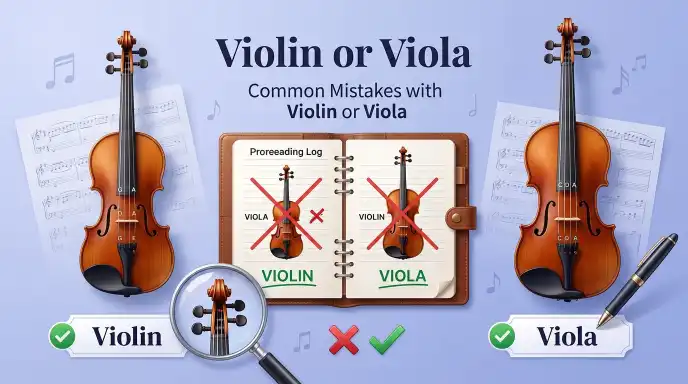
Treating Them as the Same Instrument
Incorrect idea:
A viola is simply another name for a violin.
Correct:
A viola and violin are different instruments.
The instruments belong to the same family. However, they differ in size, tuning, pitch, and sound.
Memory tip:
Think violin = higher and viola = lower.
Mixing Up Their Tuning
Incorrect:
The viola is tuned G-D-A-E.
Correct:
The standard four-string viola is tuned C-G-D-A.
The violin, on the other hand, is tuned G-D-A-E.
Therefore, the viola has a lower bottom string.
Calling Every Player a Violinist
Incorrect:
The violinist played the viola.
Better:
The violist played the viola.
A person who plays the violin is a violinist. In contrast, a person who plays the viola is a violist.
Thinking a Viola Is Just a Large Violin
The instruments are closely related. However, a viola is not simply an oversized violin.
Its tuning is different. Its strings are different. Also, its musical range and sound are different.
Confusing Viola With the Plant Name
The word viola can also refer to a plant genus that includes violets and pansies.
Therefore, context matters.
She plays the viola.
Here, viola means the musical instrument.
The garden has a Viola plant.
Here, the word refers to the plant genus.
Violin or Viola in Everyday Examples
The words violin and viola appear in many types of writing. For example, you may see them in emails, schoolwork, concert programs, blogs, and social media posts.
In Emails
A music teacher might write:
Please bring your violin to tomorrow’s lesson.
A different email could say:
Please bring your viola to the afternoon rehearsal.
In Business or Formal Writing
A concert organizer may write:
The program includes a violin performance.
However, another event might feature:
The program includes a viola ensemble.
In News Headlines
A news story might use:
Young Violinist Wins Music Competition
Similarly, another story could say:
Local Violist Joins National Orchestra
In Blogs
A beginner’s music blog might say:
Choosing between a violin and viola depends on your preferred sound and playing style.
This type of sentence clearly introduces the main difference.
On Social Media
A violin player might post:
Practicing the violin before tonight’s concert! 🎻
Meanwhile, a viola player could write:
Time for some viola practice!
In Academic Writing
A research paper might state:
The violin and viola belong to the same string family but have different tunings and ranges.
In Daily Conversation
A simple conversation could be:
Do you play the violin?
No, I play the viola.
This short exchange shows that the words refer to different instruments.
Violin or Viola : Google Trends & Usage Data
People search for violin or viola for several reasons. Some are learning music for the first time. Others want to compare instruments before choosing one.
Parents may also search the terms when choosing an instrument for a child. In addition, music students often compare them while learning about orchestras and string instruments.
Common searches include:
- What is the difference between violin and viola?
- Is a viola bigger than a violin?
- Which sounds lower, violin or viola?
- Is viola harder to play than violin?
- What is the difference between a violinist and a violist?
- How is viola tuning different from violin tuning?
Google Trends data can change based on the country, date range, language, and search category. Therefore, exact popularity claims should only be made after checking a specific time period and location.
Still, the general usage pattern is easy to understand. Violin is a very common music term. Meanwhile, viola is more specialized but remains common in orchestras, music schools, chamber music, and classical music.
The two terms also appear together in comparison searches. This happens because beginners often want to understand their size, sound, tuning, and musical role.
As a result, the search phrase violin or viola usually has an educational and comparison-based intent.
Violin or Viola : Comparison Table
| Feature | Violin | Viola |
| Type | Bowed string instrument | Bowed string instrument |
| Family | Violin family | Violin family |
| Size | Smaller | Larger |
| Pitch | Higher | Lower |
| Sound | Bright and clear | Warm and mellow |
| Strings | 4 | 4 |
| Tuning | G-D-A-E | C-G-D-A |
| Common clef | Treble clef | Alto clef |
| Player | Violinist | Violist |
| Typical role | Melody and high lines | Middle range and harmony |
In short, the violin is generally the higher voice, while the viola often fills the middle and lower range.
FAQs About Violin or Viola
Q1. What is the main difference between a violin and a viola?
The main difference is their size, tuning, pitch, and sound. A violin is smaller and usually produces higher notes. A viola is larger and has a lower range. The violin uses G-D-A-E tuning, while the viola uses C-G-D-A tuning.
Q2. Is a viola bigger than a violin?
Yes. A viola is generally larger than a violin. However, violas come in different sizes. Their larger body and lower tuning help create the deeper sound that makes the viola different from the violin.
Q3. Which sounds higher, violin or viola?
The violin sounds higher than the viola. Its tuning includes a higher E string. In contrast, the viola has a lower C string. As a result, the viola usually produces a deeper and warmer sound.
Q4. Are violin and viola the same instrument?
No. A violin and viola are different instruments. They have similar shapes and both use four strings, but their size, tuning, range, and tone are different. Therefore, you should use the correct name for the instrument you mean.
Q5. What do you call someone who plays the viola?
A person who plays the viola is called a violist. Someone who plays the violin is called a violinist. These terms are useful because they clearly identify which instrument the musician plays.
Q6. Does the viola use a different clef from the violin?
Yes. Violin music usually uses the treble clef. Viola music commonly uses the alto clef. The alto clef helps place the viola’s middle range on the musical staff without using too many ledger lines.
Q7. Is viola harder to play than violin?
Neither instrument is automatically easier for everyone. The two instruments require different skills and adjustments.
For example, the viola is larger and has a lower range. Therefore, a beginner may find its size and finger spacing different from those of a violin.
Conclusion:
The difference between a violin and a viola becomes clear when you compare their size, sound, tuning, and range. Both instruments belong to the same string family. However, they are not the same instrument.
A violin is smaller and generally has a higher pitch. Its four strings are tuned G-D-A-E. As a result, it often plays high melodies and leading musical lines. A viola, on the other hand, is larger and uses C-G-D-A tuning. Therefore, it produces a lower and warmer sound.
The names are also closely related. In fact, violin comes from the Italian violino, which is linked to viola. Their similar names reflect their shared history.
There is no British or American spelling difference to worry about. Both varieties of English use violin and viola with the same spellings.
So, use violin when you mean the smaller, higher instrument. Use viola when you mean the larger, lower instrument.
Remember: violin means higher and viola means lower.

I’m Nora Ellis, an English language writer passionate about making grammar, spelling, and confusing words easy to understand. I share clear explanations and practical examples to help readers improve their English and use words with confidence.





2 thoughts on “Violin or Viola: Differences, Sound, and How to Choose ”