Presume and assume are both correct words, but they are not always interchangeable. Both can mean accepting something as true without complete proof. The key difference is usually the level of evidence or expectation behind the idea.
People often search for presume or assume because the two words have very similar meanings. Both can describe a belief made before all the facts are known. Yet English speakers often choose one word based on context, evidence, confidence, or convention.
For example, you might assume that a meeting starts at 9:00 because that is the usual schedule. You might presume that someone is available because they have not said otherwise. In many everyday sentences, either word may sound natural. In formal or legal writing, however, presume can carry a more specific meaning. It may suggest that something is accepted as true unless evidence proves otherwise.
Understanding this small difference can make your writing more precise. It can also help you avoid awkward word choices in emails, essays, reports, and everyday conversations. This guide explains the meanings, origins, regional usage, common mistakes, and practical examples of presumed and assumed.
Presume or Assume : Quick Answer
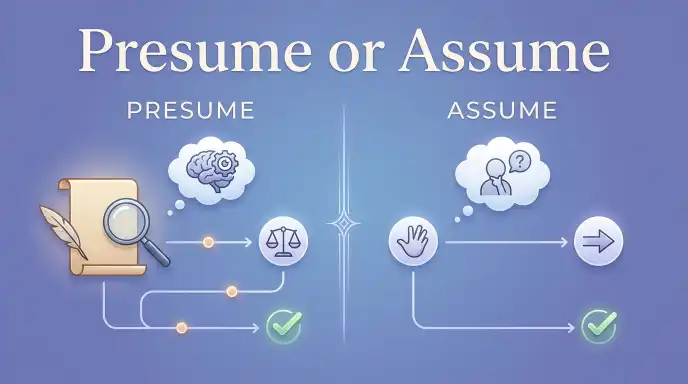
Assume usually means to accept something as true without having proof.
Presume often means to accept something as true because there is a reasonable basis, expectation, or accepted rule.
Simple examples
- I assume the shop is open because it is usually open at this time.
- I presume you have received my email because you replied to it.
- We should not assume that every result will be the same.
- The law may presume a person innocent until proven guilty.
A useful memory tip is:
Assume = accept without enough proof.
Presume = believe based on some reason or probability.
The distinction is not absolute. In many everyday situations, the two words can overlap.
Definition and Meaning of Presume or Assume
What Does Assume Mean?
Assume means to accept something as true, often without checking if it is actually true.
For example:
I assumed you were busy.
The speaker believed the person was busy, but did not necessarily have evidence.
Another example is:
We assumed the event would start on time.
The belief may have come from habit or expectation.
Assume can also have other meanings. It can mean to take on a role, responsibility, or position.
For example:
She assumed responsibility for the project.
Here, assumed does not mean “guessed.” It means taking on responsibility.
What Does Presume Mean?
Presume means to believe something is true based on reasonable evidence, probability, or an accepted situation.
For example:
I presume you have finished the report.
The speaker has some reason to believe the report is finished.
Presume can also mean to act without permission or to take something for granted.
For example:
I would not presume to tell you how to do your job.
This use can suggest that someone is being too confident or taking an unwarranted liberty.
Presume vs Assume in Simple Terms
| Word | Basic Meaning | Typical Idea |
| Assume | Accept something as true without checking | Guess or take for granted |
| Presume | Accept something as true based on reasonable grounds | Expect or infer |
The difference is often one of degree rather than a strict rule.
The Origin of Presume or Assume
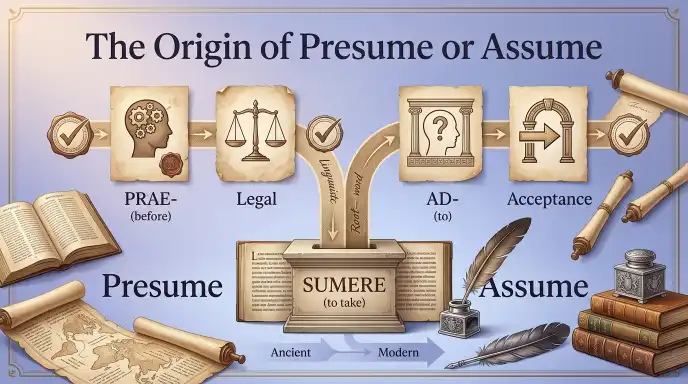
Presume and assume have different histories, although both came into English through Latin.
Origin of Assume
Assume comes from Latin assumere, meaning “to take up” or “take to oneself.” The word entered English through Old French and Latin forms.
Its original idea of taking something up developed into several modern meanings. These include accepting something as true and taking on a responsibility or role.
That is why we can say:
We assume that the information is correct.
We can also say:
He assumed control of the company.
The meanings developed from the broader idea of taking something on.
Origin of Presume
Presume comes from Latin praesumere, meaning “to take beforehand” or “anticipate.” It also entered English through French and Latin.
The idea of taking beforehand helps explain the modern meaning. A person presumes something when they accept it as likely or true before having complete proof.
For example:
We presume the package has arrived.
The speaker makes a conclusion based on what is already known.
Why Do People Confuse Them?
The two words overlap because both can describe a belief formed before complete certainty.
The easiest distinction is not their spelling. It is the reason behind the belief.
British English vs American English Spelling
There is no major British-American spelling difference between presume and assume.
Both words are spelled the same in British English and American English.
| Word | British English | American English | Example |
| Assume | assume | assume | I assume he is at home. |
| Presume | presume | presume | I presume she knows the answer. |
| Assumed | assumed | assumed | We assumed the meeting was canceled. |
| Presumed | presumed | presumed | The person was presumed innocent. |
| Assumption | assumption | assumption | That was an incorrect assumption. |
| Presumption | presumption | presumption | The law creates a presumption. |
The difference between the words is therefore meaning and usage, not regional spelling.
British and American writers can use either word. The choice depends on the intended meaning.
Which Spelling Should You Use?
You do not need to choose a British or American spelling. Presume and assume have the same spelling in both forms of English.
The important question is which word fits the context.
United States
American English uses both words regularly.
Choose assume when you mean that someone accepts an idea without checking it.
Choose presume when there is a reasonable basis for the belief or when the context is formal.
United Kingdom and Commonwealth
British English follows the same basic distinction.
For example:
I assume the train will arrive soon.
This expresses an expectation without strong evidence.
I presume the train has arrived because everyone has left the platform.
This suggests a conclusion based on what has been observed.
International Writing
Both words are widely understood internationally.
For ESL learners, the safest approach is to focus on meaning rather than region.
Academic Writing
Use assume when describing a starting condition or an idea accepted for the purpose of an argument.
We assume that all participants have equal access.
Use presume when the meaning involves a reasonable inference or an accepted condition.
Business Writing
Be careful with both words because they can affect tone.
Instead of writing:
I assume you approved the document.
You may write:
I presume you have approved the document.
However, if you are not certain, a direct question is often clearer:
Could you please confirm that you approved the document?
This avoids creating confusion about what you actually know.
Common Mistakes with Presume or Assume
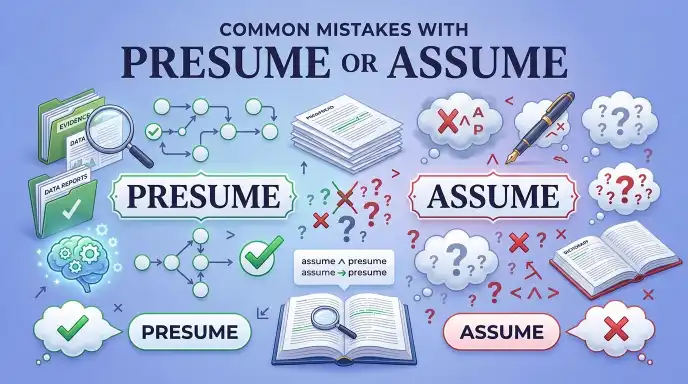
The biggest mistake is treating presume and assume as completely identical.
| Incorrect or Unclear Use | Better Choice | Explanation | Memory Tip |
| I presume the answer without checking anything. | I assume the answer. | Assume often fits an unsupported belief. | Assume = accept. |
| The court assumed the person innocent under the legal rule. | The court presumed the person innocent. | Presume has a formal/legal use. | Presume = accepted unless shown otherwise. |
| She assumed responsibility for the team. | She assumed responsibility for the team. | Assume means take on responsibility here. | Assume can mean take on. |
| I presume you are angry because you did not reply. | I assume you are angry. | The conclusion may be based on little evidence. | Check before assuming. |
| I assume that he knows because he studied the topic. | I presume that he knows. | There is a reasonable basis for the belief. | Presume = reasonable basis. |
Memory Tip
Think of assume as a broader word.
Assume can mean:
- accept as true
- take for granted
- take on a role
- take responsibility
Presume often focuses on:
- reasonable belief
- expectation
- inference
- formal or legal acceptance
Presume or Assume in Everyday Examples
These words appear in emails, conversations, reports, news articles, and formal writing.
In Emails
I assume you received the attached document.
This can sound slightly direct because the writer is stating a belief.
A softer option is:
I presume you have received the attached document.
If confirmation matters, a question is clearer:
Could you please confirm that you received the document?
In Business Writing
We should not assume that the customer understands the new policy.
The sentence warns against accepting an idea without checking it.
Another example:
We can presume that the client understands the terms because they signed the agreement.
Here, the conclusion has a stated basis.
In News Writing
Officials should not assume that the situation will improve quickly.
News writing may also use presume in legal contexts:
The defendant is presumed innocent until proven guilty.
In Blog Writing
Many people assume that expensive products are always better.
The word works well when discussing common beliefs or expectations.
In Social Media
Don’t assume you know the whole story from one post.
This is a natural everyday use.
In Academic Writing
The study assumes that all participants understand the instructions.
Here, assumes identifies a condition used in the study.
In Daily Conversation
I assumed you were coming with us.
This is one of the most common conversational uses.
You could also say:
I presumed you were coming with us.
That sentence is correct, but it may sound more formal or less casual.
Presume or Assume : Google Trends & Usage Data
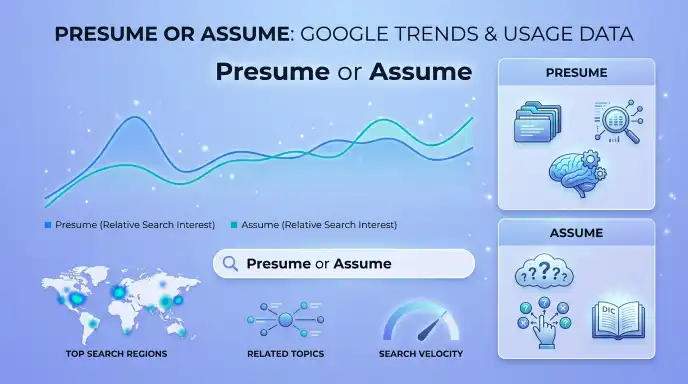
Searches for presume or assume are usually driven by a language-learning question: readers want to understand which word fits a particular sentence.
The terms are closely related, so learners often look for explanations of:
- presume vs assume
- assume or presume
- difference between presume and assume
- presume meaning
- assume meaning
- when to use presume
- when to use assume
Both words are established English vocabulary in British and American English. Their usage is not restricted to one country.
Search interest can also vary by context. Assume appears frequently in everyday speech, academic writing, mathematics, science, and business. Presume is common in formal writing and legal contexts.
Exact Google Trends rankings or search volumes should not be invented without a defined country, time range, and search category. Trends data measures relative search interest, not a fixed number of searches.
For content, the strongest approach is to answer the user’s actual question directly. A clear explanation of evidence, expectation, and context is more useful than repeating the two keywords.
Quick Comparison Table
| Version | Meaning | Correct? | Typical Context | Example |
| Assume | Accept something as true without proof | Yes | Everyday, academic, business | I assume he is busy. |
| Presume | Believe something based on reasonable grounds | Yes | Formal, legal, everyday | I presume she has agreed. |
| Assumed | Accepted or took on | Yes | Past actions and beliefs | We assumed the meeting was canceled. |
| Presumed | Believed or accepted as likely | Yes | Formal and legal | He was presumed innocent. |
| Assumption | An idea accepted as true | Yes | Academic and everyday | That assumption was wrong. |
| Presumption | A belief accepted as likely or valid | Yes | Formal and legal | The law creates a presumption. |
Key Takeaways
- Assume and presume are both correct English words.
- Assume often means accepting something as true without checking it.
- Presume often suggests a reasonable basis for the belief.
- The distinction is about meaning, not British versus American spelling.
- Both words are spelled the same in British and American English.
- Assume is common in everyday, academic, business, and scientific writing.
- Presume often sounds more formal and appears frequently in legal contexts.
- When certainty matters, asking for confirmation can be clearer than using either word.
FAQs About Presume or Assume
Q1. What is the difference between presume and assume?
Assume usually means accepting something as true without complete proof. Presume often suggests that there is a reasonable basis for the belief. For example, you might assume that someone is home because their car is outside. You might presume they are home because you have just spoken to them.
Q2. Is presume more formal than assume?
Often, yes. Presume can sound more formal than assume, especially in legal, official, or academic contexts. However, the words are not simply formal and informal versions of each other. Their meanings can differ depending on the evidence or reasoning behind the belief.
Q3. Can presume and assume be used interchangeably?
Sometimes. In many everyday sentences, either word can work without changing the basic meaning. However, the choice can affect the level of certainty or the reason for the belief. Presume often suggests some reasonable basis, while assume can describe a belief made without checking.
Q4. Should I say assume or presume in an email?
Either can be correct. Assume is natural for a simple expectation, while presume can sound more formal. If the information is important, a direct confirmation request is often better. For example, “Could you please confirm that you received the file?” removes uncertainty completely.
Q5. What is the legal difference between presume and assume?
In legal language, presume can describe accepting something as true unless evidence shows otherwise. A well-known example is the principle that an accused person is presumed innocent until proven guilty. The exact legal meaning can depend on the law and jurisdiction.
Q6. Is “I presume” polite?
Yes. I presume it can sound polite and formal, especially when making a reasonable inference. However, tone depends on the sentence. In some situations, “I presume you know” could sound like the speaker expects knowledge rather than asking about it.
Q7. Is assume a bad word?
No. Assume is a normal and useful English word. It becomes problematic only when someone accepts an idea without enough evidence and treats it as fact. In academic and technical writing, assumptions can be clearly stated and can be an important part of an argument or model.
Conclusion:
Presume and assume are closely related, but they are not always interchangeable. Both words can describe accepting something as true before complete certainty is available. The main difference often comes from the reason behind the belief.
Assume is broader and very common in everyday English. It can describe an unsupported belief, an expectation, or taking on a responsibility. Presume often suggests a reasonable basis for the belief. It also has important formal and legal uses.
Neither word is a British or American spelling variant of the other. Both presume and assume are spelled the same in British and American English. Your choice should therefore depend on meaning and context, not region.
For casual conversation, assume is usually the more natural choice when you simply accept something without checking. Use presume when the belief has a reasonable basis or when a more formal tone fits the situation.
When accuracy matters most, avoid guessing. Check the facts, choose the right word, and make your meaning clear.

I’m Nora Ellis, an English language writer passionate about making grammar, spelling, and confusing words easy to understand. I share clear explanations and practical examples to help readers improve their English and use words with confidence.