Sapphire is the correct modern English spelling, while saphire is not the standard spelling used for the gemstone or its blue color today. If you have ever typed saphire or sapphire, the confusion is easy to understand. The two forms look almost identical, and the word does not clearly show its double p when spoken.
People often search for this spelling because they see both forms online. Some also wonder if saphire is a British spelling, an American spelling, or an older form of the word. In modern standard English, the answer is simple: use sapphire.
The word can refer to a precious stone, usually associated with blue, or to a bright blue color. It can also work as an adjective, as in sapphire eyes or sapphire blue. Cambridge Dictionary lists sapphire as both a noun and an adjective.
This guide explains the difference between saphire and sapphire, their history, regional spelling, common mistakes, and natural examples. It also shows which form to use in school, business, and everyday writing.
Saphire or Sapphire : Featured Snippet & AI Overview
Sapphire is the correct standard spelling in modern English. Saphire is generally a misspelling today, although historical English sources contain older forms such as saphire. Use sapphire when referring to the gemstone, its blue color, or something described as sapphire.
Saphire or Sapphire : Quick Answer
The correct modern spelling is sapphire.
Saphire is not the standard spelling for the gemstone in present-day English. However, it has appeared as an older English form, so the word is not simply a random modern invention. Historical dictionaries record saphire among earlier forms of the word.
Quick examples
- Correct: She wore a sapphire necklace.
- Correct: The ring has a large sapphire.
- Correct: The dress was a deep sapphire blue.
- Modern standard: sapphire
- Usually incorrect today: saphire
Easy memory tip
Remember the spelling this way:
SA + PPHIRE = SAPPHIRE
The word has two p’s before h.
What Does Saphire or Sapphire Mean?
What Does Sapphire Mean?
Sapphire is a noun that usually refers to a precious stone that is bright blue. It can also refer to the bright blue color associated with the gemstone. Cambridge Dictionary lists both meanings.
For example:
She received a sapphire ring for her birthday.
The word can also describe something that has a similar color.
The lake looked sapphire blue in the sunlight.
Sapphire as an Adjective
Sapphire can also work as an adjective.
Examples include:
- sapphire eyes
- sapphire blue
- sapphire sea
- sapphire ring
In these uses, the word describes the stone, color, or appearance connected with sapphire.
What Does Saphire Mean?
In modern standard English, saphire is normally not the spelling you should use.
However, historical records show that saphire was once used as a form of the word. The Dictionary of the Older Scottish Tongue records forms such as saphire, saphyr, and safyre, along with the later spelling sapphire.
That distinction matters.
Historical form: saphire
Modern standard form: sapphire
So, if you are writing modern English, choose sapphire.
The Origin of Saphire or Sapphire
The history of sapphire is much older than modern English spelling.
The word passed through several languages before reaching modern English. Historical sources connect it with Greek sappheiros and Latin sapphirus. Older English and French forms included spellings such as saphir, saphire, and safyre.
Early English spelling was not fixed in the way modern spelling is. Writers used different forms of many words. Historical records show several versions of the gemstone’s name, including saphir, saphire, safir, sapphir, and sapphire.
Over time, sapphire became the standard spelling in modern English.
This history explains why saphire can sometimes look familiar. It is not entirely unrelated to the real word. It is an older recorded form, but it is not the normal spelling for modern English writing.
Why Does Sapphire Have Two P’s?
The spelling reflects the history of the word and its development through earlier languages. Modern English keeps the double p in sapphire.
That gives us an easy spelling rule:
Sapphire = S-A-P-P-H-I-R-E
British English vs American English
There is no standard British-American spelling difference between sapphire and saphire.
British and American English both use sapphire as the modern standard spelling. Cambridge gives British and American pronunciations, but the written form remains the same.
| Form | British English | American English | Example |
| sapphire | Correct | Correct | She bought a sapphire ring. |
| saphire | Not standard today | Not standard today | ❌ She bought a saphire ring. |
| sapphire blue | Correct | Correct | The wall is sapphire blue. |
| sapphire eyes | Correct | Correct | She has sapphire eyes. |
Regional Spelling
Some English words change spelling between the UK and US. Examples include:
- colour / color
- favourite / favorite
- centre / center
Sapphire does not follow this pattern.
The spelling stays sapphire in both major English varieties.
Which Version Should You Use?
The safest modern choice is simple:
Use sapphire.
United States
Use sapphire in schoolwork, business writing, product descriptions, and everyday communication.
United Kingdom
Use sapphire in the same way. British English does not require saphire.
Canada
Canadian English also uses sapphire as the standard modern spelling.
Australia
Use sapphire in Australian English as well.
International Writing
For international readers, sapphire is the clearest choice. It is widely recognized and avoids confusion.
Academic Writing
Academic writing should use sapphire unless you are discussing a historical text that deliberately uses the older spelling.
Business Writing
Use sapphire in:
- Product descriptions
- Jewelry listings
- Marketing copy
- Emails
- Reports
- Catalogs
- Website content
A spelling mistake can make otherwise professional writing look less polished.
Common Mistakes with Saphire or Sapphire
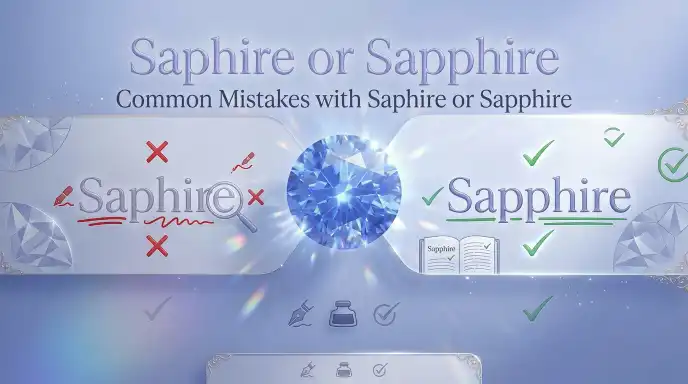
The most common mistake is leaving out the second p.
| Incorrect | Correct | Explanation | Memory Tip |
| saphire ring | sapphire ring | The modern spelling has two p’s. | Remember PP |
| saphire necklace | sapphire necklace | Saphire is not the standard modern form. | Think sapphire = double p. |
| saphire blue | sapphire blue | The color name uses the standard spelling. | Keep PP. |
| saphire eyes | sapphire eyes | The adjective keeps the same spelling. | Don’t drop the second p. |
| saphire stone | sapphire stone | Modern English uses sapphire. | Write SAPPHIRE. |
Using One P
❌ The necklace contains a beautiful saphire.
✅ The necklace contains a beautiful sapphire.
The missing p is the main spelling error.
Assuming It Is a Regional Variant
Some writers think saphire belongs to British English.
That is not correct for modern standard English. Both British and American English use sapphire.
Treating It as a Completely Made-Up Form
There is one important historical detail.
Saphire has appeared in older English texts. Historical dictionaries record it as an earlier form. Therefore, calling it a modern spelling mistake is correct for current writing, but it should not be confused with saying the form never existed.
Best Memory Trick
Think of the word in two parts:
SAP + PHIRE
Then remember that the middle contains PPH:
SA-PP-HIRE
Saphire or Sapphire in Everyday Examples
The modern form sapphire appears in many types of writing. It is common in jewelry descriptions, color descriptions, fashion writing, and general conversation.
In Emails
The customer selected the sapphire pendant.
In Business Writing
Our new collection includes a sapphire bracelet.
In News Headlines
Rare Sapphire Found During Gemstone Survey
Headlines may capitalize the word when it appears in a title.
In Blogs
A sapphire necklace can add a rich blue color to a simple outfit.
In Social Media
Loving this beautiful sapphire blue today! 💙
In Academic Writing
The mineral was identified as sapphire after further examination.
In Daily Conversation
I really like your sapphire ring.
When Describing Color
The sky turned a deep sapphire blue before sunset.
These examples show that sapphire can describe both the gemstone and a strong blue color. Cambridge Dictionary gives similar noun and adjective uses.
Saphire or Sapphire : Google Trends & Modern Usage
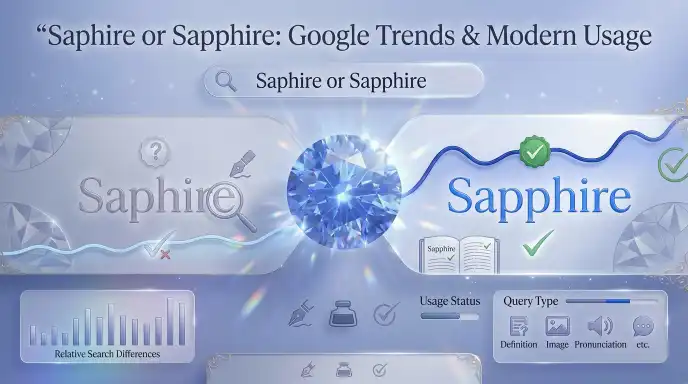
People search for saphire or sapphire mainly because the two spellings look and sound very similar.
The extra p is easy to miss. This is especially true when someone is typing quickly or spelling the word from memory.
Why Do People Search This Keyword?
Common search reasons include:
- Checking the spelling of a jewelry term
- Writing a product description
- Completing schoolwork
- Choosing the correct spelling in an email
- Searching for a gemstone
- Describing a blue color
- Checking if saphire is a British spelling
Modern Usage
In modern English, sapphire is the standard form.
Cambridge Dictionary lists sapphire as a current English word. It defines the noun as a precious stone, usually bright blue, and also lists the color and adjective uses.
Historical sources show that saphire existed in older English. This explains why the spelling can still look familiar to some readers.
What About Search Popularity?
Exact Google Trends numbers depend on the selected country, time period, language, and search category. Without a fixed Trends comparison, it would be misleading to give exact percentages or country rankings.
The search pattern itself is clear: the query is mainly a spelling-check and word-choice question. Users want to know which form belongs in modern English.
For current writing, the practical answer remains:
Use sapphire.
Saphire vs Sapphire : Quick Comparison Table
| Version | Meaning | Correct? | Region | Example |
| Sapphire | Gemstone or bright blue color | ✅ Yes | US, UK, Canada, Australia, International | She wore a sapphire ring. |
| Saphire | Historical form; modern misspelling in most contexts | ⚠️ Not standard today | Historical English | The older text used saphire. |
| Sapphire blue | Bright blue color | ✅ Yes | International | She chose a sapphire blue dress. |
| Sapphire eyes | Eyes described as sapphire-colored | ✅ Yes | International | He has sapphire eyes. |
Key Takeaways
- Sapphire is the correct modern English spelling.
- Sapphire is not the standard modern spelling.
- Historical English sources do record saphire as an older form.
- Sapphire can mean a precious gemstone or a bright blue color.
- British and American English both use sapphire.
- The word has two p’s: sapphire.
- Use sapphire in school, business, academic, and professional writing.
- Remember the spelling as SA-PP-HIRE.
FAQs About Saphire or Sapphire
Q1. Is saphire or sapphire correct?
Sapphire is the correct modern standard spelling. Saphire is generally treated as a misspelling in present-day English. However, historical English records contain saphire as an older form, so the spelling has a genuine historical background. For modern writing, use sapphire.
Q2. Why do people spell sapphire as saphire?
The main reason is that the word is easy to spell from sound. When people say sapphire, the second p is not strongly noticeable. This can lead writers to leave it out. The older historical form saphire may also add to the confusion because the spelling has appeared in earlier English texts.
Q3. Is saphire a British spelling of sapphire?
No. Saphire is not the standard British spelling. Modern British English uses sapphire, just like American English. The two varieties may differ in pronunciation, but the written spelling of this word remains the same. Cambridge lists both British and American pronunciations under sapphire.
Q4. What does sapphire mean?
Sapphire usually means a precious gemstone that is commonly bright blue. The word can also describe a bright blue color. It may work as a noun or adjective, as in a sapphire ring or sapphire eyes.
Q5. How do you spell sapphire correctly?
The correct spelling is:
S-A-P-P-H-I-R-E
The easiest part to remember is the double p. If you write saphire, you have removed one of those letters. A useful memory form is SA-PP-HIRE.
Q6. Is sapphire used in American English?
Yes. Sapphire is standard in American English. It can refer to the gemstone, its bright blue color, or something with that color. American and British English use the same spelling, although their pronunciation can differ.
Q7. Was saphire ever a correct spelling?
Saphire did appear in historical English. Older dictionaries and historical language records show several forms of the word, including saphire. Modern English later settled on sapphire as the standard spelling. So, saphire has historical evidence, but it is not the normal form for modern writing.
Q8. Should I write sapphire in formal writing?
Yes. Use sapphire in formal writing unless you are quoting or studying a historical source that uses another spelling. The modern form is appropriate for academic papers, business documents, product descriptions, news writing, and general communication.
Q9. Is sapphire only a blue gemstone?
No. Sapphire is strongly associated with blue, but the word can also describe the gemstone more generally and can be used for colors or materials described as sapphire. Cambridge specifically lists the gemstone meaning and the bright blue color sense.
Q10. What is the easiest way to remember sapphire?
Remember the double p:
SAPPHIRE
You can break it into:
SA + PP + HIRE
The key is PP. If you remember those two letters, you are much less likely to write saphire by mistake.
Conclusion:
When choosing between saphire or sapphire, use sapphire for modern English writing. It is the standard spelling for the gemstone, the associated bright blue color, and related descriptions such as sapphire blue and sapphire eyes. Cambridge Dictionary lists the word in both British and American English.
The confusion exists for a good reason. English spelling has changed over time, and historical records contain several forms of the word. Saphire was used in older English sources, so it is not simply an invented spelling. Modern English, however, has settled on sapphire as the standard form.
There is also no British-versus-American spelling issue here. Both varieties use sapphire. The main thing to remember is the double p.
Use sapphire in emails, school assignments, business writing, product descriptions, blogs, and professional documents.
The simple rule is: if you mean the gemstone or its blue color, spell it S-A-P-P-H-I-R-E.

I’m Nora Ellis, an English language writer passionate about making grammar, spelling, and confusing words easy to understand. I share clear explanations and practical examples to help readers improve their English and use words with confidence.





2 thoughts on “Saphire or Sapphire: Correct Word, Meaning and Usage ”