
Analyser and analyzer are both correct spellings. The main difference is regional: analyser is the standard British spelling, while analyzer is the standard American spelling. Both words describe a person, machine, or tool that examines something carefully.
This small spelling difference often causes confusion because the words have the same meaning and are pronounced in essentially the same way. The only major difference is the spelling pattern used in different varieties of English.
You may see an analyzer in British English, while American English normally uses an analyzer. This difference also appears in related words such as analyse/analyze and analysed/analyzed.
The choice matters most in schoolwork, professional writing, technical documents, software, and published content. A consistent spelling style makes your writing clearer and more polished.
In this guide, you will learn the meaning, origin, regional differences, common mistakes, practical examples, and the best spelling to use in different countries. Let’s make the choice simple.
Analyser or Analyzer: Featured Snippet & AI Overview
Both analyser and analyzer have the same meaning. In British English, the preferred spelling is analyser, while American English uses analyzer. Both forms describe a person, machine, or tool that examines something in detail.
Analyser or Analyzer: Quick Answer
The short answer is simple:
- Analyser = British English spelling
- Analyzer = American English spelling
- Meaning = a person, machine, or device that examines something in detail
- Pronunciation = essentially the same
- Plural = analysers / analyzers
For example:
- British: The laboratory uses a gas analyser.
- American: The laboratory uses a gas analyzer.
- British: The software includes a grammar analyser.
- American: The software includes a grammar analyzer.
Cambridge Dictionary lists analyser as the UK spelling and analyzer as the US spelling.
So, neither spelling is simply a misspelling. The correct choice depends on the English variety you are following.
What Does Analyser or Analyzer Mean?

An analyser or analyzer is someone or something that examines information, substances, data, or other material in detail.
It can refer to:
- A person who examines information
- A machine that tests a substance
- A device that measures or studies something
- A software tool that examines data or code
Cambridge defines the word as a person, machine, or device that examines something closely to determine what it is or what it contains.
Examples of the Meaning
Scientific use
The laboratory installed a new blood analyzer.
The machine examines a blood sample.
Technical use
The engineer used a network analyzer to test the system.
The device examines network activity.
Software use
The code analyzer detected several errors.
The software examines code and identifies problems.
The meaning stays the same when you change analyzer to analyser. Only the spelling changes.
The Origin of Analyser or Analyzer
The word analyzer dates from the 1620s. It developed from the verb analyze plus the noun-forming suffix -er, which can indicate a person or thing that performs an action. Etymological sources also record analyses as an alternative form.
The verb analyze entered English around the beginning of the 17th century. Its early sense involved breaking something apart or examining it closely. Later, its meanings expanded into areas such as literature, chemistry, and general investigation.
The British spelling analysis developed alongside analysis. Etymonline identifies analyse as the chiefly British spelling of analyze.
This gives us the two common patterns:
- American English: analyze → analyzer
- British English: analyse → analyser
The spelling difference follows the same regional distinction found in many other English words.
For example:
- analyze / analyse
- analyzer / analyser
- organize / organise
- recognize / recognise
However, spelling conventions can vary by country and by style guide. Therefore, it is better to follow the style required by your audience or organization rather than assuming that every English-speaking country follows exactly the same rules.
Analyser or Analyzer in British English vs American English

The clearest difference is regional spelling.
| British English | American English | Example |
| analyser | analyzer | The device is a gas analyser/analyzer. |
| analyse | analyze | Scientists analyse/analyze the results. |
| analysed | analyzed | The data was analysed/analyzed carefully. |
| analysing | analyzing | She is analysing/analyzing the report. |
Cambridge directly identifies analyser as the UK spelling of analyzer and analyzer as the US spelling of analyser.
British English
British English normally uses:
analyse → analyser
Example:
The technician checked the results with a digital analyser.
American English
American English normally uses:
analyze → analyzer
Example:
The technician checked the results with a digital analyzer.
The important point is consistency. If your document uses British English, the analyser fits naturally. If it uses American English, the analyzer fits naturally.
Which Version Should You Use?
Your audience should guide your choice.
United States
Use an analyzer.
American English normally uses analyze and related forms such as analyzer.
The laboratory purchased a new analyzer.
United Kingdom
Use analyser.
British English commonly uses analyse and analyser.
The laboratory purchased a new analyser.
Canada
Canadian English can reflect both British and American conventions. Government of Canada terminology resources, for example, show both analyzer and analyser in terminology records.
For Canadian writing, follow the style guide used by your school, publisher, employer, or organization.
Australia
Australian English commonly follows British-style spelling in words of this type. Australian English references show analyse alongside the American analyze.
For formal work, follow the spelling policy of the publication or institution.
International Writing
For a worldwide audience, either spelling can work.
The important rule is to choose one English style and use it consistently.
Do not write:
The data analyzer was used to analyse the results.
A better approach is:
The data analyzer was used to analyze the results.
Or, in British style:
The data analyser was used to analyse the results.
Academic Writing
Academic writers should follow the required style guide.
If your university uses American English, choose analyzer.
If it requires British English, choose analyser.
The same rule applies to the related forms analyze/analyse and analyzed/analysed.
Business Writing
Use the spelling preferred by your company or target audience.
For US clients:
Our analyzer provides accurate results.
For UK clients:
Our analyser provides accurate results.
Consistency across a website, report, or product document is more important than trying to mix regional styles.
Common Mistakes with Analyser or Analyzer
Because the two spellings look almost identical, writers sometimes mix them with other forms.
| Incorrect Example | Correct Example | Explanation | Memory Tip |
| The UK lab uses a gas analyzer. | The UK lab uses a gas analyser. | Use British spelling when following UK style. | UK → -ser |
| The US lab uses a gas analyser. | The US lab uses a gas analyzer. | Use American spelling for US style. | US → -zer |
| The software can analyse the data. | The software can analyze the data. | Use the American verb with American noun spelling. | analyze → analyzer |
| The software can analyze the data. | The software can analyse the data. | Use the British verb with British noun spelling. | analyse → analyser |
| The results were analyzed in a British-style report. | The results were analysed in a British-style report. | Keep the spelling system consistent. | British → -sed |
Easy Memory Tip
Think of the final letter pattern:
British: analyse → analyser
American: analyze → analyzer
So:
S = British
Z = American
This is a useful shortcut when you are unsure which spelling to choose.
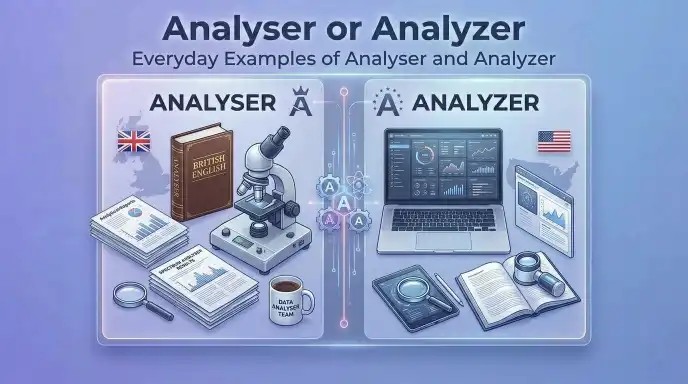
Everyday Examples of Analyser and Analyzer
In Emails
British:
Please review the results from the new analyser.
American:
Please review the results from the new analyzer.
In Business Writing
British:
Our technical team tested the system using a network analyser.
American:
Our technical team tested the system using a network analyzer.
In News Headlines
British style:
New analyser improves laboratory testing
American style:
New analyzer improves laboratory testing
Headlines often remove unnecessary words, but the regional spelling remains the same.
In Blogs
British:
A grammar analyser can help identify common writing errors.
American:
A grammar analyzer can help identify common writing errors.
On Social Media
British:
This new data analyser makes reporting much easier.
American:
This new data analyzer makes reporting much easier.
In Academic Writing
British:
The researchers used a statistical analyser to examine the results.
American:
The researchers used a statistical analyzer to examine the results.
Always follow your institution’s preferred English variety.
In Daily Conversation
The word is more common in technical or professional contexts than in casual speech.
You might hear:
The lab has a new analyzer.
Or:
The lab has a new analyser.
The choice still depends on the speaker’s English variety.
Google Trends & Modern Usage
People search analyser or analyzer because both spellings appear in dictionaries, software, scientific writing, product descriptions, and technical documents.
Modern usage continues to show a clear regional distinction. Cambridge identifies analyser as the UK spelling and analyzer as the US spelling.
The word is also widely used in technical contexts. Dictionary examples include terms such as network analyzer, digital image analyzer, and other specialized tools. British sources use corresponding forms such as network analyser and digital image analyser.
Search interest can come from several groups:
- Students checking spelling
- ESL learners comparing British and American English
- Writers preparing international content
- Researchers writing technical papers
- Editors checking regional consistency
- Developers working with software terminology
- Businesses preparing documents for different markets
Exact Google Trends numbers are not included here because search interest changes over time and depends on the selected country, date range, and search settings.
The useful takeaway is not which spelling has more searches. It is knowing which spelling matches your intended English variety.
Quick Comparison Table
| Version | Meaning | Correct? | Region | Example |
| Analyser | Person, machine, or device that analyzes | Yes | British English and British-style usage | The gas analyser is ready. |
| Analyzer | Person, machine, or device that analyzes | Yes | American English | The gas analyzer is ready. |
| Analysers | Plural of analyser | Yes | British English | The laboratory has two analysers. |
| Analyzers | Plural of analyzer | Yes | American English | The laboratory has two analyzers. |
Cambridge treats the two main forms as regional spellings of the same word rather than different words with different meanings.
Key Takeaways
- Analyser and analyzer are both correct.
- Analyser is the standard British spelling.
- Analyzer is the standard American spelling.
- Both words have the same basic meaning.
- The difference is mainly regional spelling, not meaning.
- British English uses analyse → analyser.
- American English uses analyze → analyzer.
- In Canada and other mixed-style environments, follow the required style guide.
- In academic and business writing, consistency matters.
- When in doubt, check the English variety required by your audience or publication.
FAQs
Q1. Is analyser or analyzer correct?
Both analyser and analyzer are correct English spellings. Analyser is the British English form, while analyzer is the American English form. Both words have the same meaning and refer to a person, machine, device, or software tool that examines something in detail.
Q2. Is analyser British or American?
Analyser is the British English spelling. American English normally uses analyzer. Use analyser when following British spelling conventions and analyzer when writing for a US audience.
Q3. Is analyzer American English?
Yes. Analyzer is the standard American English spelling. It follows the American spelling analyze. British English normally uses analyser, which follows the spelling analyse.
Q4. Do analyser and analyzer have the same meaning?
Yes. Analyser and analyzer have the same basic meaning. Both can describe a person, machine, device, or software tool that examines something carefully. The main difference is the regional spelling.
Q5. Which spelling should I use in the UK?
Use analyser in British English. For example: “The laboratory uses a gas analyser.” This spelling matches the British form analyse and is suitable for UK-focused writing.
Q6. Which spelling should I use in the US?
Use analyzer in American English. For example: “The laboratory uses a gas analyzer.” This spelling matches the American form analyze and is common in US academic, technical, and business writing.
Q7. Is analyser a misspelling of analyzer?
No. Analyser is not a misspelling of analyzer. It is the established British spelling. Analyzer is the American spelling. The two forms have the same meaning.
Q8. What is the plural of analyser?
The plural of analyser is analysers. In American English, the plural of analyzer is analyzers. The spelling follows the same British and American pattern as the singular forms.
Q9. Should I use analyser or analyzer in academic writing?
Follow the spelling style required by your university, journal, or publisher. American-style academic writing usually uses analyzer, while British-style academic writing uses analyser. Most importantly, keep your spelling consistent throughout the paper.
Q10. Which is better for international English?
Neither spelling is universally better. Choose the form that matches your target audience or style guide. Use analyzer for American English and analyser for British English. Consistency is more important than choosing one form for all international readers.
Conclusion:
Analyser and analyzer are both correct. The difference is mainly the English spelling convention used by the writer. Analyser is the British form, while analyzer is the American form. Both refer to a person, machine, device, or software tool that examines something in detail.
The easiest way to remember the difference is to connect each noun with its verb. British English uses analyse → analyser, while American English uses analyze → analyzer.
For US readers, use analyzer. UK readers will generally see analyser instead. In Canada, Australia, academic writing, and international content, follow the relevant style guide and keep the spelling consistent throughout the document.
You do not need to worry that one form is universally wrong. The real goal is to use the spelling that fits your audience and maintain the same English style throughout your writing.
Remember: British English uses analyser, while American English uses analyzer.
If you are unsure, identify your target audience first, then choose the spelling that matches its English convention.

I’m Nora Ellis, an English language writer passionate about making grammar, spelling, and confusing words easy to understand. I share clear explanations and practical examples to help readers improve their English and use words with confidence.








2 thoughts on “Analyser or Analyzer: Meaning, Spelling & Usage ”