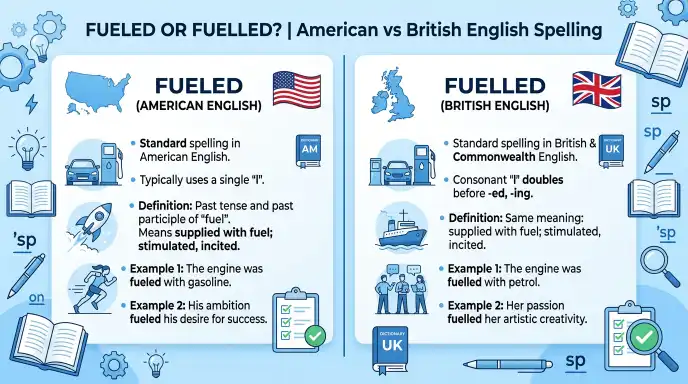
Fueled and fuelled are both correct spellings, but fueled is standard in American English, while fuelled is standard in British English. Both forms are the past tense and past participle of the verb fuel. The difference is mainly a spelling rule, not a difference in meaning.
This keyword often causes confusion because English uses different rules for adding -ed to words ending in -el. American English usually keeps one l in words such as fueled, while British English often doubles the final consonant, giving fuelled.
Knowing which form to use helps writers avoid spelling errors in schoolwork, emails, articles, business writing, and formal documents.
The same pattern appears in words such as canceled/cancelled, modeled/modelled, and labeled/labelled. In this guide, you will learn what fueled and fuelled mean, where the spelling difference comes from, how American and British English treat the word, and which form you should choose for your audience.
Fueled or Fuelled : Quick Answer
Fueled and fuelled are both correct.
- Fueled = American English
- Fuelled = British English and commonly used in other Commonwealth varieties
Examples:
- The car was fueled before the trip. 🇺🇸
- The car was fuelled before the trip. 🇬🇧
Both sentences have the same meaning.
Definition and Meaning of Fueled or Fuelled
Fueled and fuelled are forms of the verb fuel.
The verb fuel can mean to provide a vehicle, machine, or system with fuel.
The truck was fueled before leaving.
It can also have a figurative meaning. In this use, fuel means to make a feeling, action, or situation stronger.
The news fueled public concern.
The British spelling uses two l letters:
The news fuelled public concern.
Simple Meaning
Fuel means to supply energy or make something stronger.
The past forms are:
| Form | American English | British English |
| Present | fuel | fuel |
| Past | fueled | fuelled |
| Past participle | fueled | fuelled |
| -ing form | fueling | fuelling |
The meaning does not change between the two spellings.
The Origin of Fueled or Fuelled
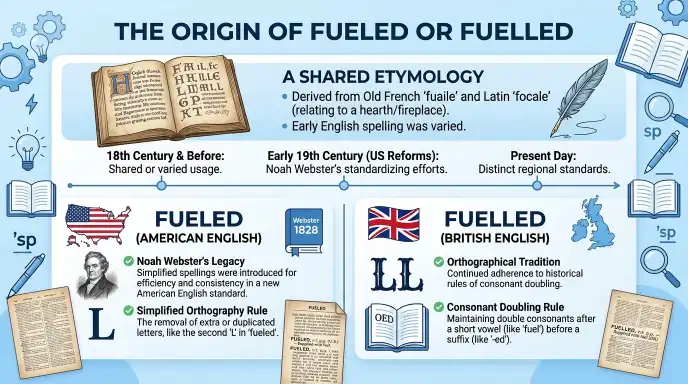
The word fuel has a long history. It came into English through Old French, from the Latin word focus, meaning “hearth” or “fireplace.”
Over time, fuel came to mean material used to produce heat or energy.
English later developed different spelling conventions in different regions.
American English generally became more likely to use -ed without doubling the final l in words such as:
- fueled
- canceled
- labeled
- modeled
British English commonly uses the doubled consonant:
- fuelled
- cancelled
- labelled
- modelled
This is why fueled and fuelled developed as regional spelling variants.
The difference is mainly about English spelling conventions. It does not indicate a different pronunciation or meaning.
British English vs American English Spelling
The main difference is the number of l letters.
American English usually writes:
fueled
British English usually writes:
fuelled
The same pattern appears in several other words.
| American English | British English |
| fueled | fuelled |
| canceled | cancelled |
| labeled | labelled |
| modeled | modelled |
| traveled | travelled |
| signaling | signalling |
For example:
American English:
The campaign fueled interest in the product.
British English:
The campaign fuelled interest in the product.
Both sentences are correct.
Which Spelling Should You Use?
Your choice should depend on your audience and writing style.
For American Readers
Use fueled when writing for readers in the United States.
Example:
Higher demand fueled production.
For British Readers
Use fuelled when writing for readers in the United Kingdom.
Example:
Higher demand fuelled production.
For Commonwealth English
Fuelled is also common in British-based varieties of English, including many contexts in countries such as Canada, Australia, and New Zealand.
However, local style guides can differ, especially in Canada.
For Global Readers
If your content targets an international audience, either spelling can work. The important point is to stay consistent.
Do not switch randomly between fueled and fuelled in the same article.
Common Mistakes with Fueled or Fuelled
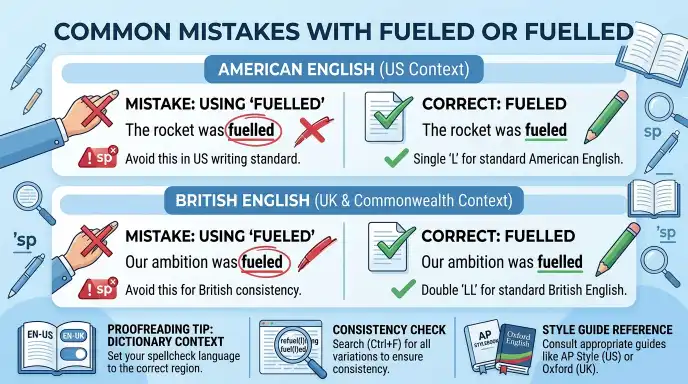
Several mistakes can occur when writers are unsure which spelling to use.
Treating One Form as Incorrect
A common mistake is assuming that fuelled is always wrong because American English uses fueled.
That is not correct.
Fuelled is standard British English.
Mixing Spelling Styles
Avoid changing styles within the same piece of writing.
For example:
The project was fueled by demand and later fuelled by new investment.
If the article follows American English, use fueled consistently.
Using an Incorrect Form
Forms such as fueld are incorrect.
Correct:
The machine was fueled.
British:
The machine was fuelled.
Confusing Fuel With Fuelling
The -ing form also changes between the two varieties.
- American: fueling
- British: fuelling
Example:
The company is fueling growth.
British:
The company is fuelling growth.
Fueled or Fuelled in Everyday Examples
The word appears in many types of writing.
In Emails
American English:
The new project fueled strong interest among our clients.
British English:
The new project fuelled strong interest among our clients.
In News Writing
Rising prices fueled concerns about household costs.
British style:
Rising prices fuelled concerns about household costs.
On Social Media
That victory fueled our excitement!
British style:
That victory fuelled our excitement!
In Formal Writing
Increased investment fueled economic growth.
British:
Increased investment fuelled economic growth.
In Everyday Speech
The coffee fueled me through the morning.
British:
The coffee fuelled me through the morning.
The word can describe both literal fuel and something that causes or increases an emotion, action, or situation.
Fueled or Fuelled : Google Trends & Usage Data
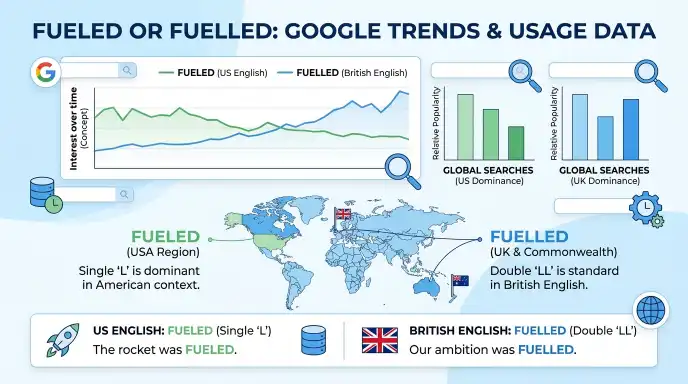
Search interest for fueled and fuelled can vary by country because English spelling preferences vary by region.
In the United States, searches and written content are generally favored.
In the United Kingdom, fuelled is the usual British spelling.
Other English-speaking regions may use either form depending on their local English standard.
Google Trends can also show differences based on the country, time period, and search term settings selected. Search interest should not be treated as a direct measure of which spelling is grammatically correct.
For writers, the more useful rule is simple:
Use the spelling that matches your target audience and keep it consistent.
Fueled vs Fuelled: Comparison Table
| Feature | Fueled | Fuelled |
| English variety | American English | British English |
| Meaning | Same | Same |
| Pronunciation | Same | Same |
| Part of speech | Verb form | Verb form |
| Present form | fuel | fuel |
| Past form | fueled | fuelled |
| Common audience | US readers | UK and many Commonwealth readers |
| Correct spelling? | Yes | Yes |
The key difference is the spelling convention, not the meaning.
Frequently Asked Questions
Q1. Is fueled or fuelled correct?
Both are correct. Fueled is the usual American English spelling, while fuelled is the usual British English spelling.
Q2. Is it American or British English?
Fueled is the standard American English spelling. British English generally uses fuelled.
Q3. Is British English fuelled?
Yes. Fuelled is the standard British English spelling of the past tense and past participle of fuel.
Q4. Do fueled and fuelled have the same meaning?
Yes. Fueled and fuelled have the same meaning. The difference is mainly regional spelling.
Q5. Is fueling or fuelling correct?
Both are correct. Fueling is common in American English, while fuelling is common in British English.
Q6. Which spelling should I use in an American article?
Use fueled for an article written in standard American English.
Q7. Can I use fueled and fuelled in the same article?
You generally should not mix them. Choose the spelling that matches your target variety of English and use it consistently.
Conclusion:
Fueled and fuelled are both correct spellings of the past tense and past participle of fuel. The main difference is regional. Fueled is the standard form in American English, while fuelled is standard in British English and is also used in many Commonwealth contexts.
Both forms can describe supplying something with fuel or making a feeling, action, or situation stronger. The pronunciation and meaning remain the same.
For American readers, choose fueled. For British readers, choose fuelled. If you write for an international audience, either form can work, but consistency matters. Avoid switching between the two forms without a clear reason.
The same spelling pattern can also help you understand words such as canceled/cancelled, labeled/labelled, and modeled/modelled. Once you know the regional spelling rule, choosing between fueled or fuelled becomes simple.

I’m Nora Ellis, an English language writer passionate about making grammar, spelling, and confusing words easy to understand. I share clear explanations and practical examples to help readers improve their English and use words with confidence.






1 thought on “Fueled or Fuelled: Correct Spelling, Meaning & Usage”