Perspective or prospective? These words look and sound similar, but they have different meanings and grammatical uses. Perspective usually means a particular way of seeing, understanding, or thinking about something.
Prospective is an adjective that describes someone or something expected or likely to become something in the future. This small spelling difference can cause big problems in writing.
A student may write “prospective” when they mean “perspective,” or a business writer may use “prospective customer” instead of the correct phrase prospective customer. The words are related in origin, which helps explain why they are easy to confuse.
The key is to focus on the idea behind the sentence. If you mean a viewpoint, opinion, or way of looking at something, use perspective. If you mean future, potential, or expected, use prospective.
This guide explains the difference between perspective or prospective, their meanings, origins, regional usage, common mistakes, and everyday examples. By the end, choosing the right word should feel simple.
Perspective or Prospective: Featured Snippet Answer
Perspective means a particular way of viewing or understanding something, while prospective means expected, possible, or likely to happen or become something in the future. For example, “from my perspective” means “from my point of view,” while “prospective students” means students who may enroll in the future.
Perspective or Prospective : Quick Answer
The simplest way to remember the difference is:
- Perspective = viewpoint or way of seeing something
- Prospective = future or potential
Examples of Perspective
From my perspective, the plan is practical.
Here, perspective means a point of view.
The story is told from the child’s perspective.
The word describes the child’s way of seeing the events.
Examples of Prospective
The university held a meeting for prospective students.
These are students who may attend the university in the future.
The company contacted several prospective customers.
These are people who may become customers.
Easy Memory Trick
Think:
Perspective = how you see something.
Prospective = what may happen next.
If you can replace the word with viewpoint, choose perspective.
If you can replace it with potential or expected, choose prospective.
What Does Perspective or Prospective Mean?
Although perspective and prospective look similar, they perform different jobs in a sentence.
What Does Perspective Mean?
Perspective is mainly a noun. It refers to a particular way of thinking about, understanding, or viewing something.
It can mean:
- Point of view
- Opinion
- Way of understanding something
- Mental outlook
- A method of showing depth in art
For example:
We need to understand the issue from a different perspective.
This means we need to look at the issue in a different way.
The word also appears in common phrases such as:
- from my perspective
- from a different perspective
- from the perspective of
- put something in perspective
- keep something in perspective
Cambridge Dictionary defines perspective as a particular way of considering something and also uses it for the artistic representation of depth and distance.
What Does Prospective Mean?
Prospective is an adjective. It describes someone or something that may become something in the future or is expected to do so.
Common examples include:
- prospective buyer
- prospective customer
- prospective student
- prospective employer
- prospective employee
- prospective parent
- prospective candidate
For example:
The college invited prospective students to an open day.
The students are not necessarily enrolled yet. They may become students in the future.
Cambridge also uses prospective buyers, employers, parents, customers, and similar future roles.
Perspective vs Prospective in One Sentence
Compare these two sentences:
From my perspective, the job is a good opportunity.
The company interviewed several prospective employees.
The first sentence talks about a viewpoint.
The second sentence talks about potential future employees.
That is the central difference.
The Origin of Perspective or Prospective
The two words are closely related because both connect to old word roots associated with looking or observing. Their shared history is one reason their spelling can be confusing.
Origin of Perspective
Perspective entered English in the late 14th century. It came through Old French and Medieval Latin and was originally connected with the science of optics and sight.
Its later artistic meaning developed around the idea of representing objects with depth and distance. The figurative meaning connected with a person’s mental outlook developed later.
This history explains why perspective can relate to both physical sight and mental viewpoint.
For example:
The artist used perspective to create depth.
And:
She has a positive perspective on life.
Both uses involve a way of seeing.
Origin of Prospective
Prospective entered English in the 16th century. Its history also connects to Latin roots involving looking forward or looking out.
The word originally carried the idea of being oriented toward what lies ahead. Its modern sense of something expected or anticipated developed over time.
The related word prospect also developed from the idea of looking forward or looking into the distance. Its later meanings included a possibility or a person or thing considered promising.
Why Are They So Easy to Confuse?
Both words:
- Begin with prospec-
- Have similar pronunciation
- Come from related historical roots
- Can involve the idea of “looking”
- Appear in formal English
But their modern meanings have separated.
Perspective focuses on a view or viewpoint.
Prospective focuses on a future possibility.
British English vs American English
There is no major British-American spelling difference between these two words. British and American English use perspective and prospective with the same spellings and basic meanings.
| British English | American English | Example |
| perspective | perspective | From my perspective, the idea works. |
| prospective | prospective | The company met prospective clients. |
| perspective | perspective | We need a new perspective. |
| prospective | prospective | Prospective students attended the event. |
The difference is therefore not regional spelling. It is a difference in meaning and grammatical use.
In British English
She offered a new perspective on the issue.
The school welcomed prospective parents.
In American English
He explained the problem from his perspective.
The company contacted prospective buyers.
Both varieties use the same forms.
Style guides and professional editors therefore do not need to choose a British or American spelling for these words. Instead, writers need to choose the word that matches the intended meaning.
Which Version Should You Use?
The correct choice depends on what you want to say.
United States
Use perspective for a viewpoint.
From my perspective, the decision makes sense.
Use prospective for a potential future person or situation.
We are meeting with a prospective client tomorrow.
United Kingdom
The same distinction applies.
His perspective changed after the experience.
The university invited prospective students to visit.
Canada
Canadian English also uses both words in the same basic way.
She gave us a different perspective.
The business is looking for prospective buyers.
Australia
Australian writers should also use the standard distinction.
The article presents another perspective.
Several prospective employees applied.
International Writing
For international English, the same rule is clear:
Use perspective for viewpoint.
Use prospective for future possibility.
Academic Writing
Perspective is common in academic writing.
The study examines the issue from a historical perspective.
Prospective is also common when describing future participants, possible outcomes, or research designs.
Researchers contacted prospective participants before the study.
Business Writing
Business writing frequently uses prospective with customers, clients, buyers, employees, and employers.
Our sales team contacted several prospective clients.
Use perspective when discussing opinions or ways of understanding a business issue.
From the customer’s perspective, the process is too complicated.
Common Mistakes with Perspective or Prospective
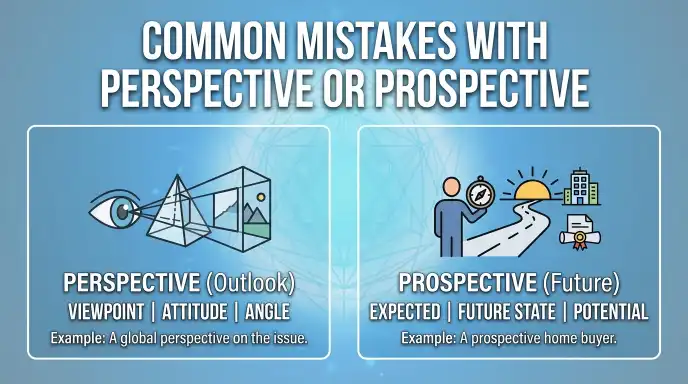
The easiest way to avoid mistakes is to identify if the sentence discusses a viewpoint or a future possibility.
| Incorrect Example | Correct Example | Explanation |
| From my prospective, the plan is useful. | From my perspective, the plan is useful. | You mean “point of view.” |
| We contacted several perspective customers. | We contacted several prospective customers. | The customers may buy in the future. |
| She gave me a new prospective on the issue. | She gave me a new perspective on the issue. | The word means viewpoint. |
| The university invited perspective students. | The university invited prospective students. | They may become students. |
| Look at it from another prospective. | Look at it from another perspective. | The phrase means another viewpoint. |
Memory Tip
Use this simple test:
Can you replace the word with “point of view”?
If yes, use perspective.
Can you replace it with “potential” or “expected”?
If yes, use prospective.
Another Easy Trick
Break the meanings into two ideas:
Perspective → See
Prospective → Future
This is not a rule about spelling. It is simply a memory aid.
Perspective or Prospective in Everyday Examples
Seeing the words in real sentences makes the difference easier to remember.
Emails
Perspective:
I understand your perspective on the matter.
Prospective:
We would like to arrange a call with a prospective client.
Business Writing
Perspective:
From the customer’s perspective, the new process is easier.
Prospective:
The sales team created a list of prospective customers.
News Headlines
Perspective:
Experts Offer a New Perspective on the Issue
Prospective:
Company Meets With Prospective Investors
The first headline focuses on a way of viewing an issue.
The second focuses on people who may become investors.
Blogs
Perspective:
Traveling can give you a new perspective on everyday life.
Prospective:
What prospective homeowners should know before buying
Social Media
Perspective:
Sometimes you just need to look at the problem from another perspective.
Prospective:
We are excited to meet our prospective customers this weekend.
Academic Writing
Perspective:
The study examines the topic from a historical perspective.
Prospective:
The researchers recruited prospective participants for the project.
Daily Conversation
Perspective:
I understand your perspective, but I see it differently.
Prospective:
She is a prospective student at the university.
Perspective or Prospective : Google Trends & Modern Usage
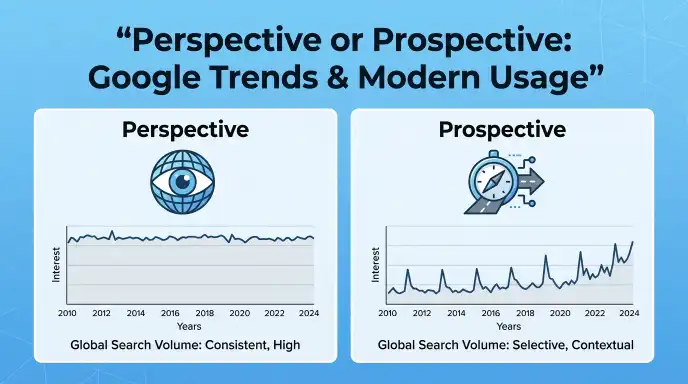
People search for perspective or prospective because the words are visually and phonetically similar. The confusion becomes especially common when people are writing quickly or relying on memory.
There is no need to invent a country-by-country ranking to explain the difference. Exact Google Trends results can change by date, location, search settings, and query wording. Search interest also does not determine which spelling is correct.
Modern English uses perspective widely when discussing opinions, viewpoints, experiences, art, and ways of understanding an issue. Cambridge lists common combinations such as perspective on something, from a perspective, and different perspective.
Prospective is especially common in phrases involving people or things that may become something in the future. Examples include prospective customers, prospective buyers, prospective students, and prospective employers. It is also used in phrases such as prospective earnings, prospective costs, and prospective studies.
A useful modern usage rule is therefore:
Perspective = viewpoint.
Prospective = potential or expected future.
Quick Comparison Table
| Version | Meaning | Correct? | Region | Example |
| Perspective | A viewpoint or way of seeing something | Yes | US, UK, Canada, Australia, International | From my perspective, it is fair. |
| Prospective | Potential, expected, or future | Yes | US, UK, Canada, Australia, International | We met a prospective customer. |
| Perspective | Artistic representation of depth | Yes | Standard English | The painting uses perspective. |
| Prospective | Likely to become something | Yes | Standard English | She is a prospective student. |
| Perspective customer | Intended meaning: potential customer | No | Not standard usage | Use prospective customers. |
| Prospective on the issue | Intended meaning: viewpoint | No | Not standard usage | Use perspective on the issue. |
Key Takeaways
- Perspective means a viewpoint, outlook, or way of seeing something.
- Prospective means potential, expected, or related to the future.
- Perspective is normally a noun.
- Prospective is normally an adjective.
- “From my perspective” means “from my point of view.”
- A prospective customer is someone who may become a customer.
- British and American English use the same spellings.
- Remember: perspective = viewpoint; prospective = future possibility.
FAQs About Perspective or Prospective
Q1. What is the difference between perspective and prospective?
Perspective means a particular way of viewing or understanding something. Prospective means possible, expected, or likely to become something in the future.
For example, “from my perspective” means “from my point of view,” while “prospective students” means students who may attend a school or university in the future.
Q2. Is it from my perspective or from my prospective?
The correct phrase is “from my perspective.” It means “from my point of view” or “based on how I see the situation.” Prospective does not normally describe someone’s viewpoint. For example: “From my perspective, the proposal is reasonable.”
Q3. Is it a prospective customer or a prospective customer?
The correct phrase is “prospective customer.” A prospective customer is someone who may become a customer.
For example: “The sales team contacted several prospective customers.” Perspective customer is usually an incorrect word choice when the intended meaning is a potential customer.
Q4. What does perspective mean in simple English?
Perspective means the way a person sees, understands, or thinks about something. It is similar to viewpoint or point of view.
For example, “From her perspective, the decision was fair” means that the decision seemed fair from the way she viewed the situation.
Q5. Are perspective and prospective pronounced the same way?
They are similar in pronunciation, but they are not the same word. The similarity can make them easy to confuse in speech. If the sentence means viewpoint, choose perspective. If it means potential or future, choose prospective.
Q6. Is prospective a noun or an adjective?
Prospective is normally an adjective. It describes a person, thing, or situation connected with a possible future state.
Examples include prospective buyer, prospective employee, and prospective student. The related noun prospect can refer to a possibility or a person or thing considered promising.
Q7. Is perspective a noun or an adjective?
Perspective is mainly a noun. It can refer to a viewpoint, outlook, or way of understanding something. It also has an artistic meaning related to showing depth and distance in a picture. For example: “The book gives readers a different perspective on the subject.”
Q8. Do British and American English spell these words differently?
No. Perspective and prospective have the same standard spellings in British and American English. The main issue is not regional spelling. Writers need to choose between the words based on meaning: perspective for viewpoint and prospective for future possibility.
Q9. How can I remember perspective vs prospective?
Use the simple memory rule “perspective = viewpoint” and “prospective = future.” If you could replace the word with point of view, use perspective. If you could replace it with potential or expected, use prospective. This quick test works in most everyday sentences.
Conclusion:
The difference between perspective or prospective becomes simple once you focus on meaning. Perspective refers to a viewpoint, outlook, or particular way of seeing and understanding something. Prospective describes someone or something that is possible, expected, or likely to become something in the future.
Use perspective in phrases such as from my perspective, a different perspective, and a new perspective on the issue. Use prospective in phrases such as prospective customer, prospective student, prospective buyer, and prospective employee.
There is no major British-American spelling difference. Both words use the same spellings across major varieties of English.
When in doubt, replace the word mentally. If you mean viewpoint, choose perspective. If you mean potential or future, choose prospective.
Remember: perspective is how you see it; prospective is what may happen next. Keep that simple distinction in mind, and you will avoid one of the most common word-choice mix-ups.

I’m Nora Ellis, an English language writer passionate about making grammar, spelling, and confusing words easy to understand. I share clear explanations and practical examples to help readers improve their English and use words with confidence.



1 thought on “Perspective or Prospective: Meaning, Usage & Examples”