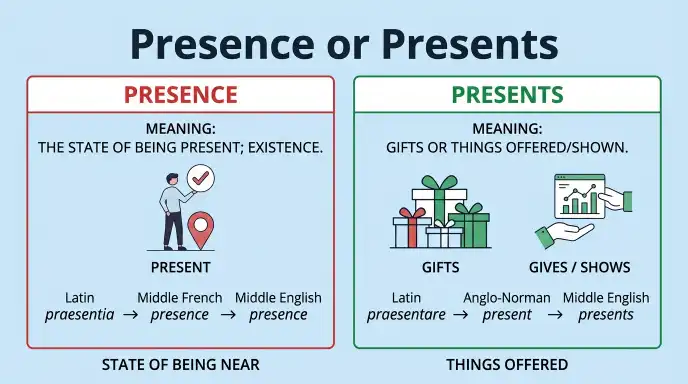
Presence and presents are different words with different meanings. Presence means being somewhere or having a noticeable effect, while presents can mean gifts or the third-person form of present.
People often search for “presence or presents” because the two words look and sound similar, especially in fast speech. This can cause spelling mistakes in emails, messages, schoolwork, and formal writing. The confusion becomes easier to solve once you know what each word means and how it works in a sentence.
For example, you might say, “Her presence made everyone feel welcome.” Here, presence means being there. But you might write, “She received many presents on her birthday.” Here, presents means gifts.
The key difference is simple: presence relates to being there, while presents can refer to gifts or an action happening now. Learning this difference will help you choose the right word with confidence.
Presence or Presents : Quick Answer
Presence means being in a place, state, or situation.
Presents has two common meanings:
- Gifts given to someone.
- The verb present in the third-person singular form, meaning shows, gives, or introduces something.
| Word | Meaning | Example |
| Presence | Being somewhere | Her presence helped me relax. |
| Presents | Gifts | He bought three presents. |
| Presents | Shows or introduces | She presented the report today. |
Easy tip: If you mean being there, use presence. If you mean gifts, use presents.
Definition and Meaning of Presence or Presents
Presence
Presence is a noun. It refers to the state of being present or being in a particular place.
For example:
- His presence was important at the meeting.
- I felt her presence in the room.
- The teacher’s presence kept the students focused.
It can also describe the noticeable effect or influence someone has.
- The actor has a strong stage presence.
- She has a calm presence that makes people comfortable.
Presents
The word presents has two common meanings.
First, it can refer to gifts given to someone.
Second, presents can be a verb that means shows, introduces, or delivers something.
Presents as Gifts
As a plural noun, presents means gifts.
- I bought birthday presents for my family.
- The children opened their presents.
- We wrapped the Christmas presents.
Presents as a Verb
Presents is also the third-person singular form of present.
It can mean shows, introduces, gives, or delivers something.
- She presents the award every year.
- The manager presents the results.
- He presents a new idea to the team.
So, the meaning depends on the sentence.
The Origin of Presence or Presents
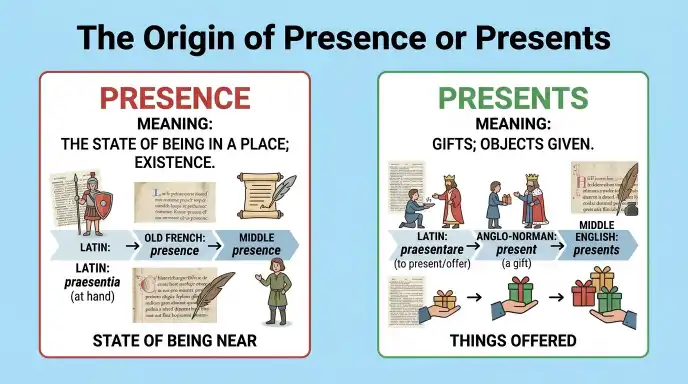
Presence comes from the Latin word praesentia, meaning being present or being at hand. It entered English through Old French and Middle English.
The word is closely related to present, which comes from the Latin praesens. This connection explains why presence and presents look similar.
Present has several meanings in English. It can describe something that exists now, someone who is in a place, a gift, or the act of showing something.
Over time, English developed different forms from the same word family. Presence became the noun for the state of being present, while presents developed as both a plural noun and a verb form.
The spelling difference is therefore not random. The words have related historical roots but serve different grammatical roles today.
British English vs American English Spelling
There is no major British-American spelling difference between presence and presents.
Both British English and American English use:
- presence
- presents
The meaning and spelling remain the same in both varieties.
| Meaning | British English | American English |
| Being somewhere | presence | presence |
| Gifts | presents | presents |
| Shows or introduces | presents | presents |
| Stage influence | presence | presence |
Examples
British English:
Her presence made the event special.
The children opened their presents.
American English:
Her presence made the event special.
The children opened their presents.
The spelling does not change based on if you write for a British or American audience.
Which Spelling Should You Use?
Choose the word based on meaning, not the country where you are writing.
Use presence when you mean:
- being somewhere
- attendance
- existence in a place
- influence or noticeable effect
Use presents when you mean:
- gifts
- shows
- introduces
- delivers information
For US Readers
Use presence and presents exactly as shown above. American English does not use a different spelling for these words.
For UK and Commonwealth Readers
The same spellings apply. British English also uses presence for being somewhere and presents for gifts or the verb form.
For Global English
The safest approach is to focus on the meaning of the sentence. Ask yourself if you mean being there, gifts, or showing something.
Common Mistakes with Presence or Presents
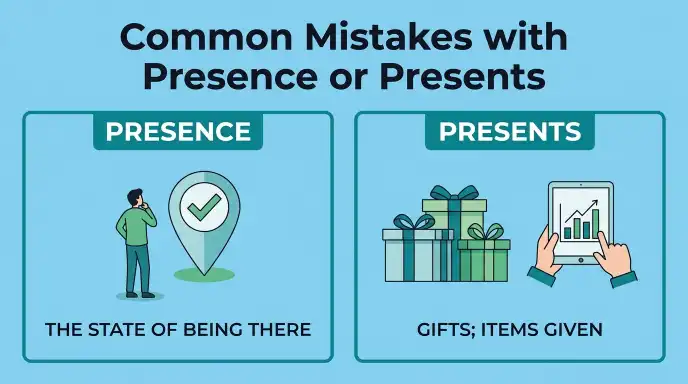
Because the words look and sound similar, writers sometimes confuse them.
| Incorrect Use | Correct Use | Reason |
| Her presents was important. | Her presence was important. | You mean being there. |
| I bought a birthday presence. | I bought birthday presents. | You mean gifts. |
| His presents made the meeting better. | His presence made the meeting better. | You mean his attendance. |
| She presence the report. | She presents the report. | Presents is the verb form. |
| We opened our Christmas presence. | We opened our Christmas presents. | Presents means gifts. |
A Simple Memory Trick
Think of presence as connected to present in the sense of being there.
A simple memory trick: If the word means “being there,” use presence.
When you mean “gifts,” the correct word is presents.
For “shows” or “introduces,” use presents as the verb form.
Presence or Presents in Everyday Examples
In Emails
Presence:
Your presence at the meeting would be greatly appreciated.
Presents:
We have prepared small presents for the guests.
In News Writing
Presence:
Police maintained a visible presence near the building.
Presents:
The host presents the evening news.
On Social Media
Presence:
Her positive presence always makes people smile.
Presents:
We finally opened our birthday presents!
In Formal Writing
Presence:
The study examined the presence of certain factors in the sample.
Presents:
The researcher presents the findings in the final section.
In Everyday Speech
I was happy to have your presence at dinner.
The children were excited about their presents.
She presents her ideas clearly.
Presence or Presents : Google Trends & Usage Data
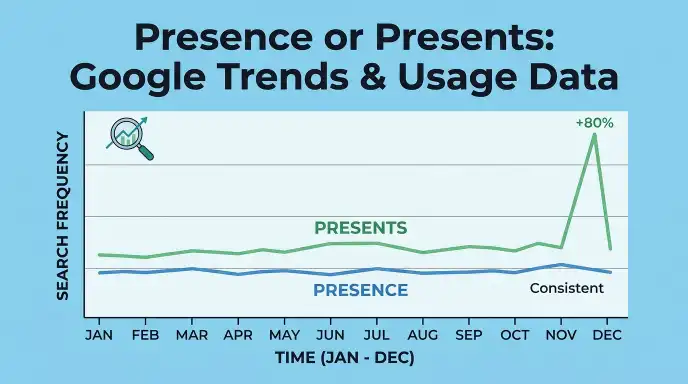
Search interest for presence and presents can vary because the words have several meanings and appear in many different contexts.
Presence is commonly used in contexts such as:
- attendance
- personal influence
- stage performance
- business
- education
- technology
- social interaction
Presents is commonly used in contexts involving:
- birthdays
- Christmas
- holidays
- gifts
- television
- presentations
- business meetings
Search data can also vary by country and season. Searches related to presents may increase around major gift-giving holidays. Searches for presence tend to have broader year-round uses because the word appears in many types of writing.
Google Trends measures search interest, not the total number of times people use a word. Therefore, search trends should be treated as a guide to online interest rather than a complete measure of language use.
Presence vs Presents: Comparison Table
| Feature | Presence | Presents |
| Main role | Noun | Noun or verb |
| Common meaning | Being somewhere | Gifts |
| Other meaning | Influence or effect | Shows or introduces |
| Singular form | Presence | Present |
| Plural form | Presences, less common | Presents |
| Verb form | Not a verb | Third-person singular of present |
| Example | His presence helped. | She bought presents. |
| Example 2 | Her stage presence was strong. | He presents the results. |
| British spelling | Presence | Presents |
| American spelling | Presence | Presents |
FAQs About Presence or Presents
Q1. What is the difference between presence and presents?
Presence means being somewhere or having an effect or influence. Presents can mean gifts or can mean shows, introduces, or gives something.
Q2. Is presence singular or plural?
Presence is normally a singular noun.
For example:
Her presence was comforting.
The plural form exists but is much less common.
Q3. Does presents mean gifts?
Yes. Presents can mean gifts.
For example:
The children opened their presents.
Here, presents is the plural of present meaning a gift.
Q4. Is present also a verb?
Yes. Presents is the third-person singular form of the verb present.
For example:
He presents the award.
It can mean shows, introduces, or delivers something.
Q5. Is presence the same as attendance?
They can be closely related, but they are not always identical.
Attendance usually focuses on if someone is present at an event or place. Presence can also describe the feeling, influence, or effect someone has.
Q6. Is presence spelled differently in British English?
No. Presence has the same spelling in British and American English.
Q7. How can I remember the difference between presence and presents?
Use this simple rule:
Presence = being there.
Presents = gifts or shows.
If you mean someone’s being in a place, use presence. If you mean gifts, use presents.
Conclusion:
Presence and presents look similar, but they have different meanings and grammatical uses. Presence is mainly a noun that describes being in a place, attendance, or a noticeable influence. For example, “Her presence made the room feel calmer.”
Presents can be a plural noun meaning gifts, as in “The children opened their presents.” It can also be a verb meaning shows, introduces, or delivers, as in “She presents the results to the team.”
The spelling is the same in British English and American English, so you do not need to choose between regional spellings. Instead, choose the word that matches your intended meaning.
When writing, ask yourself one simple question: Do I mean being there, gifts, or showing something? Use presence for being there, and presents for gifts or the verb form. This simple distinction will help you avoid one of the most common spelling and word-choice mistakes.

I’m Nora Ellis, an English language writer passionate about making grammar, spelling, and confusing words easy to understand. I share clear explanations and practical examples to help readers improve their English and use words with confidence.