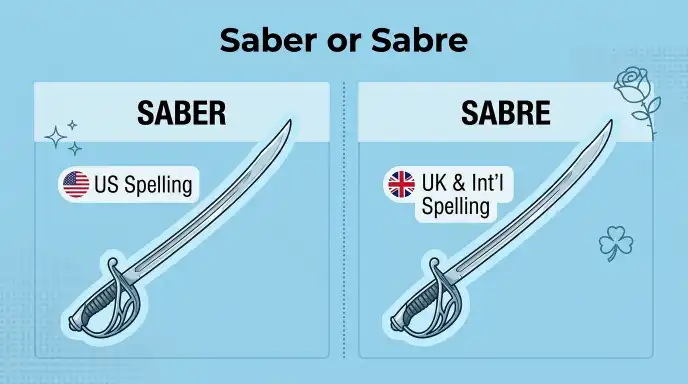
Saber and sabre are both correct spellings, but saber is standard in American English while sabre is standard in British English. Both words refer to a type of sword with a curved blade, and they have the same meaning and pronunciation in most contexts.
People often search for “saber or sabre” because the two spellings appear in different books, countries, sports, and historical texts. This can make it hard to know which form is correct. The confusion is mainly a matter of regional spelling, not meaning.
The word is common in military history, fencing, weapons studies, and literature. In the United States, saber is usually the preferred spelling. In the United Kingdom and many Commonwealth countries, sabre is more common. Both forms are accepted in English, but your choice should match your audience and style guide.
Understanding this difference helps writers avoid spelling mistakes and choose the form that fits their region. It also explains why you may see saber in American sources and sabre in British sources.
Saber or Sabre : Quick Answer
Saber and sabre are both correct spellings of the same word.
- Saber → preferred in American English
- Sabre → preferred in British English and many Commonwealth varieties
Both words mean a sword with a curved blade, traditionally used by cavalry and military forces.
Examples:
- The soldier carried a saber.
- The soldier carried a sabre.
- He trained with a fencing saber.
- She competed in sabre fencing.
The main difference is spelling, not meaning.
Definition and Meaning of Saber or Sabre
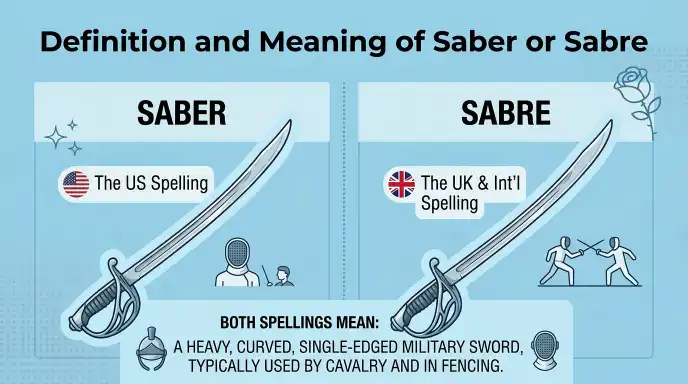
A saber or sabre is a type of sword with a curved blade and a single cutting edge. It was especially associated with cavalry and military use.
In simple terms, a saber is a curved sword designed mainly for cutting.
The word can also refer to the weapon used in the sport of fencing. In fencing, the saber or sabre is one of the three main weapons, along with the foil and épée.
Military Meaning
Historically, cavalry soldiers often carried sabers because the curved blade was well suited to cutting while riding a horse.
Example:
The cavalry officer drew his saber before entering the battle.
Fencing Meaning
In fencing, saber/sabre refers to a lightweight weapon with a protective guard. Saber fencing allows touches with the edge and tip of the weapon.
Example:
She won the saber fencing match.
Figurative or Literary Use
The word may also appear in historical novels, fantasy writing, and descriptions of military scenes.
Example:
The warrior raised his sabre and rode toward the enemy.
The Origin of Saber or Sabre
The word saber/sabre has a long history connected with European military language.
English adopted the word from French sabre. The French word is linked to earlier forms associated with curved swords used by cavalry forces in Europe.
The spelling developed differently in English-speaking regions. Sabre remained common in British English, while saber became the usual American English form.
This is similar to other spelling differences between American and British English. American English often uses simpler or modified spellings, while British English may retain forms influenced by French or other European languages.
The two spellings do not represent two different weapons. They are regional spelling variants of the same word.
British English vs American English Spelling
The main difference between saber and sabre is regional preference.
| English Variety | Preferred Spelling | Example |
| American English | saber | He carried a saber. |
| British English | sabre | He carried a sabre. |
| Canadian English | sabre is common | The officer used a sabre. |
| Australian English | sabre is common | The soldier carried a sabre. |
| International English | Either, based on audience | Both forms are correct. |
American English
In American English, saber is the standard spelling.
Example:
The museum displayed an old military saber.
British English
In British English, sabre is the standard spelling.
Example:
The museum displayed an old military sabre.
Fencing
The spelling can also vary in fencing contexts. American sources commonly use saber, while British and international fencing sources often use sabre.
The important point is to keep your spelling consistent throughout an article or document.
Which Spelling Should You Use?
Choose the spelling based on your audience and regional English.
For American Readers
Use a saber.
Example:
The soldier carried a saber.
For British Readers
Use sabre.
Example:
The soldier carried a sabre.
For Commonwealth Readers
Sabre is generally a safe choice in British-based varieties of English, including many Commonwealth contexts.
For Global Readers
Either spelling can work. If your content follows American English, use saber. If it follows British English, use sabre.
For Academic and Professional Writing
Follow the spelling style required by your institution, publication, or style guide. The most important rule is consistency.
Common Mistakes with Saber or Sabre
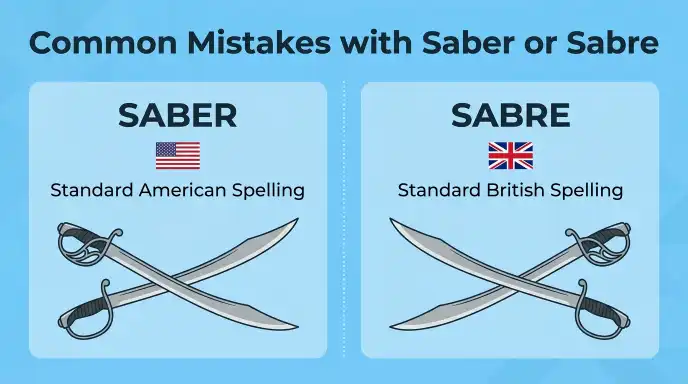
People often make mistakes because they are unsure if the final letters should be -er or -re.
| Incorrect or Confusing Form | Correct Form | Note |
| sabir | saber / sabre | Wrong spelling |
| sabre in American-style text | saber | Use the regional standard |
| saber in British-style text | sabre | Use the regional standard |
| sabre sword | sabre | “Sword” may be unnecessary in some contexts |
| sabers / sabres | Both correct | Use the plural that matches your spelling style |
Treating Them as Different Words
Saber and sabre do not normally have different meanings.
They are spelling variants.
Mixing Regional Spellings
Avoid switching between saber and sabre in the same piece of writing unless you are discussing the spelling difference.
Assuming One Form Is Wrong
Neither spelling is wrong. The correct choice depends mainly on regional English.
Saber or Sabre in Everyday Examples
Seeing both forms in real sentences makes the difference easier to understand.
In Emails
American English:
The historical collection includes an original cavalry saber.
British English:
The historical collection includes an original cavalry sabre.
In News Writing
American English:
The museum recently displayed a rare military saber.
British English:
The museum recently displayed a rare military sabre.
On Social Media
American English:
That antique saber looks amazing!
British English:
That antique sabre looks amazing!
In Formal Writing
American English:
The study examines the use of the saber in nineteenth-century cavalry units.
British English:
The study examines the use of the sabre in nineteenth-century cavalry units.
In Fencing
American English:
She competes in saber fencing.
British English:
She competes in sabre fencing.
Saber or Sabre : Google Trends & Usage Data

Search interest for saber and sabre reflects the regional difference between American and British English.
Saber tends to be more common in the United States, where American spelling is used. Sabre is more common in the United Kingdom and other regions influenced by British English.
Searches can also vary because the word appears in several contexts, including:
- Fencing
- Military history
- Historical weapons
- Museums
- Literature
- Fantasy and games
Google Trends can show relative search interest over time and by location, but it does not provide a simple count of every use of a word. Search results can also change based on events, sports competitions, and popular culture.
For this reason, usage data should be treated as a guide rather than proof that one spelling is universally correct.
Saber vs Sabre: Comparison Table
| Feature | Saber | Sabre |
| Meaning | Curved sword | Curved sword |
| Spelling | American English | British English |
| Pronunciation | Usually the same | Usually the same |
| Main use | US English | UK and Commonwealth English |
| Fencing | Common in US sources | Common in UK/international sources |
| Plural | Sabers | Sabres |
| Correct? | Yes | Yes |
The key difference is regional spelling preference.
FAQs About Saber or Sabre
Q1. Is saber or sabre correct?
Both saber and sabre are correct. Saber is preferred in American English, while sabre is preferred in British English and many Commonwealth varieties.
Q2. What is the difference between saber and sabre?
There is usually no difference in meaning. They are two regional spellings of the same word. The main difference is that American English uses saber, while British English uses sabre.
Q3. Is saber American or British English?
Saber is the standard American English spelling. British English generally uses sabre.
Q4. Is it British English?
Yes. Sabre is the traditional British English spelling. It is also widely used in other varieties influenced by British English.
Q5. Which spelling should I use in the US?
Use sabers for American readers. This form is standard in American English.
Q6. Which spelling should I use in the UK?
Use sabre for British readers. It is the standard British English spelling.
Q7. Does saber mean a sword?
Yes. A saber or sabre is a type of sword, traditionally characterized by a curved blade and mainly associated with cutting.
Conclusion: Saber or Sabre
Saber and sabre are both correct spellings of the same word. The main difference is regional English usage. American English normally uses saber, while British English uses sabre.
The word refers to a type of curved sword and can also describe one of the weapons used in fencing. Both forms have the same basic meaning, so choosing between them is usually a matter of spelling style rather than meaning.
If you are writing for an American audience, choose saber. If your readers use British or Commonwealth English, sabre is usually the better choice. For international writing, either form can work, but you should follow your chosen English style and remain consistent.
In short, saber = American English and sabre = British English. Neither spelling is incorrect. The best choice depends on your audience, region, and writing style.

I’m Nora Ellis, an English language writer passionate about making grammar, spelling, and confusing words easy to understand. I share clear explanations and practical examples to help readers improve their English and use words with confidence.





6 thoughts on “Saber or Sabre: Correct Spelling, Meaning & Usage”