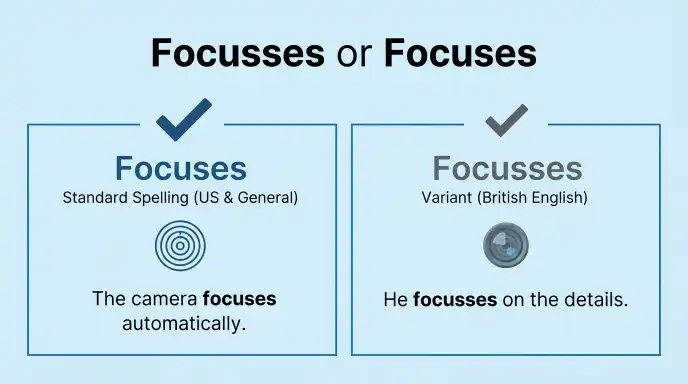
Both “focusses” and “focuses” are correct, but “focuses” is more common in American English, while “focusses” is preferred in British English. This spelling difference often confuses writers because both forms come from the verb focus and follow different spelling conventions.
People search for “focusses or focuses” when they need to decide which form to use in an email, essay, report, article, or other English writing. The confusion comes from the way British and American English handle verbs ending in -s after a final -s.
The good news is that you do not need to learn two different meanings. Focusses and focuses are forms of the same verb, focus. They mean to give attention to something or direct attention toward a particular subject.
The main difference is regional spelling style. Focuses is widely used in American English and is also common internationally. Focusses is a standard British English form and appears in other varieties that follow British spelling rules.
Focusses or Focuses : Quick Answer
Both “focusses” and “focuses” are correct.
- Focuses is the more common spelling in American English.
- Focusses is a standard spelling in British English.
- Both mean giving attention to, concentrates on, or directs attention toward something.
Examples:
- The report focuses on climate change.
- The report focusses on climate change.
Both sentences are correct. Choose the form that matches your preferred variety of English.
Definition and Meaning of Focusses or Focuses
Focusses and focuses are third-person singular forms of the verb focus.
The verb focus means to give special attention to something or to concentrate on a particular subject, activity, or goal.
What Does Focuses Mean?
Focusing means giving attention to something or concentrating on something.
For example:
The article focuses on healthy eating.
Here, focuses means that the article gives most of its attention to healthy eating.
What Does Focusses Mean?
Focusses have the same meaning.
The article focusses on healthy eating.
The meaning does not change. Only the spelling is different.
Focuses and Focusses as Verbs
Both forms can describe a person, organization, study, report, or other subject that gives attention to something.
- The teacher focuses on grammar.
- The teacher focusses on grammar.
- The company focuses on customer service.
- The company focusses on customer service.
Both versions are grammatically correct.
The Origin of Focusses or Focuses
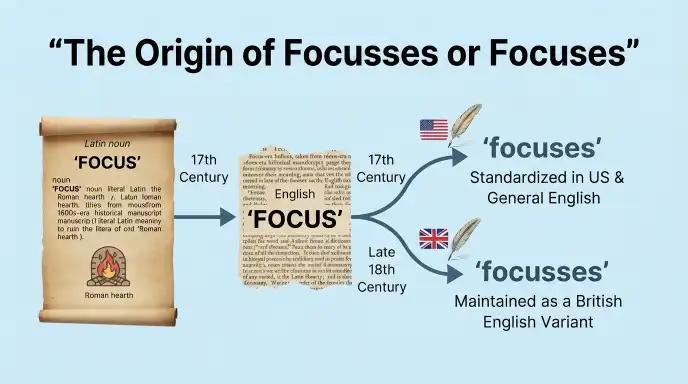
The spelling difference comes from the word focus and the way English developed different spelling conventions.
The noun focus comes from Latin focus, meaning hearth or fireplace. The word later developed a figurative sense connected with a central point of attention.
English uses focus as both a noun and a verb. When the verb is used with he, she, it, or a singular noun, it takes the third-person singular ending.
This creates two accepted spellings:
- focus + es = focuses
- focus + ses = focusses
British English commonly uses focusses, while American English generally uses focuses.
This pattern is similar to other spelling differences involving verbs that end in -s. British English often keeps a double consonant in certain forms, while American English tends to use the simpler form.
The spelling difference does not create a difference in meaning or pronunciation.
British English vs American English Spelling
The main difference between focusses and focuses is regional spelling preference.
British English
Focusses is a standard British English spelling.
Example:
The study focusses on children’s education.
British English also commonly uses focussing for the present participle.
American English
Focuses is the standard American English spelling.
Example:
The study focuses on children’s education.
American English commonly uses focusing rather than focussing.
Comparison Table
| English Variety | Preferred Spelling | Example |
| American English | Focuses | The report focuses on education. |
| British English | Focusses | The report focusses on education. |
| Canadian English | Focuses / Focusses | Both forms may appear. |
| Australian English | Focusses | The study focusses on health. |
| International English | Focuses | The article focuses on grammar. |
The key point is simple: both spellings are correct, but regional style affects which one you should choose.
Which Spelling Should You Use?
Your choice should depend on your audience.
For American English
Use focuses.
The research focuses on language learning.
This is the normal American spelling.
For British English
Use focusses.
The research focusses on language learning.
This spelling fits traditional British English conventions.
For Australian English
Focusses is commonly used and fits Australian spelling conventions.
For Canadian English
You may see both forms. Check the style guide used by your school, employer, publisher, or organization.
For Global English
Focuses is often the safest choice because it is widely recognized and very common internationally.
For Academic Writing
Follow the spelling standard required by your institution or publication. The most important rule is consistency.
Do not switch between focuses and focusses randomly in the same document.
Common Mistakes with Focusses or Focuses
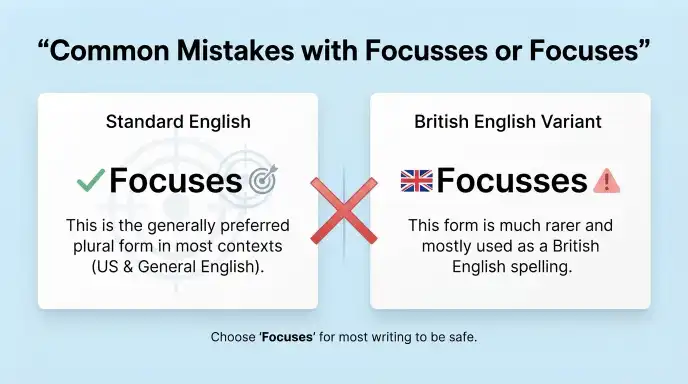
Writers often make mistakes because they are unsure which spelling follows their chosen English variety.
| Incorrect or Confusing Form | Correct Form | Explanation |
| Focus’s | Focuses | Use the verb form when meaning “gives attention to.” |
| Focusses in American English | Focuses | Focuses is the usual American form. |
| Focuses in British style | Focusses | Focusses is a standard British form. |
| Focusses and focuses used randomly | Choose one | Keep your spelling consistent. |
| Focuses on to | Focuses on | The usual phrase is “focuses on.” |
Mistake 1: Thinking Focusses Is Always Wrong
Focusses is not wrong. It is a standard spelling, especially in British English.
Mistake 2: Thinking Focuses Is Always Wrong
Focuses is also correct. It is the usual spelling in American English.
Mixing Regional Styles
A document should normally follow one spelling system.
For example, if you are writing in British English, use focusses consistently rather than switching between focusses and focuses without a reason.
Focusses or Focuses in Everyday Examples
Both forms can be used in many types of writing.
In an Email
American English:
The meeting focuses on our plans for next month.
British English:
The meeting focusses on our plans for next month.
In News Writing
The new policy focuses on improving public transport.
British-style writing may use:
The new policy focusses on improving public transport.
On Social Media
Today’s post focuses on simple writing tips.
This is natural and widely understood.
In Formal Writing
The research focuses on the effects of technology on education.
Or in British English:
The research focusses on the effects of technology on education.
More Everyday Examples
- The lesson focuses on sentence structure.
- The lesson focusses on sentence structure.
- The company focuses on quality.
- The company focusses on quality.
- Her research focuses on language development.
- Her research focusses on language development.
Focusses or Focuses : Google Trends & Usage Data
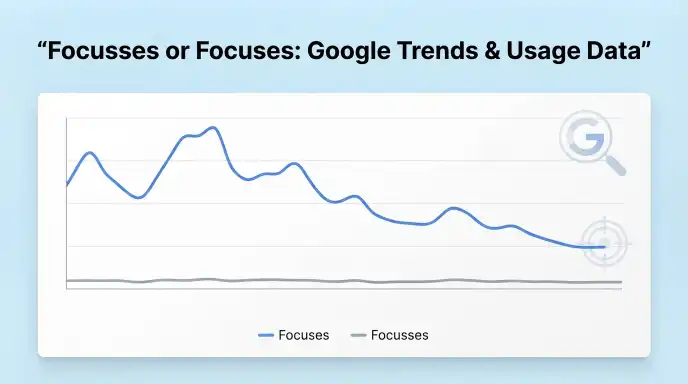
Search interest for focuses is generally much higher than for focusses. This reflects the fact that focuses is the dominant spelling in American English and is also widely used in international English.
Focusses has a stronger connection with British-style spelling and appears more often in regions and publications that follow British English conventions.
Search trends can change over time and may vary by country. They also reflect what people search for, not necessarily what dictionaries consider correct.
For this keyword, the broad usage pattern is more useful than a single search number:
| Context | More Likely Form |
| American English | Focuses |
| British English | Focusses |
| Australian English | Focusses |
| International websites | Focuses |
| Academic writing | Depends on style guide |
| Business writing | Depends on regional style |
| Search queries | Focuses is generally more common |
If your goal is broad international readability, focuses is usually the safer choice.
Focusses vs Focuses: Comparison Table
| Feature | Focuses | Focusses |
| Meaning | Gives attention to | Gives attention to |
| Part of speech | Verb | Verb |
| Correct? | Yes | Yes |
| American English | Preferred | Less common |
| British English | Common | Preferred |
| Australian English | Used | Commonly preferred |
| Canadian English | Common | Also used |
| Pronunciation | Same | Same |
| Modern usage | Very common | Less common globally |
| Best choice for US readers | Focuses | No |
| Best choice for UK readers | No | Focusses |
FAQs About Focusses or Focuses
Q1. Is focusses or focuses correct?
Both are correct. Focuses is the usual American English spelling, while focusses is a standard British English spelling.
Q2. Is focusses British or American?
Focusses is mainly associated with British English and other varieties that follow similar spelling conventions.
Q3. Is it focused on American English?
Yes. Focuses is the standard and more common American English form.
Q4. Do focusses and focuses have the same meaning?
Yes. Both mean giving attention to, concentrates on, or directs attention toward something.
Q5. Which is more common, focusses or focuses?
Focuses is more common overall, especially in American English and international writing.
Q6. Should I use focuses or focusses in academic writing?
Use the form required by your institution, publisher, or style guide. The most important point is to remain consistent.
Q7. Is focusses a spelling mistake?
No. Focusses is a correct spelling, particularly in British English.
Conclusion:
Focusses and focuses are both correct spellings of the same verb form. The main difference is regional spelling preference, not meaning or grammar. Focuses is the standard form in American English and is also very common in international writing. Focusses is a standard British English form and is also used in Australian English.
Both forms mean giving attention to, concentrating on, or directing attention toward something. For example, both “The report focuses on education” and “The report focusses on education” are correct.
When choosing between them, think about your audience. Use focuses for American readers and for broad international audiences. Use focusses when following British English spelling conventions. In academic and professional writing, always follow the required style guide.
The most important rule is consistency. Choose one spelling that matches your English variety, then use it throughout your document. This keeps your writing clear, professional, and easy to read.

I’m Nora Ellis, an English language writer passionate about making grammar, spelling, and confusing words easy to understand. I share clear explanations and practical examples to help readers improve their English and use words with confidence.