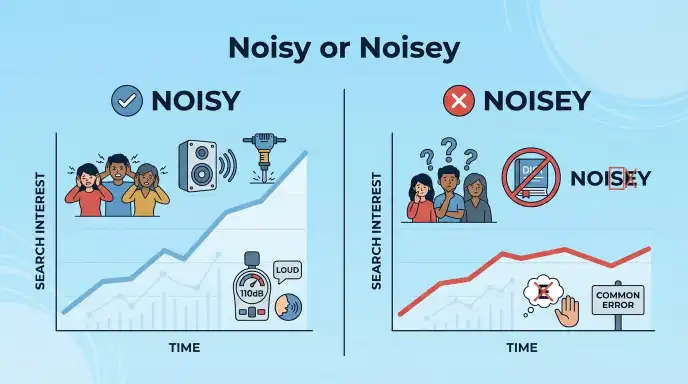
The correct spelling is noisy, not noisey. Noisy means making a lot of sound or having a high level of noise. The word often causes confusion because noise ends in -se, so some writers expect the adjective to become “noisey.”
However, English spelling changes the ending when -y is added. This makes noisy the standard form in both British and American English.
People often search for “noisy or noisey” when writing schoolwork, emails, messages, or formal documents. The mistake is easy to make because words such as key, grey, and money have different spelling patterns. Learning the correct form helps you avoid a common spelling error.
In this guide, you will learn what noisy means, where the word comes from, why noisey is incorrect, and how to use noisy in everyday and formal writing. You will also see simple examples and spelling comparisons.
Noisy or Noisey : Quick Answer
Noisy is the correct spelling. Noisey is a common misspelling and should not be used in standard English.
- Correct: The classroom was noisy.
- Incorrect: The classroom was noisey.
- Correct: It is too noisy outside.
- Incorrect: It is too noisey outside.
Noisy is an adjective. It describes a person, place, thing, or situation that produces a lot of sound.
Definition and Meaning of Noisy or Noisey
What Does Noisy Mean?
Noisy means making a lot of noise or having a lot of unwanted or loud sounds.
For example:
The children were noisy during the break.
This means the children were making a lot of sound.
Simple Meaning
The simple meaning of noisy is:
Noisy = full of or making a lot of sound.
The word can describe many things, including:
- A noisy classroom
- A noisy street
- A noisy restaurant
- A noisy machine
- A noisy neighbor
- A noisy party
Context and Usage
Noisy is used when sound is noticeable, loud, disturbing, or greater than expected.
For example:
The office became noisy after lunch.
We live near a noisy road.
The old machine is very noisy.
The word does not always mean that the sound is unpleasant. It simply means there is a lot of noise.
Is Noisey a Word?
Noisey is not the standard spelling of the adjective. It is usually a spelling mistake for noisy.
Use noisy in schoolwork, professional writing, emails, articles, and other standard English.
The Origin of Noisy or Noisey
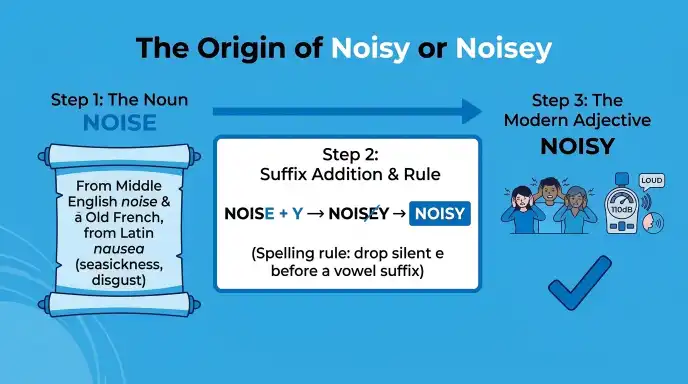
The word noisy comes from noise.
Noise entered English through Anglo-French and Old French forms related to disturbance, sound, or clamor. Over time, English developed noisy as the adjective meaning “full of noise” or “making much noise.”
The spelling noisy follows an established English spelling pattern. When the noun noise becomes the adjective noisy, the final e is removed before -y is added.
noise → noisy
This is why noisey is not the standard form.
The spelling can seem confusing because English has many words that do not follow one simple spelling rule. However, in modern standard English, noisy is the accepted spelling in both major varieties.
British English vs American English Spelling
There is no spelling difference between British and American English for this word.
Both use:
noisy
| English Variety | Correct Spelling | Example |
| British English | noisy | The street is noisy. |
| American English | noisy | The street is noisy. |
| Canadian English | noisy | The street is noisy. |
| Australian English | noisy | The street is noisy. |
| Standard International English | noisy | The street is noisy. |
Noisey is not the standard British or American spelling.
Examples in British English
The children were very noisy.
The train station can be noisy during rush hour.
Examples in American English
The neighbors were noisy last night.
This machine is too noisy for the office.
The spelling stays the same even though British and American English have differences in other words.
Noisy or Noisey : Which Spelling Should You Use?
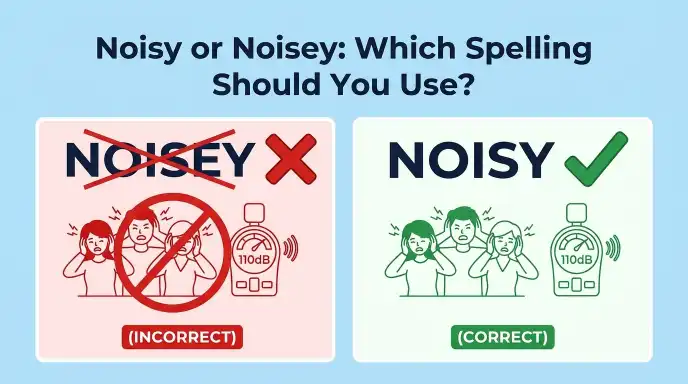
Use noisy in almost every standard English situation.
For American English
Use noisy in:
- School assignments
- Emails
- Business writing
- Articles
- Reports
- Social media posts
For British and Commonwealth English
Use noisy as well. The spelling does not change.
For Global English
Noisy is the safest and standard choice for international readers.
If you are unsure if to write noisy or noisey, choose noisy.
Remember:
Noise + y = noisy
Common Mistakes with Noisy or Noisey
The most common mistake is adding -ey instead of -y.
| Incorrect | Correct | Example |
| noisey | noisy | The room is noisy. |
| Noisey | Noisy | It was a noisy morning. |
| noisey streets | noisy streets | The city has noisy streets. |
| very noisey | very noisy | The children were very noisy. |
Writing Noisey
❌ The classroom was noisey.
✅ The classroom was noisy.
Using Noisey in Formal Writing
❌ The factory has a noisey environment.
✅ The factory has a noisy environment.
Confusing Noise and Noisy
Noise is usually a noun.
The noise was loud.
Noisy is an adjective.
The room was noisy.
This simple difference can help you choose the right word.
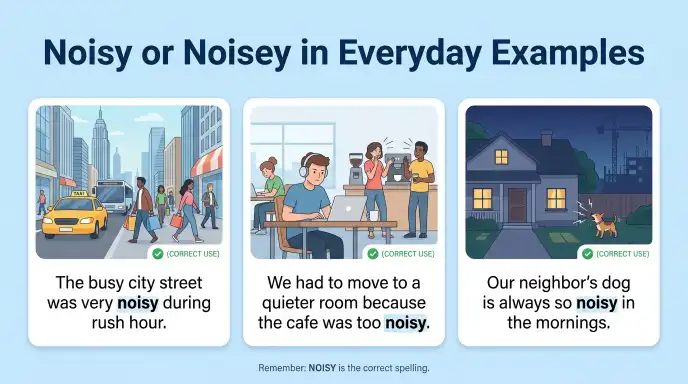
Noisy or Noisey in Everyday Examples
In Emails
The meeting room was too noisy, so we moved to another room.
Please close the door because the hallway is very noisy.
In News Writing
Residents complained about noisy traffic during the night.
Officials received complaints about noisy construction work.
On Social Media
The restaurant was crowded and noisy tonight.
My neighborhood gets really noisy on weekends.
In Formal Writing
Excessive traffic can create a noisy environment for nearby residents.
The equipment became noisy after several hours of use.
In Everyday Conversation
Why is it so noisy here?
The kids are being noisy today.
This fan is really noisy.
Noisy or Noisey : Google Trends & Usage Data
Search interest for spelling questions such as “noisy or noisey” usually comes from people checking which form is correct. The confusion is mainly caused by the appearance of the word noise and the incorrect assumption that the e should remain before -y.
For standard written English, noisy is the established form across English-speaking countries.
The word is used in many contexts, including:
- Everyday conversation
- Education
- Workplace communication
- News reports
- Social media
- Technical writing
- Descriptions of places and sounds
The misspelling noisey may appear in informal online content, user-generated posts, or other unedited text. Its appearance does not make it the standard spelling.
For professional and educational writing, use noisy.
Noisy vs Noisey: Spelling Comparison
| Feature | Noisy | Noisey |
| Spelling | Correct | Incorrect |
| Word type | Adjective | Misspelling |
| Meaning | Making or having a lot of noise | Intended to mean “noisy” |
| British English | Used | Not standard |
| American English | Used | Not standard |
| Formal writing | Recommended | Avoid |
| Example | A noisy street | A noisey street |
The key difference is simple:
Noisy = correct
Noisey = incorrect
FAQs About Noisy or Noisey
Q1. Is Noisy or Noisey Correct?
Noisy is correct. Noisey is a common misspelling and should be avoided in standard English.
Q2. How Do You Spell Noisy?
The correct spelling is noisy.
It is spelled:
N-O-I-S-Y
Q3. Is Noisey a Word?
Noisey is not the standard spelling of the adjective. Use noisy in standard English.
Q4. What Does Noisy Mean?
Noisy means making a lot of sound or having a lot of noise.
Example:
The children were noisy.
Q5. Is Noisy the Same in British and American English?
Yes. Both British and American English use noisy.
There is no standard spelling difference between the two varieties.
Q6. Why Is Noisy Spelled Without an E?
The word comes from noise, but the final e is removed before -y is added.
noise → noisy
Q7. What Is the Difference Between Noise and Noisy?
Noise is a noun, while noisy is an adjective.
The noise was loud.
The room was noisy.
Conclusion:
Noisy is the correct spelling, while noisey is a common misspelling. The word noisy is an adjective that means making or containing a lot of sound. It can describe people, places, machines, streets, rooms, events, and many other things.
The spelling stays the same in British English, American English, Canadian English, and Australian English. There is no standard English variety where noisey replaces noisy.
The confusion comes from the noun noise. When the adjective is formed, the spelling changes from noise to noisy. The final e is removed before -y is added.
For schoolwork, professional emails, reports, articles, and everyday writing, always choose noisy.
The easiest way to remember it is:
noise → noisy

I’m Nora Ellis, an English language writer passionate about making grammar, spelling, and confusing words easy to understand. I share clear explanations and practical examples to help readers improve their English and use words with confidence.







5 thoughts on “Noisy or Noisey: Correct Spelling, Meaning & Usage”