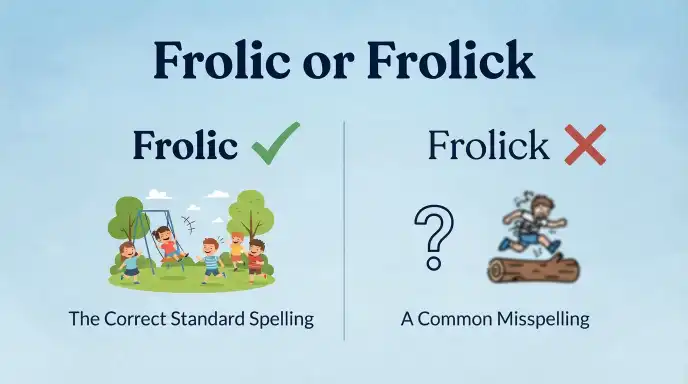
Frolic is the correct spelling, while frolick is incorrect in standard English. The word frolic can be a noun or a verb and means to play, move, or behave in a lively and cheerful way.
People often search for “frolic or frolick” because the final -k sound can make “frolick” seem like a possible spelling. This confusion is common when writing the past tense or present participle forms of the verb.
However, English spelling rules change slightly when a word ends in -c, so the correct forms are frolic, frolicked, and frolicking. Knowing these forms helps avoid mistakes in schoolwork, emails, creative writing, and formal documents.
In this guide, you will learn the correct spelling, meaning, origin, British and American usage, common errors, and practical examples. You will also see how frolic is used in different contexts and which form you should choose in everyday and professional writing.
Frolic or Frolick : Quick Answer
Frolic is the correct spelling. Frolick is not a standard English word.
Frolic can be used as both a verb and a noun.
- Verb: The children frolic in the garden.
- Past tense: The children frolicked in the garden.
- Present participle: The children are frolicking in the garden.
- Noun: We watched their joyful frolic.
The key point is that the base word is always frolic.
| Form | Correct? | Example |
| Frolic | ✅ Yes | The puppies frolic outside. |
| Frolick | ❌ No | Incorrect standard spelling |
| Frolicked | ✅ Yes | The children frolicked on the beach. |
| Frolicking | ✅ Yes | They are frolicking in the park. |
Definition and Meaning of Frolic or Frolick
Frolic means to play, run, jump, or move in a happy and energetic way. It often describes children, animals, or people enjoying themselves.
As a verb, frolic means to behave in a playful and lively way.
Example:
The puppies frolic in the grass.
As a noun, frolic refers to playful or lively activity.
Example:
The children enjoyed a frolic in the snow.
The word often creates a cheerful image. It can describe people playing outdoors, animals running around, or a group enjoying a lighthearted activity.
Simple Meaning
Frolic = to play or move happily and energetically.
Common examples include:
- Children frolic in the park.
- Horses frolic in the field.
- Lambs frolic in the meadow.
- The dolphins frolic in the water.
The spelling frolick does not have a separate meaning. It is simply a spelling error when used as the base form.
The Origin of Frolic or Frolick
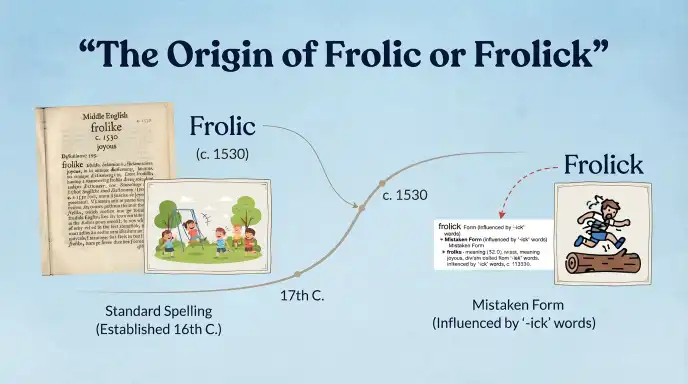
The word frolic has been used in English for several centuries. It came into English through older European languages and was associated with ideas of merriment, enjoyment, and playful behavior.
The modern spelling settled as frolic, without a second k at the end.
The confusion with frolick may come from the word’s pronunciation. The final c in frolic has a /k/ sound. When people hear the word, they may think the spelling should end in -ck.
English has many words where spelling and pronunciation do not match in an obvious way. In this case, the correct base form remains frolic.
There is also an important spelling change when adding some endings:
- frolic
- frolicked
- frolicking
The extra k appears before -ed and -ing to keep the hard /k/ sound.
This does not make frolick correct as the base word.
British English vs American English Spelling
There is no spelling difference between British English and American English for frolic.
Both varieties use:
frolic → frolicked → frolicking
The same spelling is also used in other major English varieties, including Canadian and Australian English.
| English Variety | Correct Base Form | Past Form | -ing Form |
| American English | frolic | frolicked | frolicking |
| British English | frolic | frolicked | frolicking |
| Canadian English | frolic | frolicked | frolicking |
| Australian English | frolic | frolicked | frolicking |
| International English | frolic | frolicked | frolicking |
So, unlike words such as color/colour or analyze/analyse, frolic does not change based on the English variety.
The main spelling rule to remember is that frolic takes an extra k before endings that begin with e or i:
- frolic + ed = frolicked
- frolic + ing = frolicking
Which Spelling Should You Use?
Use frolic when you need the base form of the word.
This spelling is correct for:
- American English
- British English
- Canadian English
- Australian English
- Academic writing
- Business writing
- Formal writing
- Creative writing
If you are writing in the United States, use frolic.
If you are writing for readers in the United Kingdom or other Commonwealth countries, also use frolic.
The spelling frolick should be avoided in standard English.
Easy Rule
Use “frolic” as the base word. Use “frolicked” and “frolicking” when adding those endings.
Common Mistakes with Frolic or Frolick
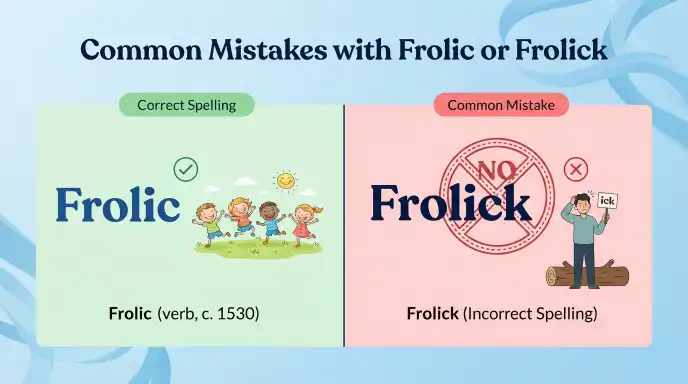
The most common mistake is adding k to the base word.
| Incorrect | Correct | Explanation |
| frolick | frolic | The base word ends in -lic. |
| frolicking | frolicking | The k is added before -ing. |
| frolicked | frolicked | The k is added before -ed. |
| frolics | frolics | The base spelling stays frolic. |
| frolics | frolics | The plural or third-person form keeps the original spelling. |
Using Frolick as the Base Word
❌ The children frolick in the park.
✅ The children frolic in the park.
Removing the K from Frolicked
❌ The children froliced in the park.
✅ The children frolicked in the park.
Removing the K from Frolicking
❌ The puppies are frolicing outside.
✅ The puppies are frolicking outside.
The important difference is simple:
Frolic is the base word, but frolicked and frolicking use kk.
Frolic or Frolick in Everyday Examples
In Emails
Correct:
The children will frolic outside during the school picnic.
Correct:
The puppies were frolicking in the garden.
In News Writing
Correct:
Young animals were seen frolicking in the open field.
News writing may use frolic when describing playful movement in a natural or public setting.
In Social Media
Correct:
Watching these puppies frolic around the yard made my day!
The word can sound warm, cheerful, and playful in social media posts.
In Formal Writing
Correct:
The children frolicked along the beach during the holiday.
Although frolic is a playful word, it can still appear in polished writing when the context suits it.
In Everyday Conversation
Correct:
The kids were frolicking in the rain.
Correct:
The lambs frolic in the field.
Frolic or Frolick : Google Trends & Usage Data
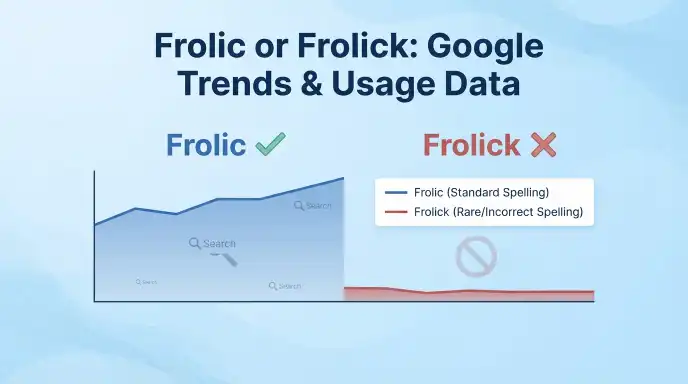
Searches for “frolic or frolick” usually come from people checking if the base word should end in -c or -ck.
The correct standard form is frolic across major English-speaking regions. There is no separate British spelling frolick and no American spelling frolick.
Usage also changes with context. Frolic is more common in:
- Creative writing
- Children’s writing
- Nature descriptions
- Literature
- Descriptions of animals
- Informal and cheerful content
The forms frolicked and frolicking are also common because they describe completed or ongoing playful action.
Search interest can vary by country and over time. However, search volume alone does not determine if a spelling is correct. A spelling dictionary and established English usage provide stronger evidence for standard spelling.
Frolic or Frolick: Spelling Comparison
| Word | Status | Meaning/Use |
| Frolic | ✅ Correct | Base verb or noun |
| Frolick | ❌ Incorrect | Not the standard base spelling |
| Frolics | ✅ Correct | Present-tense verb or plural noun |
| Frolicked | ✅ Correct | Past tense |
| Frolicking | ✅ Correct | Present participle |
| Frolicing | ❌ Incorrect | Missing the required k |
The easiest way to remember the pattern is:
frolic → frolicked → frolicking
Not:
frolick → froliced → frolicing
FAQs About Frolic or Frolick
Q1. Is frolic or frolick correct?
Frolic is correct. Frolick is not the standard English spelling of the base word.
Q2. Is frolic a verb or a noun?
Frolic can be both a verb and a noun. As a verb, it means to play or move in a lively way. As a noun, it means playful or lively activity.
Q3. Is frolicked spelled with two Ks?
Yes. The correct past-tense spelling is frolicked. The extra k keeps the hard /k/ sound before -ed.
Q4. Is frolicking correct spelling?
Yes. Frolicking is correct. The base word is frolic, but an extra k is added before -ing.
Q5. Do British people spell it frolic or frolick?
British English uses frolic. There is no British spelling frolick.
Q6. Why is it frolicked but not frolick?
English spelling rules require the k to be added before -ed and -ing to preserve the hard /k/ sound. The base form remains frolic.
Q7. What is the easiest way to remember frolic?
Remember this pattern: frolic, frolicked, frolicking. The extra k appears only when certain endings are added.
Conclusion:
Frolic is the correct standard spelling, while frolick is incorrect as the base form. The word frolic means to play, move, or behave in a happy and energetic way. It can work as both a verb and a noun.
The spelling stays the same in British and American English. This makes the word easier to use across different types of English. The main spelling point comes when you add endings. The correct forms are frolicked and frolicking, not froliced or frolicing.
If you are writing an email, school assignment, article, social media post, or formal document, choose frolic for the base form. When you need the past tense, use frolicked. For an ongoing action, use frolicking.
The simple rule is easy to remember: frolic is the base word, while frolicked and frolicking take an extra k.

I’m Nora Ellis, an English language writer passionate about making grammar, spelling, and confusing words easy to understand. I share clear explanations and practical examples to help readers improve their English and use words with confidence.




1 thought on “Frolic or Frolick: Meaning, Usage, and Examples in English”