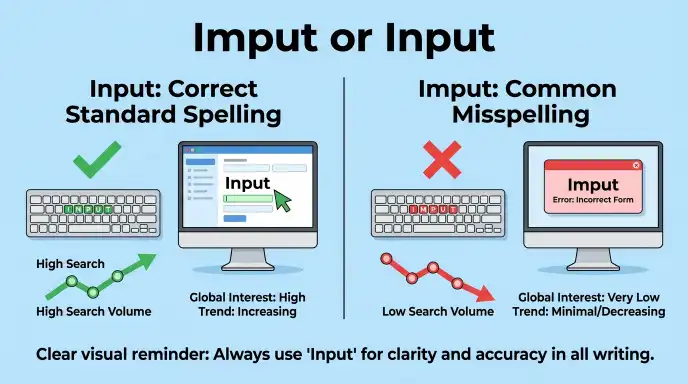
Input is the correct spelling, while imput is a common spelling mistake. The word input refers to information, ideas, or data that someone gives to a person, system, or device.
Many people search for imput or input because the two words can sound similar in everyday speech. When people speak quickly, the final sound of input may sound like an “m” before the “p.” This can lead to confusion when they write the word.
You may see this mistake in emails, school assignments, online forms, business reports, or social media posts. However, standard English dictionaries recognize input, not imput, as the correct spelling for this meaning.
The word input has several uses. You can input data into a computer, ask someone for input on a plan, or provide input during a meeting. In each case, the spelling stays the same.
This guide explains the meaning, origin, and correct use of imput or input. You will also see common mistakes, practical examples, and tips for remembering the correct spelling. By the end, you will know how to use input with confidence in both formal and everyday writing.
Imput or Input: Quick Answer
Input is the correct spelling. Imput is a misspelling and should not be used in standard English writing.
Examples:
- Please input your password.
- Thank you for your input on this project.
- The computer needs more input to complete the task.
Memory tip: The correct word is input, made from in and put. Remember the word put to help you spell it correctly.
Definition and Meaning of Imput or Input
The difference between imput and input is simple. Input is a real English word, while imput is a spelling error in standard usage.
What Does Input Mean?
Input means information, data, advice, or ideas given to a person, group, or system.
It can be used as both a noun and a verb.
Input as a Noun
As a noun, input refers to something that a person or system receives.
Examples:
- Your input helped us improve the plan.
- The computer processes the input from the keyboard.
- We need your input before making a final decision.
In these examples, input means advice, information, or data that someone or something receives.
Input as a Verb
As a verb, input means to enter or put information into a system, form, or device.
Examples:
- Please input your details into the form.
- She will input the results into the computer.
- The worker input the figures into the database yesterday.
The past tense is commonly input or inputted. Both forms are used, although the preferred form can depend on context and style.
Input in Technology
In technology, input means data or signals supplied to a computer, machine, or electronic system.
Examples include:
- Text entered through a keyboard
- Numbers entered into a calculator
- Voice commands given to a digital assistant
- Data sent to a computer program
The system uses this input to perform a task or produce an output.
Input in Work and Daily Life
In everyday language, input often means advice, feedback, or an opinion.
For example:
- The manager asked for everyone’s input.
- I would appreciate your input on this design.
- Her input helped us solve the problem.
In these sentences, input does not refer to computer data. It refers to ideas or feedback.
The Origin of Imput or Input
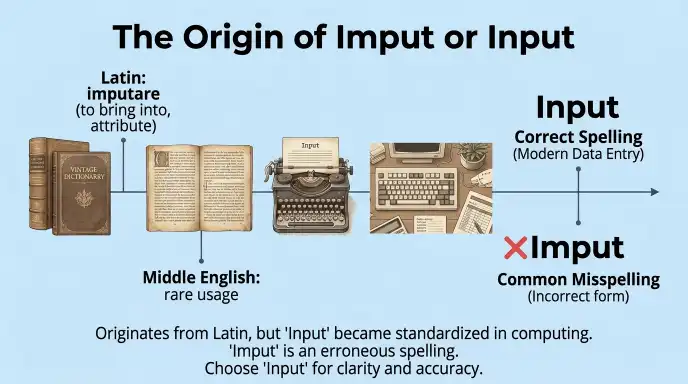
The word input comes from the combination of in and put. It follows a simple English pattern: something is put in, or information is entered into a system.
The word developed from the ordinary verb put and the prefix in. Over time, input became useful in areas such as business, engineering, computing, and communication.
In modern English, the word has two common roles. As a noun, it refers to information or advice that is supplied. As a verb, it means to enter or supply information.
The spelling imput likely appears because of how some people pronounce the word. When the sounds of n and p occur close together, the word may sound as if it contains an m. However, pronunciation does not change the standard spelling.
There is no separate standard meaning that makes imput correct in place of input. For ordinary English writing, always use input.
British English vs American English Spelling
There is no standard British and American spelling difference between input and imput. Both British and American English use input.
| British English | American English | Correct Usage |
| Input | Input | Please input your details. |
| Input | Input | We need your input on the report. |
| Input | Input | The system requires more input. |
| Inputted / Input | Inputted / Input | She inputted the data yesterday. |
Is Input Correct in British English?
Yes. Input is correct in British English. British writers use it when talking about information, advice, computer data, or entering details into a system.
Example: “Please input your information before you continue.”
Is Input Correct in American English?
Yes. Input is also the standard spelling in American English.
Example: “The software needs more input to complete the task.”
Why Do People Confuse Input and Imput?
The confusion usually comes from pronunciation. Some speakers may pronounce the word in a way that makes the n sound closer to m before the p. When they write the word, they may choose the wrong letter.
However, the correct spelling remains input in both English varieties.
Which Spelling Should You Use?
The choice is easy because input is the correct spelling across standard English varieties.
United States
Use input in emails, reports, schoolwork, and technical documents.
Example: “Please provide your input before Friday.”
United Kingdom
Use input in both formal and informal writing.
Example: “We welcome your input on the proposal.”
Canada and Australia
Use input in Canadian and Australian English as well. There is no regional spelling change to learn for this word.
International Writing
For international readers, always write input. It is widely understood and works in general, business, academic, and technical contexts.
Academic Writing
Use input when discussing data, research methods, feedback, or information supplied to a process.
Example: “The researchers collected input from 200 participants.”
Make sure the sentence explains what kind of input you mean.
Business Writing
Use input when requesting feedback or describing information entered into a system.
Example: “Please share your input on the new marketing plan.”
Avoid imput, as it can make professional writing look careless.
Common Mistakes with Imput or Input
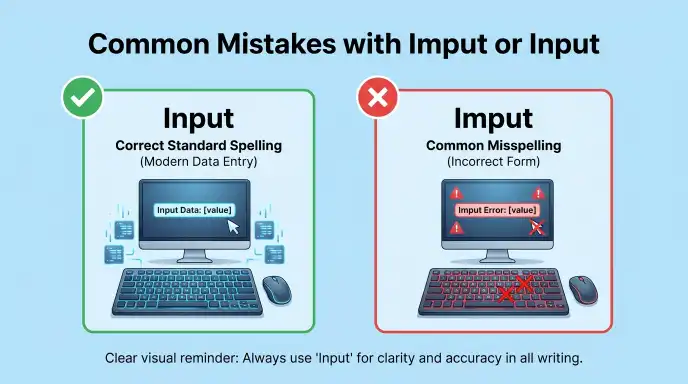
Writers often misspell input because they rely on how the word sounds. The following examples show how to correct this mistake.
| Incorrect | Correct | Explanation |
| Please imput your name. | Please input your name. | Input is the correct spelling. |
| We need your imput. | We need your input. | Use input when asking for feedback. |
| I will imput the data. | I will input the data. | Use input for entering information. |
| The system needs more imput. | The system needs more input. | The correct spelling applies to technical use too. |
| Thanks for your imput on the report. | Thanks for your input on the report. | Input is correct in business writing. |
How to Remember the Correct Spelling
Use this simple trick:
Input = In + Put
The word contains the familiar word put. Think of putting information in a form or computer.
Remember these points:
- Write input, not imput.
- Use input for information, advice, or data.
- Use input in both British and American English.
- Check your spelling before sending important emails or reports.
Input in Everyday Examples
The word input appears in many parts of daily life. These examples show how to use it correctly.
Emails
Correct: “Could you please provide your input on the attached document?”
This sentence asks someone to review a document and share their ideas.
Incorrect: “Could you please provide your imput on the attached document?”
The correct spelling is input.
Business Writing
Correct: “We value your input and will review your suggestions.”
Here, input means feedback or advice.
Incorrect: “We value your imput and will review your suggestions.”
Always use input in professional communication.
News Writing
Correct: “Local residents gave input on the proposed changes.”
This sentence means that residents shared their views.
Incorrect: “Local residents gave imput on the proposed changes.”
The spelling imput is incorrect.
Social Media
Correct: “I would love your input on my new design.”
This is a natural way to ask followers for feedback.
Incorrect: “I would love your imput on my new design.”
Even in casual posts, use the correct spelling.
Academic Writing
Correct: “The study examined input from teachers and students.”
Here, input refers to information or opinions gathered during research.
Incorrect: “The study examined imput from teachers and students.”
Use input in assignments, essays, and research papers.
Technology
Correct: “The program uses user input to generate a result.”
Here, input means data provided to the program.
Incorrect: “The program uses user imput to generate a result.”
The correct technical term is input.
Daily Conversation
Correct: “Can I get your input on this idea?”
This is a common way to ask for someone’s opinion.
Incorrect: “Can I get your imput on this idea?”
Although the word may sound different when spoken, the spelling does not change.
Imput or Input: Google Trends and Usage Data
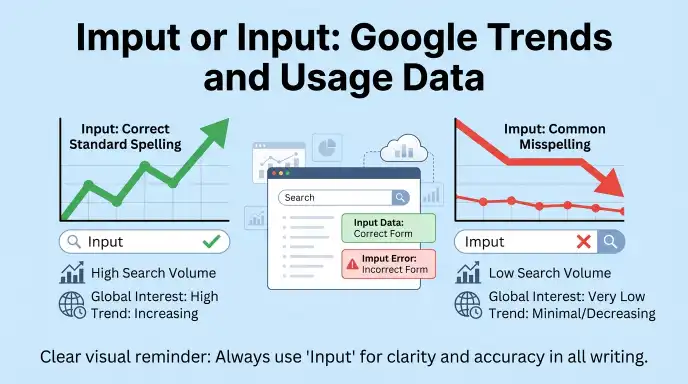
People search for imput or input because they want to confirm the correct spelling. The words can sound similar, and the error may appear when someone writes quickly or relies on pronunciation.
The correct form, input, is used in many contexts:
- Technology: Data entered into a computer or device
- Business: Feedback and suggestions
- Education: Information or opinions provided for a task
- Everyday writing: Advice or ideas from another person
The misspelling imput may appear in online searches, informal posts, or user-generated text. Its presence does not make it an accepted alternative.
Search interest may vary by country, language background, and context. However, no exact Google Trends figures are included here because a verified comparison for a defined time period and location has not been checked. Search frequency also does not determine if a spelling is correct.
For practical use, the advice is the same everywhere: write input in standard English.
Quick Comparison Table: Imput vs Input
| Word | Meaning | Correct? | Usage | Example |
| Input | Information, data, or feedback supplied to a person or system | Yes | Standard English | Please provide your input. |
| Imput | Common misspelling of input | No | Avoid in standard writing | Incorrect: Please imput your details. |
The difference is not regional. Input is correct in British, American, Canadian, Australian, and international English.
FAQs: Imput or Input
Q1. Is imput or input correct?
Input is correct. Imput is a common spelling mistake and is not the standard spelling of the word. Use input when talking about data, information, advice, or feedback. This rule applies to British, American, Canadian, and Australian English.
Q2. What does input mean?
Input means information, data, ideas, or advice given to a person or system. As a noun, it can mean feedback from a colleague or data sent to a computer. As a verb, it means to enter information into a form, device, or computer system.
Q3. Why do people spell input as imput?
People may write imput because of how they hear or pronounce the word. The n before the p can sound similar to an m in quick speech. However, the standard spelling is always input. Remembering the word as in + put can help prevent this error.
Q4. Is input correct in British English?
Yes. Input is the correct spelling in British English. British writers use it for data, advice, feedback, and information entered into a system. Unlike some words that have British and American spelling variations, input does not change between these two forms of English.
Q5. Is input a noun or a verb?
Input can be both a noun and a verb. As a noun, it means information or feedback that someone provides. For example, “We need your input.” As a verb, it means to enter information. For example, “Please input your details.” The sentence tells you which meaning applies.
Q6. What is the past tense of input?
The past tense can be input or inputted. Both forms are used in modern English. For example, you can write, “She inputted the data yesterday” or “She inputted the data yesterday.” In formal or technical writing, follow the style guide used by your organization.
Q7. How can I remember the spelling of input?
Think of input as two parts: in and out. When you enter data into a computer or form, you put information in. This memory tip helps you remember the correct spelling. Avoid imput, even if that is how the word sounds when spoken quickly.
Conclusion: Imput or Input?
When choosing between imput or input, always use input. It is the correct spelling in standard English, while imput is a misspelling. There is no British or American spelling difference for this word.
Input can work as both a noun and a verb. As a noun, it means information, feedback, advice, or data that someone or something receives. As a verb, it means to enter information into a computer, form, or system.
You may use the word in business emails, academic writing, technology guides, news articles, and everyday conversation. For example, you can ask a colleague for input, provide input on a report, or input details into an online form.
The easiest way to remember the spelling is to think of in + put. This simple trick can help you avoid the common mistake of writing imput.
No matter where your readers live, choose input and use it consistently. Correct spelling makes your writing clearer and helps you communicate with confidence.
Remember: You put information in, so the correct word is input, never imput.

I’m Nora Ellis, an English language writer passionate about making grammar, spelling, and confusing words easy to understand. I share clear explanations and practical examples to help readers improve their English and use words with confidence.