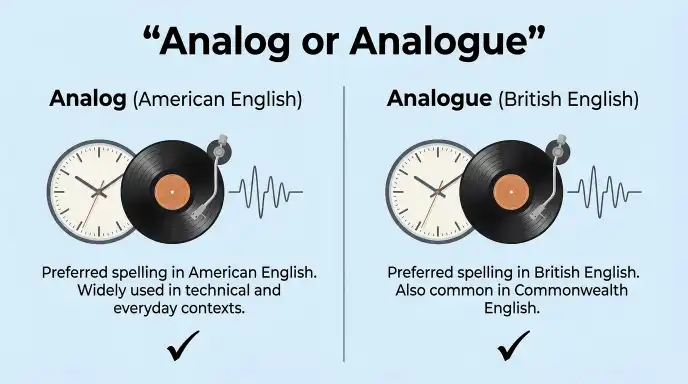
The correct choice between analog or analogue depends on your audience, region, and context. Both spellings are correct, and both can describe something that works in a continuous way rather than through digital values.
However, analog is the usual spelling in American English, while analogue is more common in British English. This difference can cause confusion when you write about technology, science, music, or everyday comparisons. For example, an American writer will usually refer to an analog clock, while a British writer may prefer an analogue clock. Both forms have the same basic meaning.
The words can also act as nouns and adjectives. In general writing, an analogue can be something that serves as a counterpart or equivalent to something else. In science and technology, analog and analogue often describe signals or devices that represent changing values continuously.
So, which spelling should you use? That depends on who will read your work and which style guide you follow. This guide explains the meaning, origin, regional differences, common mistakes, and practical examples of analog or analogue. By the end, you will know which spelling fits your writing.
Analog or Analogue: Which Spelling Is Correct?
Both analog and analogue are correct English spellings. Analog is preferred in American English, while analogue is widely used in British English and other varieties that follow British spelling conventions.
Both forms can describe technology that uses continuous signals, such as an analog or analogue clock. The main difference is regional spelling, not meaning.
Analog or Analogue: Quick Answer
- Analog: The standard spelling in American English.
- Analogue: The common spelling in British English.
- Meaning: Both can describe continuous signals or something that serves as a counterpart to another thing.
Examples:
- The American manual explains how to use an analog watch.
- The British textbook describes an analogue signal.
- This model is the closest analogue to the original design.
Choose the spelling that matches your audience, and use it consistently throughout your writing.
What Does Analog or Analogue Mean?
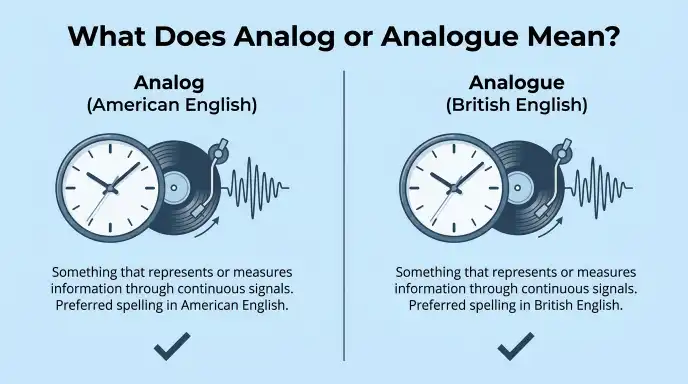
Analog and analogue have closely related meanings. Their use depends on the subject and the sentence.
Analog or Analogue in Technology
In technology, these words describe systems that represent information through continuously changing physical values, such as voltage or sound waves.
Examples include:
- Analog clock: A clock with hands that move around a dial.
- Analog radio: A radio that receives or processes signals in an analog format.
- Analog signal: A signal that changes continuously over a range of values.
A digital system, by contrast, represents information using separate values, often as binary digits.
Analogue as a Noun
The noun analogue can mean something that matches or performs a similar role to something else.
For example:
- This plant is an analogue of a species found in another region.
- The new system serves as a modern analogue of the older model.
- Scientists studied an animal analogue to understand a biological process.
American English often uses analog in technical terms. In broader British usage, analogue is common when referring to a counterpart or equivalent.
Analog or Analogue in Everyday Language
People may also use these words when comparing things that share a similar purpose or structure.
For example:
- A paper planner can be an analogue to a digital calendar.
- A real-world model may serve as an analogue for a complex process.
In ordinary conversation, simpler words such as equivalent, counterpart, or similar example may sound more natural.
The Origin of Analog or Analogue
Both spellings come from the same word family. They are linked to the Greek word analogos, which carries the idea of being proportionate or corresponding.
The term entered English through forms related to analogy. Over time, analogue became common in British English, while analog became the usual American spelling.
The difference follows a wider pattern in English. Some words have shorter American forms and longer British forms. Examples include catalogue/catalog and dialogue/dialog in certain styles, although preferences can vary by word and publisher.
The terms gained importance in science and engineering because they describe systems that represent changing quantities. An analog or analogue signal can vary smoothly rather than moving only between separate digital states.
Today, both spellings remain established. The spelling you choose usually reflects regional convention or the style guide used by your school, publisher, or workplace.
British English vs American English
The main difference between analog and analogue is regional spelling. Both forms are understood in English-speaking countries, but one may look more natural than the other.
| British English | American English | Example |
| Analogue | Analog | An analogue/analog clock hangs on the wall. |
| Analogue signal | Analog signal | The device converts sound into an analogue/analog signal. |
| Analogue technology | Analog technology | The company still uses analogue/analog equipment. |
| An analogue of something | An analog of something | The model is an analogue/analog of the original system. |
Regional Differences
United States: Use analog in most writing, including technical documents and general articles.
United Kingdom: Analogue is the traditional and widely used spelling. It is common in British technical and general writing.
Canada: Both forms may appear. Follow the spelling used by the relevant Canadian institution, publication, or technical standard.
Australia: Analogue is generally the more familiar spelling in standard Australian English, though technical contexts may follow specific standards.
What About Style Guides?
Style guides help writers keep spelling consistent. A university, journal, company, or publisher may have its own preferred form.
If you are writing for an American publication, use analog unless its style guide says otherwise. For a British publication, analogue is usually the safer choice.
In technical writing, check the terminology used by the relevant organization or industry standard. Consistency matters more than switching between the two forms.
Analog or Analogue: Which Version Should You Use?
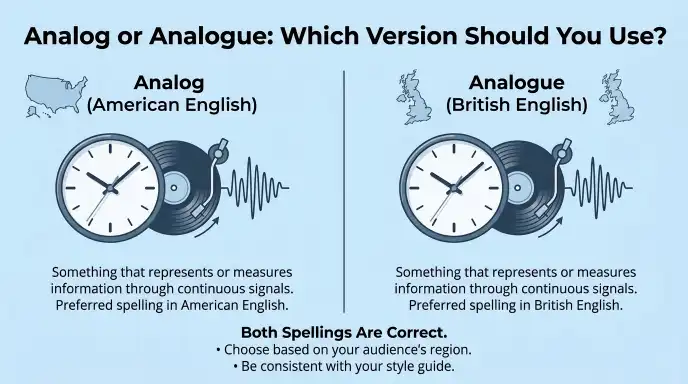
Choose the spelling that fits your readers and the type of writing you are doing.
United States
Use analog.
Examples:
- an analog clock
- an analog recording
- an analog signal
This spelling is standard in American English.
United Kingdom
Use analogue.
Examples:
- an analogue clock
- analogue equipment
- an analogue signal
This form is common in British English.
Canada
Check your organization’s style guide. Canadian English includes both British and American influences, so the best choice can depend on the publication and subject.
If you are writing for a Canadian technical organization, follow its terminology and documentation standards.
Australia
Analogue is generally a suitable choice for standard Australian English. Still, follow the house style of a publisher, employer, or academic institution when one exists.
International Writing
For an international audience, either spelling can work. Choose one based on your main audience or the English variety used by your organization.
Do not alternate between analog and analogue without a clear reason.
Academic Writing
Follow the style guide required by your school, university, journal, or professor. In technical subjects, also check if a field-specific standard uses one form.
Business Writing
Use the form preferred by your company or target market. If your business serves American customers, analog is usually the natural choice. For British customers, analogue is often more suitable.
Common Mistakes with Analog or Analogue
The most common mistake is assuming that one spelling is correct everywhere and the other is always wrong. Both are accepted, but regional preferences differ.
| Incorrect or less suitable use | Better choice | Explanation |
| An analogue clock in an American style guide that requires US spelling | An analog clock | Match American spelling conventions. |
| An analog clock in a British publication that requires UK spelling | An analogue clock | Match British spelling conventions. |
| Switching between analog and analogue in one article without a reason | Use one spelling consistently | Consistency makes writing easier to read. |
| Calling every non-digital object an analog device | Use the term that fits the technology | Not every non-digital item uses analog signals. |
| Using analogue when you mean an exact copy | Use copy or duplicate if that is the meaning | An analogue is often a counterpart, not an identical item. |
Memory Tip
Remember this simple rule:
- US = analog
- UK = analogue
The extra -ue is a helpful clue for the British form. This is a spelling guide, not an absolute rule for every organization, so check any required style guide.
Analog or Analogue in Everyday Examples
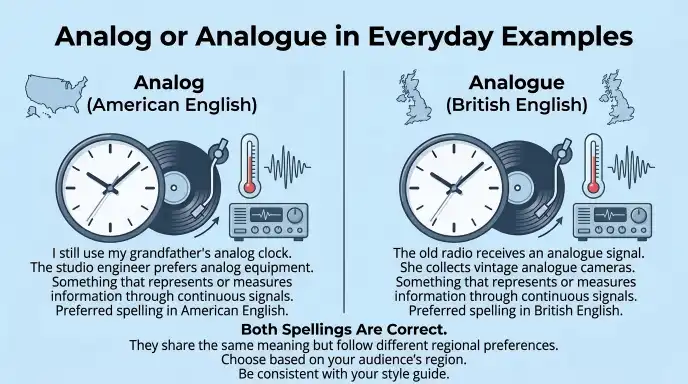
These examples show how the words work in different types of writing.
Emails
American English:
“Please bring the analog meter to the meeting.”
British English:
“Please bring the analogue meter to the meeting.”
Both sentences are correct. The spelling changes to match the reader.
Business Writing
American English:
“Our team is replacing the old analog equipment with digital systems.”
British English:
“Our team is replacing the old analogue equipment with digital systems.”
Use the spelling preferred by your company’s style guide.
News Headlines
American English:
“Analog Technology Still Has a Place in Modern Audio”
British English:
“Analogue Technology Still Has a Place in Modern Audio”
Headlines should follow the publication’s usual spelling.
Blogs
- This guide explains how an analog clock works.
- This article compares analogue and digital recording.
- An analogue can serve as a useful model for a more complex idea.
When writing a blog, identify your main audience before choosing the spelling.
Social Media
- “Do you still use an analog camera?”
- “I love the look of analogue photography.”
- “An old-fashioned clock can be a simple example of analog technology.”
Social media allows a more casual tone, but regional spelling still helps maintain consistency.
Academic Writing
- The researcher measured the output of an analog circuit.
- The study used an analogue model to explain the process.
Use the spelling required by the academic style guide. In technical research, make sure the word matches the concept you are describing.
Daily Conversation
- “My grandfather still wears an analog watch.”
- “This analogue system is based on the older design.”
- “The example is an analogue of the real process.”
In everyday speech, both spellings are usually easy to understand. The difference mainly appears in writing.
Analog or Analogue: Google Trends and Modern Usage
Both spellings remain in modern use. The choice often reflects the country, publication, or technical field in which the word appears.
In the United States, analog is the usual form. In the United Kingdom and many contexts that follow British spelling, analogue is common. Canadian and Australian usage can depend on the publisher, institution, or subject.
People search for “analog or analogue” for several reasons:
- They want to know which spelling is correct.
- They are writing about clocks, signals, audio, or electronics.
- They need to follow American or British spelling.
- They want to avoid inconsistent spelling in a school assignment, report, or article.
Google Trends can help compare search interest across locations and over time. However, search interest does not prove that a spelling is more correct. No exact Trends figures are included here because verified data for a specific period and location has not been provided.
For practical writing, the most useful rule is to match the regional spelling convention and follow any relevant style guide.
Quick Comparison Table: Analog vs Analogue
| Version | Meaning | Correct? | Region | Example |
| Analog | A continuous signal or a corresponding model | Yes | Mainly American English | The analog clock is on the desk. |
| Analogue | A continuous signal or a corresponding model | Yes | Mainly British English | The analogue clock is on the desk. |
| Analog signal | A signal that changes continuously | Yes | Common in US writing | The sensor produces an analog signal. |
| Analogue signal | A signal that changes continuously | Yes | Common in UK writing | The sensor produces an analogue signal. |
The key difference is spelling preference, not a change in the basic meaning.
Key Takeaways
- Analog and analogue are both correct spellings.
- Analog is the usual choice in American English.
- Analogue is common in British English.
- Both can describe continuous signals and devices.
- Analogue can also mean a counterpart or equivalent.
- Canadian and Australian usage may depend on the publication or field.
- Follow your style guide when writing for school, work, or publication.
- Choose one spelling and use it consistently.
FAQs: Analog or Analogue
Q1. Is analog or analogue correct?
Both analog and analogue are correct. The main difference is regional spelling. American English usually uses analog, while British English commonly uses analogue.
If you are writing for a specific publication, school, or business, follow its style guide. Neither spelling is automatically wrong in every context.
Q2. What is the difference between analog and analogue?
There is usually no difference in meaning. Both words can describe technology that represents continuously changing values, such as an analog or analogue signal.
They can also refer to a counterpart or equivalent. The main difference is that analog is preferred in American English, while analogue is common in British English.
Q3. Is analog American or British English?
Analog is the standard spelling in American English. It appears in terms such as analog clock, analog signal, and analog recording.
British English generally prefers analogue in these contexts. When writing for an American audience, choose analog unless a required style guide specifies another form.
Q4. Is it an analogue of British English?
Yes. Analogue is widely used in British English. It appears in phrases such as analogue clock, analogue signal, and analogue technology.
It is also understood in American English, although analog is more common there. The spelling you choose should fit your readers and any style rules you must follow.
Q5. Should I write an analog clock or analogue clock?
Use analog clock for most American English writing and analogue clock for most British English writing. Both describe a clock that commonly displays time with hands moving around a dial. The difference is spelling, not the basic meaning. If you are following a style guide, use its preferred form.
Q6. Is analog or analogue used in science?
Both forms are used in scientific and technical writing. American publications often use analog, while British publications often use analogue.
The best choice may depend on a journal’s style guide or an industry’s terminology standard. In technical work, use the spelling consistently and make sure the term accurately describes the system or signal.
Q7. Does analogue mean the same as equivalent?
Not always, but the meanings can overlap. An analogue is something that corresponds to or serves a similar role to another thing. An equivalent is something equal in value, function, or meaning. A useful analogue may be similar without being identical. Choose the word that best matches the relationship you want to describe.
Q8. Is analogue correct in American English?
Yes, analogue is a recognized spelling, but analog is the usual American form. You may see analogue in American writing, especially when quoting a source or following a particular style. For most US-focused articles, reports, and manuals, use analog to match common American spelling conventions.
Conclusion: Analog or Analogue?
The choice between analog or analogue is simple once you know your audience. Both spellings are correct, and both can describe continuous signals, related technology, or something that serves as a counterpart to another thing.
For American English, analog is usually the best choice. For British English, analogue is generally preferred. Canadian and Australian writers should check the spelling used by their organization or publication, especially in academic and technical work.
Do not assume that one spelling is always right and the other is wrong. Instead, focus on regional convention, meaning, and consistency. If a style guide gives a clear rule, follow it. If no rule applies, choose the spelling that suits your readers and use it throughout the document.
The same approach helps with many other spelling differences in English. Knowing the audience often matters more than memorizing a long list of regional forms.
Remember: analog for most US writing, analogue for most UK writing. Choose your audience, then keep your spelling consistent.

I’m Nora Ellis, an English language writer passionate about making grammar, spelling, and confusing words easy to understand. I share clear explanations and practical examples to help readers improve their English and use words with confidence.