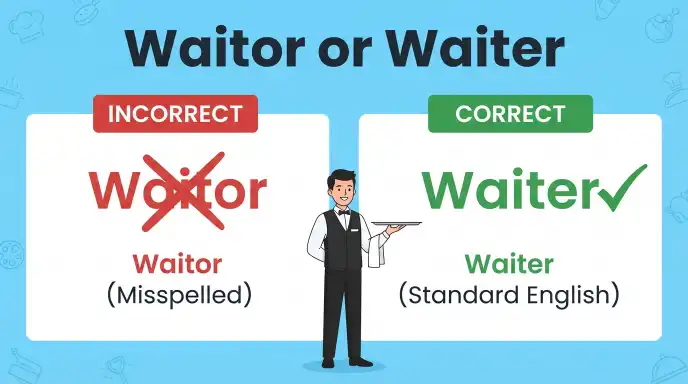
The correct spelling is waiter, not waitor. A waiter is a person who serves food and drinks to customers in a restaurant, café, hotel, or similar place.
Many people search for waitor or waiter because the two forms sound similar when spoken. The confusion often comes from the endings -er and -or, which both appear in English words. However, only waiter is the standard spelling.
Knowing the correct form can help you avoid mistakes in emails, schoolwork, job applications, restaurant reviews, and everyday messages. Fortunately, the rule is simple. The word is formed from wait + -er, giving us waiter. This spelling is used in both British and American English, so there is no regional spelling choice to make.
Traditionally, waiter referred to a male restaurant worker, while waitress referred to a female worker. Today, server is also widely used as a gender-neutral term. This guide explains the meaning, origin, spelling, common mistakes, and everyday use of waiter.
Waitor or Waiter : Quick Answer
Waiter is the correct spelling. Waitor is incorrect in standard English.
A waiter is a person who serves food and drinks to customers, usually in a restaurant or café.
Correct: The waiter brought us the menu.
Incorrect: The waitor brought us the menu.
Therefore, remember that the word ends in -er, not -or.
Definition and Meaning of Waitor or Waiter
The correct word is waiter. It describes a person whose job is to serve customers in a restaurant, café, hotel, or similar place.
In simple terms, a waiter may take orders, bring food and drinks, answer questions, and help customers during a meal.
Waiter as a Job
The most common meaning relates to restaurant service.
For example:
The waiter took our order quickly.
Here, waiter means the person serving the customers.
Waiter in Everyday English
People often use waiter when talking about restaurant service. For instance:
We asked the waiter for some water.
The word can appear in casual speech as well as formal writing.
Waiter and Server
Server is another common word for a person who serves customers. It is gender-neutral and can be useful in modern workplaces.
However, waiter remains a standard and widely understood term. The best choice depends on the context and the style you want to use.
The Origin of Waitor or Waiter
The word waiter comes from the verb wait and the suffix -er. In English, the suffix -er often creates a noun for a person who performs an action.
Consider these familiar examples:
- teach + er = teacher
- work + er = worker
- drive + er = driver
- wait + er = waiter
As a result, waiter follows a common English word-building pattern.
The verb wait has a long history in the English language. It developed through older French and Germanic influences before becoming established in English. Over time, waiter came to describe a person who waits on or serves customers.
The incorrect spelling waitor likely comes from confusion with words that end in -or. English has many such words, including actor, doctor, and visitor. Even so, the waiter does not follow that pattern.
Waitor or Waiter: British English vs American English Spelling
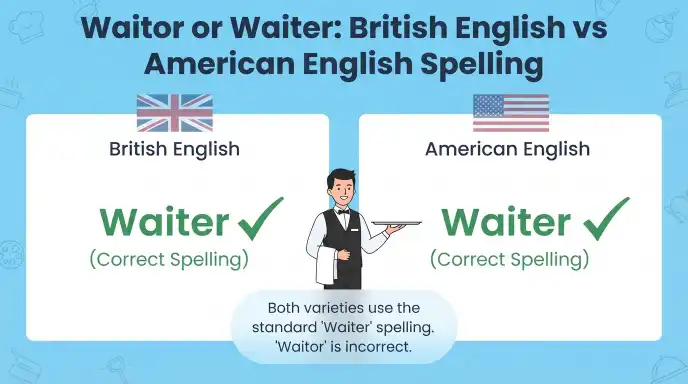
There is no spelling difference between British and American English for this word. Both varieties use a waiter.
| English Variety | Correct Spelling | Example |
| British English | waiter | The waiter brought the bill. |
| American English | waiter | The waiter brought the check. |
| Canadian English | waiter | The waiter took our order. |
| Australian English | waiter | The waiter served the meal. |
| International English | waiter | The waiter welcomed the guests. |
Although the spelling stays the same, some restaurant vocabulary can differ by region. For example, British English commonly uses bill, while American English often uses check.
Nevertheless, waiter remains the correct spelling in both varieties.
The form waitor is not a standard British or American spelling.
Which Spelling Should You Use?
Use waiter whenever you mean a person who serves customers in a restaurant or similar setting.
For American English
American writers should use waiter in schoolwork, emails, business writing, and everyday communication. The same spelling applies in both casual and formal situations.
For British English
British writers should also use waiter. There is no need to change the spelling for British audiences.
For Other English Varieties
Speakers and writers in Canada, Australia, New Zealand, and many other English-speaking regions also use waiter.
Therefore, waiter is a safe choice for international English.
For Formal Writing
The word waiter is suitable for reports, applications, articles, and other formal documents. However, a server may be preferable when you want a gender-neutral job title.
Common Mistakes with Waitor or Waiter
The biggest spelling mistake is writing waitor instead of waiter. Other errors can occur when writers form plurals or possessive forms.
| Incorrect | Correct | Explanation |
| waitor | waiter | The standard word ends in -er. |
| waitors | waiters | The plural form adds -s to waiter. |
| waitor’s | waiter’s | The possessive form comes from waiter. |
| waitors’ | waiters’ | The plural possessive comes from waiters. |
Using Waitor
Wrong: The waitor gave us the menu.
Correct: The waiter gave us the menu.
The correction is simple because the standard spelling uses -er.
Using Waitors
Wrong: Several waitors were working that evening.
Correct: Several waiters were working that evening.
The plural form is made by adding -s to waiter.
Mistake 3: Confusing Waiter With Server
Both waiter and server can describe a restaurant worker. However, server is broader and is often used as a gender-neutral term.
For traditional wording, waiter is still perfectly correct.
Waitor or Waiter in Everyday Examples
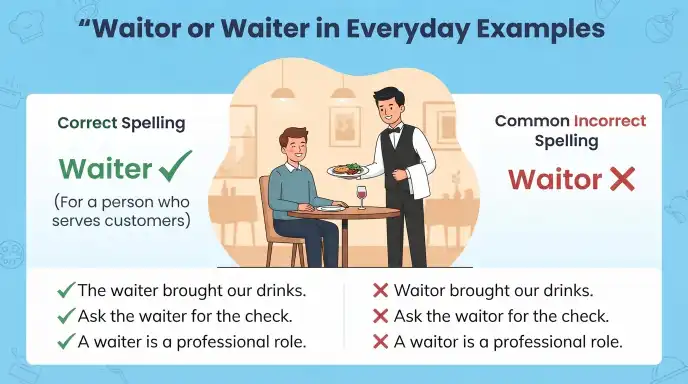
The word waiter can appear in many types of writing. Here are some simple examples.
In Emails
Could you please ask the waiter for another glass of water?
This sentence uses waiter correctly in a polite request.
In News Writing
The waiter helped guests leave the restaurant safely.
News writing can use waiter when describing a person involved in a restaurant event.
On Social Media
Our waiter was very friendly and helpful tonight.
The word also works naturally in casual social media posts.
In Formal Writing
The waiter provided professional service throughout the meal.
This example shows that waiter is also suitable for more formal contexts.
In Conversation
The waiter just brought our food.
Short, direct sentences like this are common in everyday speech.
In a Restaurant Review
The food was excellent, and the waiter was polite and attentive.
Here, the waiter clearly identifies the person who served the customers.
Waitor or Waiter : Google Trends & Usage Data
People often search for waitor or waiter because they are unsure about the correct spelling. The confusion is understandable because the word can sound similar to other English words that use -or.
However, waiter is the established spelling in standard English. The incorrect form waitor may appear in informal online content or user-generated text, but such appearances do not make it a standard spelling.
Usage can also depend on the setting. In many modern restaurants, server is preferred as a gender-neutral job title. Even so, waiters remain common and widely understood.
Country differences do not change the spelling. British, American, Canadian, and Australian English all use waiter.
Therefore, if your goal is correct standard English, choose waiter rather than waitor.
Waitor vs Waiter: Comparison Table
| Word | Correct? | Meaning | Usage |
| waiter | ✅ Yes | A person who serves customers | Standard English |
| waitor | ❌ No | Intended to mean a restaurant server | Spelling mistake |
| waiters | ✅ Yes | More than one waiter | Plural |
| waiter’s | ✅ Yes | Belonging to one waiter | Singular possessive |
| waiters’ | ✅ Yes | Belonging to several waiters | Plural possessive |
| server | ✅ Yes | A person who serves customers | Gender-neutral term |
The key point is that waiter is the only standard spelling of the two forms in the main comparison.
FAQs About Waitor or Waiter
Q1. Is waitor or waiter correct?
Waiter is correct. Waitor is a spelling mistake. Use waiter when referring to a person who serves food and drinks.
Q2. Why is waiter spelled with -er?
The word waiter comes from wait + -er. English commonly uses -er to create nouns for people who perform an action, such as teacher, worker, and driver.
Q3. Is waitor a word?
Waitor is not the standard spelling for a restaurant server. In standard English, the correct form is waiter.
Q4. Is waiter spelled the same in British and American English?
Yes. British and American English both use waiters. Unlike some English words, this term has no regional spelling difference.
Q5. What is the plural of waiter?
The plural of waiter is waiters.
For example:
Three waiters were serving the guests.
The spelling stays the same apart from the added -s.
Q6. Can waiter be used for a woman?
Traditionally, waiter referred to a male restaurant worker, while waitress referred to a female worker. Today, usage can be broader, and server is often used as a gender-neutral alternative.
Q7. What is another word for waiter?
Server is a common alternative. It is gender-neutral and can describe a person who serves customers in a restaurant or similar setting.
Conclusion:
The correct spelling is waiter, while waitor is incorrect. A waiter is a person who serves food and drinks to customers, usually in a restaurant, café, or hotel. The spelling remains the same in British and American English, so there is no regional version to remember.
The main reason people make this mistake is confusion between the endings -er and -or. Fortunately, the spelling is easy to remember: wait + er = waiter. The plural is waiters, while waiter’s and waiters’ are the correct possessive forms.
In everyday writing, use waiter in conversations, emails, reviews, social media posts, school assignments, and formal documents. If you prefer a gender-neutral job title, server is another useful option. Above all, avoid waitor when you want standard English.
Remembering this simple rule will help you spell the word correctly and communicate clearly in any English-speaking context.

I’m Nora Ellis, an English language writer passionate about making grammar, spelling, and confusing words easy to understand. I share clear explanations and practical examples to help readers improve their English and use words with confidence.





2 thoughts on “Waitor or Waiter: Correct Spelling, Meaning & Usage”