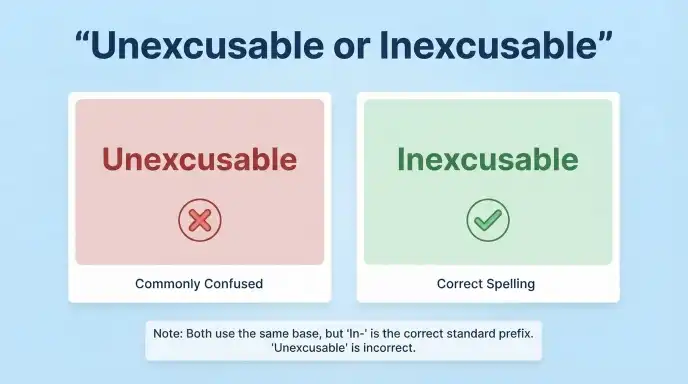
Inexcusable is the correct spelling, while unexcusable is not the standard form. Many people search for unexcusable or inexcusable because both forms look possible at first. The confusion often comes from the English prefix un-, which creates many negative words.
For example, we use unhappy, unfair, and unclear. However, English does not use un- with every word. The standard English word is inexcusable. It describes something that people cannot reasonably excuse, forgive, or justify. For example, you can say, “His rude behavior was inexcusable.” The word often shows strong disapproval of an action, mistake, delay, or behavior.
Fortunately, the spelling stays the same in British and American English. You can also use inexcusable in everyday conversations, emails, news reports, social media posts, and formal writing. This guide explains the meaning, origin, spelling, common mistakes, and correct usage of inexcusable. By the end, you will know which form to use and why.
Unexcusable or Inexcusable : Quick Answer
Inexcusable is the correct spelling. Unexcusable is not the standard form.
The word inexcusable means something that people cannot reasonably excuse, forgive, or justify.
Correct: His behavior was inexcusable.
Incorrect: His behavior was unexcusable.
For another example:
Being late without a good reason was inexcusable.
Therefore, use inexcusable when you mean that something is too wrong or unacceptable to excuse.
Definition and Meaning of Unexcusable or Inexcusable
Inexcusable is an adjective. It describes an action, mistake, behavior, or situation that people cannot reasonably forgive or justify.
In simple terms, inexcusable means not acceptable and impossible to justify.
Simple Meaning
The word inexcusable can mean:
- impossible to excuse
- impossible to justify
- not acceptable
- too wrong to forgive
For example:
The employee’s rude behavior was inexcusable.
This sentence means that the behavior was too inappropriate to justify.
Context and Usage
People use inexcusable words when they want to express strong criticism. The word can describe many things, including mistakes, actions, behavior, delays, and failures.
For instance:
The company called the mistake inexcusable.
Here, the company considers the mistake unacceptable.
Inexcusable Behavior
The word often describes behavior that someone strongly disapproves of.
Lying to a customer is inexcusable.
The speaker considers the action unacceptable and cannot find a good reason for it.
Inexcusable and Excusable
Excusable and inexcusable have opposite meanings.
Excusable means something has a reasonable explanation or can receive forgiveness.
Inexcusable means something has no acceptable excuse.
For example:
A small mistake may be excusable, but repeated dishonesty is inexcusable.
The Origin of Unexcusable or Inexcusable
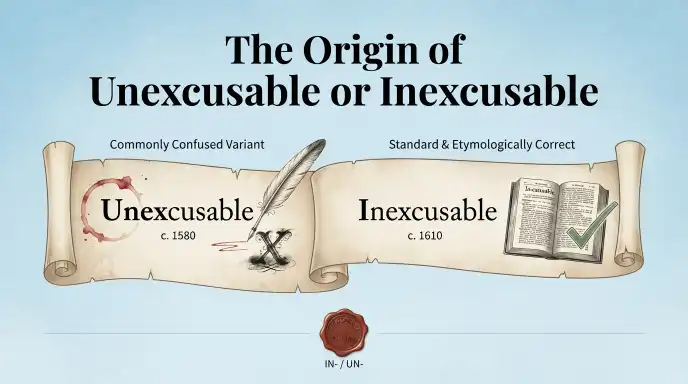
The word inexcusable comes from excuse and the suffix -able. English then adds the negative prefix in- to create the opposite meaning.
The word excuse has roots in Latin. It entered English through French and developed the sense of giving a reason that removes blame or explains an action.
The suffix -able means something can happen or receive an action. Therefore, excusable means something that people can excuse.
Adding in- changes the meaning:
in + excusable = inexcusable
As a result, inexcusable describes something that people cannot excuse.
The form unexcusable may look logical because English uses un- in many negative adjectives. However, English does not let writers add un- freely to every adjective.
For this reason, standard English is inexcusable.
British English vs American English Spelling
British and American English use the same spelling for this word.
The correct form in both varieties is:
inexcusable
| English Variety | Correct Spelling | Example |
| British English | inexcusable | His behavior was inexcusable. |
| American English | inexcusable | His behavior was inexcusable. |
| Canadian English | inexcusable | The delay was inexcusable. |
| Australian English | inexcusable | Such conduct was inexcusable. |
| International English | inexcusable | The mistake was inexcusable. |
Unlike some English words, inexcusable does not have a British or American spelling variant.
So, writers in both major varieties should use inexcusable.
The spelling unexcusable does not become correct in either variety.
Which Spelling Should You Use?
Use inexcusable whenever you want to say that something cannot reasonably receive an excuse or justification.
For American English
American writers should use inexcusable in school assignments, emails, reports, articles, and everyday communication.
For British English
British writers should also choose inexcusable. The spelling does not change.
For Canadian and Australian English
Writers in Canada and Australia can use inexcusable without changing the spelling.
For Global English
International writers should choose inexcusable because it works across major English varieties.
The unexcusable form can create doubt about your spelling. Therefore, avoid it in professional and formal writing.
Common Mistakes with Unexcusable or Inexcusable
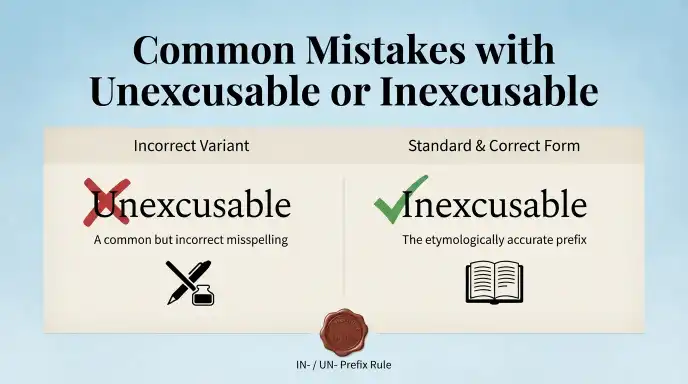
The most common error involves choosing unexcusable instead of inexcusable.
| Incorrect | Correct | Explanation |
| unexcusable | inexcusable | Standard English uses in-. |
| unexcusable behavior | inexcusable behavior | Use the established adjective. |
| unexcusable mistake | inexcusable mistake | The correct form is inexcusable. |
| unexcusable delay | inexcusable delay | Use inexcusable for an unacceptable delay. |
Assuming Un- Always Works
English uses un- in many common words. Examples include unhappy, unfair, and unclear.
However, you cannot add un- to every adjective. English has different negative prefixes, and each word follows its established form.
Therefore:
Correct: inexcusable
Incorrect: unexcusable
Confusing Excusable With Inexcusable
These two words have opposite meanings.
Excusable means that people can forgive or justify something.
Inexcusable means that people cannot reasonably forgive or justify it.
Compare these examples:
The small error was excusable.
The repeated error was inexcusable.
The first sentence shows acceptance. The second sentence shows strong disapproval.
Choosing the Wrong Prefix
A simple memory trick can help.
Start with excusable and add in-:
excusable → inexcusable
This pattern gives you the correct spelling every time.
Unexcusable or Inexcusable in Everyday Examples
The correct word inexcusable works in many forms of writing.
In Emails
The delay in responding to your message was inexcusable. I apologize for the mistake.
This example uses the word in a professional email.
In News Writing
Officials called the treatment of the workers inexcusable.
News writers may use the word when reporting strong criticism.
On Social Media
Ignoring someone who needs help is inexcusable.
People often use this word when expressing strong opinions online.
In Formal Writing
The failure to follow the safety rules was inexcusable.
This sentence fits a formal report or official statement.
In Everyday Conversation
Forgetting her birthday was bad, but lying about it was inexcusable.
Here, the speaker uses the word to show strong disapproval.
In a Workplace Context
Repeatedly missing important deadlines without an explanation is inexcusable.
The word works well when someone discusses serious workplace problems.
Unexcusable or Inexcusable : Google Trends & Usage Data
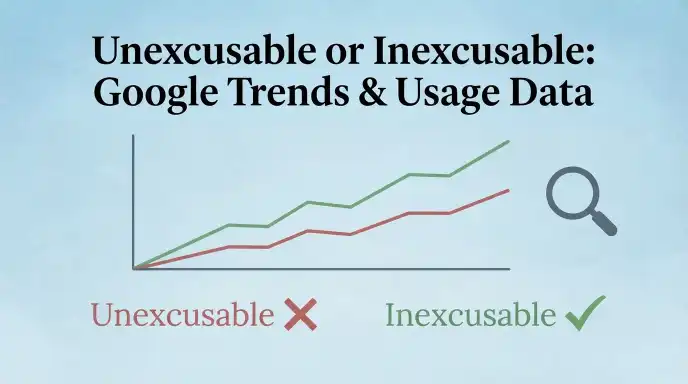
People search for unexcusable or inexcusable because the incorrect form may look natural. The prefix un- appears in many familiar English words, so writers may expect the same pattern here.
However, inexcusable remains the standard form. Dictionaries, professional writing, news reports, and everyday English use are inexcusable.
The spelling unexcusable may appear in informal online content or user-generated writing. Such examples do not make it the preferred standard form.
Usage also depends on context. People often use inexcusable when they want to express strong criticism of behavior, actions, mistakes, delays, treatment, or failures.
Furthermore, the spelling stays the same across major English varieties. British, American, Canadian, and Australian English all use inexcusable words.
Therefore, choose inexcusable for school, work, professional communication, and other standard English writing.
Unexcusable vs Inexcusable: Comparison Table
| Word or Form | Correct? | Meaning | Example |
| inexcusable | ✅ Yes | Cannot be excused or justified | His behavior was inexcusable. |
| unexcusable | ❌ No | Intended to mean cannot be excused | Avoid this spelling. |
| excusable | ✅ Yes | Can be excused or justified | The small error was excusable. |
| excuse | ✅ Yes | A reason used to explain something | She gave an excuse for being late. |
| inexcusable behavior | ✅ Yes | Behavior that cannot be accepted | His actions were inexcusable. |
| inexcusable mistake | ✅ Yes | A mistake that cannot be justified | The error was inexcusable. |
The main rule is simple: inexcusable is the standard negative form of excusable.
FAQs About Unexcusable or Inexcusable
Q1. Is unexcusable or inexcusable correct?
Inexcusable is correct. Unexcusable is not the standard form. Use inexcusable when something cannot reasonably be excused or justified.
Q2. What does inexcusable mean?
Inexcusable means that something cannot reasonably receive forgiveness or justification. People often use it for serious mistakes, actions, behavior, or failures.
Q3. Is unexcusable a real word?
You may find unexcusable in some informal writing, but standard English prefers inexcusable. For formal and professional writing, choose inexcusable.
Q4. Why is it inexcusable instead of unexcusable?
English uses the established negative prefix in- with excusable. Therefore, the standard form is inexcusable, not unexcusable.
Q5. Is the same in British and American English?
Yes. British and American English use inexcusable words with the same spelling and meaning.
Q6. What is the opposite of inexcusable?
The opposite is excusable. Something excusable can receive a reasonable explanation or forgiveness, while something inexcusable cannot.
Q7. Can I use inexcusable in formal writing?
Yes. Inexcusable works well in formal writing, professional communication, reports, news articles, and other situations where you need to express strong criticism.
Conclusion:
Inexcusable is the correct spelling, while unexcusable is not the standard form. The word describes something that people cannot reasonably forgive, justify, or accept. You can use it for behavior, actions, mistakes, delays, failures, and other serious problems.
The spelling often causes confusion because English uses un- to create many negative words. Words such as unhappy, unfair, and unclear make unexcusable look possible. However, English does not use the same negative prefix with every adjective. In this case, the established form uses in-.
A simple way to remember the spelling is to start with excusable and add in-: in + excusable = inexcusable. British and American English use the same form, so you do not need a regional spelling.
For schoolwork, professional documents, emails, news writing, and everyday communication, choose inexcusable. Avoid the unexcusable when you want to follow standard English. Once you remember this simple pattern, the spelling becomes much easier to use correctly.

I’m Nora Ellis, an English language writer passionate about making grammar, spelling, and confusing words easy to understand. I share clear explanations and practical examples to help readers improve their English and use words with confidence.