Losing someone or something important can bring deep sadness, but grieve and grief are not interchangeable because one is mainly a verb and the other is mainly a noun. This is the key difference between grieve or grief.
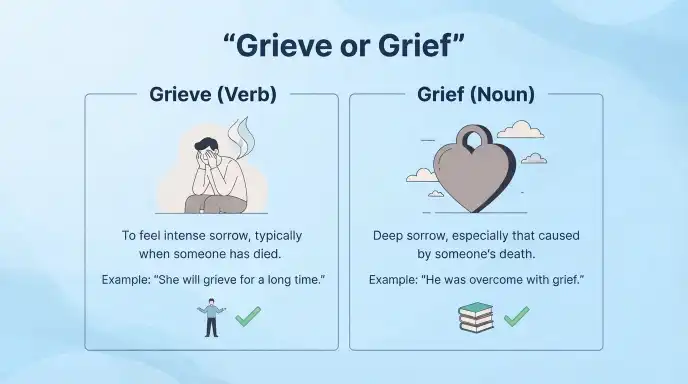
Grieve describes the act of feeling or expressing deep sadness, while grief names the sadness itself. For example, “They grieve for their father” uses grieve as a verb, while “They feel deep grief after his death” uses grief as a noun. People often search for these words because they look and sound closely related.
They also appear in similar sentences about loss, death, mourning, and emotional pain. The confusion becomes greater when learners are unsure if a sentence needs a verb or a noun. This guide explains the difference in plain English.
You will learn the meaning, grammar, origin, British and American usage, common mistakes, and everyday examples. By the end, choosing between grieve and grief should feel simple.
Grieve or Grief : Quick Answer
Grieve is mainly a verb. It means to feel or express deep sadness, especially after a loss.
Grief is mainly a noun. It means the deep sadness caused by loss, especially the death of someone.
- Grieve: They grieve for their mother.
- Grief: They are dealing with deep grief.
- Grieving: She is grieving after the loss.
Easy rule
Grieve = the action or experience of feeling sadness.
Grief = the sadness itself.
Think of the sentence:
They grieve because they feel grief.
This simple pattern can help you choose the right word.
What Does Grieve or Grief Mean?
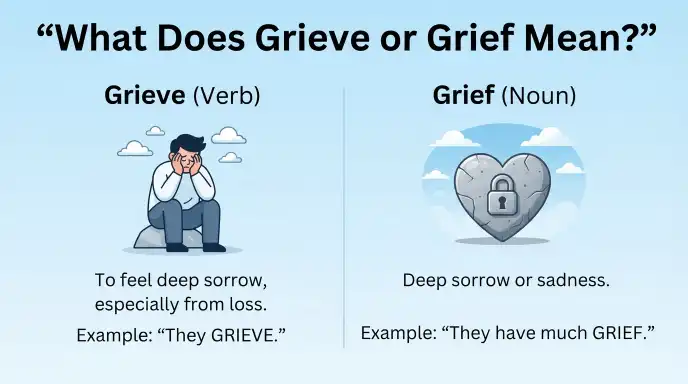
What Does Grieve Mean?
Grieve is a verb that means to feel or express deep sadness. It is most often used when someone experiences a serious loss.
For example:
- She grieved for her brother.
- He is grieving after the death of his friend.
- The family continues to grieve their loss.
Grieve can also mean to cause someone to feel sad or distressed. This use is more formal.
For example:
It grieves me to see them suffer.
The word can be used with several prepositions, including for and over.
- grieve for someone
- grieve over a loss
- grieve at something
The most natural choice depends on the sentence.
What Does Grief Mean?
Grief is a noun. It refers to deep sadness, especially the sadness felt after the death of someone or another major loss.
Examples include:
- Her grief was overwhelming.
- He struggled with grief after his father’s death.
- The family shared their grief with close friends.
The word can also be used more broadly for emotional pain caused by loss.
In informal English, especially in some expressions, grief can also mean trouble, criticism, or annoyance.
For example:
He gave me grief about my decision.
This meaning is different from the emotional sense of grief.
Grieve vs Grief Grammar
The easiest grammatical difference is:
| Word | Part of Speech | Basic Meaning | Example |
| Grieve | Verb | To feel or express deep sadness | They grieve for her. |
| Grief | Noun | Deep sadness after a loss | Their grief was painful. |
| Grieved | Verb | Past form of grieve | She grieved for years. |
| Grieving | Verb/adjective | Experiencing grief | He is grieving now. |
A quick test can help.
If you need action, choose grieve.
If you need the feeling or condition, choose grief.
The Origin of Grieve or Grief
Grieve and grief are closely related words with a long history in English.
The verb grieve entered Middle English through Old French. Its history can be traced to Latin gravare, meaning to make heavy or burden someone. The Latin word is related to gravis, meaning “heavy” or “grave.”
The older meaning of grieve was broader than its most common modern use. It could refer to causing pain, burdening, troubling, or distressing someone. Over time, its meaning became strongly connected with sorrow and emotional loss.
Grief has a related history. It came into English through Old French and developed from the same family of words connected with burden and suffering.
This history explains why grieve and grief look so similar today. They are not two unrelated words. They belong to the same word family.
Modern English uses them in different grammatical roles:
- grieve = verb
- grief = noun
- grieved = past tense
- grieving = present participle
- griever = a person who grieves
The spelling did not change because of a British-versus-American difference. The difference between grieve and grief comes from their different word forms and historical development.
British English vs American English
There is no major spelling difference between British and American English for grieve and grief.
Both varieties use the same spellings:
- grieve
- grief
- grieved
- grieving
The pronunciation is also essentially the same in standard British and American English.
| British English | American English | Example |
| grieve | grieve | They grieve for their friend. |
| grief | grief | Her grief was deep. |
| grieved | grieved | He grieved after the loss. |
| grieving | grieving | The family is grieving. |
This means writers do not need to switch forms based on their audience.
A British newspaper can write:
The family continues to grieve for their loved one.
An American newspaper can use the same wording.
The main issue is not regional spelling. It is grammar and meaning.
Style guides may differ in tone and preferred wording, especially when discussing sensitive subjects such as death. However, the basic forms grieve and grief remain standard in both major varieties of English.
Which Version Should You Use?
The answer depends on what you are trying to say, not where your reader lives.
United States
Use grieve when you need a verb.
Many families grieve after a sudden loss.
Use grief when you need a noun.
The family experienced deep grief.
United Kingdom
The same rule applies.
She continues to grieve for her husband.
Her grief was clear to everyone.
Canada
Canadian English also uses grieve and grief in the same way.
Australia
Australian English follows the same basic distinction.
International Writing
For international readers, use the simplest structure:
They grieve after a loss.
They are experiencing grief.
This makes the grammatical difference easy to understand.
Academic Writing
In academic writing, choose the word based on its grammatical role. Avoid using one as a replacement for the other.
Business Writing
Sensitive workplace messages often use grief, grieving, or bereavement.
For example:
We extend our sympathy to everyone affected by this loss.
In formal writing, simple and respectful language is usually best.
Common Mistakes with Grieve or Grief
Many mistakes happen because the two words are related and appear in the same context.
| Incorrect Example | Correct Example | Explanation |
| She is grieving for her father. | She is grieving for her father. | The sentence needs a verb. |
| They grief for their friend. | They grieve for their friend. | Grieve is the verb. |
| His grieve was deep. | His grief was deep. | Grief is the noun. |
| She felt great grieve. | She felt great grief. | The sentence needs a noun. |
| They are griefing the loss. | They are grieving the loss. | The correct verb form is grieving. |
Memory Tip
Remember this simple pair:
People grieve. People feel grief.
You can also remember:
Grieve = verb
Grief = noun
This rule works in most everyday sentences.
Grieve or Grief in Everyday Examples
Emails
A sympathy email may use both words naturally:
We are deeply sorry for your loss. Please know that we are thinking of you and your family during this difficult time.
Or:
We understand that you need time to grieve and offer our sincere support.
Business Writing
Formal business communication often uses grief when referring to the emotional effect of a loss.
The company offered support to employees experiencing grief after the tragic event.
News Headlines
News writing may use either word depending on the structure:
Family Grieves After Sudden Loss
or:
Community Shares Grief After Local Tragedy
The first uses grieves as a verb. The second uses grief as a noun.
Blogs
Everyone experiences grief differently.
People may grieve in different ways.
Both sentences are correct because the words have different grammatical jobs.
Social Media
We continue to grieve the loss of a beloved friend.
There are no easy words for this kind of grief.
Both forms are natural.
Academic Writing
Researchers have studied how people grieve after major losses.
Grief can affect emotional and social well-being.
Academic writing often uses both words because the concepts are closely related.
Daily Conversation
She is still grieving.
He is dealing with a lot of grief.
These are simple and natural examples.
Grieve or Grief : Google Trends & Modern Usage
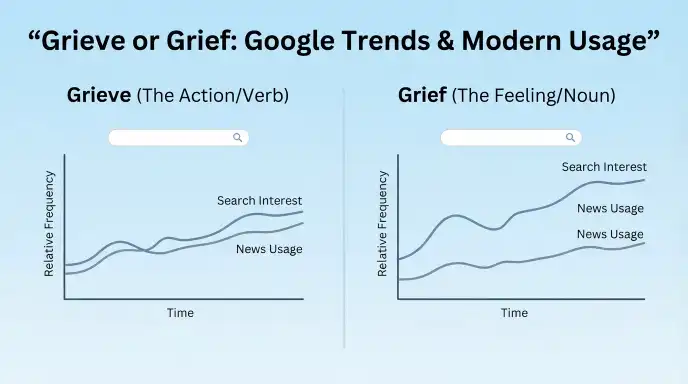
Searches for “grieve or grief” usually come from people who understand that the words are related but are unsure which form belongs in a sentence.
The confusion is mainly grammatical. The words share similar letters, pronunciation patterns, and meanings, but they do different jobs.
Modern English commonly uses:
- grieve as a verb
- grief as a noun
- grieving for an ongoing experience
- grieved for a past action
The words are used in many settings, including personal writing, news reports, academic discussions, workplace communication, literature, and everyday speech.
There is no reliable reason to claim that one word is simply “more popular” than the other. They are not direct alternatives. Their frequency depends heavily on sentence structure and context.
For example, a sentence about an action may require grieve, while a sentence describing an emotion may require grief.
Search interest can also increase when people encounter these words in sensitive contexts involving death, loss, mourning, or bereavement. However, search volume should not be treated as evidence that one form is grammatically better than the other.
The key point is simple: grieve and grief are both correct, but they are used differently.
Quick Comparison Table
| Version | Meaning | Correct? | Region | Example |
| Grieve | To feel or express deep sadness | Yes | US, UK, Canada, Australia, International | They grieve for him. |
| Grief | Deep sadness after a loss | Yes | US, UK, Canada, Australia, International | Her grief was intense. |
| Grieved | Past form of grieve | Yes | All major English varieties | She grieved for her friend. |
| Grieving | Experiencing or expressing grief | Yes | All major English varieties | They are grieving now. |
| Griefing | Incorrect standard form in this meaning | No | Avoid | Use grieving instead. |
Key Takeaways
- Grieve is mainly a verb.
- Grief is mainly a noun.
- People grieve after a major loss.
- People experience or feel grief.
- Grieved is the past tense of grieve.
- Grieving describes an ongoing experience.
- British and American English use the same basic spellings.
- The best choice depends on grammar and context, not region.
FAQs About Grieve or Grief
Q1. What is the difference between grieve and grief?
Grieve is mainly a verb, while grief is mainly a noun. To grieve means to feel or express deep sadness. Grief is the sadness itself. For example, “She continues to grieve” uses the verb, while “She feels deep grief” uses the noun.
Q2. Is it correct to say “I am grief”?
No. Grief is a noun, so it does not normally follow “I am” in that structure. Say, “I am grieving,” or “I am experiencing grief.” The correct choice depends on if you want to describe the action of grieving or the emotional state itself.
Q3. Is it correct to say “I grieve for you”?
Yes. Grieve can be used for when someone is expressing sorrow for another person or a loss. For example, “We grieve for those who lost their lives.” The phrase is grammatically correct and can sound formal or solemn depending on the context.
Q4. Is grief a verb or a noun?
Grief is primarily a noun. It names a feeling of deep sadness, especially after a major loss. For example, “Her grief was overwhelming.” The related verb is grieve: “She continues to grieve.” This noun-versus-verb distinction is the easiest way to separate the two words.
Q5. What is the verb form of grief?
The related verb is grieve. Its main forms are grieve, grieved, and grieving. For example: “They grieve for their friend,” “They grieved after the loss,” and “They are grieving now.” Do not normally use grief as the verb when describing this emotional process.
Q6. Is “grieving” the same as “grief”?
No. Grieving is the present participle of grieve and describes the process of experiencing or expressing grief. Grief is the noun for the feeling itself. For example, “She is grieving” describes what she is doing, while “She feels grief” describes what she feels.
Q7. Do British and American English use grieve differently?
The basic meanings and spellings are the same in British and American English. Both use grieve, grief, grieved, and grieving. Differences may appear in style or preferred expressions, but there is no standard British spelling that replaces grieve or grief.
Q8. Can you grieve a person?
Yes, but the grammar needs care. Traditional usage often uses grieve for or grieve over a person or loss. Modern English also uses grieve a loss in some contexts. For clear everyday writing, “They grieve for their mother” or “They grieve over the loss” is easy to understand.
Q9. What is the easiest way to remember grieve vs grief?
Use this sentence: People grieve, and people feel grief. If you need a verb for an action, choose grieve. If you need a noun for the feeling, choose grief. This simple pattern will solve most everyday grammar questions involving the two words.
Conclusion
Grieve and grief are closely related, but they are not interchangeable. Grieve is mainly a verb that describes the act of feeling or expressing deep sadness. Grief is a noun that names the deep sadness itself. The simplest rule is: people grieve, and people feel grief.
Both words are standard in American and British English. There is no major regional spelling difference to remember. The real issue is grammar. Use grieve when the sentence needs an action, and use grief when it needs a thing, feeling, or emotional state.
The related forms are also useful. Grieved is the past form, while grieving describes an ongoing experience. These forms appear often in news reports, personal writing, academic work, and everyday conversation.
When in doubt, check the role of the word in the sentence. If you can replace it with an action such as “feel” or “mourn,” grieve may be the right choice. If you are naming the emotion, choose grief.
Remember: You grieve, but you feel grief.
Use this simple rule, and the difference becomes much easier to remember.

I’m Nora Ellis, an English language writer passionate about making grammar, spelling, and confusing words easy to understand. I share clear explanations and practical examples to help readers improve their English and use words with confidence.