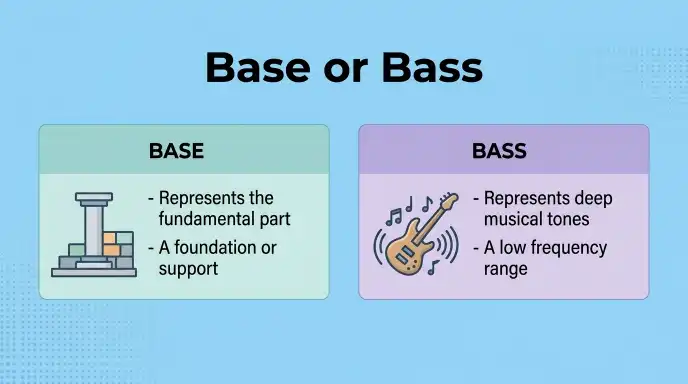
Base and bass are different words, although bass can sound exactly like base when it refers to music. This is why people often search for base or bass when they are unsure which spelling to use.
The two words have different meanings and uses. Base can mean the bottom of something, a main place, a foundation, or a starting point. It is also used in science, mathematics, grammar, sports, and business.
Bass usually refers to low musical sounds, a low musical voice or instrument, or certain types of fish. The musical word bass is pronounced like base, while the fish name is pronounced differently in many varieties of English.
The confusion often comes from pronunciation. If you hear someone say “bass” in a music context, it may sound exactly like “base.” This guide explains the meanings, pronunciation, origins, regional use, common mistakes, and practical examples so you can choose the right word with confidence.
Base or Bass: Featured Snippet & AI Overview
Base and bass are different words with different meanings. A base can mean a bottom, foundation, main place, or starting point.
By contrast, bass usually refers to a low musical sound, voice, or instrument, and it can also mean a type of fish. In music, bass is pronounced like base, while the fish meaning has a different pronunciation.
Base or Bass : Quick Answer
The correct word depends on what you mean.
Use base when you mean:
- The bottom of something.
- A foundation or starting point.
- A main place of operation.
- A mathematical or scientific starting value.
- A starting or scoring point in sports.
Examples:
- The lamp has a heavy base.
- The company is based in London.
- The argument has a strong base of evidence.
Use bass when you mean:
- A low musical sound.
- A low male singing voice.
- A bass guitar or similar instrument.
- A type of fish.
Examples:
- Turn down the bass on the speakers.
- He sings bass in the choir.
- They caught a large bass.
The key point is simple: base is usually about a foundation, bottom, place, or starting point. Bass is usually about music or fish.
What Does Base or Bass Mean?
What Does Base Mean?
Base has many meanings, but its central idea is something that supports or forms the starting point of something else.
As a noun, base can mean the bottom part of an object.
Example:
“The statue has a wide base.”
It can also mean a main place where a person works or where an organization operates.
Example:
“Paris is the company’s European base.”
Science also gives base several specialized meanings. In chemistry, a base is a substance with chemical properties opposite to those of an acid. In biology, bases in DNA and RNA are chemical components that carry genetic information. Meanwhile, mathematics uses base to describe part of a number system or a value used in powers.
The word can also work as a verb.
Example:
“The company is based in Chicago.”
The phrase based on is also very common.
Example:
“The film is based on a true story.”
What Does Bass Mean?
Bass has several meanings, but two are especially common.
In music, bass refers to the lowest range of musical sounds. It can describe a low voice, a musical part, an instrument, or low-frequency sound. Cambridge gives the musical pronunciation as /beɪs/, which sounds like base.
Examples:
- She has a deep bass voice.
- The song has a strong bass line.
- He plays bass in a band.
Bass can also refer to certain fish.
Example:
“The fisherman caught a large bass.”
In this sense, the pronunciation is different from the musical word. This is one reason the spelling can be confusing for English learners.
The Origin of Base or Bass
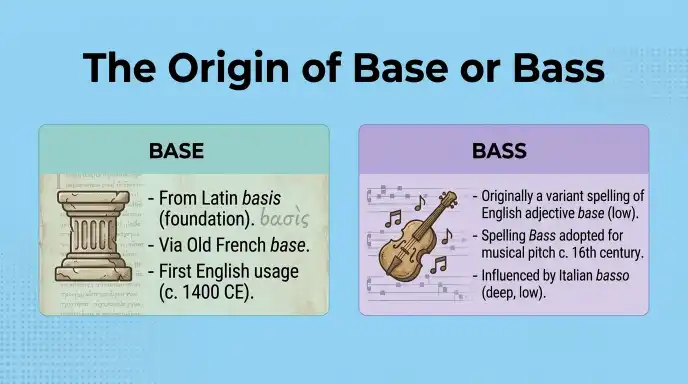
The history of base and bass helps explain why the words look so similar.
Origin of Base
The noun base entered English through Old French and ultimately traces back to Latin basis and Greek basis, connected with the idea of a foundation or something on which a person stands. Its early English sense referred to the foundation or bottom of something.
Over time, the meaning expanded.
The word came to describe:
- A foundation.
- The bottom part.
- A starting point.
- A place from which activities operate.
- A source of support.
- Specialized concepts in science and mathematics.
For example, the military meaning of base developed from the idea of a secure place from which operations could proceed.
Origin of Musical Bass
The musical word bass has a different spelling history. It developed from forms related to base, meaning low, and its spelling was influenced by the Italian basso. The musical sense became established in English for low voices and musical parts.
This explains an important point: musical bass and base are closely related historically, but modern English uses different spellings for them.
Origin of Fish Bass
The fish word bass has a separate history. It comes from an older English word for a fish or perch and is not simply another spelling of the musical word.
So, the spelling bass covers words with different histories and meanings.
British English vs American English
There is no major spelling difference between British English and American English for base or bass. The important difference is often pronunciation and meaning, especially with bass.
| Word or Meaning | British English | American English | Example |
| Base | base /beɪs/ | base /beɪs/ | The base is strong. |
| Musical bass | bass /beɪs/ | bass /beɪs/ | Turn up the bass. |
| Fish bass | bass /bæs/ | bass /bæs/ | He caught a bass. |
| Bass guitar | bass /beɪs/ | bass /beɪs/ | She plays bass. |
| Based | based /beɪst/ | based /beɪst/ | The company is based here. |
Cambridge lists base with the pronunciation /beɪs/ and gives the musical sense of bass as /beɪs/. Its American entry also distinguishes the fish sense with /bæs/.
Do British and American Writers Spell Them Differently?
No. Both varieties normally use:
- base for the foundation or starting point.
- bass for musical meaning.
- bass for the fish.
Regional style guides may differ in punctuation, vocabulary, or other spelling choices, but they do not normally change base into bass or vice versa.
Which Version Should You Use?
Your choice depends on the meaning, not the country where you are writing.
United States
Use base for a foundation, bottom, place, or starting point.
Use bass for music or fish.
Example:
“The bass player returned to the military base.”
Both words are correct because they have different meanings.
United Kingdom
The same distinction applies. British writers use base and bass according to meaning.
Canada
Canadian English also uses base and bass in their standard meanings.
Australia
Australian English follows the same basic distinction.
International Writing
For international readers, focus on the context. Avoid relying only on sound because bass has more than one pronunciation.
Academic Writing
Use base when discussing a foundation, mathematical concept, scientific concept, or linguistic structure.
Use bass when discussing music or fish.
Business Writing
Base is common in business phrases such as:
- customer base
- client base
- business base
- revenue base
- based in
Bass is uncommon in business writing unless the subject involves music, audio, entertainment, or fishing.
Common Mistakes with Base or Bass
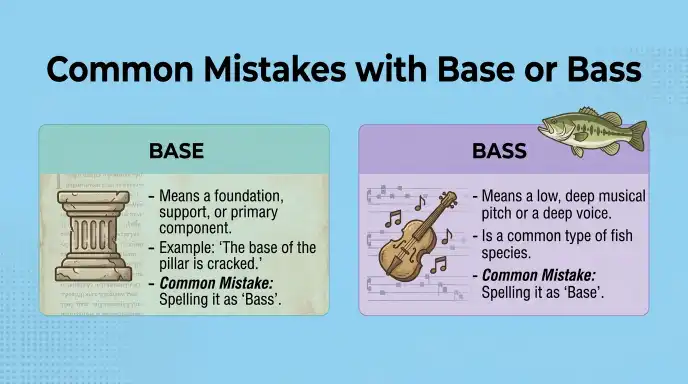
Using bass for a foundation
Incorrect:
“The building has a strong bass.”
Correct:
“The building has a strong base.”
Why?
The word refers to the supporting bottom part.
Memory tip: Think base = bottom.
Using base for musical sound
Incorrect:
“Turn up the base on the speakers.”
Correct:
“Turn up the bass on the speakers.”
Why?
The word for low musical sound is bass.
Memory tip: Think bass = beats and low sound.
Confusing bass the fish with bass the music
The spelling is the same, but the pronunciation and meaning can differ.
Musical bass:
“The bass is too loud.”
Fish bass:
“They caught a bass in the lake.”
Context tells you which meaning is intended.
Assuming base and bass are interchangeable
They are not interchangeable.
Base and bass may sound alike in some contexts, but their meanings are different.
Everyday Examples of Base or Bass
Emails
Base:
“Our main office is now based in Toronto.”
Bass:
“The audio file has too much bass.”
Business Writing
Base:
“We are building a strong customer base.”
Bass:
“The company sells professional bass equipment.”
News Headlines
Base:
“New Research Base Opens in the Arctic.”
Bass:
“Local Fisherman Lands Record Bass.”
Blogs
Base:
“A strong knowledge base can help new employees learn faster.”
Bass:
“How to Adjust the Bass on Your Speakers.”
Social Media
Base:
“Our team has a strong support base.”
Bass:
“This song sounds amazing with the bass turned up.”
Academic Writing
Base:
“The study used a broad data base.”
Bass:
“The bass line supports the main melody.”
Daily Conversation
Base:
“Put the vase on the base.”
Bass:
“I love the bass in this song.”
Base or Bass: Google Trends & Modern Usage
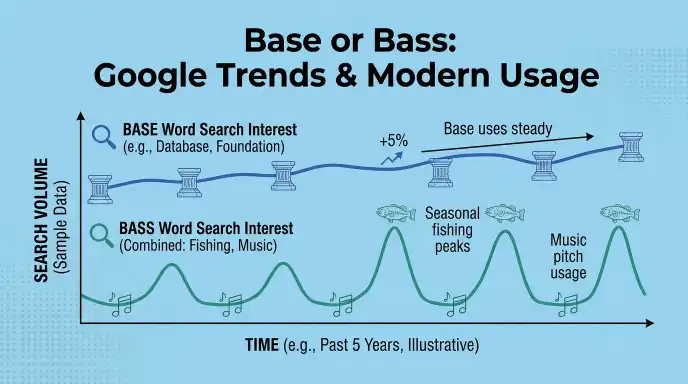
People search for base or bass mainly because the words can sound alike, especially when bass refers to music. English learners may also encounter bass in songs, audio settings, musical instruments, and fishing content and wonder why it is not spelled base.
Modern usage keeps the distinction clear:
- Base is common in everyday, academic, business, scientific, mathematical, and technical English.
- Bass is common in music and fishing contexts.
- Bass in music is pronounced like base.
- Bass referring to fish has a different pronunciation in standard English.
Exact search-volume numbers can change by country, platform, and time. Without a specific Google Trends comparison for a defined country and date range, it would be misleading to give exact popularity figures.
The broader usage pattern is clear, though. Base has a very wide range of meanings, while bass is strongly tied to particular fields such as music and fishing. Dictionary entries reflect these distinct meanings and pronunciations.
Quick Comparison Table
| Version | Meaning | Correct? | Region | Example |
| Base | Bottom or foundation | Yes | All major English varieties | The base is solid. |
| Base | Main place of operation | Yes | All major English varieties | London is our base. |
| Base | Starting point in sports | Yes | All major English varieties | He reached first base. |
| Base | Scientific or mathematical concept | Yes | All major English varieties | Find the base of the number. |
| Bass | Low musical sound | Yes | All major English varieties | Turn down the bass. |
| Bass | Low musical voice | Yes | All major English varieties | He sings bass. |
| Bass | Bass guitar or instrument | Yes | All major English varieties | She plays bass. |
| Bass | Type of fish | Yes | All major English varieties | They caught a bass. |
Key Takeaways
- Base and bass are different words.
- Base can mean a bottom, foundation, starting point, or main place.
- Bass can refer to low musical sounds, voices, or instruments.
- Bass can also mean several types of fish.
- Musical bass is pronounced like base.
- Fish bass has a different pronunciation.
- British and American English use the same spellings.
- Always choose the word based on meaning and context.
FAQs About Base or Bass
Q1. What is the difference between base and bass?
Base usually means a foundation, bottom, starting point, or main place. Bass usually refers to low musical sounds, a low musical voice, a bass instrument, or certain fish. The musical word bass sounds like base, which causes much of the confusion.
Q2. Is bass pronounced the same as base?
Bass has two common pronunciations because it has different meanings. Musical bass is pronounced like base, /beɪs/. When bass refers to a type of fish, it is pronounced /bæs/. Context usually makes the intended meaning clear.
Q3. Should I write bass or base for music?
Use bass when you mean the low range of music, a low musical voice, or a bass instrument. For example, write “Turn up the bass” and “He plays bass guitar.” Although the musical word sounds like base, its standard spelling is bass.
Q4. Should I write base or bass for a foundation?
Use base. A base is the bottom or supporting part of something. For example, you can say “the base of the building” or “the base of the statue.” The spelling bass is not correct for this meaning.
Q5. Are base and bass homophones?
They can be homophones when bass has its musical meaning because both are pronounced /beɪs/. However, bass meaning a fish has a different pronunciation. Therefore, the words do not always sound the same.
Q6. Is bass a musical instrument?
Yes. Bass can refer to a bass guitar or another instrument that produces or plays low musical notes. It can also refer to the lowest musical part or range. In everyday speech, bass often means the bass guitar or low-frequency sound in recorded music.
Q7. Is bass also a type of fish?
Yes. Bass is the name used for several types of freshwater and saltwater fish. Examples include largemouth bass, smallmouth bass, and striped bass. The fish’s meaning has a different historical origin from the musical sense.
Q8. Is base or bass correct in American English?
Both are correct, but they have different meanings. American English uses base for a foundation, starting point, or main place and bass for musical meanings and certain fish. The choice depends on what you are trying to say.
Q9. Is base or bass correct in British English?
Both words are also correct in British English. Base refers to a foundation, bottom, or starting point, while bass is used for music and fish. British English does not normally replace one spelling with the other.
Q10. How can I remember base vs bass?
Use base when you think of a bottom or foundation. Use bass when you think of music or fish. A useful memory tip is: base supports, bass sounds. Always check the context before choosing the spelling.
Conclusion:
Base and bass are not interchangeable spellings. They are separate words with different meanings, although musical bass sounds exactly like base in standard pronunciation.
Use base for a foundation, bottom, starting point, main location, or related scientific, mathematical, and business meanings. For example, you can talk about the base of a building, a military base, a customer base, or the base of a number.
Use bass when you mean a low musical sound, a low voice, a bass instrument, or a type of fish. The musical word is pronounced like base, while the fish name has a different pronunciation.
The spelling does not change between standard British and American English. The meaning and context should guide your choice.
If you remember only one rule, remember this: base supports or starts something, while bass is mainly heard in music or found in water. Keep that distinction in mind, and you will avoid one of the most common base-and-bass word-choice mistakes.

I’m Nora Ellis, an English language writer passionate about making grammar, spelling, and confusing words easy to understand. I share clear explanations and practical examples to help readers improve their English and use words with confidence.






3 thoughts on “Base or Bass: Meaning, Differences, and Usage Guide ”