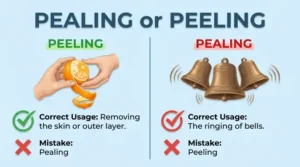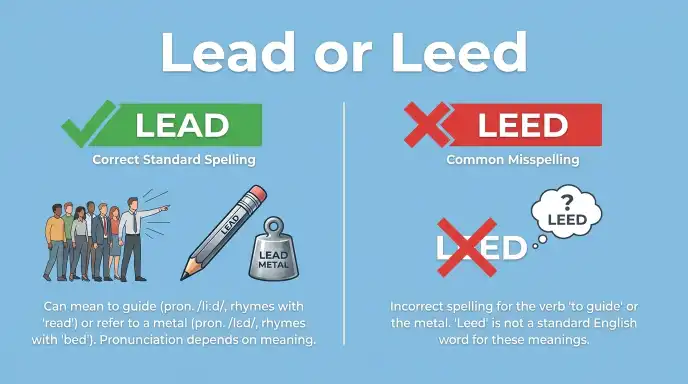
The correct spelling depends on what you mean, but lead is the standard English word, while leed is not a standard spelling.
If you mean to guide someone or take charge, use lead. If you mean the past tense of lead when it rhymes with “need,” the correct spelling is also led, not leed.
The confusion around lead or leed comes from English pronunciation. The word lead has two common pronunciations and two different meanings. As a verb, it usually means to guide, direct, or show the way.
It is pronounced like “leed.” As a noun, lead can mean a type of metal and is pronounced like “led.” These differences can make the word hard to spell, even for fluent English speakers.
Knowing when to use lead, led, and leed can help you write better emails, school assignments, reports, and social media posts. It can also help you avoid mistakes in professional and academic writing.
In this guide, you will learn the meanings, pronunciations, history, and correct usage of these words. You will also find clear examples, comparison tables, common mistakes, and simple tips to help you choose the right spelling every time.
Lead or Leed: Featured Snippet Answer
Lead is the correct spelling when you mean to guide someone or take charge. It is pronounced “leed.” The past tense is led, pronounced “led.” Lead can also mean a heavy metal, with a different pronunciation. Leed is not a standard spelling for these meanings.
Lead or Leed: Quick Answer
The correct choice is usually lead, but the right word depends on the meaning and tense.
- Lead (verb): To guide or direct someone. It rhymes with “need.”
- Lead (noun): A heavy metal. It rhymes with “red.”
- Led (past tense): The past form of the verb lead. It rhymes with “red.”
- Leed: A nonstandard spelling that should not replace lead or led in normal English writing.
Examples
- Correct: She will lead the team.
- Correct: He led the team last year.
- Correct: The old pipe contains lead.
- Incorrect: She will leed the team.
- Incorrect: He leed the team last year.
Easy rule: Use lead for the present-tense verb, led for its past tense, and lead when referring to the metal.
What Does Lead or Leed Mean?
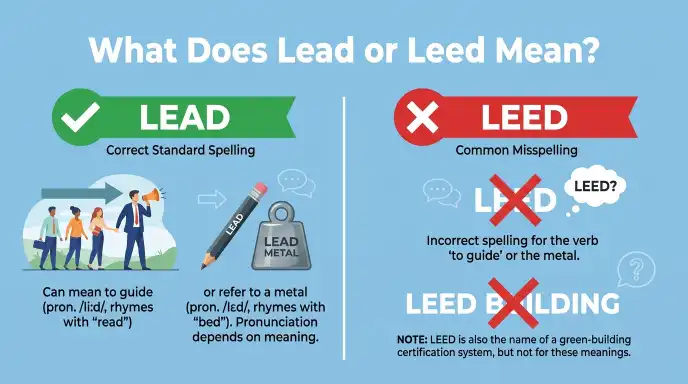
The words lead, led, and leed can cause confusion because their sounds overlap. However, their spelling and meaning are not interchangeable.
What Does Lead Mean as a Verb?
As a verb, lead means to guide, direct, manage, or show someone the way.
It can describe a person who guides a team, a teacher who directs a class, or a path that takes someone to a place.
Examples:
- The manager will lead the meeting.
- Good teachers lead students toward success.
- This road will lead us to the village.
- She hopes to lead the project next year.
In these sentences, lead describes an action. It is pronounced “leed.”
What Does Lead Mean as a Noun?
As a noun, lead can refer to a soft, heavy metal. It is pronounced like “led.”
Lead has been used in batteries, weights, and other products. It can be harmful to human health, especially when people swallow or breathe in lead dust or fumes.
Examples:
- The old paint may contain lead.
- The factory tested the water for lead.
- Lead is a metal with the chemical symbol Pb.
The spelling stays the same, but the pronunciation and meaning change.
What Does Led Mean?
Led is the simple past tense and past participle of the verb lead. Use it when describing an action that happened in the past or when forming a perfect tense.
Examples:
- She led the team to victory.
- He led us through the forest.
- They have led several successful projects.
- The guide led the visitors into the museum.
Remember that led is pronounced like “red.” It is the correct past-tense form, not lead or leed.
What Does Leed Mean?
Leed is not the standard spelling of the verb lead, the metal lead, or the past tense led.
You may see leed in names, usernames, creative writing, or phonetic explanations. However, these uses do not make it the correct spelling in standard English.
Incorrect: The coach will leed the players.
Correct: The coach will lead the players.
For schoolwork, professional writing, and everyday communication, choose the spelling that matches the meaning.
The Origin of Lead or Leed
The word lead has a long history in English. Its forms developed over many centuries, which helps explain why its spelling and pronunciation may seem unusual.
Where Does the Word Lead Come From?
The verb lead comes from Old English lǣdan, meaning to guide, conduct, or cause someone to go along a path. Over time, it developed into the modern verb lead.
The noun lead, meaning the metal, comes from a different Old English word, lēad. Both words eventually took the same spelling in modern English, although they kept different pronunciations.
This is one reason English can be confusing: words may share a spelling but have different meanings and sounds.
Why Is the Past Tense Led?
The verb lead is an irregular verb. This means it does not form its past tense by simply adding -ed.
Its main forms are:
- Base form: Lead
- Past tense: Led
- Past participle: Led
- Present participle: Leading
Other irregular verbs follow similar patterns.
| Base Form | Past Tense | Past Participle |
| Lead | Led | Led |
| Read | Read | Read |
| Keep | Kept | Kept |
| Feel | Felt | Felt |
| Leave | Left | Left |
The spelling of read stays the same, although its pronunciation changes in the past tense. In contrast, lead changes to led when used in the past tense.
Why Do People Write Leed?
People often write leed because they hear the sound of the verb lead and try to spell it as it sounds.
English spelling does not always match pronunciation. The correct spelling of a word must be learned along with its meaning and grammatical role.
For example, lead and led have different spellings even though they can sound alike. Writing leed may seem logical, but it is not the standard form.
British English vs American English
There is no spelling difference between British and American English for lead, led, or the nonstandard form leed. Both varieties use the same standard spellings.
The main difference is pronunciation within the word lead, depending on its meaning. As a verb, lead rhymes with “need.” As a noun for metal, it rhymes with “red.”
British English vs American English Comparison
| British English | American English | Example |
| Lead, meaning guide | Lead, meaning guide | She will lead the group. |
| Led, past tense | Led, past tense | She led the group yesterday. |
| Lead, the metal | Lead, the metal | The paint contains lead. |
| Leed, nonstandard spelling | Leed, nonstandard spelling | Use lead or led instead. |
Do Style Guides Prefer One Spelling?
No. Major English dictionaries and standard writing guides recognize lead and led for these meanings. They do not recommend leed as a replacement.
In British and American writing, the correct choice depends on the sentence, not the country.
British English example: The guide will lead the visitors around the museum.
American English example: The guide will lead the visitors around the museum.
Both sentences are correct.
Which Version Should You Use?
For standard English, use lead or led according to the meaning and tense. Avoid leed unless you are using it as a specific name or a deliberate creative spelling.
United States
American English uses lead for the present-tense verb and the metal. Use led for the past tense.
- Present: The captain will lead the team.
- Past: The captain led the team.
United Kingdom
British English follows the same spelling rules.
- Present: The teacher will lead the discussion.
- Past: The teacher led the discussion.
Canada
Canadian English also uses lead and led. The standard forms do not change because of regional spelling preferences.
Example: The director led the project to completion.
Australia
Australian English follows the same rule.
Example: The tour guide will lead us through the park.
International Writing
If you write for readers around the world, use lead and led in the correct contexts. These forms are standard in international English.
Academic Writing
In essays, research papers, and assignments, choose the form that matches the tense.
- Correct: The findings led to further research.
- Correct: These results may lead to new discoveries.
- Incorrect: The findings leed to further research.
Business Writing
Use lead when discussing leadership, future actions, or general responsibilities. Use led for completed actions.
- Correct: Maria will lead the new team.
- Correct: Maria led the previous project.
- Incorrect: Maria leed the new team.
Professional tip: Ask yourself if the action is happening now or happened in the past. Use lead for the base form and led for the past.
Common Mistakes with Lead or Leed
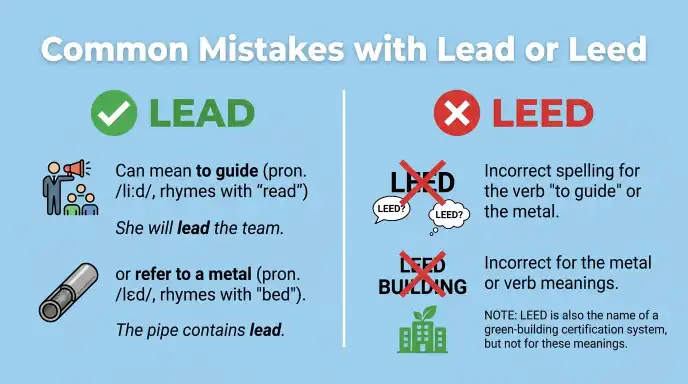
Writers often confuse these forms because they sound alike in some contexts. The following examples show how to correct the most common errors.
Using Leed Instead of Lead
Incorrect: He will leed the discussion.
Correct: He will lead the discussion.
Why? The verb lead means to guide or direct. Leed is not its standard spelling.
Using Lead Instead of Led for the Past Tense
Incorrect: She lead the group yesterday.
Correct: She led the group yesterday.
Why? The sentence describes a completed action, so the past tense led is needed.
Using Leed Instead of Led
Incorrect: The coach leed the team to victory.
Correct: The coach led the team to victory.
Why? The past tense of lead is led, not leed.
Confusing the Verb with the Metal
Example: The pipe contains lead.
Here, lead refers to the metal, so it is pronounced like “red.” Do not confuse it with the verb lead, which rhymes with “need.”
Common Errors Table
| Incorrect | Correct | Reason |
| I will leed the team. | I will lead the team. | Use the standard verb spelling. |
| She lead the group yesterday. | She led the group yesterday. | Use the past tense. |
| He has lead the team for years. | He has led the team for years. | Use the past participle. |
| The paint contains leed. | The paint contains lead. | The metal is spelled lead. |
| They leed the project last year. | They led the project last year. | Past actions require led. |
Memory Tip
Remember this simple pattern:
Lead now. Led before. Lead the metal.
- I will lead the team tomorrow.
- I led the team yesterday.
- The old paint contains lead.
This rule can help you choose the right word quickly.
Lead or Leed in Everyday Examples
The words lead and led appear in many kinds of writing. Here is how to use them in common situations.
Emails
Use lead when talking about a future task or responsibility.
Example:
Subject: Project Responsibilities
Hi Sarah,
You will lead the new project starting next week. Please arrange a meeting with the team and share the plan.
Best regards,
James
For a completed task, use led:
Thank you for the way you led the team during the project.
Business Writing
Business writing often uses lead to describe management and responsibility.
Examples:
- David will lead the sales team this year.
- The director led the company through a major change.
- Good planning can lead to better results.
These examples use the correct form for the tense.
News Headlines
News reports use lead and led to describe leadership and events.
Examples:
- Local Coach to Lead National Team
- Strong Defense Led the Team to Victory
- New Research May Lead to Better Treatments
The correct form depends on if the headline describes a current or future action, a past event, or a possible result.
Blogs
In blog posts, lead can describe a process or a person’s role.
Examples:
- Five Ways to Lead a Successful Team
- How One Decision Led to a Better Outcome
- Simple Habits That Lead to Better Writing
Social Media
People use these words in posts about lessons, leadership, and personal growth.
Examples:
- Be the person who can lead with kindness.
- Hard work led me to new opportunities.
- Small steps can lead to big changes.
Academic Writing
In academic work, use the form that matches the sentence.
Examples:
- The results may lead to further study.
- The experiment led to a new discovery.
- Previous studies have led researchers to consider other explanations.
Daily Conversation
These words are common in spoken English.
Examples:
- Can you lead us to the station?
- Who led the meeting yesterday?
- Where does this path lead?
- Does this old paint contain lead?
Remember that pronunciation alone may not tell you which spelling to use. Think about the meaning and tense.
Lead or Leed: Google Trends and Modern Usage
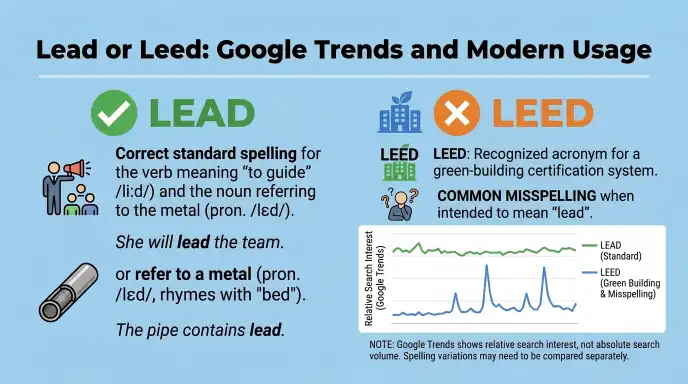
People search for lead or leed because English spelling can be confusing, especially when a word’s sound does not clearly reveal its spelling.
The query may come from students, English learners, writers, or people checking a sentence before sending a message. Some users may also be unsure about the past tense of lead.
Which Form Is Used in Modern English?
In standard modern English:
- Lead is used for the base form of the verb and for the metal.
- Led is used for the past tense and past participle of the verb.
- Leed is not a standard replacement for either word.
These forms are used across major English-speaking regions.
Regional Popularity
The spelling rules are the same in the United States, the United Kingdom, Canada, and Australia. There is no standard regional preference for leed.
Exact search popularity may vary by country and over time. Without verified Google Trends data for a specific location and period, it would be misleading to claim that one country searches for the phrase more often than another.
Why Do People Search for Lead or Leed?
Common reasons include:
- Checking the spelling of a word that sounds like “leed.”
- Learning the past tense of lead.
- Understanding the difference between lead and led.
- Checking grammar before writing an email or assignment.
- Learning how pronunciation changes the meaning of lead.
Usage advice: Do not use search popularity to decide which spelling is correct. Use the meaning and tense of the sentence instead.
Quick Comparison Table: Lead, Led, and Leed
| Version | Meaning | Correct? | Region | Example |
| Lead | To guide or direct | Yes | All English varieties | I will lead the team. |
| Led | Past tense of lead | Yes | All English varieties | She led the team yesterday. |
| Lead | A heavy metal | Yes | All English varieties | The paint contains lead. |
| Leed | Nonstandard spelling for these meanings | No | Not standard | Write lead or led. |
Verb Forms at a Glance
| Tense or Form | Correct Word | Example |
| Base form | Lead | I lead the group. |
| Third-person singular | Leads | She leads the group. |
| Past tense | Led | She led the group. |
| Past participle | Led | She has led the group. |
| Present participle | Leading | She is leading the group. |
Key Takeaways
- Lead is the correct spelling for the verb meaning to guide or direct.
- Led is the past tense and past participle of lead.
- Lead can also mean a metal and has a different pronunciation.
- Leed is not the standard spelling for these meanings.
- British and American English use the same standard forms.
- Use lead for the base form and lead for completed actions.
- Check the meaning and tense before choosing the spelling.
Frequently Asked Questions
Q1. Is it lead or leed?
Lead is the correct spelling when you mean to guide, direct, or take charge. Leed is not the standard spelling for this meaning. For example, write, “She will lead the team,” not “She will leed the team.”
Q2. Is leed ever a correct word?
Leed may appear in names, usernames, or creative spellings. However, it is not the standard spelling of the verb lead, the metal lead, or the past tense led. In normal English writing, use the standard form that matches your meaning.
Q3. Is the past tense of lead lead or led?
The past tense of the verb lead is led. For example, “She led the meeting yesterday.” Use lead for the base form, as in “She will lead the meeting tomorrow.”
Q4. Why are lead and led pronounced differently?
The verb lead rhymes with “need,” while led rhymes with “red.” English spelling follows historical patterns, so related words do not always look or sound alike. The noun lead, meaning the metal, also rhymes with “red.”
Q5. Is lead the same in British and American English?
Yes. British and American English use lead for the verb and the metal, and led for the verb’s past tense. There is no regional spelling difference. The correct form depends on the meaning and tense, not the country.
Q6. Should I write lead or led in a sentence?
Use lead for the base form or present-tense verb, and use led for a past action. For example, “I lead the team today” describes a current role, while “I led the team yesterday” describes a completed action.
Q7. How can I remember the difference between lead and lead?
Use this memory tip: Lead now, lead before. If the sentence describes a current, general, or future action, lead may be correct. If it describes an action that has already happened, use led.
Q8. Is lead the past tense of lead?
No. Led is the normal past tense and past participle of the verb meaning to guide. Lead can appear in technical contexts, such as describing a material containing lead, but it does not replace lead in ordinary sentences about leadership.
Q9. How do you pronounce lead when it means metal?
When lead means metal, it rhymes with “red.” When lead means to guide or direct, it rhymes with “need.” The spelling stays the same, but the meaning and pronunciation change.
Conclusion: Lead or Leed?
When choosing between lead or leed, remember that lead is the standard spelling for the verb meaning to guide or direct. Led is the correct past tense and past participle of that verb. Leed is not a standard spelling for either form.
The word lead can also refer to a heavy metal, and in that case it rhymes with “red.” When it means to guide someone, it rhymes with “need.” This difference in pronunciation is a common source of confusion, but the meaning of the sentence can help you choose the right word.
These rules apply in American English, British English, Canadian English, Australian English, and international writing. If you are writing an email, an academic paper, a business report, or a social media post, use the form that matches the meaning and tense.
A simple way to remember the rule is to think about time: you lead now, and you led before. Avoid leed in standard writing, and check your sentence whenever you are unsure.
Remember: Lead now, led before, and never use leed as the standard spelling. Practise these forms in your own sentences to make the rule easy to remember.

I’m Nora Ellis, an English language writer passionate about making grammar, spelling, and confusing words easy to understand. I share clear explanations and practical examples to help readers improve their English and use words with confidence.