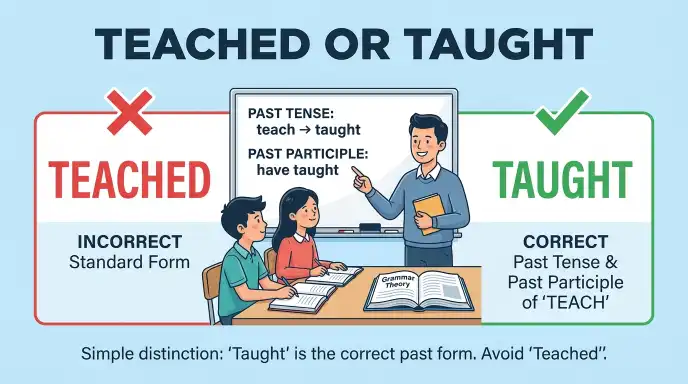
Have you ever wondered if to write teached or taught? The correct word is taught. It is the past tense and past participle of the verb teach. The word teached is not the standard form in modern English.
Many people search for teached or taught because English has many verbs that form the past tense by adding -ed. For example, we say we walked, played, and worked. However, some verbs do not follow this rule. These verbs are called irregular verbs. The verb teach is one of them.
Knowing the difference helps you write better sentences, speak clearly, and avoid common grammar mistakes. Students, English learners, teachers, and writers may all face this confusion. It is especially common when learning the past tense of irregular verbs.
In this guide, you will learn the meaning of taught, why teached is incorrect in standard English, and how to use the correct form in everyday conversations, emails, and formal writing. You will also find simple examples, spelling comparisons, and answers to common questions.
By the end, you will know which word to use and how to remember it with ease.
Teached or Taught : Quick Answer
Taught is the correct past tense and past participle of teach. Teached is not accepted in standard modern English.
Use taught when talking about teaching that happened in the past.
Examples:
- Correct: My mother taught me how to cook.
- Incorrect: My mother teached me how to cook.
- Correct: Our teacher has taught us many useful lessons.
- Incorrect: Our teacher has teached us many useful lessons.
Remember these three forms:
- Present: Teach
- Past: Taught
- Past participle: Taught
The simple rule is easy: use teach, taught, taught, not teach, teached, teached.
Definition and Meaning of Teached or Taught
The words teached and taught relate to the verb teach, but they do not have the same status in standard English.
What Does Taught Mean?
Taught is the past tense and past participle of teach. It means to have given someone knowledge, skills, information, or instructions.
Teaching can happen in a school, at home, at work, or in everyday life.
Examples:
- The teacher taught us English.
- My father taught me how to ride a bicycle.
- She has taught science for ten years.
- Experience taught him an important lesson.
In each example, the word taught describes giving knowledge or learning something through instruction or experience.
What Does Teached Mean?
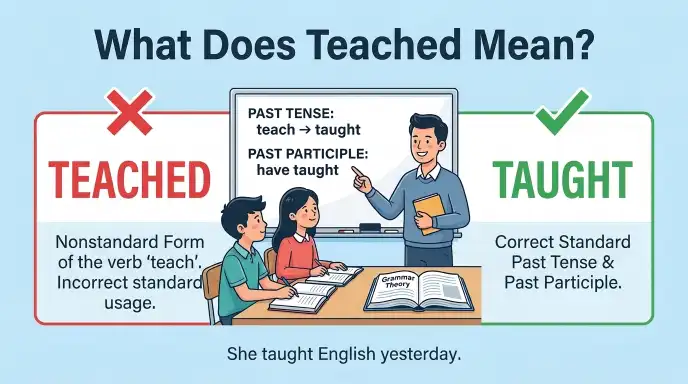
Teached is a nonstandard form created by adding -ed to teach. It may appear in the speech of young children, English learners, or people who are still learning irregular verbs.
However, it is not the correct form for standard written or spoken English.
Incorrect: The coach teached us how to play.
Correct: The coach taught us how to play.
Use taught in school assignments, professional emails, articles, reports, and formal conversations.
Context and Usage
The word taught can be used in several situations.
Education
Use it when someone gives lessons or explains a subject.
Example: Our English teacher taught us new words.
Practical Skills
Use it when someone helps another person learn a skill.
Example: My uncle taught me how to drive.
Life Lessons
Use it when an experience helps someone understand something.
Example: That mistake taught me to be more careful.
Work and Training
Use it when a person trains others at work.
Example: The manager taught new employees how to use the system.
In all these situations, taught is the correct form.
The Origin of Teached or Taught
The difference between teached and taught comes from the history of the English language.
The verb teach has Old English roots. Its earlier form was tǣcan, which meant to show, instruct, or guide someone. Over time, the word developed into the modern English verb teach.
In older forms of English, many verbs changed their internal sounds to form the past tense. These verbs are now known as irregular verbs.
The past tense of teach developed into taught rather than following the regular pattern of adding -ed. Similar changes appear in other English verbs, such as:
- Catch → Caught
- Bring → Brought
- Buy → Bought
- Think → Thought
- Teach → Taught
These words do not follow the usual pattern of regular verbs.
Why Do People Write Teached?
People often learn that adding -ed makes a verb past tense. This rule works for many verbs, such as talked, cleaned, and helped.
However, learners may apply the same rule to teach and produce teached.
This is a common type of grammar error called overregularization. It happens when someone applies a regular grammar rule to an irregular verb.
Although the mistake is understandable, standard English is taught.
British English vs American English Spelling
There is no difference between British and American English when it comes to teached and taught. Both varieties use taught as the standard past tense and past participle of teach.
Some English words have different spellings in the United States and the United Kingdom. For example, Americans write color, while British writers usually write colour. However, this spelling difference does not apply to taught.
Comparison Table
| Feature | American English | British English |
| Present tense | Teach | Teach |
| Past tense | Taught | Taught |
| Past participle | Taught | Taught |
| Nonstandard form | Teached | Teached |
| Correct example | She taught math. | She taught maths. |
| Standard usage | Taught | Taught |
The words math and maths show a regional difference in vocabulary. The verb taught remains the same.
Examples in Both Varieties
American English:
- My teacher taught us how to write essays.
- She has taught at this school for five years.
British English:
- My teacher taught us how to write essays.
- She has taught at this school for five years.
Both varieties follow the same verb pattern: teach, taught, taught.
Teached or Taught: Which Spelling Should You Use?
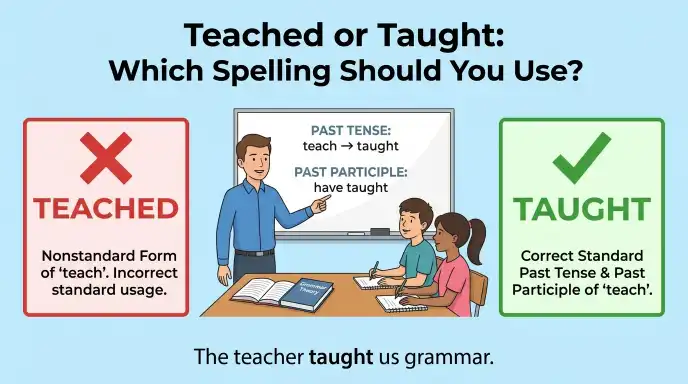
You should use it in every standard English setting. The choice does not depend on your country, audience, or writing style.
For American English
If you are writing for readers in the United States, use taught.
Example: My professor taught us how to conduct research.
For British English and Commonwealth Countries
Readers in the United Kingdom, Canada, Australia, New Zealand, and other Commonwealth countries also expect to be taught.
Example: Our instructor taught us first aid.
For International English
If you write for a global audience, taught is the correct choice.
Example: The course taught students valuable communication skills.
For Academic and Professional Writing
Always used in essays, research papers, job applications, reports, and business emails.
Example: She has taught English to students from different backgrounds.
Using teached in these settings may make your writing appear grammatically incorrect.
Professional advice: Learn the three forms together: teach, taught, taught. This simple habit will help you avoid mistakes in both speaking and writing.
Common Mistakes with Teached or Taught
Many English learners make mistakes with irregular verbs because they try to follow the regular -ed rule. Understanding the correct form of teach can help prevent these errors.
Common Errors and Corrections
| Incorrect Sentence | Correct Sentence | Reason |
| She teached English. | She taught English. | Teach has an irregular past tense. |
| He has teached me a lot. | He has taught me a lot. | Use the past participle after has. |
| They have teached us well. | They have taught us well. | Use taught after having. |
| I was taught by my father. | I was taught by my father. | Use taught in the passive voice. |
| Who teached you this? | Who taught you this? | Use taught for a past action. |
Adding -Ed to Teach
Some people write because they believe all past-tense verbs end in -ed.
Incorrect: My father teached me to swim.
Correct: My father taught me to swim.
Remember that teach is an irregular verb.
Using Teached After Has or Have
The present perfect tense uses has or have with a past participle.
Incorrect: She has teached many students.
Correct: She has taught many students.
The correct form is still taught.
Confusing Taught with Teaching
These forms serve different purposes.
- Teach: I teach English.
- Taught: I taught English yesterday.
- Teaching: I am teaching English now.
Choose the form that matches the tense and sentence structure.
Using Teached in Formal Writing
Even if readers understand what teached means, it is not the standard form.
Incorrect: The course teached me useful skills.
Correct: The course taught me useful skills.
Always used in formal and professional writing.
Teached or Taught in Everyday Examples
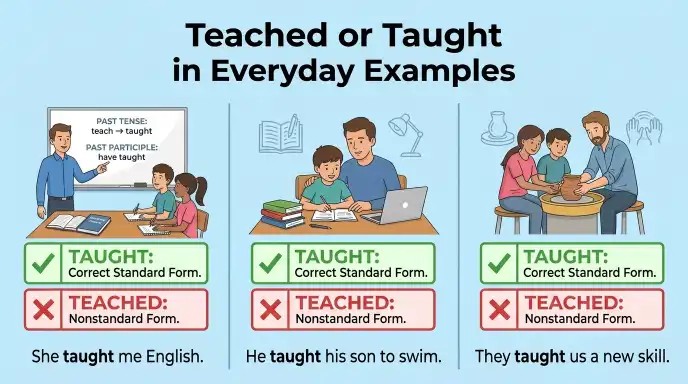
The word taught appears in many everyday situations. Here are examples showing how to use it correctly.
In Emails
Use taught when describing lessons, training, or past experiences in an email.
Example:
Subject: Thank You for Your Support
Dear Mr. Smith,
Thank you for the time you spent helping me. You taught me several useful skills that I will use in my future work.
Best regards,
James
In News Reports
News stories often use taught to explain what a teacher, coach, expert, or experience helped someone learn.
Examples:
- The instructor taught hundreds of students during her career.
- The training program taught workers how to respond to emergencies.
- The experience taught the team the importance of preparation.
On Social Media
People use taught when sharing personal experiences, advice, and lessons.
Examples:
- My parents taught me to respect others.
- Life taught me to be patient.
- My first job taught me the value of teamwork.
These sentences are suitable for posts, captions, and everyday messages.
In Formal Writing
Use taught in academic work, reports, and professional documents.
Examples:
- The study taught participants how to identify common risks.
- The instructor has taught this subject for several years.
- Students were taught how to evaluate the evidence.
The last example uses the passive voice. The form we were taught is correct.
In Everyday Conversation
Examples:
- Who taught you to cook?
- My brother taught me how to swim.
- Our coach taught us a new technique.
- I was taught to always tell the truth.
In every example, taught is the correct form.
Teached or Taught : Google Trends and Usage Data
People may search for teached or taught when they want to check the past tense of teach. The question is especially relevant to students, English learners, and people writing in English as a second language.
However, the existence of these searches does not mean both forms are correct.
Which Word Is More Common?
Taught is the standard form used in books, newspapers, educational materials, and professional writing. Teached is a nonstandard form and is not accepted as the normal past tense of teach in modern standard English.
Usage by Country
| Country or Region | Standard Form | Usage Advice |
| United States | Taught | Use in all standard writing. |
| United Kingdom | Taught | Use in all standard writing. |
| Canada | Taught | Use in all standard writing. |
| Australia | Taught | Use in all standard writing. |
| New Zealand | Taught | Use in all standard writing. |
| International English | Taught | Use for a global audience. |
What About Google Trends?
Google Trends can help compare search interest in teached and taught. However, search interest is not the same as correct grammatical usage.
No verified live Google Trends figures are provided here, so exact popularity scores, percentages, and country rankings should not be assumed.
Search interest may change based on the time period, location, and wording of the query. A person may search for reach because they are unsure if it is correct, not because they regularly use it.
The key takeaway: Use taught regardless of search popularity or location.
Teached vs Taught: Comparison Table
The following table summarizes the main differences between the two forms.
| Feature | Teached | Taught |
| Standard English form | No | Yes |
| Past tense of teach | Incorrect | Correct |
| Past participle of teach | Incorrect | Correct |
| Used in formal writing | No | Yes |
| Used in academic work | No | Yes |
| Used in professional emails | No | Yes |
| Example | She teached me. | She taught me. |
| Recommended choice | Avoid | Use |
The Three Main Forms of Teach
| Verb Form | Word | Example |
| Base form | Teach | I teach English. |
| Past tense | Taught | I taught English yesterday. |
| Past participle | Taught | I have taught English for years. |
| Present participle | Teaching | I am teaching English now. |
| Third-person singular | Teaches | She teaches English. |
Notice that teaches is correct in the present tense, but teached is not the standard past tense.
Frequently Asked Questions
Q1. Is it teached or taught?
Taught is correct. It is the past tense and past participle of teach. The word teached is not standard modern English.
Example: She taught me how to read.
Q2. Why is teached incorrect?
Teached is incorrect in standard English because teach is an irregular verb. Its past tense does not follow the usual rule of adding -ed. The correct forms are teach, taught, taught.
Q3. Is the past tense of teach?
Yes. Taught is the simple past tense of teach.
Example: Our teacher taught us grammar yesterday.
Q4. Is taught also a past participle?
Yes. Taught serves as both the past tense and the past participle.
Examples:
- Past tense: He taught me French.
- Past participle: He has taught me French.
Q5. Do British and American English teachers use it?
Yes. Both British and American English are taught. There is no spelling difference between these varieties for this verb.
Example: She taught the class.
Q6. Can I use teached in an essay or email?
No. You should use it in essays, emails, reports, and other forms of standard writing.
Incorrect: The instructor teached us well.
Correct: The instructor taught us well.
Q7. How can I remember to teach, taught, taught?
Learn the three forms together: teach, taught, taught. You can also compare teach with catch and bring, which changes to taught, caught, and brought.
Practise writing short sentences with each form to help you remember the pattern.
Conclusion: Teached or Taught?
The correct choice between teached or taught is simple: use taught. It is the standard past tense and past participle of the verb teach. The word teached is a nonstandard form that often appears when learners apply the regular -ed rule to an irregular verb.
Remember the three main forms: teach, taught, taught. Use teach for the base form, taught for past actions, and taught after helping verbs such as has, have, and had. For example, you can say, “I teach English,” “I taught English yesterday,” and “I have taught English for five years.”
There is no difference between British and American English in this case. Writers in the United States, United Kingdom, Canada, Australia, and other English-speaking regions use taught.
For students, teachers, writers, and English learners, learning this pattern can prevent common grammar errors. It also helps make your writing clear and professional.
Whenever you are unsure, remember that taught is correct and teached is not standard English. Use the correct form in conversations, schoolwork, emails, and formal documents.

I’m Nora Ellis, an English language writer passionate about making grammar, spelling, and confusing words easy to understand. I share clear explanations and practical examples to help readers improve their English and use words with confidence.