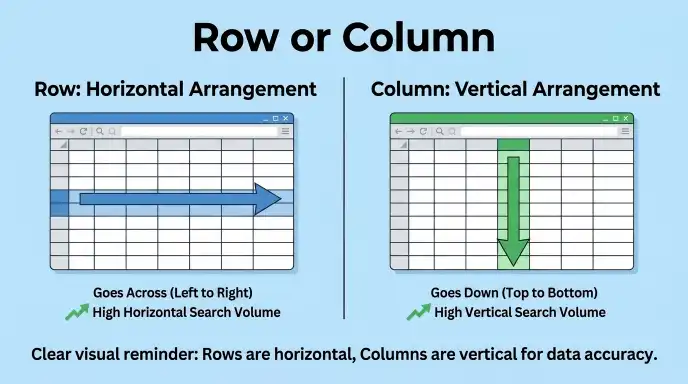
A row runs horizontally, while a column runs vertically in a table, spreadsheet, or grid. Both terms describe how information is arranged, but they refer to different directions. Knowing the difference helps you read tables, organize data, and use spreadsheet tools with confidence.
People often search for row or column because these words look similar in use. Both describe groups of cells or items, especially in tools like Microsoft Excel and Google Sheets. However, mixing them up can lead to errors when entering data, reading reports, or following instructions.
The easiest way to remember the difference is to look at the direction. A row goes from left to right. A column goes from top to bottom. In a spreadsheet, rows usually have numbers, while columns usually have letters.
These words also appear in other settings, such as school tables, printed forms, buildings, and newspaper layouts. Their exact use can depend on the context, but the basic idea stays the same. This guide explains the meaning, origin, common mistakes, and everyday use of row or column so you can choose the right term with ease.
Row or Column: Quick Answer
A row is a horizontal line of items. A column is a vertical line of items. Both help arrange information in a clear order.
Examples:
- Row: A line of student names across a table.
- Column: A vertical list of student names.
- Spreadsheet: Row 3 runs across the sheet, while Column B runs down it.
Quick memory tip: Rows go across. Columns go down.
Definition and Meaning of Row or Column
The words row and column describe the position and arrangement of items. You will often see them in tables, spreadsheets, charts, and other organized layouts.
What Does Row Mean?
A row is a series of items arranged from left to right. In a table, each row often contains information about one person, product, or record.
For example, a school table may show one student’s name, age, class, and grade in the same row. Each item appears in a separate column.
Rows are common in:
- Spreadsheets: A horizontal group of cells.
- Tables: A line of related information.
- Seating plans: People seated side by side.
- Text and layouts: Lines of items arranged across a page.
The word row can also mean a line of people or things standing next to one another.
What Does Column Mean?
A column is a series of items arranged from top to bottom. In a table, a column often contains the same type of information for several records.
For example, a student table may have a column for names, another for ages, and another for grades.
Columns are common in:
- Spreadsheets: A vertical group of cells.
- Tables: Information listed from top to bottom.
- Buildings: A tall support post.
- Newspapers: A vertical section of printed text.
The meaning depends on the context. In a spreadsheet, a column organizes data. In a building, a column may support part of the structure.
Row vs Column in a Spreadsheet
In spreadsheet programs, rows and columns form a grid of cells.
- Rows usually use numbers, such as 1, 2, and 3.
- Columns usually use letters, such as A, B, and C.
- Cells sit where a row and a column meet.
For example, B3 means the cell in Column B and Row 3. This system helps users find and edit data quickly.
The Origin of Row or Column
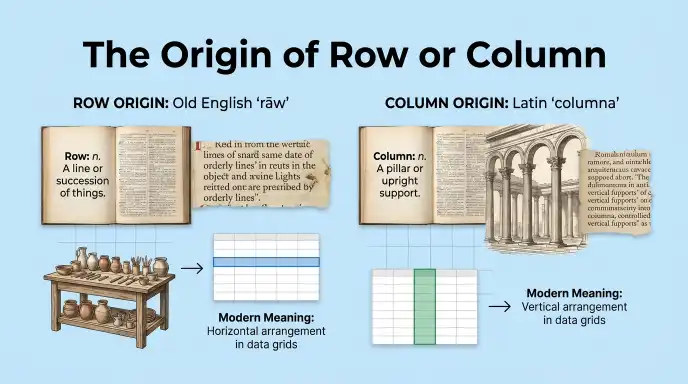
The words row and column have different histories, but both have long been used to describe the arrangement of people, objects, or structures.
The word row, meaning a line of things, developed from older English and Germanic word forms linked to a line or series. Today, it can describe a line of seats, houses, objects, or cells in a table.
The word column came into English through French from Latin columna, meaning a pillar or supporting post. In architecture, a column is a tall structure that supports part of a building. The word later gained other uses, including a vertical section of text or data.
As tables and printed layouts became common, the two words gained more specific meanings. A row described a horizontal series, while a column described a vertical series.
Modern spreadsheet software uses these same terms. Although technology has made them more common, the words themselves are not new. Their meanings developed over time as people found more ways to arrange information.
British English vs American English Spelling
There is no spelling difference between row and column in British and American English. Both countries use the same words with the same basic meanings.
| Term | British English | American English | Example |
| Row | Row | Row | Enter the student’s details in the next row. |
| Column | Column | Column | Add the total to the last column. |
| Rows | Rows | Rows | The table has five rows. |
| Columns | Columns | Columns | The spreadsheet has four columns. |
Are There Any Regional Differences?
The spelling stays the same in both varieties of English. However, the context may affect how people use these words.
For example, both British and American writers use row and column in spreadsheets, tables, and reports. Both also use columns to describe a pillar in a building.
The word row has another meaning in British English: an argument or disagreement, often pronounced like “cow.” In American English, row is more often understood as a line or series unless the context makes the other meaning clear.
This difference does not change the spelling of the word. It only affects its meaning and pronunciation in certain situations.
Which Spelling Should You Use?
You do not need to choose between different spellings of row and column. Both words are standard in the United States, the United Kingdom, Canada, Australia, and other English-speaking regions.
However, you should choose the correct word for the direction or meaning you want to describe.
United States
Use row for a horizontal series and column for a vertical series. These terms are standard in American schools, offices, reports, and spreadsheet tools.
United Kingdom
Use the same rule. A row runs across, and a column runs down. Remember that row can also mean an argument in British English.
Canada and Australia
Both countries use row and column in the same way as the United States and United Kingdom. Follow any special terminology required by your school, workplace, or publisher.
International Writing
For an international audience, these words are widely understood. You can use them in instructions, reports, forms, and educational materials without changing the spelling.
Academic and Business Writing
In academic and business documents, use each word precisely. If you ask someone to enter information in a row, make sure you mean a horizontal line. If you mean a vertical list, use columns.
Clear wording helps readers follow instructions and reduces data-entry mistakes.
Common Mistakes with Row or Column
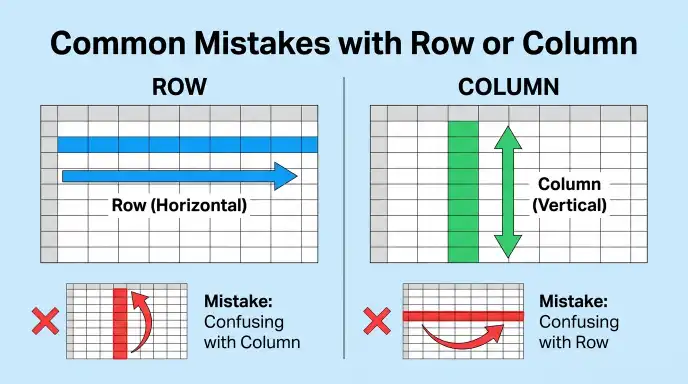
People often confuse row and column because both describe groups of items in a grid. The most common error is mixing up their directions.
| Incorrect Usage | Correct Usage | Explanation |
| A row runs from top to bottom. | A column runs from top to bottom. | Columns are vertical. |
| A column runs from left to right. | A row runs from left to right. | Rows are horizontal. |
| Cell A2 is in Row A. | Cell A2 is in Column A and Row 2. | Letters identify columns, and numbers identify rows in standard spreadsheets. |
| Put all the names in one row when you mean a vertical list. | Put all the names in one column. | A vertical list uses a column. |
| The spreadsheet has five columns, meaning five horizontal lines. | The spreadsheet has five rows, meaning five horizontal lines. | Rows run across the sheet. |
Easy Ways to Remember
Use these simple tips:
- Row = across. Imagine people sitting in a row of chairs.
- Column = down. Imagine a tall column in a building.
- Rows use numbers in common spreadsheet layouts.
- Columns use letters in common spreadsheet layouts.
If you are unsure, look at the direction of the items. This quick check will help you choose the right word.
Row or Column in Everyday Examples
Both terms appear in daily life, schoolwork, office tasks, and digital tools. Here are examples of how to use them correctly.
Emails
Row example:
“Please add the new customer’s details to the next row of the spreadsheet.”
Column example:
“Please enter the customer’s email address in the email column.”
Business Writing
Row example:
“Each row in the sales report represents one order.”
Column example:
“The final column shows the total price for each order.”
These examples make instructions clear and help staff organize records correctly.
News and Reports
Row example:
“The table includes a row for each region.”
Column example:
“The report adds a column showing the change in sales.”
Writers use these terms to explain how information appears in tables and reports.
Blogs and Online Guides
- A row moves horizontally across the spreadsheet.
- A column holds related values vertically.
- Select the correct row before editing a record.
- Check the column heading before entering data.
These short examples work well in tutorials and help pages.
Social Media
- “Quick Excel tip: rows go across, and columns go down.”
- “Keep your data neat by giving each column a clear heading.”
- “One row for each record makes a table easier to read.”
The terms are useful when explaining spreadsheets in a short post.
Academic Writing

Row example:
“Each row in Table 2 represents one participant.”
Column example:
“The age column reports the participants’ ages.”
In research, clear table labels help readers understand the data and compare results.
Daily Conversation
- “Which row are you sitting in?”
- “The building has a tall stone column.”
- “Write your name in the first column.”
- “Look at the last row to find the total.”
The meaning comes from the situation. In a table or spreadsheet, the direction is the main clue.
Row or Column: Google Trends and Usage Data
Row and column are common words in education, office work, data analysis, and spreadsheet software. People may search for them when learning Excel, creating tables, completing school assignments, or trying to understand a form.
Search interest can vary by country and topic. For example, a person learning spreadsheet basics may search for “row vs column,” while someone studying architecture may search for “column meaning.” Someone reading about seating arrangements may look up “row.”
Google Trends can help compare search interest over time and across regions. However, it measures relative search interest, not the correctness of a word. No exact figures are given here because verified data for a specific time period and location is not available.
Common reasons people search for row or column include:
- Learning the difference between horizontal and vertical layouts.
- Understanding spreadsheet cell references.
- Creating tables for school or work.
- Learning technical terms in English.
- Checking how to describe data clearly.
The best way to understand these words is to focus on the context. In a grid, a row runs across and a column runs down. In other settings, the words can have additional meanings.
Quick Comparison Table: Row vs Column
| Word | Meaning | Direction or Use | Example |
| Row | A horizontal line of items | Left to right | The names appear in one row. |
| Column | A vertical line of items | Top to bottom | The names appear in one column. |
| Rows | More than one horizontal line | Across | The table has ten rows. |
| Columns | More than one vertical line | Down | The table has three columns. |
| Cell | One box where a row and column meet | At their intersection | Cell B3 is in Column B and Row 3. |
Remember that row and column are not competing spellings. They are different words for different parts of an organized layout.
FAQs: Row or Column
Q1. What is the difference between a row and a column?
A row runs horizontally from left to right, while a column runs vertically from top to bottom. In a spreadsheet, rows usually have numbers and columns usually have letters. A cell appears where a row and a column meet. These terms help people organize, read, and find information in tables.
Q2. Does a row go up and down or side to side?
A row goes side to side. It runs horizontally across a table or spreadsheet. Think of people sitting next to one another in a row of chairs. In a spreadsheet, Row 1 stretches across the sheet. A column, by contrast, runs vertically from top to bottom.
Q3. Does a column go up and down?
Yes. A column runs vertically, from top to bottom. In a spreadsheet, Column A is a vertical set of cells, as is Column B. In a table, a column often holds one type of information, such as names, dates, prices, or grades. This makes data easier to compare.
Q4. Is row or column used in both British and American English?
Yes. Row and column have the same spelling and basic meanings in British and American English. Both varieties use them in spreadsheets, tables, and reports. One extra meaning to remember is that row can mean an argument in British English. The meaning depends on context.
Q5. What comes first in a spreadsheet, the row or the column?
A spreadsheet cell reference usually lists the column letter first, followed by the row number. For example, B3 means Column B, Row 3. The cell is where that column and row meet. This format helps users identify a specific location in a spreadsheet quickly.
Q6. What is a row in a table?
A row is a horizontal line of cells or information in a table. Each row often contains details about one item, person, or record. For example, a school table may use one row for each student, with columns for the student’s name, age, class, and grade.
Q7. What is a column in a table?
A column is a vertical line of cells or information in a table. It often groups the same kind of data together. For example, a student table may have one column for names and another for grades. Columns make it easier to compare one type of information across several records.
Conclusion: Row or Column
Understanding rows or columns is easy once you remember their directions. A row runs horizontally from left to right, while a column runs vertically from top to bottom. Both words help people organize information in spreadsheets, tables, reports, and other layouts.
There is no British or American spelling difference between these terms. Writers in both regions use the same words. The main task is to choose the word that matches the arrangement you mean.
In spreadsheets, rows usually have numbers and columns usually have letters. A cell reference such as B3 points to Column B and Row 3. This simple system helps you find data and follow instructions.
When writing emails, reports, school assignments, or online guides, use these terms clearly. If you are unsure, check if the items run across or down. That small step can prevent confusion and make your instructions easier to follow.
Remember: rows go across, columns go down. Use this rule whenever you work with tables or spreadsheets, and you will be much less likely to mix them up.

I’m Nora Ellis, an English language writer passionate about making grammar, spelling, and confusing words easy to understand. I share clear explanations and practical examples to help readers improve their English and use words with confidence.