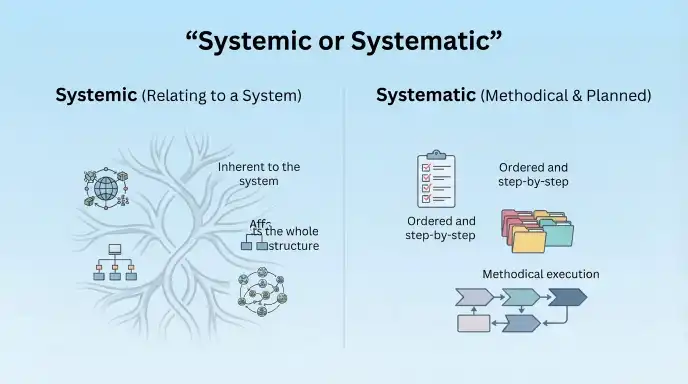
If you are unsure if to use systemic or systematic, choose systemic when you mean something that affects a whole system, and systematic when you mean something done according to a clear system or plan.
These words look and sound alike, so the confusion is common. They also share the word system, which makes their meanings seem almost identical. But they do different jobs in a sentence. Systemic focuses on the whole system and its parts. Systematic focuses on the method used to do something.
For example, a problem that affects an entire organization can be systemic, while a careful step-by-step review of that problem can be systematic. This difference matters in academic writing, business reports, news articles, medicine, and everyday English. It can also change the meaning of a sentence.
In this guide, you will learn the exact difference between systemic and systematic, their meanings, origins, regional usage, common mistakes, and practical examples. By the end, choosing the right word should be simple.
Systemic or Systematic: Quick Answer
Systemic means affecting or relating to an entire system, especially rather than one isolated part.
Systematic means done in an organized, planned, or methodical way.
A simple memory rule is:
Systemic = the whole system.
Systematic = the method or process.
For example:
- The company has a systemic problem.
This means the problem affects the organization at a broad level. - The team used a systematic approach.
This means the team followed an organized method. - Researchers conducted a systematic review.
They used a planned and structured method to review evidence. - The disease caused systemic effects.
It affected the body as a whole rather than only one local area.
Cambridge defines systematic as following an agreed method or organized plan, while systemic refers to something affecting or involving a whole system.
What Does Systemic or Systematic Mean?
Although systemic and systematic come from the same word family, they describe different ideas.
What Does Systemic Mean?
Systemic is an adjective that means affecting, involving, or relating to an entire system.
The system may be:
- A human body
- An organization
- An economy
- A society
- A computer network
- A government
- An institution
For example:
The company has systemic weaknesses.
This suggests that the weaknesses are not limited to one employee or one department. They are connected to the organization as a whole.
In medicine, systemic often has a more specific meaning. A systemic disease or treatment affects the body as a whole rather than only one part. Oxford gives systemic disease as an example of something affecting or connected with the whole body.
What Does Systematic Mean?
Systematic means organized according to a system, method, or plan.
It describes the way an action is performed.
For example:
The researchers used a systematic approach.
This means they followed an organized process rather than working randomly.
You can be systematic when you:
- Study for an exam
- Analyze data
- Search for evidence
- Organize files
- Test a product
- Solve a problem
- Review research
Oxford defines systematic as something done according to a system or plan in a thorough, efficient, or determined way.
The Core Difference
The easiest distinction is:
Systemic describes the nature or scope of a problem.
Systematic describes the method used to do something.
Compare these sentences:
The company has a systemic problem.
The company conducted a systematic review of the problem.
The first sentence describes what the problem affects.
The second describes how the problem was examined.
The Origin of Systemic or Systematic

Both words are connected to the older word system.
The English noun system came through Latin systema from Greek systēma, referring to an organized whole or a combination of parts. The underlying idea was something whose parts were arranged together as a whole.
Origin of Systematic
Systematic entered English in the 17th century. It came through French systématique or directly from Late Latin systematicus, ultimately related to Greek systēmatikos. Its early sense was connected with something belonging to or concerning a system. Later, its meaning developed toward the idea of following a system or method.
That explains its modern use in phrases such as:
- systematic analysis
- systematic review
- systematic approach
- systematic study
- systematic investigation
Origin of Systemic
Systemic appeared later. Etymological records date its use to around 1803, especially in anatomy and physiology. It originally described something related to the body as a whole or common to a system, in contrast with something local. Its broader sense of relating to a system developed later.
This history helps explain an important modern distinction:
Systemic became strongly associated with the whole system.
Systematic became strongly associated with an organized method or process.
The words still overlap in some contexts, but their usual meanings are now different.
Systemic or Systematic: British English vs American English
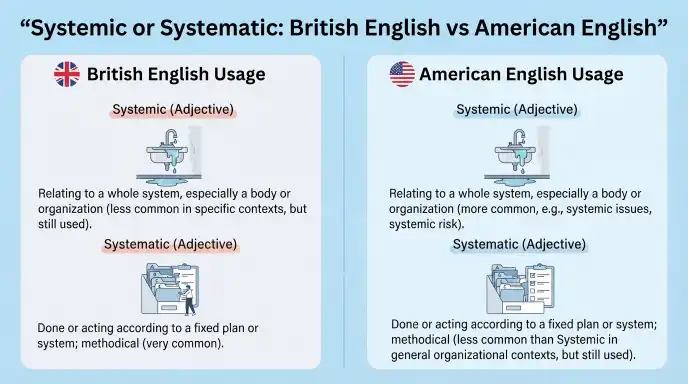
There is no major spelling difference between British and American English for systemic or systematic.
Both varieties use the same spellings:
- systemic
- systematic
- systemically
- systematically
The main difference is not spelling. It has meaning and context.
| British English | American English | Example |
| systemic | systemic | The problem is systemic. |
| systematic | systematic | We used a systematic method. |
| systemically | systemically | The issue affects the organization systemically. |
| systematically | systematically | The evidence was systematically reviewed. |
Cambridge provides both UK and US pronunciations for these words and keeps the same spellings.
Do Style Guides Change the Meaning?
Style guides generally do not create a British-versus-American spelling split here.
Instead, professional writing depends on context.
A medical writer may use:
systemic infection
An academic writer may use:
systematic review
A business writer may use:
systemic risk
A researcher may describe a:
systematic analysis
So, the question is usually not “Which country’s spelling should I use?”
The better question is:
“Am I describing the whole system, or am I describing an organized method?”
Which Version Should You Use?
Use the word that matches the meaning you want. Neither word is simply the British or American version.
United States
American English uses both words.
Choose systemic for broad effects on a system.
Choose systematic for organized processes.
Example:
The company faces systemic financial problems.
The auditors conducted a systematic review.
United Kingdom
British English also uses both forms in the same way.
Example:
The policy created systemic problems.
The researchers used a systematic method.
Canada
Canadian English follows the same basic distinction.
Use systemic for system-wide effects and systematic for organized methods.
Australia
Australian English also uses both words according to meaning, not nationality.
International Writing
For international readers, make the distinction clear through context.
Instead of writing:
We need a better system.
You may write:
We need a systematic way to review the records.
If you mean that the entire organization has a problem, write:
The problem is systemic.
Academic Writing
Academic writing often uses both words.
Common phrases include:
- systematic review
- systematic analysis
- systematic investigation
- systemic effects
- systemic inequality
- systemic change
Be especially careful with systematic review. In research, this is a specific and established term for a structured review of evidence.
Business Writing
Business writers often use systemic when discussing large organizational or economic problems.
Examples include:
- systemic risk
- systemic failure
- systemic problems
- systemic change
Use systematic when describing a business process:
- systematic evaluation
- systematic planning
- systematic review
- systematic testing
Common Mistakes with Systemic or Systematic
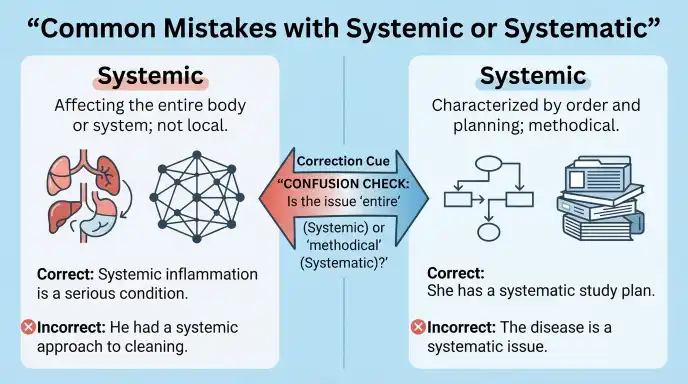
The most common mistake is treating the words as exact synonyms.
Using Systematic for a System-Wide Problem
❌ The organization has a systematic problem.
This may suggest that the problem is organized or methodical.
✅ The organization has a systemic problem.
This clearly says the problem affects the organization at a broad level.
Using Systemic for a Method
❌ We used a systemic approach to examine the records.
If you mean that the team followed a clear and organized process, this is usually the wrong choice.
✅ We used a systematic approach to examine the records.
Confusing Systemic and Systematic in Medicine
❌ The treatment was systematic.
If the treatment affects the whole body, systemic may be the intended word.
✅ The treatment has systemic effects.
The exact medical meaning still depends on the context.
Memory Tip
Remember this:
Systemic = system-wide.
Systematic = step-by-step.
This simple contrast will solve most usage questions.
Everyday Examples of Systemic or Systematic

Emails
Systematic:
We need a systematic process for checking customer requests.
Systemic:
The repeated delays suggest a systemic issue within the department.
Business Writing
Systematic:
The company introduced a systematic review of its hiring process.
Systemic:
The report identified systemic weaknesses in the organization.
News Headlines
Systemic:
Report Finds Systemic Problems Across the Industry
Systematic:
Researchers Begin Systematic Review of New Evidence
The first headline focuses on broad problems.
The second focuses on a structured research process.
Blogs
Systematic:
A systematic approach can make your study plan easier to follow.
Systemic:
The article explores systemic problems within the education system.
Social Media
Systemic:
This is not just one small mistake. It may be a systemic problem.
Systematic:
I used a systematic method to organize all my notes.
Academic Writing
Systematic:
The researchers performed a systematic review of previous studies.
Systemic:
The findings suggest that the issue may have systemic causes.
Daily Conversation
Systematic:
She is very systematic when she plans her work.
Systemic:
The problem seems systemic, not limited to one person.
Google Trends & Modern Usage
People search “systemic or systematic” because the two words share the same root and have similar sounds. Their meanings also overlap enough to cause uncertainty.
Modern English uses both words widely, but they tend to appear in different contexts.
Systemic is especially common when people discuss:
- Health
- Medicine
- Economics
- Organizations
- Social issues
- Government
- Institutional problems
- Risk
Systematic is especially common in:
- Academic research
- Science
- Education
- Business processes
- Data analysis
- Planning
- Investigation
- Reviews
Dictionary sources support this distinction. Cambridge describes systemic as relating to or affecting a whole system, while systematic refers to an organized method or plan.
There is no need to invent country-by-country search-volume figures to explain the difference. Search interest changes over time, and exact Google Trends results depend on the selected country, date range, search type, and comparison settings.
The more useful point for writers is that both words are established in modern English, but their normal contexts differ.
Quick Comparison Table
| Version | Meaning | Correct? | Typical Context | Example |
| Systemic | Affecting a whole system | Yes | Society, business, medicine | The problem is systemic. |
| Systematic | Following an organized method | Yes | Research, planning, analysis | We used a systematic method. |
| Systemically | In a way that affects a whole system | Yes | Medicine, organizations, society | The issue affects the company systemically. |
| Systematically | In an organized or planned way | Yes | Research, work, investigation | The evidence was systematically reviewed. |
Systemic vs Systematic in One Table
| Question | Choose |
| Does it affect the whole system? | Systemic |
| Does it involve the whole body? | Systemic |
| Does it describe a system-wide problem? | Systemic |
| Does it describe a planned method? | Systematic |
| Does it describe an organized process? | Systematic |
| Does it describe a step-by-step approach? | Systematic |
| Are you talking about a systematic review? | Systematic |
Key Takeaways
- Systemic and systematic are both correct English words.
- Systemic means affecting or relating to a whole system.
- Systematic means organized according to a method or plan.
- A systemic problem affects a system broadly.
- A systematic approach follows an organized process.
- Both words have the same spelling in British and American English.
- In academic writing, systematic review is a common and important phrase.
- In business and social discussions, systemic problems often describe a broad or structural issue.
- Use systemically when describing whole-system effects.
- Use systematically when describing an organized way of doing something.
FAQs About Systemic or Systematic
Q1. What is the difference between systemic and systematic?
Systemic means affecting or relating to an entire system. Systematic means following an organized method or plan. For example, a company may have a systemic problem, while its managers may use a systematic approach to investigate that problem.
The simplest memory rule is systemic = whole system and systematic = organized method.
Q2. Is a problem systemic or systematic?
A problem is usually systemic when it affects an entire system or comes from broad structural conditions. For example, “The organization has a systemic problem” suggests that the issue is widespread.
Systematic is more suitable when you mean that something is done in an organized or repeated way.
Q3. Is it a systemic approach or a systematic approach?
Usually, it is a systematic approach when you mean a planned, organized, or step-by-step method. For example, “The researchers used a systematic approach to analyze the data.”
Systemic approach can be correct in specialist contexts when the approach considers an entire system and the relationships among its parts.
Q4. Is systemic a negative word?
No. Systemic is not inherently negative. It simply describes something that affects or relates to a whole system. However, it often appears with negative terms such as systemic failure, systemic inequality, or systemic problems, so it can sound negative in many modern contexts.
Q5. Is systematic always positive?
No. Systematic is mainly neutral. It means organized or methodical. It can describe positive actions, such as systematic research, but it can also describe harmful actions, such as a systematic attack.
The surrounding noun and context determine if the meaning is positive, negative, or neutral.
Q6. What is the difference between systemic and systematic in medicine?
In medicine, systemic often means affecting the body as a whole rather than only one local area. Systematic still refers to an organized method or process.
For example, a systemic treatment may affect the whole body, while a systematic review follows a structured method for examining research evidence.
Q7. Is “systematic review” correct?
Yes. Systematic review is a well-established research term. It refers to a structured process for finding, assessing, and synthesizing relevant research. Oxford and Cambridge both use systematic in contexts involving organized analysis and research methods.
Q8. Are systemic and systematic interchangeable?
Usually, no. Replacing one with the other can change the meaning. Systemic focuses on the whole system, while systematic focuses on the way something is done.
In some specialist contexts, the meanings may overlap, but writers should choose the word that matches the intended idea.
Conclusion:
The difference between systemic and systematic is small in spelling but important in meaning. Systemic describes something that affects, involves, or relates to a whole system. Systematic describes something done according to an organized method, plan, or process. This distinction works across American, British, Canadian, Australian, and international English.
When discussing a broad organizational, social, economic, or medical effect, systemic is usually the better choice. When discussing research, planning, analysis, investigation, or another structured process, systematic is usually correct. Phrases such as systemic problem, systemic risk, systemic disease, systematic approach, and systematic review show the difference clearly.
Both words are standard English, so there is no question of one being correct and the other being wrong. The real issue is choosing the word that matches your meaning.
Remember: systemic describes the whole system, while systematic describes the method.
When in doubt, ask yourself one question: Am I describing what the system affects, or how something is done?

I’m Nora Ellis, an English language writer passionate about making grammar, spelling, and confusing words easy to understand. I share clear explanations and practical examples to help readers improve their English and use words with confidence.








2 thoughts on “Systemic or Systematic: Meaning, Differences & Usage”