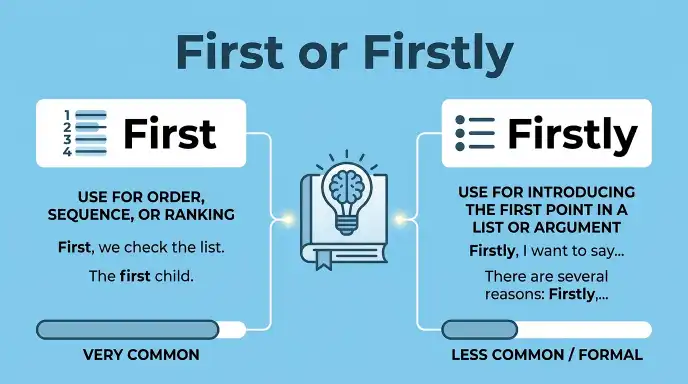
First and firstly are both correct words, but first is usually the better choice in modern English. People often search for “first or firstly” because they are unsure which word sounds natural when introducing the first point in a list, argument, or explanation.
The confusion is common in both everyday and formal writing. In most cases, use first when you mean “before anything else” or when you are listing points. For example, “First, check the instructions.” You can also say “Firstly, check the instructions,” and the sentence is grammatically correct. However, the first is shorter, cleaner, and more common.
The choice can also depend on writing style. First works well in conversations, emails, essays, reports, and professional writing. Firstly may sound more formal or traditional, especially when followed by secondly, thirdly, and so on.
This guide explains the difference between first or firstly, their meanings, history, common mistakes, everyday use, and which form you should choose.
First or Firstly : Quick Answer
First and firstly are both correct, but first is generally preferred in modern English.
- First = before anything else; the first point in a sequence.
- Firstly = in the first place; used to introduce the first point.
Examples
First, wash your hands before cooking.
Firstly, wash your hands before cooking.
Both sentences are correct. However, first sounds more natural and direct.
Best general choice: Use first in most situations.
Definition and Meaning of First or Firstly
What Does First Mean?
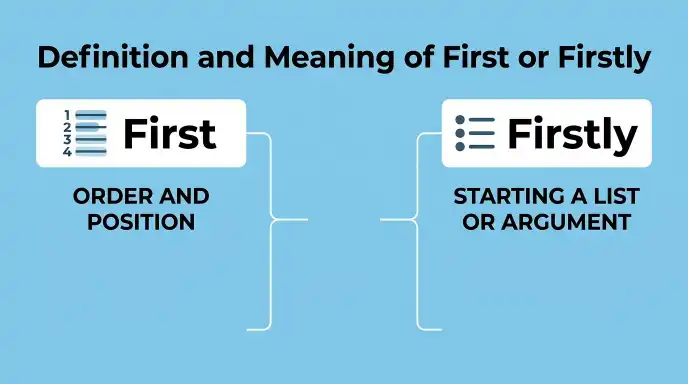
First means coming before all others in time, order, or importance. It can work as an adjective, adverb, noun, or other grammatical forms depending on the sentence.
Examples:
- She arrived first.
- He won first place.
- First, read the question carefully.
- This was my first visit.
When used to organize ideas, first means before anything else.
What Does Firstly Mean?
Firstly is an adverb. It means first or in the first place.
It is often used to introduce the first point in a series.
Example:
Firstly, we need to understand the problem.
The word does not have a major difference in meaning from the first when both are used as sequence markers.
First vs Firstly in Context
The main difference is style, not basic meaning.
First is shorter and more natural:
First, check the spelling.
Firstly is also correct:
Firstly, check the spelling.
In modern writing, first is often the stronger choice because it is simple and direct.
The Origin of First or Firstly
The word first has a very old history. It comes from Old English fyrst, which was related to words meaning “foremost” or “earliest.”
Over time, the spelling changed as English developed. The modern form first became established in Middle English and later English.
The word firstly developed from first with the addition of the adverb-forming ending -ly.
This pattern is common in English. For example:
- slow → slowly
- careful → carefully
- final → finally
- first → firstly
However, first can already function as an adverb. Because of this, English does not need firstly to make the meaning grammatical.
That explains why both forms exist.
The difference is mainly one of style and usage rather than spelling rules.
British English vs American English Spelling
There is no spelling difference between British English and American English for first or firstly.
Both forms are spelled the same in the two varieties of English.
| Feature | British English | American English |
| First | first | first |
| Firstly | firstly | firstly |
| Meaning | Same | Same |
| Spelling difference | None | None |
| Common modern choice | first | first |
Both British and American writers may use firstly. However, first is widely accepted and often preferred for clear, direct writing.
Examples
British English:
First, complete the form.
American English:
First, complete the form.
The spelling remains exactly the same.
Which Spelling Should You Use?
You do not need to choose based on country because first and firstly are both standard in British and American English.
The better choice depends on your writing style.
For Everyday English
Use first.
First, let’s have breakfast.
It sounds natural and simple.
For Professional Writing
First is usually a good choice because it keeps sentences concise.
First, review the report.
For Academic Writing
Both forms can be correct, but first is often more direct.
First, this study examines the causes.
For Formal or Traditional Writing
Firstly may be used, especially when the writer also uses secondly and thirdly.
Firstly, we need to identify the issue.
Secondly, we need to find a solution.
For Global English
Choose first if you want the simplest and most widely understood option.
Recommended choice: First
Common Mistakes with First or Firstly
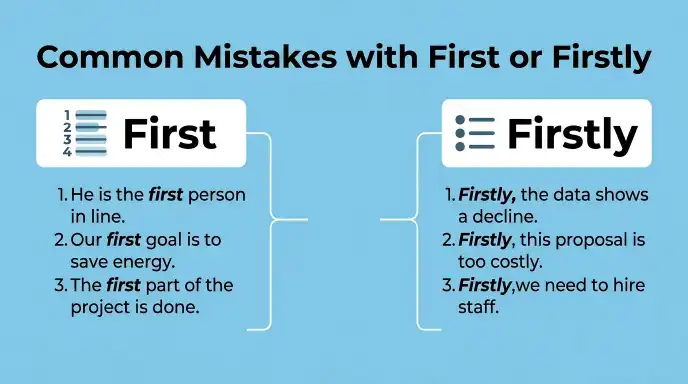
Many mistakes happen because writers believe firstly is always more formal or grammatically better. It is not.
Thinking “First” Is Incorrect
Incorrect idea:
First is not grammatically correct before a comma.
This is false.
Correct:
First, check the instructions.
Using Both Words Together
Avoid:
First, we need to discuss the problem.
Use only one:
First, we need to discuss the problem.
or:
Firstly, we need to discuss the problem.
Adding “of All” Unnecessarily
Some writers create long phrases when a simple word works better.
Wordy:
Firstly, of all, we need to understand the issue.
Better:
First, we need to understand the issue.
Assuming “Firstly” Is More Correct
Firstly is not automatically more correct because it ends in -ly.
Both are grammatically acceptable:
First, consider the evidence.
Firstly, consider the evidence.
Mixing List Styles
Avoid switching between different forms without reason:
Firstly, we collect the data.
Second, we analyze it.
Thirdly, we report the results.
A consistent style is better:
First, we collect the data.
Second, we analyze it.
Third, we report the results.
First or Firstly in Everyday Examples
The word first appears often in everyday and professional communication.
In Emails
First, please review the attached information.
First, I would like to thank you for your help.
In News Writing
First, the team needs to address the main issue.
News writing often favors short and direct language, so first can work well.
In Social Media
First, let me explain what happened.
First, thank you to everyone who supported us.
In Formal Writing
First, the report examines the main cause of the problem.
With Secondly
Both styles are possible.
Style 1:
First, we need more evidence.
Second, we need more time.
Style 2:
Firstly, we need more evidence.
Secondly, we need more time.
The first style is often shorter and more direct.
First or Firstly : Google Trends & Usage Data
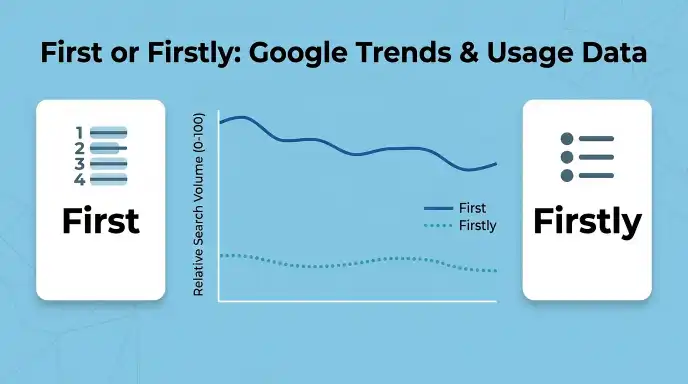
Search interest for first or firstly comes from people who want to understand the difference between the two words and decide which one sounds correct.
The two forms are not competing spellings. They are two grammatical forms with similar meanings.
Usage also depends on context.
- First is common in everyday speech.
- First is common in instructions and professional writing.
- Firstly appears more often when writers organize a series of points.
- Firstly is sometimes linked with formal or traditional writing styles.
Searches can also vary by country because English-learning questions are common in regions where British or American English is taught.
Google Trends can show relative search interest over time, but it does not provide a complete measure of how often people use a word in all writing and speech. For that reason, search trends should be treated as an indicator of interest, not as exact language-use statistics.
First vs Firstly: Comparison Table
| Feature | First | Firstly |
| Part of speech | Can function as an adverb | Adverb |
| Basic meaning | Before anything else | In the first place |
| Correct? | Yes | Yes |
| Common in speech | Very common | Less common |
| Common in professional writing | Very common | Common |
| Common in formal lists | Yes | Yes |
| British English | Correct | Correct |
| American English | Correct | Correct |
| Style | Simple and direct | More formal or traditional |
| Recommended general choice | Yes | Sometimes |
FAQs About First or Firstly
Q1. Is first or firstly correct?
Both are correct. However, first is usually the simpler and more natural choice in modern English.
Q2. Is it better to say first or firstly?
In most situations, first is better because it is shorter, clearer, and widely used.
Q3. Is it grammatically correct?
Yes. Firstly is a standard English adverb used to introduce the first point in a sequence.
Q4. Can I use first and second together?
Yes, but it is better to keep the list style consistent.
For example:
First, we collect the data.
Second, we study the results.
This is usually cleaner than mixing first with secondly.
Q5. Do British people use it first?
Yes. Firstly is used in British English, just as it is in American English. There is no British-only spelling.
Q6. Is firstly more formal than first?
Firstly can sound more formal or traditional, but that does not make it more correct. First is also suitable for formal writing.
Q7. Should I use it first in academic writing?
Yes. First is completely acceptable in academic writing. Use it when it makes your sentence clear and direct.
Conclusion:
First and firstly are both correct English words, and both can introduce the first point in a sequence. The main difference is style and preference, not correctness. First is shorter, simpler, and very common in modern English. Firstly is also standard but can sound more formal or traditional.
For everyday conversation, emails, instructions, professional writing, and most academic writing, first is usually the best choice. For example, “First, read the question carefully” is clear and natural.
You can use firstly when you want a more traditional list structure, especially with secondly and thirdly. However, there is no need to use firstly simply because you think it is more grammatically correct.
Remember that first and firstly are spelled the same in British and American English. If you want a simple rule, choose first unless your writing style calls for firstly.

I’m Nora Ellis, an English language writer passionate about making grammar, spelling, and confusing words easy to understand. I share clear explanations and practical examples to help readers improve their English and use words with confidence.




2 thoughts on “First or Firstly: Meaning, Usage, and Examples in English ”