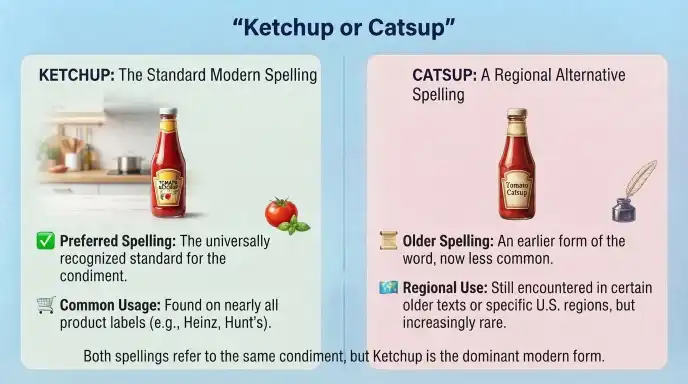
Ketchup or catsup? Both spellings refer to the same tomato-based condiment, but ketchup is the standard and far more common spelling today. Catsup is a less common variant, especially in modern American English.
People often search for “Ketchup or Catsup” because both forms appear in dictionaries, older texts, product names, and historical references. This can make it hard to know which spelling is correct. The confusion is not about two different foods. In most cases, ketchup and catsup mean the same thing.
The difference comes mainly from the history of the word and the different spellings used over time. Today, ketchup is the normal choice in everyday English, while catsup may appear in older writing, some brand names, or historical contexts.
If you are writing an email, school assignment, article, menu, or social media post, choosing the right form matters. This guide explains the meaning, history, spelling, usage, regional differences, common mistakes, and modern popularity of ketchup or catsup.
Ketchup or Catsup : Quick Answer
Ketchup is the standard spelling used today. Catsup is an accepted but much less common variant.
Both words usually mean the same thick, sweet tomato sauce served with foods such as fries, burgers, sandwiches, and hot dogs.
Examples:
- Please pass the ketchup.
- She added ketchup to her fries.
- The older label used the spelling catsup.
For modern writing, ketchup is the safest and most natural choice.
Definition and Meaning of Ketchup or Catsup
Ketchup and catsup are nouns. They generally refer to a thick sauce made from tomatoes, vinegar, sugar, salt, and spices.
What Does Ketchup Mean?
Ketchup is a common condiment with a sweet, tangy, and slightly salty taste. It is often served with fast food and many everyday meals.
For example:
- I put ketchup on my burger.
- The children like ketchup with their fries.
- Please bring a bottle of ketchup.
What Does Catsup Mean?
Catsup has essentially the same meaning as ketchup. It is an alternative spelling rather than a different type of sauce.
The spelling catsup is much less common in modern English. It may still appear in historical material, older publications, or certain product names.
Ketchup vs Catsup
| Spelling | Meaning | Modern Usage |
| Ketchup | Tomato-based condiment | Very common |
| Catsup | Tomato-based condiment | Less common |
| Ketchup | Standard modern form | Preferred |
| Catsup | Historical/variant form | Limited use |
So, if you are unsure which form to use, choose ketchup.
The Origin of Ketchup or Catsup
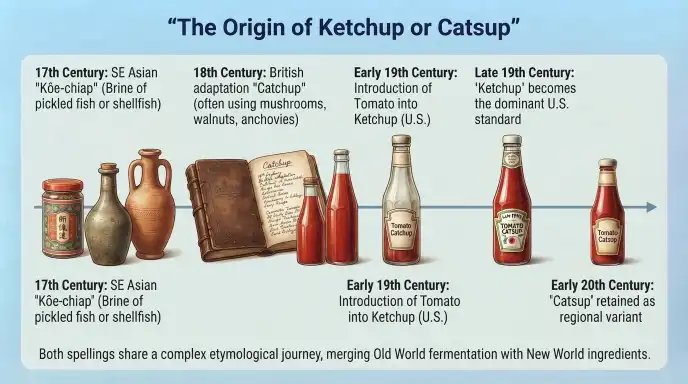
The history of ketchup is more complex than its spelling suggests.
The word is linked to older Asian sauce names. One commonly discussed source is the Hokkien Chinese term kê-tsiap, which refers to a type of fermented fish sauce. The word later traveled through trade and changed as it entered other languages and cultures.
Early versions of ketchup were not necessarily made from tomatoes. They could contain ingredients such as fish, mushrooms, or other foods.
When the sauce became popular in the Western world, different spellings appeared. These included forms such as catchup, catsup, and ketchup.
Tomato ketchup became especially popular later. As recipes changed, the tomato-based version became the familiar condiment many people know today.
The spelling ketchup eventually became dominant in modern English. Catsup survived as a less common variant.
This explains why both forms can be found in dictionaries and historical sources. They developed from a long history of changing recipes, languages, and spellings.
British English vs American English Spelling
There is an important point about ketchup or catsup: this is not mainly a British-versus-American spelling difference.
Unlike pairs such as colour/color or centre/center, both ketchup and catsup have been used in American English.
Today, however, ketchup is the dominant spelling in both British and American English.
| Variety | Preferred Spelling | Example |
| American English | Ketchup | I need some ketchup. |
| British English | Ketchup | Could you pass the ketchup? |
| Canadian English | Ketchup | He added ketchup to his fries. |
| Australian English | Ketchup | The children asked for ketchup. |
| International English | Ketchup | Ketchup is served with the meal. |
| Historical English | Catsup/Ketchup | Both forms can appear. |
Is Catsup Wrong?
No. Catsup is not simply a misspelling of ketchup. It is an established variant spelling.
However, its use is much less common today. In most modern writing, ketchup will sound more natural.
Which Spelling Should You Use?
For most readers, ketchup is the best choice.
For American English
Use ketchup in normal writing. It is the familiar modern spelling.
For British English
Use ketchup as well. British English does not normally require catsup.
For Canadian and Australian English
Ketchup is also the normal modern form.
For Academic Writing
Use ketchup unless you are discussing the history of the word or quoting an original source that uses catsup.
For Historical Writing
Catsup may be appropriate when discussing historical texts, old labels, or historical usage.
For Global Readers
Choose ketchup because it is widely recognized and easy to understand.
Simple rule: When writing about the condiment today, use ketchup.
Common Mistakes with Ketchup or Catsup
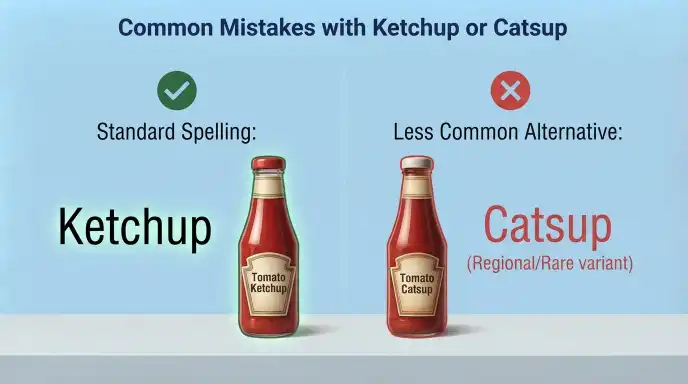
People make several mistakes when using these words.
| Mistake | Correct Form | Explanation |
| Catsup is always wrong. | Catsup can be correct. | It is a recognized variant. |
| Ketchup and catsup are different sauces. | They usually mean the same thing. | The main difference is spelling and usage. |
| Ketch-up | Ketchup | The modern word is normally written as one word. |
| Catsup is the British spelling. | Ketchup is common in British English. | Catsup is not simply a British form. |
| Ketchup is only American. | Ketchup is widely used internationally. | It is common in many varieties of English. |
Calling Catsup Incorrect
It is better to call catsup an alternative or less common spelling, not simply a spelling mistake.
Assuming the Words Have Different Meanings
In modern usage, ketchup and catsup usually refer to the same condiment.
Using Catsup in Modern General Writing
Although catsup is valid, it may look unusual to modern readers. Ketchup is usually the clearer choice.
Ketchup or Catsup in Everyday Examples
The spelling you choose can depend on the context.
In an Email
Could you please buy some ketchup on your way home?
This is natural and standard.
In News Writing
The restaurant serves burgers with homemade ketchup.
Ketchup is the expected modern form.
On Social Media
Nothing beats hot fries with extra ketchup!
The modern spelling works best for casual posts.
In Formal Writing
The study examined consumer preferences for tomato ketchup.
Ketchup is suitable for reports and academic writing.
In Historical Writing
The old recipe used the spelling catsup for the tomato sauce.
Here, catsup is useful because the sentence is discussing historical spelling.
More Everyday Examples
- Do you want ketchup with your fries?
- He spilled ketchup on his shirt.
- The bottle of ketchup was almost empty.
- Some older texts use catsup instead of ketchup.
- The recipe calls for two tablespoons of ketchup.
Ketchup or Catsup : Google Trends & Usage Data
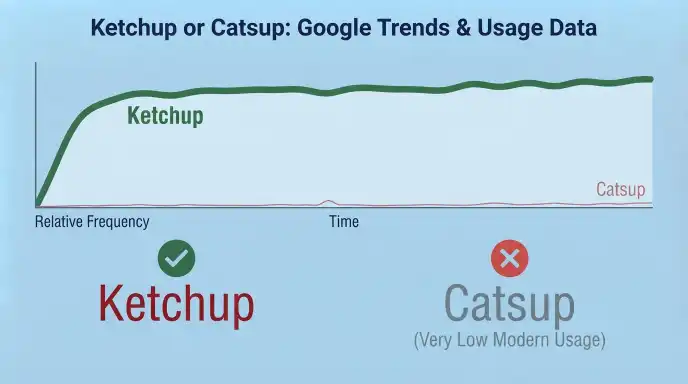
Modern usage strongly favors ketchup over catsup.
Search interest can vary by country, time period, and context. However, the broader pattern is clear: ketchup is the dominant modern spelling, while catsup has a much smaller presence.
This difference is also visible in everyday writing. People are far more likely to see ketchup on menus, food packaging, recipes, restaurant websites, and social media.
The spelling catsup may attract attention because it is unusual. It can also appear in searches about word history, spelling differences, or older products.
Google Trends should be treated as a measure of search interest, not as a dictionary or proof that one spelling is grammatically correct.
Usage by Context
| Context | More Common Form |
| Modern food writing | Ketchup |
| Restaurant menus | Ketchup |
| Recipes | Ketchup |
| Social media | Ketchup |
| Academic writing | Ketchup |
| Historical discussion | Catsup/Ketchup |
| Older texts | Catsup/Ketchup |
| Modern general English | Ketchup |
The overall advice is simple: use ketchup for modern everyday English.
Ketchup vs Catsup: Comparison Table
| Feature | Ketchup | Catsup |
| Meaning | Tomato-based condiment | Tomato-based condiment |
| Part of speech | Noun | Noun |
| Correct spelling | Yes | Yes |
| Modern popularity | Very high | Low |
| Common today | Yes | Less common |
| British English | Common | Uncommon |
| American English | Very common | Less common |
| Historical use | Yes | Yes |
| Best for modern writing | Yes | Usually no |
| Main difference | Modern standard form | Variant form |
FAQs
Q1. Is ketchup or catsup correct?
Ketchup and catsup are both accepted spellings. However, ketchup is the standard and much more common modern form.
Q2. Is catsup a misspelling of ketchup?
No. Catsup is an established variant spelling. It is less common today but has a long history of use.
Q3. Do ketchup and catsup mean the same thing?
Yes. In modern English, ketchup and catsup generally refer to the same tomato-based condiment.
Q4. Is catsup British or American?
Catsup is not simply the British spelling. It has been used in American English, while ketchup is now common in both American and British English.
Q5. Which spelling is more common, ketchup or catsup?
Ketchup is much more common. It is the normal spelling in modern everyday English.
Q6. Should I use ketchup in formal writing?
Yes. Ketchup is the best choice for most formal, academic, professional, and general writing.
Q7. Why are there two spellings?
The two spellings developed from the word’s long linguistic history. Different languages and writers used different forms, including catsup and ketchup.
Conclusion:
Ketchup is the best spelling for most modern English writing, while catsup is an accepted but much less common variant. Both words normally refer to the same tomato-based condiment, so the difference is mainly one of spelling, history, and modern usage.
The word has a long history that connects to older Asian sauce names. As the word traveled between languages and cultures, several spellings developed. Catsup remained in use, but ketchup eventually became the dominant modern form.
There is also no simple rule that says catsup is British and ketchup is American. Today, ketchup is widely used in American, British, Canadian, Australian, and international English.
If you are writing a school assignment, email, article, recipe, menu, or social media post, ketchup is the safest choice. Use catsup when the historical spelling is important or when you are referring to a source that specifically uses that form.
In short: both are valid, but ketchup is the clear modern preference.

I’m Nora Ellis, an English language writer passionate about making grammar, spelling, and confusing words easy to understand. I share clear explanations and practical examples to help readers improve their English and use words with confidence.