Cubby is the standard spelling, while cubbie is a less common variant. Both words can refer to a small storage space, compartment, or enclosed area.
People often search for “cubby or cubbie” because the two spellings look and sound very similar. The confusion often appears when people write about school storage spaces, lockers, shelves, desks, or small compartments. Although both forms can be found in English, they are not equally common today.
In modern English, cubby is the usual choice. It is especially common in schools, childcare centers, offices, homes, and furniture descriptions. Cubbie can also be found, but it has much less use in general writing.
Knowing the preferred spelling helps you write clearly in emails, school notices, product descriptions, articles, and everyday messages. In most cases, cubby is the safer and more natural choice. However, cubbie may still appear in informal writing or specific names.
This guide explains the meaning, origin, spelling, regional use, common mistakes, everyday examples, and modern usage of cubby or cubbie.
Cubby or Cubbie : Quick Answer
Cubby is the preferred spelling in modern English. Cubbie is a less common variant.
A cubby is usually a small storage space, compartment, or open shelf used to keep personal items.
Examples:
- Please put your shoes in your cubby.
- Each child has a cubby at school.
- The office has small cubbies for employees.
- She placed her books in a cubbie.
Therefore, if you are unsure which spelling to use, choose cubby for most modern writing.
Definition and Meaning of Cubby or Cubbie
Cubby is a noun that usually means a small compartment or storage space. It often describes an open space used to store books, clothes, bags, toys, shoes, or other personal items.
What Does Cubby Mean?
A cubby is a small space designed for storing things.
For example:
- The students put their bags in their cubbies.
- My desk has a small cubby for books.
- Please put your coat in your cubby.
In schools, a cubby often gives each child a separate place for personal belongings. Likewise, offices may use cubbies to help workers store bags and other items.
What Does Cubbie Mean?
Cubbie can also refer to a small storage space or compartment. However, it is a less common spelling of cubby.
For example:
- The children have individual cubbies.
- Put your lunch in your cubbie.
Although cubbie is understandable, cubby is usually the better choice in modern general writing.
Other Meaning of Cubby
The word cubby can also describe a small enclosed space or room.
For example:
The office worker sat in a small cubby.
In this context, the word does not necessarily mean a storage compartment. Instead, it describes a small or confined area.
The Origin of Cubby or Cubbie
The exact history of cubby is not completely certain. However, the word has been used in English for a long time to describe a small or confined space.
An older sense of cubby referred to a small room or confined place. Over time, the word became strongly associated with small compartments used for storage.
The spelling cubby became the more established form in modern English. Meanwhile, cubbie developed as an alternative spelling and can still be found in some informal contexts.
This type of spelling variation is not unusual in English. In some words, writers use -ie instead of -y, especially when a word has an informal or diminutive feel.
As a result, both cubby and cubbie can be found in English. Nevertheless, cubby has become the dominant modern form.
Today, the word is especially common in school and workplace settings. It is also widely used in descriptions of furniture and home storage.
Cubby or Cubbie: British English vs American English Spelling

Cubby is especially common in American English, particularly in schools, childcare centers, offices, and homes.
However, the difference between cubby and cubbie is not a strict British English versus American English spelling rule. Instead, cubby is the more common modern form across different varieties of English.
| English Variety | Preferred Form | Example |
| American English | Cubby | Put your bag in your cubby. |
| British English | Cubby | Keep your things in the cubby. |
| Canadian English | Cubby | Each child has a cubby. |
| Australian English | Cubby | The students use cubbies. |
| International English | Cubby | Put the books in the cubby. |
| Informal/variant use | Cubbie | The child has a small cubbie. |
Unlike pairs such as colour/color, cubby/cubbie is not a standard regional spelling distinction.
Instead, cubby is the safer choice for readers in most English-speaking countries. It is also easier for readers to recognize because it is much more common.
Which Spelling Should You Use?
For American English
Use cubby. It is the most common spelling and is widely understood.
Please place your backpack in your cubby.
For British English
Cubby is also a good choice. Although cubbie can be found, it is not the required British spelling.
For Canadian and Australian English
Use cubby for clear and standard modern writing. This form is widely understood and works well for general readers.
For Academic Writing
Use cubby unless you are quoting a source that specifically uses cubbie. This approach keeps your writing consistent and familiar.
For Global English
Cubby is the safest option because it is more widely recognized. Therefore, international writers should normally choose this form.
Simple Rule
If you are unsure, choose cubby. It is the standard and more common choice in modern English.
Common Mistakes with Cubby or Cubbie
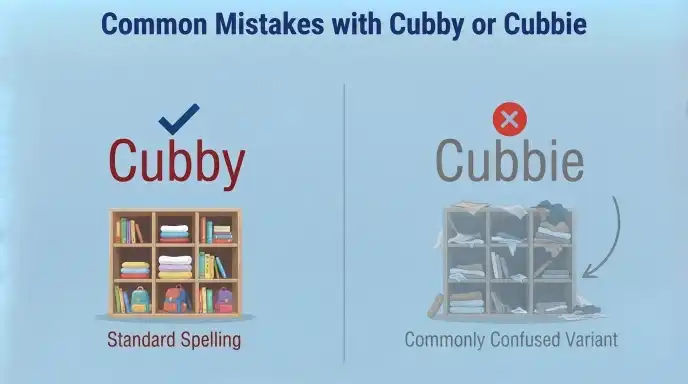
Several mistakes can cause confusion when people use these words.
| Common Mistake | Correct Form | Explanation |
| Cubbys | Cubbies | The plural of cubby changes y to ies. |
| Cubbie is always wrong. | Cubbie can be used. | It is a less common variant. |
| Cubby is only American. | Cubby is used more widely. | It is not limited to American English. |
| Cubby and cubbie always mean different things. | Usually the same meaning | Both can refer to a small compartment. |
| Cubbyes | Cubbies | The standard plural is cubbies. |
Cubby vs Cubbie
The main difference is usage frequency, not meaning.
Cubby is the normal modern spelling. It appears frequently in school, office, home, and furniture contexts.
By comparison, cubbie is less common. It may appear in informal writing, specific names, or individual usage.
Therefore, modern writers should normally choose cubby.
Remember the Plural
One cubby becomes two cubbies.
For example:
- One cubby
- Two cubbies
- Several cubbies
This spelling is important because cubbys is not the standard plural form.
Cubby or Cubbie in Everyday Examples
Understanding how the word works in real sentences makes the difference easier to remember.
In an Email
Please remind the students to place their coats in their cubbies.
This sentence uses the standard plural form.
In School Writing
Every student has a cubby for personal belongings.
Here, cubby clearly describes an individual storage space.
In News Writing
The new classroom includes storage cubbies for students.
In this context, the standard spelling sounds natural and professional.
On Social Media
New classroom, new cubbies, and lots of new supplies!
For casual posts, cubbies is still the usual plural form.
In Formal Writing
Each employee is provided with a personal storage cubby.
Formal writing also favors cubby because it is the more familiar form.
In a Product Description
This desk includes a small cubby for books and office supplies.
Product descriptions commonly use cubby when describing built-in storage.
With the Plural Form
The plural of cubby is cubbies.
- One cubby
- Two cubbies
- Several cubbies
As a result, remembering the plural form can help prevent a common spelling error.
Cubby or Cubbie : Google Trends & Usage Data

Modern usage strongly favors cubby over cubbie.
Search interest can change by country, time, and context. Even so, the overall pattern shows that cubby is the more familiar form in modern English.
The word cubby is especially common in searches related to schools, classrooms, childcare, storage furniture, desks, shelves, and organization.
Meanwhile, cubbie has a smaller presence. It may appear in informal writing, product names, business names, or searches where users are unsure about the spelling.
Google Trends should be viewed as a measure of search interest, not as a dictionary ruling. Search results can also change based on location and the meaning people intend.
Usage by Context
| Context | More Common Form |
| School storage | Cubby |
| Classroom writing | Cubby |
| Office storage | Cubby |
| Furniture descriptions | Cubby |
| Everyday English | Cubby |
| Formal writing | Cubby |
| Informal variant use | Cubbie |
| Historical or specific usage | Cubbie may appear |
Overall, cubby is the stronger choice for modern English.
Cubby vs Cubbie: Comparison Table
| Feature | Cubby | Cubbie |
| Meaning | Small compartment or storage space | Small compartment or storage space |
| Part of speech | Noun | Noun |
| Standard modern form | Yes | Less common |
| Common in schools | Yes | Less common |
| Common in American English | Yes | Less common |
| Common in British English | Yes | Less common |
| Plural | Cubbies | Cubbies |
| Modern usage | Very common | Limited |
| Best general choice | Yes | Usually no |
FAQs About Cubby or Cubbie
Q1. Is it cubby or cubbie?
Cubby is the preferred spelling in modern English. Cubbie is a less common variant.
Q2. Is cubbie a correct spelling?
Yes. Cubbie can be used as a variant spelling, but cubby is much more common.
Q3. What does cubby mean?
A cubby is usually a small storage compartment or open space used to keep personal items.
Q4. What is the plural of cubby?
The plural of cubby is cubbies.
For example, you can say, “The students put their bags in their cubbies.”
Q5. Is Cubby American or British?
Cubby is especially common in American English, but it is not limited to the United States. It can also be used in British and other varieties of English.
Q6. Is cubbie a British spelling of cubby?
No. Cubbie is not simply the British spelling of cubby. It is a less common variant that can appear in different English contexts.
Q7. Which spelling should I use in formal writing?
Use cubby in most formal and professional writing. It is clearer, more common, and more widely recognized.
Conclusion:
Cubby is the preferred spelling in modern English, while cubbie is a less common variant. Both words can describe a small storage compartment, shelf space, or enclosed area. Therefore, the main difference is spelling and frequency of use rather than meaning.
The word cubby is especially common in schools, classrooms, childcare centers, offices, homes, and furniture descriptions. In addition, it is widely understood outside the United States, so it works well for international readers.
One important spelling point concerns the plural form. The plural of cubby is cubbies, not cubbys. This follows the common English spelling rule that changes a final y to ies.
If you are writing an email, school notice, article, product description, or formal document, cubby is the safest choice. However, cubbie may be suitable when a particular source, name, or informal style uses that form.
Overall, both forms can be found in English, but cubby is the clear modern preference.

I’m Nora Ellis, an English language writer passionate about making grammar, spelling, and confusing words easy to understand. I share clear explanations and practical examples to help readers improve their English and use words with confidence.