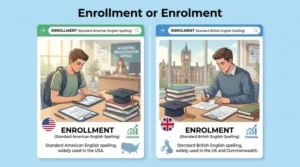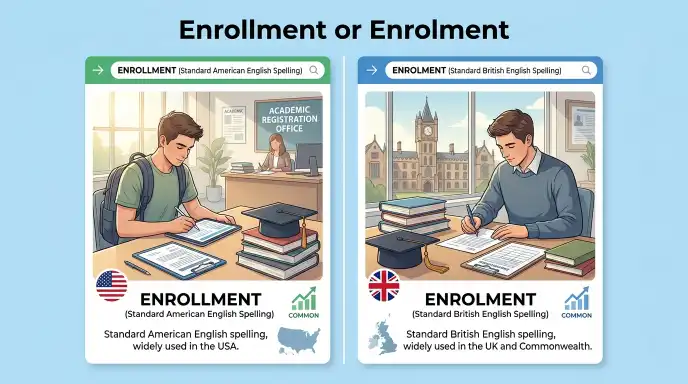
Enrollment or enrolment are both correct spellings of the same word. The main difference is regional: enrollment is standard in American English, while enrolment is standard in British English and is also used in other countries that follow British spelling conventions.
Both words refer to the act of joining or registering for a school, course, program, or service. These spellings often confuse students, parents, teachers, and professionals. You may see enrollment on an American college website but find enrolment on a British school form.
This difference does not change the meaning of the word. It reflects the spelling rules used in different varieties of English. Knowing which version to use can help you write clear school applications, business emails, official documents, and academic papers. It also helps you keep your spelling consistent when writing for a particular country.
In this guide, you will learn the meaning, origin, and regional spelling rules for enrollment or enrolment. You will also find practical examples, common mistakes, usage advice, and answers to frequently asked questions. By the end, you will know which spelling best suits your readers.
Featured Snippet: What Is the Difference Between Enrollment and Enrolment?
Enrollment is the standard American English spelling, while enrolment is the standard British English spelling. Both mean the act of registering or joining a school, course, program, or service. For example, American schools may announce student enrollment, while British schools may announce student enrolment. The meaning remains the same.
Enrollment or Enrolment: Quick Answer
Both enrollment and enrolment are correct. The right choice depends on your audience and the English spelling style you follow.
- Enrollment: Preferred in American English.
- Enrolment: Preferred in British English and commonly used in other British-influenced spelling systems.
- Meaning: The act of registering or joining a school, course, program, or organization.
Examples
- American English: Student enrollment opens in August.
- British English: Student enrolment opens in August.
- Both varieties: Online enrollment/enrolment is available for new students.
Easy tip: Use enrollment for a US audience and enrolment for a UK audience. Keep the spelling consistent throughout your writing.
What Does Enrollment or Enrolment Mean?
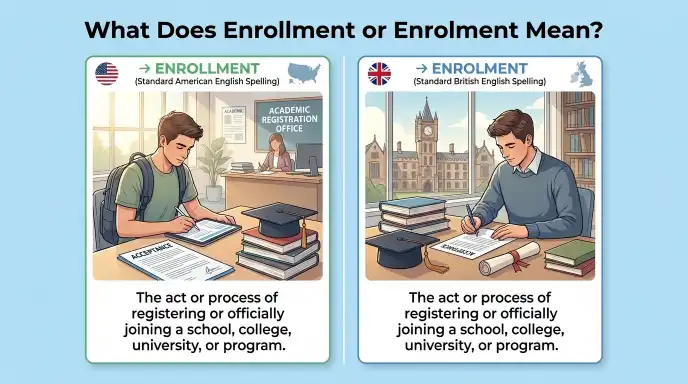
Enrollment and enrolment are nouns. They describe the process of signing up, registering, or becoming a member of an institution, course, program, or service.
The two spellings have the same meaning. Only the regional spelling convention changes.
Definition and Simple Meaning
In simple terms, enrollment or enrolment means joining something officially by registering your details.
For example, when a student completes a college application and registers for classes, the student takes part in the enrollment or enrolment process.
Examples:
- The school opened enrollment for new students. (American English)
- The school opened enrolment for new students. (British English)
- Online enrollment is available for the training course.
- The university reported a rise in student enrolment.
Each sentence refers to registration or the number of people who have registered.
Different Contexts and Uses
The word appears in several settings.
Education
Schools, colleges, and universities use the word when students register for classes or programs.
Example: College enrollment begins next month.
Online courses
Training platforms use the term when learners sign up for digital lessons.
Example: Enrolment is open to learners from around the world.
Health insurance and employee benefits
Organizations may use the word for registration in a health plan or benefits program.
Example: Open enrollment for employee benefits ends on Friday.
Membership and services
Clubs, professional groups, and public programs may use the word for new registrations.
Example: Enrolment in the community program is free.
Student numbers
The word can also refer to the number of students registered at an institution.
Example: The college recorded higher student enrollment this year.
In this last use, the word describes the total number of registered students rather than just the registration process.
The Origin of Enrollment or Enrolment
The words enrollment and enrolment come from the verb enroll or enrol, which means to register someone or enter a name on an official list.
The verb developed from the idea of entering a name or record on a roll. A roll was a list or document that recorded names, often for official purposes.
The word family includes:
- Enroll / enrol: To register or join officially.
- Enrollment / enrolment: The act or process of registering.
- Enrolled / enrolled: Registered or officially entered.
- Enrolling / enroling: The act of registering, with the spelling depending on the English variety.
Why Do the Spellings Differ?
American and British English developed different spelling preferences over time. American English often uses forms such as enroll and enrollment, with a double l before endings such as -ed and -ment.
British English generally prefers enrol and enrolment. The noun keeps one l, while the verb usually doubles the final l in forms such as enrolled and enrolling.
This difference is part of a wider pattern in English spelling. Similar regional differences appear in words such as color/colour and organize/organise, although each word has its own spelling conventions.
The two forms of the target word are both established English spellings. Neither is universally wrong.
British English vs American English
The main difference between enrollment and enrolment is regional spelling. American English uses enrollment, while British English uses enrolment.
Comparison Table
| British English | American English | Example |
| Enrolment | Enrollment | Student enrolment/enrollment begins soon. |
| Enrol | Enroll | You can enrol/enroll online. |
| Enrolled | Enrolled | She enrolled in a course. |
| Enrolling | Enrolling | He is enrolling in college. |
| Enrolment form | Enrollment form | Please complete the registration form. |
| Enrolment numbers | Enrollment numbers | The school reported higher student numbers. |
Notice that enrolled and enrolling use a double l in both varieties. The main difference appears in the base verb and the noun.
British English Examples
- Enrolment for the new term starts in June.
- The college has increased its student enrolment.
- Please complete the enrolment form before classes begin.
- She plans to enrol in an online course.
American English Examples
- Enrollment for the new semester starts in June.
- The college has increased its student enrollment.
- Please complete the enrollment form before classes begin.
- She plans to enroll in an online course.
Do Style Guides Prefer One Spelling?
Style guides normally follow the spelling conventions of their intended audience. A US publication will generally use enrollment, while a UK publication will generally use enrolment.
Schools, universities, employers, and government agencies may also use their own established wording. When completing an official form, copy the spelling used by the institution.
The key is consistency. Avoid switching between the two spellings in the same document unless you are quoting an official title or text.
Which Version Should You Use?
Your audience should guide your choice. Both forms are correct, so you do not need to treat one as a spelling mistake.
United States
Use enrollment in American English.
Examples:
- Student enrollment opens in August.
- The university reported a rise in enrollment.
- Complete the online enrollment form.
Use enroll, enrolled, and enrolling for the related verb forms.
United Kingdom
Use enrolment in British English.
Examples:
- Student enrolment opens in August.
- The university reported a rise in enrolment.
- Complete the online enrolment form.
The related verb is generally spelled enrol.
Canada
Canadian English uses spelling conventions from both British and American English, depending on the word and the institution. Enrollment is common in Canadian educational contexts, but usage can vary.
Check the spelling used by your school, employer, or provincial authority before preparing formal documents.
Australia
Australian English generally follows British spelling for this word, so enrolment is the usual choice.
Example: Student enrolment for the next school year begins soon.
For official paperwork, follow the wording used by the relevant Australian institution.
International Writing
For international readers, either spelling is understandable. Choose one based on your main audience or the style guide you follow.
If your content targets several countries, explain the regional difference once and use each spelling only where relevant.
Academic Writing
Use the spelling required by your university, instructor, or journal.
- American academic writing: enrollment
- British academic writing: enrolment
Do not change the spelling of an official program name or quoted document.
Business Writing
Businesses may use the word for training, insurance, membership, and employee benefit registration.
Choose the spelling that matches your company’s house style and target audience. For a US company, enrollment is the usual choice. For a UK or Australian audience, enrolment is generally preferred.
Common Mistakes with Enrollment or Enrolment
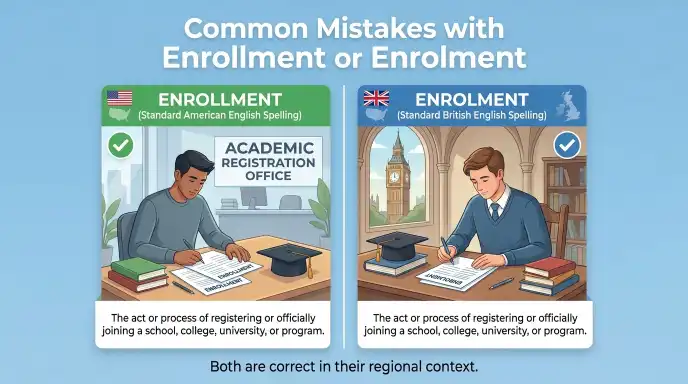
Although both forms are correct, writers can make mistakes when they mix spelling styles or confuse related words.
Using the American Spelling in British Text
Less suitable for standard British English: Student enrollment is now open.
Preferred British English: Student enrolment is now open.
Explanation: British English generally uses enrolment. The American spelling is not inherently wrong, but it may be inconsistent with a British style guide.
Using the British Spelling in American Text
Less suitable for standard American English: Student enrolment is now open.
Preferred American English: Student enrollment is now open.
Explanation: American English uses enrollment as the standard noun form.
Mixing Spellings
Inconsistent: Students can enroll online, and their enrolment will be confirmed by email.
Consistent American English: Students can enroll online, and their enrollment will be confirmed by email.
Consistent British English: Students can enrol online, and their enrolment will be confirmed by email.
Explanation: Keep related word forms consistent with your chosen spelling style.
Misspelling Enrolled
Incorrect: She enroled in the course.
Correct: She enrolled in the course.
Explanation: Both British and American English normally double the final l in enrolled.
Confusing Enrollment with Admission
Incorrect assumption: Enrollment and admission always mean the same thing.
Correct understanding: Admission usually refers to being accepted into an institution or program. Enrollment refers to registering or becoming officially listed as a participant or student.
Example: The university admitted Sara in May, and she completed her enrollment in June.
Memory Tip
Remember this simple rule:
- US: Enroll, enrollment.
- UK: Enrol, enrolment.
- Both: Enrolled, enrolling.
The country-based rule makes it easier to choose the right spelling.
Enrollment or Enrolment in Everyday Examples
These examples show how the word appears in common forms of writing.
In Emails
American English:
Subject: Course Enrollment Confirmation
Dear Student,
Your enrollment in the online course has been confirmed. Please review your schedule before the first class.
Best regards,
Student Services
British English:
Subject: Course Enrolment Confirmation
Dear Student,
Your enrolment in the online course has been confirmed. Please review your timetable before the first class.
Kind regards,
Student Services
In Business Writing
- Employee enrollment for health benefits closes on Friday. (US)
- Employee enrolment for the training program closes next week. (UK)
- Online enrollment makes registration faster.
- The organization opened enrolment for its new membership program.
In News Headlines
- University Enrollment Rises This Year
- School Enrolment Opens for the New Term
- New Program Aims to Increase Student Enrollment
- Colleges Review Student Enrolment Numbers
These are illustrative headline examples, not reports of actual events.
In Blog Posts
American English:
“College enrollment can feel confusing for new students. Prepare your documents early and check each deadline.”
British English:
“College enrolment can feel confusing for new students. Prepare your documents early and check each deadline.”
The spelling changes, but the advice and meaning remain the same.
On Social Media
- College enrollment is open! Submit your application today. (US)
- Student enrolment is now open for the next term. (UK)
- Online enrollment makes it easy to register from home.
- Check your documents before completing your enrolment.
In Academic Writing
- The university recorded a rise in student enrollment. (US)
- Student enrolment varied across the departments. (UK)
- The study examined factors that influence college enrollment.
- The report compared school enrolment across several regions.
In Daily Conversation
- “When does enrollment begin?” (US)
- “When does enrolment begin?” (UK)
- “I completed my enrollment online.”
- “My enrolment was confirmed yesterday.”
Both versions sound natural when used according to the speaker’s spelling convention.
Enrollment or Enrolment: Google Trends and Modern Usage
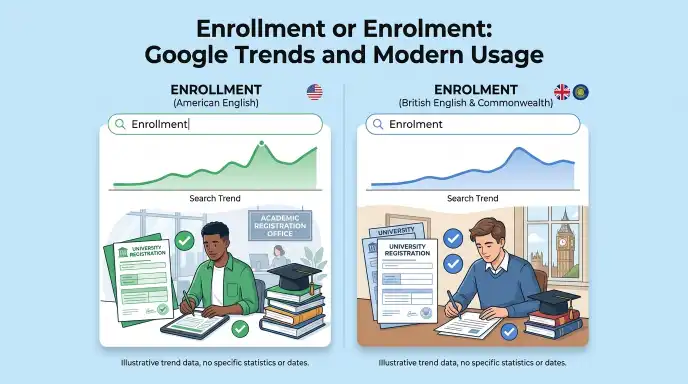
People search for enrollment or enrolment because they want to know which spelling is correct for school forms, college applications, online courses, and official documents.
Why Do People Search for This Keyword?
Common reasons include:
- Spelling checks: Writers want to choose the correct regional form.
- Education: Students and parents search for registration information.
- Business: Employees may need to complete benefits or training forms.
- Academic writing: Researchers want consistent spelling in papers and reports.
- International communication: Writers need to adapt content for US, UK, or other audiences.
Regional Usage Patterns
The general pattern is clear:
- United States: Enrollment is standard.
- United Kingdom: Enrolment is standard.
- Australia: Enrolment is generally preferred.
- Canada: Enrollment is common, but institutional usage can vary.
- International audiences: Either spelling may be understood.
These are general spelling patterns, not exact measurements of search popularity.
What Does Google Trends Tell Us?
Google Trends can compare the relative search interest in enrollment and enrolment across countries and time periods. However, without a current, verified comparison, it would be misleading to report exact search volumes, percentages, or claims that one form is more popular worldwide.
To compare the terms accurately:
- Open Google Trends.
- Enter enrollment as the first search term.
- Add enrolment as the second search term.
- Select a country or region.
- Choose the same time range for both terms.
- Compare the results.
Google Trends measures relative search interest rather than total search counts. Results can also change based on the region, date range, and search settings.
Modern Usage
Both spellings remain in regular use. Schools, colleges, employers, and online platforms use the word when people register for courses, benefits, memberships, or services.
The best spelling depends on the audience and the institution’s style. Search popularity does not determine which spelling is correct.
Quick Comparison Table: Enrollment vs Enrolment
| Version | Meaning | Correct? | Region | Example |
| Enrollment | Registration or the act of joining | Yes | American English | Student enrollment opens today. |
| Enrolment | Registration or the act of joining | Yes | British English | Student enrolment opens today. |
| Enroll | To register or join | Yes | American English | I will enroll next week. |
| Enrol | To register or join | Yes | British English | I will enrol next week. |
| Enrolled | Registered or officially listed | Yes | Both | She enrolled in the course. |
| Enrolling | Registering or joining | Yes | Both | He is enrolling today. |
Key Takeaways
- Enrollment is the standard American English spelling.
- Enrolment is the standard British English spelling.
- Both words have the same meaning.
- Use enroll in American English and enrol in British English.
- Both varieties usually spell the past form enrolled.
- Admission and enrollment can refer to different stages of joining an institution.
- Follow your audience’s spelling style and stay consistent.
FAQs About Enrollment or Enrolment
Q1. Is Enrollment or Enrolment Correct?
Both spellings are correct. Enrollment is standard in American English, while enrolment is standard in British English. Both words refer to the act of registering or joining a school, course, program, or service. Choose the form that matches your audience or the style guide required by your institution.
Q2. What Is the Difference Between Enrollment and Enrolment?
There is no difference in meaning. The difference is regional spelling. American English uses enrollment, while British English uses enrolment. For example, an American university may announce student enrollment, while a British university may announce student enrollment. Both phrases describe the same process.
Q3. Is Enrollment American or British English?
Enrollment is the standard American English spelling. It is common in US school documents, college applications, employee benefit forms, and online registration systems. British English generally prefers enrolment. If you are writing for a US audience, enrollment is usually the safest choice.
Q4. Is Enrolment British English?
Yes. Enrolment is the standard British English spelling. It is also generally preferred in Australian English and other contexts that follow British spelling conventions. The word means registration or the process of becoming an official member or student. The American equivalent is enrollment.
Q5. Is It Enroll or Enrol?
Use enroll in American English and enrol in British English. Both verbs mean to register or officially join a course, school, program, or organization. For example, an American student may enroll in college, while a British student may enroll in a university course.
Q6. Is It Enrolled or Enroled?
The standard spelling is enrolled in both American and British English. The final l is doubled when forming the past tense. For example, “She enrolled in the course yesterday” is correct in both varieties. The spelling enroled is generally considered nonstandard.
Q7. Should I Use Enrollment or Enrolment on a Resume?
Use the spelling that matches the country and employer you are targeting. For a US employer, choose enrollment. For a UK employer, enrolment is generally preferred. If you are describing your own education, use the official name of the program or institution when applicable.
Q8. Is Enrollment the Same as Admission?
Not always. Admission usually means that a school or program has accepted an applicant. Enrollment usually refers to the process of registering or officially joining after acceptance. For example, a student may receive admission in May and complete enrollment in June. The exact process depends on the institution.
Conclusion:
The difference between enrollment or enrolment is simple: both words mean the act of registering or joining, but their spellings vary by region. American English uses enrollment, while British English generally uses enrolment. Australian English usually follows the British form, while Canadian usage can vary by institution and context.
When writing for a specific audience, choose the spelling that readers expect. Use enrollment for US schools, businesses, and official documents. Choose enrolment for British audiences and follow the spelling used by Australian institutions when writing for them. For Canadian documents, check the relevant organization’s style.
Remember that the related verb also changes: American English uses enroll, while British English uses enrol. Both varieties normally use enrolled and enrolling.
Consistency is the most important rule. Do not mix regional forms in the same document unless you are quoting an official name or source.
Remember: Enrollment is American, enrolment is British, and both mean the same thing. Apply this simple rule to your next application, email, or article for clear and professional writing.

I’m Nora Ellis, an English language writer passionate about making grammar, spelling, and confusing words easy to understand. I share clear explanations and practical examples to help readers improve their English and use words with confidence.