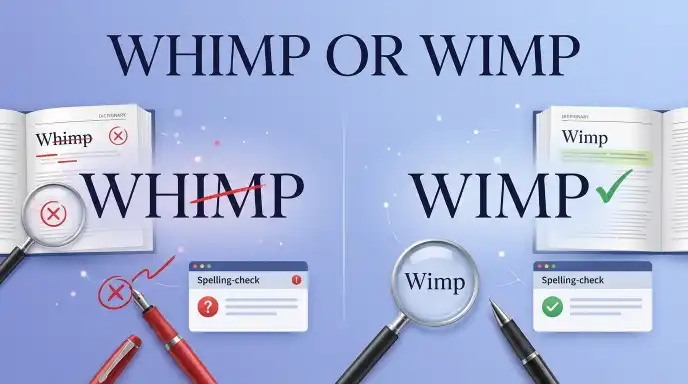
If you are wondering if whimp or wimp is correct, wimp is the standard spelling, while whimp is a common misspelling. The word wimp describes a person who seems weak, timid, or lacking in courage.
Many people search for whimp or wimp because the word sounds as if it could begin with “wh,” especially when spoken quickly. This makes the spelling easy to mix up.
The confusion is simple to solve. In standard English, the correct form is wimp, with no “h.” You may see whimp in casual writing, online posts, or messages, but it is generally treated as a spelling error rather than a separate standard word.
Knowing the correct spelling is useful when writing emails, school assignments, articles, social media posts, or other formal content. This guide explains the meaning, origin, spelling, common mistakes, and everyday use of wimp. It also shows when to use the word and if British and American English treat it differently.
Whimp or Wimp : Quick Answer
Wimp is the correct standard spelling. Whimp is usually a misspelling.
- Correct: He is not a wimp.
- Incorrect: He is not a whimp.
- Correct: She called him a wimp because he was afraid to try.
- Incorrect: She called him a whimp.
The word wimp is an informal noun. It usually describes someone who is seen as weak, timid, or easily frightened.
Quick rule: Use wimp, not whimp, in standard English.
Definition and Meaning of Whimp or Wimp
The standard word is wimp.
A wimp is a person who is considered weak, timid, or lacking courage. The word is informal and can sound insulting, depending on how it is used.
Simple Meaning
In simple terms, a wimp is someone who does not seem brave or strong in a situation.
For example:
- “Don’t be a wimp. Give it a try.”
- “He felt like a wimp after giving up so quickly.”
- “She is not a wimp when it comes to hard work.”
The word can describe physical weakness, lack of courage, or unwillingness to face something difficult.
Context and Usage
Wimp is mainly used in casual English. You may hear it in conversations, movies, sports discussions, and social media.
It is less suitable for formal writing because it can be insulting or judgmental.
For example:
Casual:
“Stop acting like a wimp.”
Formal:
“He was unwilling to face the difficult situation.”
The second sentence is more suitable for professional or academic writing.
The Origin of Whimp or Wimp
The word wimp has been used in English since the 20th century. Its exact origin is not completely certain, but dictionaries generally describe it as an informal American English word.
Some theories connect wimp with earlier slang terms meaning a weak or insignificant person. Over time, wimp became established as a common informal word.
The spelling whimp likely appears because English speakers sometimes add h to words that have a similar sound pattern. However, whimp did not become the standard spelling.
This is why you may occasionally see whimp in informal writing, even though standard dictionaries recognize wimp as the normal spelling.
The spelling difference is therefore not a British-versus-American spelling rule. Wimp is the standard form in both major varieties of English.
British English vs American English Spelling
There is no major British-American spelling difference for this word.
Both British English and American English normally use wimp.
| English Variety | Standard Spelling | Example |
| American English | wimp | “He is not a wimp.” |
| British English | wimp | “He is not a wimp.” |
| Canadian English | wimp | “Don’t call him a wimp.” |
| Australian English | wimp | “Nobody wants to look like a wimp.” |
| Informal misspelling | whimp | “He is a whimp.” |
The important point is that wimp is not an American-only spelling. It is the standard spelling used across English-speaking regions.
Which Spelling Should You Use?
Use wimp when writing for almost any English-speaking audience.
For US English
Use wimp.
“He does not want to be called a wimp.”
For UK and Commonwealth English
Use wimp as well.
“The character is portrayed as a wimp.”
For International English
Wimp is the safest choice because it is the standard dictionary spelling.
If you see whimp online, do not assume that it is a British spelling. It is generally a nonstandard spelling or typo.
For school, business, academic, and professional writing, always choose wimp.
Common Mistakes with Whimp or Wimp
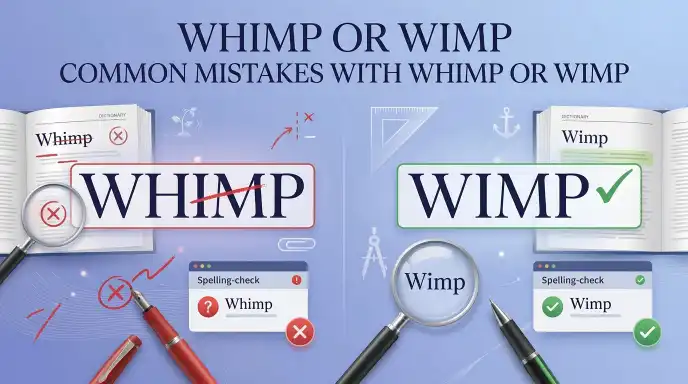
The most common mistake is adding an unnecessary h.
| Mistake | Correct Form | Example |
| whimp | wimp | “He is a wimp.” |
| whimmp | wimp | “She called him a wimp.” |
| wimpp | wimp | “Nobody wants to be a wimp.” |
| wimp | wimp | Correct |
Another common mistake is treating whimp as a different standard word. In normal English, it is not a separate standard spelling that you need to learn.
Wimp vs Whim
Do not confuse wimp with whim.
A wimp is a person who is seen as weak or timid.
A whim is a sudden desire or idea.
For example:
- “He is a wimp.”
- “She bought it on a whim.”
These words have different meanings and spellings.
Whimp or Wimp in Everyday Examples
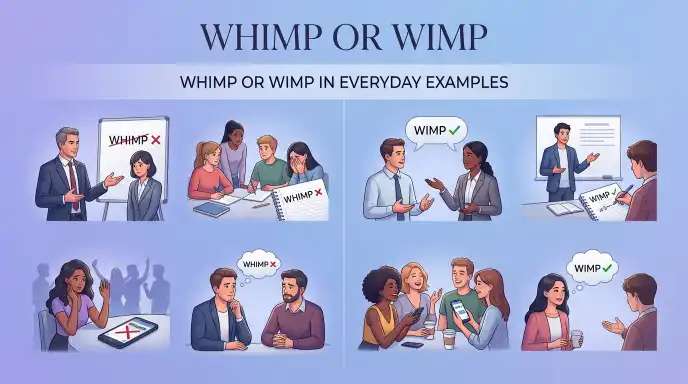
Here are examples showing how wimp can appear in different types of writing.
In Everyday Conversation
“Come on. Don’t be a wimp.”
“I was a wimp and avoided the roller coaster.”
In an Email
“I know the task looks difficult, but don’t be a wimp.”
This sounds very casual. It may not be suitable for a professional email.
In News or Commentary
“The movie presents the character as a nervous wimp who avoids every challenge.”
Here, wimp can describe how a character is portrayed.
On Social Media
“I almost quit, but I didn’t want to be a wimp!”
The informal tone makes wimp more natural in social media.
In Formal Writing
The word can appear in formal writing when discussing a quotation, character, cultural expression, or informal language. However, a more neutral word may be better when describing a real person.
Instead of:
“He is a wimp.”
A formal writer might say:
“He is often described as timid.”
Whimp or Wimp : Google Trends & Usage Data
Searches for whimp or wimp usually come from spelling uncertainty. People often know how the word sounds but are unsure if it contains h.
The standard form is wimp, while whimp is generally a nonstandard spelling.
Usage can also vary by context. Wimp appears more naturally in casual conversations, entertainment, social media, and informal descriptions. It is less common in academic and professional writing because it can sound insulting.
When people search for whimp or wimp, they are usually looking for a spelling answer rather than a difference in meaning. This makes the query a common example of a correct-spelling comparison.
Because search popularity changes over time and by country, exact search-volume figures should not be assumed without current measurement. The safest conclusion is based on standard dictionary usage: wimp is the established spelling.
Whimp vs Wimp: Comparison Table
| Feature | Wimp | Whimp |
| Standard spelling | Yes | No |
| Common meaning | Weak or timid person | Usually intended to mean “wimp” |
| British English | Used | Nonstandard |
| American English | Used | Nonstandard |
| Formal writing | Usually acceptable when context requires the word | Avoid |
| Casual writing | Common | Usually a spelling error |
| Recommended | Yes | No |
The difference is simple: wimp is the standard word, while whimp is generally a misspelling.
Key Takeaways
- Wimp is the correct standard spelling.
- Whimp is generally a misspelling.
- Wimp means a weak, timid, or easily frightened person.
- The word is mainly informal.
- British and American English both normally use wimp.
- Use wimp in standard writing.
- Use a more neutral word such as timid or cowardly when a formal tone is needed, depending on the intended meaning.
FAQs About Whimp or Wimp
Q1. Is whimp or wimp correct?
Wimp is correct. Whimp is generally a misspelling and should be avoided in standard English.
Q2. What does wimp mean?
A wimp is an informal word for someone who is considered weak, timid, or lacking courage.
Q3. Is whimp a real word?
Whimp may appear in informal writing, but it is not the standard spelling of the common word. In normal English, use wimp.
Q4. Is wimp British or American?
Wimp is used in both British and American English. It is not a spelling difference between the two varieties.
Q5. Is wimp a rude word?
Wimp can be insulting because it describes someone as weak or lacking courage. Its tone depends on the context and relationship between the speakers.
Q6. Can I use wimp in formal writing?
You can use wimp when the context requires the exact informal term, such as when discussing a character or quotation. In many formal situations, a neutral word such as timid may be better.
Q7. Why do people spell wimp as whimp?
People may add h because of the way the word sounds or because they associate it with other English words beginning with wh. However, the standard spelling is wimp.
Conclusion:
When choosing between whimp or wimp, the correct standard spelling is wimp. The word refers to a person who is seen as weak, timid, or lacking courage. It is an informal term and can sometimes sound insulting, so context matters.
There is no important British-American spelling difference here. Both British and American English normally use wimp, making it the best choice for general English writing. Whimp may appear in online posts, messages, or other casual text, but it is generally a misspelling rather than a separate standard word.
For everyday conversation and informal writing, wimp is natural. In professional or academic writing, consider if a more neutral word, such as timid, fearful, or weak, better expresses your meaning.
The easiest rule to remember is simple: wimp is correct; whimp is not the standard spelling. If you are ever unsure, choose wimp.
Meta Description: Whimp or wimp? Learn the correct spelling, meaning, origin, British and American usage, common mistakes, examples, and simple rules.

I’m Nora Ellis, an English language writer passionate about making grammar, spelling, and confusing words easy to understand. I share clear explanations and practical examples to help readers improve their English and use words with confidence.



5 thoughts on “Whimp or Wimp: Correct Spelling, Meaning & Usage”