Laminate or vinyl? Vinyl is usually better for wet areas, while laminate can be a strong choice for dry rooms where a wood-like look and feel matter. Both flooring types are popular, but they are made from different materials and handle moisture in different ways.
People search for laminate or vinyl because both options can look like wood, stone, or tile. They can also be affordable alternatives to traditional hardwood or other flooring materials. At first glance, the two can look almost identical.
The biggest difference is what is inside each floor. Laminate flooring usually has a wood-fiber core, while vinyl flooring is made from synthetic material. This difference affects water resistance, feel, maintenance, and where each floor works best.
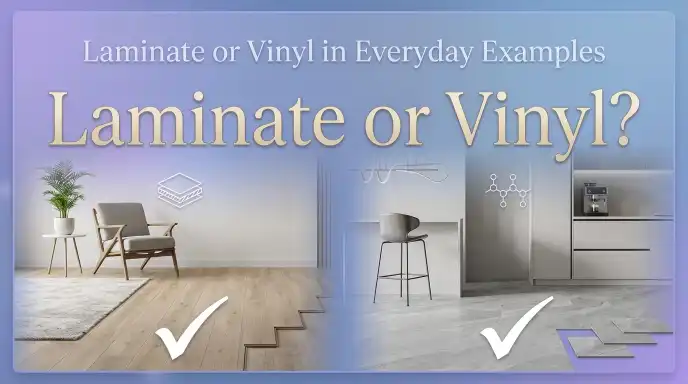
Vinyl is often used in kitchens, bathrooms, laundry rooms, and other areas where moisture is a concern. Laminate is often chosen for bedrooms, living rooms, offices, and hallways.
This guide explains the differences in simple terms. You will learn what laminate and vinyl mean, how they compare, where each works best, and what to consider before buying.
Laminate or Vinyl: Featured Snippet Answer
Laminate and vinyl are different types of flooring. A wood-based core is common in laminate flooring, while vinyl uses synthetic materials. For wet areas, vinyl is often a practical choice because many products resist water well. Standard laminate is usually better for dry rooms.
Laminate or Vinyl : Quick Answer
Both laminate and vinyl flooring can be good choices. The right option depends on the room and your needs.
Choose laminate when you want:
- A strong wood-like appearance
- A firm feel underfoot
- A popular option for dry rooms
- Good scratch resistance in many products
- A wide range of wood styles
Choose vinyl when you need:
- Strong water resistance
- Easy cleaning
- Flooring for moisture-prone rooms
- A softer or more resilient feel
- Wood, stone, or tile looks
Standard laminate is generally water-resistant rather than fully waterproof. Vinyl products, especially many luxury vinyl products, can offer waterproof construction. However, the performance of a complete floor still depends on the product and installation.
For example:
Laminate can work well in a bedroom.
Vinyl can work well in a bathroom.
Product specifications always matter. Modern flooring includes many different types of laminate and vinyl.
Definition and Meaning of Laminate or Vinyl
What Is Laminate Flooring?
Laminate flooring is a layered flooring product. It usually contains a wood-based core, a decorative image layer, and a protective top layer.
The decorative layer can make the floor look like:
- Oak
- Walnut
- Maple
- Stone
- Tile
Laminate flooring is designed to copy the appearance of natural materials without using solid hardwood throughout the product.
Cambridge Dictionary defines laminate as a material made by joining several layers together and specifically includes laminate flooring as a use.
What Is Vinyl Flooring?
Vinyl flooring is a synthetic flooring material. It can come in sheets, tiles, or planks.
Modern vinyl flooring includes products such as:
- LVP, or luxury vinyl plank
- LVT, or luxury vinyl tile
- Sheet vinyl
- Rigid-core vinyl
- SPC and WPC products
Vinyl can copy the look of wood, stone, and tile. Many modern products use printed designs and textured surfaces to create a more realistic appearance.
Cambridge Dictionary defines vinyl as a strong plastic used for products such as floor coverings, furniture, and clothing.
Are Laminate and Vinyl the Same?
No.
They may look similar, but their construction is different.
Laminate usually uses a wood-based core.
Vinyl uses synthetic material.
That difference becomes especially important when water enters the picture.
The Origin of Laminate or Vinyl
The words laminate and vinyl do not come from two different spellings of the same word. They have different origins and describe different materials.
Origin of Laminate
The word laminate comes from the idea of making something in layers.
The English verb laminate dates to the 1660s. It came from Latin lamina, meaning a thin plate, layer, or slice. The modern noun sense later developed for artificial layered materials.
This history fits the structure of laminate flooring. The product is made with multiple layers that work together.
The word therefore describes a layered material, not one specific type of wood.
Origin of Vinyl
The word vinyl has a different history.
In chemistry, vinyl was used for a chemical group related to ethylene. The modern use of vinyl for a plastic or synthetic resin dates to the twentieth century. The word later became widely associated with plastic products and flooring.
Today, vinyl flooring refers to flooring made with vinyl-based synthetic materials.
Why Are Laminate and Vinyl Sometimes Confused?
The confusion is mostly visual.
Both products can have:
- Wood-look designs
- Stone-look designs
- Plank formats
- Tile formats
- Click-lock installation systems
- Protective surface layers
So two floors can look very similar while having different cores and different moisture performance.
British English vs American English Spelling
There is no major British or American spelling difference between laminate and vinyl.
Both terms are used in British and American English.
| Term | British English | American English | Example |
| Laminate | Laminate | Laminate | We chose laminate flooring. |
| Vinyl | Vinyl | Vinyl | The kitchen has vinyl flooring. |
| Laminate flooring | Correct | Correct | Laminate flooring is popular. |
| Vinyl flooring | Correct | Correct | Vinyl flooring is easy to clean. |
| Luxury vinyl plank | Correct | Correct | LVP is common in modern homes. |
The main difference is not spelling. It is product type and usage.
There can be differences in product names, trade terms, or preferred descriptions between markets. However, the basic words laminate and vinyl remain the same.
Which Version Should You Use?
Because laminate and vinyl are flooring products, your choice should depend on the space rather than your country.
United States
Both options are widely used.
Vinyl is often considered for kitchens, bathrooms, laundry rooms, and other moisture-prone areas. Laminate can be a practical choice for dry living areas and bedrooms.
United Kingdom
Both laminate flooring and vinyl flooring are standard terms.
Your room conditions should guide the choice.
Canada
Cold weather, moisture, and room conditions can affect flooring decisions. Check the manufacturer’s installation requirements, especially over concrete or in areas where moisture may be present.
Australia
Both flooring types are widely understood. Consider moisture, sunlight, traffic, cleaning needs, and the manufacturer’s specifications before choosing.
International Writing
For international readers, use the standard terms:
- Laminate flooring
- Vinyl flooring
- Luxury vinyl plank
- Luxury vinyl tile
These terms are clear and widely understood.
Academic Writing
Use the exact product name when discussing flooring in a research paper or technical document.
For example:
The study compared laminate flooring with vinyl flooring under different moisture conditions.
Business Writing
Use simple product terms.
For example:
We are considering laminate and vinyl flooring for the new office.
Avoid using laminate and vinyl as if they were interchangeable. They describe different flooring categories.
Common Mistakes with Laminate or Vinyl
Treating Laminate as Fully Waterproof
Incorrect idea:
All laminate flooring is waterproof.
Better:
Standard laminate flooring is generally water-resistant, while some modern products are designed with enhanced or waterproof protection.
Why?
Laminate products differ. A wood-based core can be affected by water if moisture reaches it. Some newer products have improved moisture protection.
Memory tip:
Think laminate = check the water rating.
Assuming All Vinyl Is the Same
Vinyl comes in different forms.
Sheet vinyl, LVP, LVT, and rigid-core products can have different construction and performance.
Memory tip:
Always check the exact product specifications.
Choosing Only by Appearance
Two floors may look almost identical but perform differently.
A bathroom needs different moisture protection from a bedroom.
Better approach:
Choose the material based on both appearance and room conditions.
Ignoring Installation
A good flooring product can still perform poorly if installed incorrectly.
Subfloor condition, moisture control, expansion space, seams, and transitions all matter.
Assuming Vinyl Is Always Better
Vinyl has important advantages, especially around moisture. However, laminate can also have advantages in appearance, feel, and product choice.
The best decision depends on the room and the specific product.
Laminate or Vinyl in Everyday Examples
In Emails
We are comparing laminate and vinyl flooring for the office renovation.
In Business Writing
The contractor recommended vinyl flooring for areas exposed to frequent moisture.
In News Headlines
Homeowners Compare Laminate and Vinyl Flooring for Modern Homes
In Blogs
Laminate flooring can create a warm wood look without using solid hardwood throughout the floor.
On Social Media
Thinking about new floors? Compare laminate vs. vinyl before you choose.
In Academic Writing
The study examined differences between laminate and vinyl flooring under various conditions.
In Daily Conversation
Should we use laminate or vinyl in the kitchen?
I prefer vinyl because cleaning it is easy.
Laminate or Vinyl: Google Trends & Modern Usage
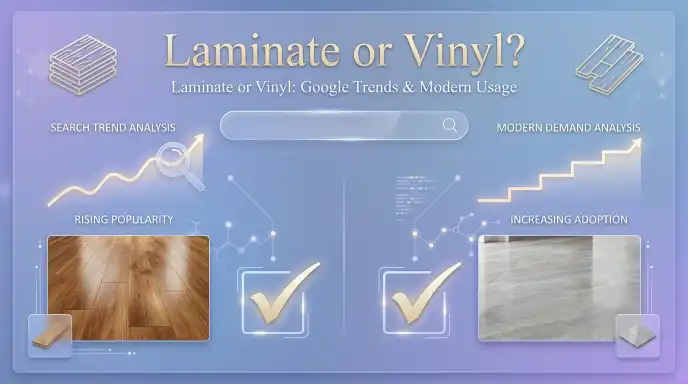
People search for laminate or vinyl because they are comparing flooring options before making a purchase or starting a renovation.
Searches often include longer phrases such as:
- laminate or vinyl flooring
- vinyl vs laminate flooring
- laminate vs vinyl
- is vinyl better than laminate
- which is better laminate or vinyl
- laminate or vinyl for kitchen
- laminate or vinyl for bathroom
- vinyl plank vs laminate
These searches show an important point about search intent. People usually do not want a dictionary definition. They want help making a flooring decision.
Google Trends can compare exact search terms, but the results depend on the wording, country, time period, and if you compare a search term or a broader topic. Google explains that a search term measures the exact words entered, while a topic can combine related searches.
For that reason, it would be misleading to claim that one phrase is permanently more popular without checking a specific country and date range.
Modern interest in both products is also linked to home renovation, affordable flooring, realistic wood-look designs, and easier installation.
Quick Comparison Table
| Feature | Laminate | Vinyl |
| Main construction | Usually wood-based core with layered surface | Synthetic vinyl-based construction |
| Water resistance | Usually water-resistant; some products offer enhanced protection | Many modern products are waterproof |
| Best for | Many dry rooms | Wet or moisture-prone rooms and many dry rooms |
| Wood appearance | Very realistic in many products | Very realistic in many modern products |
| Feel | Often firm and wood-like | Can feel softer or more resilient |
| Cleaning | Easy, but avoid excess water unless product allows it | Generally easy to clean |
| Installation | Many products use floating click systems | Many products use click, glue, or other systems |
| Moisture concern | Check product rating carefully | Check product specifications and installation |
| Common forms | Planks and some tiles | Sheets, planks, and tiles |
| Main thing to check | Moisture rating and wear rating | Waterproof rating, wear layer, and core |
Which Is Better for Different Rooms?
Living Room
Both can work well.
Laminate may appeal to people who want a traditional wood-like appearance and firm feel. Vinyl can be useful when easy cleaning and spill resistance are priorities.
Bedroom
Laminate can be a good option for a dry bedroom. Vinyl can also work well if you prefer easy maintenance.
Kitchen
Moisture and spills make vinyl an attractive option.
If you prefer laminate, check if the specific product is designed for kitchen use and what its water-resistance warranty covers.
Bathroom
Vinyl is often considered because many products are waterproof. Standard laminate is generally not the first choice for areas with frequent water exposure.
Basement
Moisture is an important concern.
Vinyl is often considered for basement floors, but the condition and moisture level of the subfloor still need attention.
Home Office
Either option can work.
Think about appearance, chair movement, cleaning, and traffic.
Key Takeaways
- Laminate and vinyl are different flooring materials.
- Laminate usually has a wood-based core.
- Vinyl is made from synthetic material.
- Standard laminate is generally water-resistant, not fully waterproof.
- Many vinyl products offer waterproof construction.
- Both can imitate wood, stone, and tile.
- Room conditions should guide your choice.
- Always check the manufacturer’s specifications and warranty.
- Installation quality matters for both products.
- Laminate for dry rooms and vinyl for moisture-prone rooms is a useful starting rule, not an absolute rule.
FAQs
Q1. Which is better, laminate or vinyl?
Neither is automatically better for every room. Vinyl can be a practical choice where moisture is a major concern. Laminate can be attractive in dry rooms where you want a wood-like appearance and firm feel.
The product’s construction, rating, installation method, and room conditions all matter.
Q2. Is vinyl flooring better than laminate for water?
Many vinyl products have strong waterproof properties, while standard laminate is usually more sensitive to moisture. This makes vinyl a common choice for bathrooms, laundry rooms, kitchens, and other wet areas.
However, always check the product’s specifications because not every vinyl product has the same construction.
Q3. Which lasts longer, laminate or vinyl?
The lifespan depends on product quality, installation, traffic, maintenance, and room conditions. Neither material has one universal lifespan. A high-quality floor installed correctly can perform well for many years.
Instead of relying only on material type, compare the product’s warranty, wear protection, construction, and intended use.
Q4. Is laminate flooring waterproof?
Standard laminate flooring is generally not fully waterproof. It often has a wood-based core that can be affected by moisture. However, modern manufacturers also make laminate products with improved water resistance.
Always read the product specifications and warranty before using laminate in a moisture-prone room.
Q5. Is vinyl flooring good for bathrooms?
Many vinyl flooring products are suitable for bathrooms because they can provide strong water resistance or waterproof construction. Luxury vinyl products are commonly considered for wet areas. Proper installation still matters because water can reach the subfloor through seams, edges, or other openings.
Q6. Does laminate look more like real wood than vinyl?
Both can look very realistic. Laminate has traditionally been known for convincing wood visuals and a firm feel. Modern vinyl can also reproduce wood grain, texture, and stone patterns very well.
The final appearance depends heavily on the product’s design, surface texture, printing quality, and installation.
Q7. Is vinyl easier to clean than laminate?
Vinyl is often easier to clean with regular damp cleaning because many products have strong moisture resistance. Laminate also needs routine cleaning, but excess water can be a concern with products that are not designed for wet cleaning.
Follow the cleaning instructions supplied by the flooring manufacturer.
Q8. Can you use laminate in a kitchen?
Some modern laminate products are designed to handle greater moisture exposure than traditional laminate. However, kitchen use depends on the exact product.
Check its water-resistance claims, warranty, installation requirements, and cleaning instructions before choosing it for a kitchen.
Q9. Is vinyl cheaper than laminate?
There is no single price that applies to all vinyl or laminate flooring. Both come in budget, mid-range, and premium products. Installation can also change the total cost.
Compare the full project price, including underlayment, preparation, installation, transitions, and other required materials.
Q10. Which should I choose for my home?
Start with the room rather than the brand name. Consider water exposure, traffic, pets, cleaning, appearance, comfort, budget, and installation. Vinyl may make sense where moisture is a major concern.
Laminate may suit dry rooms where you prefer its appearance or feel. Then compare specific products within your budget.
Conclusion:
Choosing between laminate or vinyl starts with understanding how the two materials differ. Both can create attractive wood, stone, or tile looks. Both can also provide a practical alternative to more expensive flooring.
The main difference is their construction. Laminate usually uses a wood-based core and layered surface, while vinyl uses synthetic material. This difference affects how each product responds to moisture and daily use.
For bathrooms, laundry rooms, and other areas where water is a major concern, many vinyl products offer an important advantage because they can provide waterproof construction. Standard laminate is generally better suited to dry areas, although some newer laminate products have improved moisture protection.
Do not choose based on appearance alone. Check the product specifications, water rating, wear protection, installation requirements, and warranty. The right floor is the one that matches the room and your daily needs.

I’m Nora Ellis, an English language writer passionate about making grammar, spelling, and confusing words easy to understand. I share clear explanations and practical examples to help readers improve their English and use words with confidence.






1 thought on “Laminate or Vinyl: Which Flooring Is Right for You?”