
The phrase boom or bust describes a situation with two possible results: great success or complete failure. It often appears when the outcome is uncertain and the difference between success and failure is large.
For example, a new business may be described as “boom or bust” if it could grow quickly or fail completely.
Many people search for boom or bust because they want to understand its meaning, grammar, and correct use. The phrase can describe business, money, careers, sports, projects, and other situations.
The words boom and bust have opposite meanings in this expression. A boom means strong growth, success, or activity. A bust means failure, decline, or a poor result.
This guide explains what boom or bust means, where the phrase came from, how to use it, and how it differs from boom and bust. You will also find simple examples, common mistakes, and answers to common questions.
Boom or Bust: Featured Snippet Answer
Boom or bust means a situation where something will either become very successful or fail badly. The phrase highlights a sharp contrast between a positive and negative result. It is common in business, finance, sports, careers, and everyday speech.
For example, “The new company is boom or bust” means it may succeed greatly or fail completely.
Boom or Bust : Quick Answer
Boom or bust is a common English phrase that describes a high-risk situation.
It suggests two very different outcomes:
- Boom means strong growth or success.
- Bust means failure, decline, or collapse.
- Boom or bust means one extreme result or the other.
For example:
The new restaurant could be a boom or bust.
This means the restaurant could become very successful or fail badly.
Another example is:
Her new business is a boom-or-bust venture.
Here, the writer presents the business as having a high chance of either great success or serious failure.
The phrase can also describe a person, plan, industry, investment, or career.
It does not always mean that failure is certain. Instead, it stresses the high-risk nature of the situation.
The phrase is often written as boom or bust. When it works as an adjective before a noun, you may also see boom-or-bust.
What Does Boom or Bust Mean?
The meaning of boom or bust becomes clear when you understand each word.
What Does Boom Mean?
In this context, boom means a period of strong growth or success.
For example:
- The housing market had a boom.
- The company experienced rapid growth.
- Online sales are booming.
- The local economy is enjoying a boom.
The word can describe business activity, money, popularity, population, or other forms of growth.
What Does Bust Mean?
In this context, bust means failure or a period of decline.
For example:
- The business went bust.
- The market suffered a bust.
- The project was a complete bust.
- The company could not survive the downturn.
Bust has other meanings in English. However, the meaning changes with context.
What Does Boom or Bust Mean Together?
When the two words appear together, they create a strong contrast.
Boom or bust = great success or serious failure.
For example:
It is a boom or bust industry.
This means the industry may produce very strong results or very poor results.
The phrase often suggests risk and uncertainty.
The Origin of Boom or Bust

The two words have different histories.
The word boom has been used in English for centuries. Its modern business sense developed later. Etymonline records the noun boom in the sense of a sudden increase in business or activity from the 19th century. The economic expression boom and bust has been used since the 1930s.
The word bust has several meanings. The financial sense refers to a period of failure or decline. The word is also used in expressions such as go bust, meaning to fail financially.
The exact phrase boom or bust uses the contrast between these two ideas. It presents success and failure as opposite possible outcomes.
The phrase boom or bust is also related to boom and bust. However, the two expressions do not always mean exactly the same thing.
Boom and bust often describes a cycle. One period of growth is followed by decline.
Boom or bust often focuses on a choice or possible outcome. Something may succeed greatly or fail badly.
British English vs American English
The phrase boom or bust is understood in both British and American English.
The spelling does not change between the two varieties. The main difference is often the context in which the phrase appears.
| British English | American English | Example |
| boom or bust | boom or bust | The project could be boom or bust. |
| boom-and-bust | boom-and-bust | The industry has a boom-and-bust cycle. |
| go bust | go bust | The company could go bust. |
| bust | bust | The investment was a bust. |
| booming | booming | The business is booming. |
British English commonly uses go bust to mean that a business fails financially.
American English also uses bust for failure. For example, someone may call a failed plan “a bust.”
Both varieties can use boom or bust in business and everyday writing.
There is no need to change the spelling for American or British readers.
Which Version Should You Use?
Your choice depends on what you want to say.
United States
Use boom or bust for a high-risk situation.
The new product could be a boom or bust.
American English also commonly uses go bust in some contexts, although other expressions such as go bankrupt may sound more formal.
United Kingdom
Boom or bust is also natural in British English.
You may also see go bust when talking about financial failure.
The small company went bust after two difficult years.
Canada
Canadian English can use boom or bust in business, finance, and everyday writing.
The same basic meaning applies.
Australia
Australian English also uses boom or bust.
The phrase can describe business, property, mining, sports, and other areas.
International Writing
Boom or bust is widely understood.
For international readers, give enough context when the phrase appears in formal writing.
For example:
The project is a boom-or-bust investment, with either very high returns or major losses.
This makes the meaning clear.
Academic Writing
Academic writing may need more precise language.
Instead of using the phrase alone, explain what you mean.
For example:
The industry faced a high-risk pattern of rapid growth or severe decline.
You can still use boom or bust when discussing an established term.
Business Writing
The phrase works well in business writing when the tone is not too formal.
For example:
The new product launch could be a boom or bust for the company.
In a formal report, you may want to explain the risk more directly.
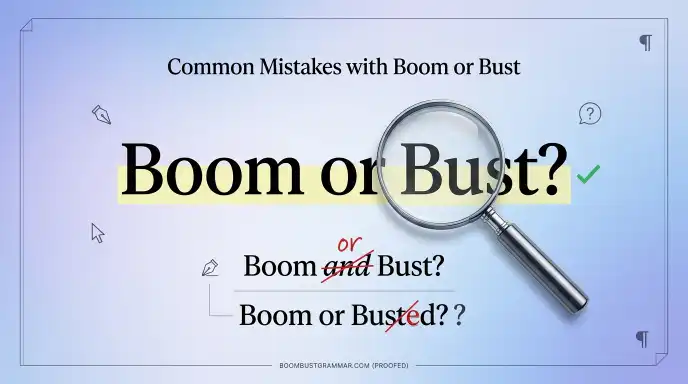
Common Mistakes with Boom or Bust
Thinking Boom Means Failure
Incorrect idea:
Boom means the business failed.
Correct idea:
Boom means strong growth or success.
A boom is normally a positive period.
Memory tip: Think of a boom as something growing quickly.
Thinking Bust Always Means Bankruptcy
A bust can refer to financial failure, but it does not always mean bankruptcy.
For example:
The movie was a bust.
This means the movie was unsuccessful.
The phrase can describe a failed attempt without involving money.
Using Boom or Bust for Every Change
Not every change is a boom-or-bust situation.
The phrase suggests a strong difference between success and failure.
For example:
The project may succeed or fail.
This is neutral.
The project is boom or bust.
This sounds stronger and suggests extreme results.
Confusing Boom or Bust with Boom and Bust
These phrases are related, but they often serve different purposes.
Boom or bust focuses on possible outcomes.
Boom and bust often describes a repeated cycle.
For example:
The business is boom or bust.
This focuses on the possible result.
The economy has a boom-and-bust cycle.
This focuses on repeated periods of growth and decline.
Writing “Boom or Busts”
When you use the phrase as a fixed expression, do not normally add s to either word.
Correct:
It is a boom or bust situation.
Not:
It is a booms or bust situation.
The plural forms booms and busts can appear when you are talking about separate periods.
Boom or Bust in Everyday Examples

In Emails
The new campaign could be a boom or bust for our team.
This sounds direct and informal.
For a more formal email, you could write:
The campaign carries a high level of risk.
In Business Writing
The new product could be a boom-or-bust investment.
This means the investment could produce excellent results or fail badly.
In News Headlines
News writers often use boom or bust because it is short and powerful.
Examples include:
Boom or Bust for the Housing Market?
Boom or Bust: What Comes Next for the Industry?
The phrase creates interest without explaining the whole story.
In Blogs
For small businesses, the holiday season can be boom or bust.
Here, the writer means that sales may rise sharply or remain very weak.
On Social Media
This new app is boom or bust. There is no middle ground!
This use is informal and dramatic.
It shows strong confidence or uncertainty.
In Academic Writing
The region experienced repeated boom-and-bust cycles during the period.
Here, boom-and-bust is better because the writer describes a recurring pattern.
In Daily Conversation
I think this business will be a boom or bust.
The movie was either going to be a huge hit or a bust.
These examples show how natural the phrase can sound in everyday speech.
Google Trends & Modern Usage
People search for boom or bust for several reasons.
Some want to understand the phrase itself. Others see it in articles about business, money, housing, careers, sports, or entertainment.
The phrase is especially useful because it expresses a complex idea in only three words. It quickly shows that the possible outcomes are far apart.
Search interest can also come from headlines and popular discussions. Writers often use boom or bust because it is short, memorable, and easy to understand.
There is an important difference between searching for the phrase and searching for the economic term boom and bust.
Boom and bust is often used when discussing economic cycles. It describes growth followed by decline.
Boom or bust is often used when discussing risk. It suggests that something may either succeed greatly or fail badly.
Search patterns can change over time and by topic. Without a specific Google Trends dataset and date range, it is not accurate to claim that one region always has higher search interest than another.
The safest conclusion is that boom or bust remains a familiar English expression, especially in business and informal discussion.
Quick Comparison Table
| Version | Meaning | Correct? | Region | Example |
| boom | Strong growth or success | Yes | All major English varieties | The company is enjoying a boom. |
| bust | Failure or decline | Yes | All major English varieties | The project was a bust. |
| boom or bust | Either great success or serious failure | Yes | British, American, Canadian, Australian | It could be a boom or a bust. |
| boom and bust | Growth followed by decline | Yes | British, American, Canadian, Australian | The industry has a boom-and-bust cycle. |
| boom-or-bust | Describes something with extreme possible outcomes | Yes | International | It was a boom-or-bust investment. |
| booms or busts | More than one period of growth or failure | Yes | All major varieties | Markets experience booms and busts. |
Boom or Bust vs. Boom and Bust
The difference is easy to remember.
| Phrase | Main Idea | Typical Use | Example |
| boom or bust | One of two extreme outcomes | Risk or uncertainty | The company is a boom or bust. |
| boom and bust | A pattern of growth and decline | Economics or history | The industry has boom-and-bust cycles. |
| booming | Growing quickly | Business or activity | The market is booming. |
| go bust | Fail financially | Business | The company went bust. |
| a bust | A failure | Informal English | The project was a bust. |
This distinction helps you choose the right phrase.
Use boom or bust when you are talking about possible results.
Use boom and bust when you are describing a cycle.
Key Takeaways
- Boom or bust means great success or serious failure.
- Boom means strong growth, success, or activity.
- Bust can mean failure, decline, or financial trouble.
- Boom or bust often describes risk and uncertainty.
- Boom and bust usually describes a cycle of growth and decline.
- The phrase works in both British and American English.
- Use boom-or-bust before a noun when it acts as a compound adjective.
- Context determines the exact meaning of bust.
- The phrase is common in business, finance, media, and everyday speech.
FAQs
Q1. What does boom or bust mean?
Boom or bust means that something may have one of two extreme results. It may become very successful, or it may fail badly. The phrase often describes a risky business, project, investment, career, or plan. It highlights the large difference between the possible positive and negative outcomes.
Q2. Is boom or bust an idiom?
Yes. Boom or bust is a common English expression. It describes a situation with two very different possible outcomes. The phrase is often used in informal speech, business discussions, news writing, and financial contexts. Its meaning is usually clear from the words boom and bust.
Q3. What is the difference between boom or bust and boom and bust?
Boom or bust focuses on possible outcomes. Something may succeed greatly or fail badly. Boom and bust usually describes a cycle in which a period of growth is followed by a period of decline. Both phrases are correct, but they serve different purposes.
Q4. Is boom or bust hyphenated?
It depends on how you use it. When the phrase comes after a verb, boom or bust is common. When it works directly before a noun as a compound modifier, boom-or-bust may be used. For example, “It could be boom or bust” and “a boom-or-bust investment” are both natural.
Q5. Does bust mean failure?
In some contexts, yes. Bust can mean failure or a period of poor results. For example, “The project was a bust” means the project failed or was unsuccessful. In financial contexts, bust can refer to a serious decline after a period of growth.
Q6. Can boom or bust describe a person?
Yes. The phrase can describe a person’s career, business plans, or chances of success. For example, “Her new business could be boom or bust” means the business may become highly successful or fail. The phrase is usually about the person’s situation rather than the person’s personality.
Q7. Is boom or bust formal or informal?
Boom or bust is widely understood, but it has a conversational and journalistic feel. It works well in articles, headlines, blogs, and business discussions. In highly formal academic writing, a more precise phrase such as high risk of success or failure may sometimes be better.
Q8. What is an example of boom or bust?
A simple example is: “The new company is a boom or bust.” This means the company may become very successful or fail badly. Another example is: “The investment could be boom or bust.” Here, the phrase highlights the high level of risk.
Q9. What does boom and bust mean in economics?
In economics, boom and bust describes a pattern of strong growth followed by a sharp decline. During a boom, economic activity may rise. During a bust, activity can fall. The phrase is often used when discussing markets, housing, employment, business activity, and other economic conditions.
Q10. Is boom or bust the same in British and American English?
Yes. Boom or bust has the same basic meaning in British and American English. The spelling stays the same. British English also commonly uses go bust for financial failure. American English uses bust in several informal contexts as well.
Conclusion:
Boom or bust describes a situation with two very different possible results. Something may achieve major success, or it may fail badly. The phrase is common in business, finance, careers, sports, media, and everyday conversation.
The word boom suggests growth, success, or strong activity. Bust suggests failure, decline, or poor results. Together, they create a strong contrast.
It is also important to separate boom or bust from boom and bust. The first usually focuses on possible outcomes. The second often describes a cycle of growth followed by decline.
The phrase works in both British and American English. You can use it in everyday writing, articles, emails, and business discussions. In very formal writing, explain the idea more directly when precision matters.
The easiest way to remember it is simple: boom means strong success, while bust means failure.
When the outcome could go to either extreme, boom or bust is the right expression.

I’m Nora Ellis, an English language writer passionate about making grammar, spelling, and confusing words easy to understand. I share clear explanations and practical examples to help readers improve their English and use words with confidence.







5 thoughts on “Boom or Bust: Meaning, Examples, and Usage Explained ”