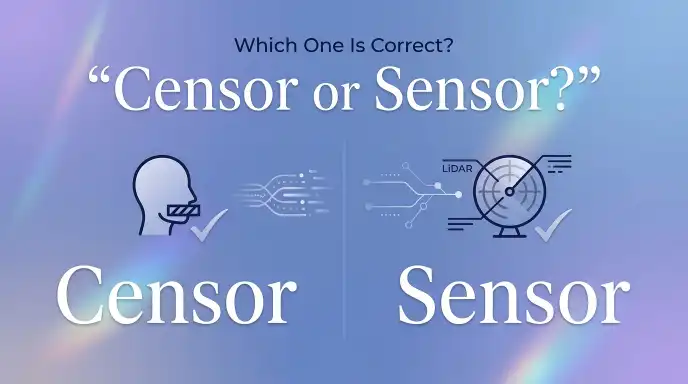
Censor and sensor are different words with different meanings. Censor relates to checking, limiting, or removing information, while a sensor is a device or system that detects something.
People often search for censor or sensor because the two words sound almost the same. Their spelling differs by only one letter, but their meanings are not related in everyday English. This can make the words easy to confuse when writing quickly.
For example, a government may censor information, while a phone may use a sensor to detect light. A smoke alarm also has a sensor that detects smoke. In contrast, a website may use a censor or filtering system to block certain content.
The key difference is simple. Think of censor as something connected with controlling information. Think of a sensor as something that detects or measures.
This guide explains the meaning, origin, spelling, regional usage, common mistakes, and everyday examples of both words. By the end, you will know exactly when to use the censor and when to use the sensor.
Censor or Sensor: Featured Snippet Answer
Censor means to examine, remove, restrict, or block information that someone considers unsuitable or sensitive. Sensor means a device or system that detects something such as light, heat, movement, sound, or pressure. Use censor for controlling information and sensor for detecting physical conditions.
Censor or Sensor: Quick Answer
The correct word depends on what you mean.
- Censor = to restrict, remove, or control information.
- Censor = a person or system that checks content.
- Sensor = a device that detects or measures something.
Examples
Censor:
The editor decided to censor the offensive language.
Sensor:
The phone has a sensor that detects light.
Another example makes the difference clear:
The website may censor certain content.
The camera uses a sensor to capture light.
The words sound similar, but they describe very different things.
A useful memory trick is:
Censor = content
Sensor = senses
A censor deals with information or content. A sensor detects something in the environment.
What Does Censor or Sensor Mean?
What Does Censor Mean?
Censor can be a noun or a verb.
As a noun, a censor is a person or system that examines books, films, documents, communications, or other material. The goal may be to prevent certain information from being shown or shared.
For example:
The government appointed a censor to review the film.
As a verb, censor means to remove, hide, or block part of something.
For example:
The network censored the violent scene.
The word can also describe self-control.
She tried not to censor herself during the interview.
What Does Sensor Mean?
A sensor is a device or system that detects a physical condition or change.
Sensors can detect things such as:
- Light
- Heat
- Sound
- Movement
- Pressure
- Touch
- Smoke
- Moisture
For example:
The motion sensor turned on the lights.
A smartphone can contain several sensors. These may help detect movement, light, orientation, or other physical changes.
The Main Difference
The easiest distinction is:
Censors control information.
The sensor detects something.
This difference helps you choose the right spelling in most situations.
The Origin of Censor or Sensor
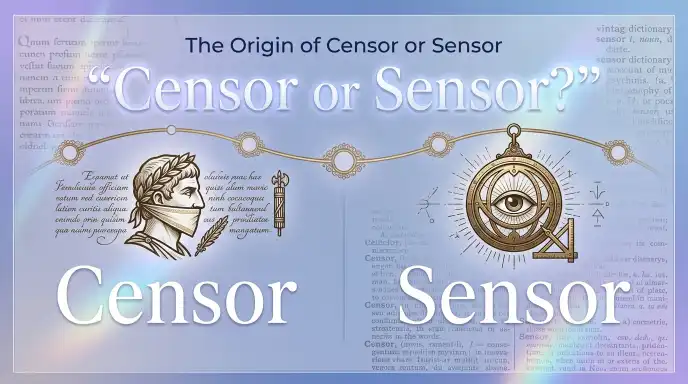
The two words have different histories.
Origin of Censor
Censor has an old Latin history. The English noun comes from Latin censor, which referred to a Roman official.
Roman censors had duties connected with public records, finances, and public behavior. Over time, the English word developed broader meanings connected with judging or examining material.
The meaning later became strongly associated with officials who examined books, plays, films, and other forms of communication.
The verb censor developed from this noun. It came to mean examining or restricting material.
The related word censorship describes the practice or process of censoring information.
Origin of Sensor
Sensors have a different history.
It is connected with the idea of sensing or detecting something. The modern technical meaning developed with the growth of technology and scientific equipment.
A sensor can detect a change and send information about it to another system.
For example, a temperature sensor detects temperature. A motion sensor detects movement.
The spelling difference reflects the different meanings:
censor → control or restrict information
sensor → detect or sense something
British English vs American English
There is no major spelling difference between censor and sensor in British and American English.
Both varieties use the same spellings.
| Word | British English | American English | Example |
| censor | Censor | Censor | The film was censored. |
| sensor | Sensor | Sensor | The sensor detected movement. |
| censored | Censored | Censored | The scene was censored. |
| sensors | Sensors | Sensors | The device contains several sensors. |
The main difference is not regional spelling. It has meaning and context.
A British writer and an American writer would both normally write:
The government censored the report.
They would also both write:
The device has a temperature sensor.
Publishing and Style Guides
Professional writing follows the same basic distinction.
Use censor when discussing the restriction or removal of information.
Use a sensor when discussing a device or system that detects something.
This rule works well in:
- Academic writing
- Business writing
- Technical writing
- Journalism
- Websites
- Everyday communication
Which Version Should You Use?
Your choice depends on the meaning, not your country.
United States
Use censor when talking about restricted information.
Use a sensor for a device that detects something.
The platform may censor certain posts.
The car has a parking sensor.
United Kingdom
British English follows the same distinction.
The newspaper was censored.
The machine has a heat sensor.
Canada
Canadian English also uses censor and sensor according to their normal meanings.
Australia
Australian English follows the same basic spelling and meaning distinction.
International Writing
For global readers, use the word that matches the meaning.
Avoid choosing the word based only on how it sounds.
Academic Writing
Academic writing may use both words often.
For example:
Researchers used a sensor to measure temperature.
A different sentence might say:
The article discusses the censorship of scientific information.
Business Writing
Business documents may also use both terms.
The website automatically censors offensive language.
The factory installed a safety sensor.
Common Mistakes with Censor or Sensor
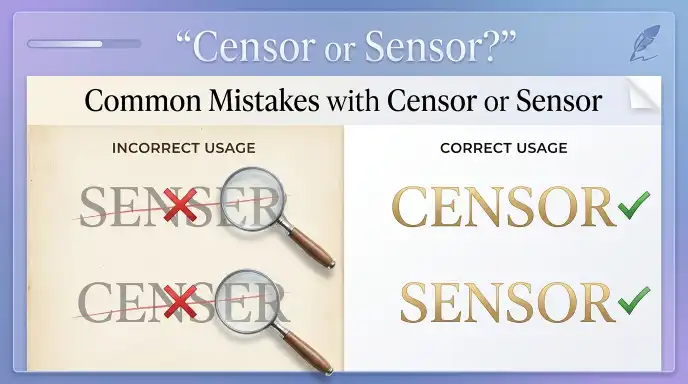
Using Sensor for Content
Incorrect:
The website detects offensive comments.
Correct:
The website censors offensive comments.
Why?
The website is restricting content. Therefore, the correct word is censors.
Using Censor for a Device
Incorrect:
The car has a parking censor.
Correct:
The car has a parking sensor.
Why?
The device detects objects or distance. Therefore, use a sensor.
Confusing Censor With Censorship
Censor can be a person, system, or verb.
Censorship refers to the practice of restricting information.
For example:
The government censored the report.
The report was affected by censorship.
Choosing by Sound
Both words can sound very similar.
This can cause spelling mistakes.
Do not choose the spelling based only on pronunciation. Look at the meaning first.
Easy Memory Tip
Remember these two ideas:
Censor = content
Sensor = senses
If something controls content, think censor.
If something detects or senses a condition, think of a sensor.
Censor or Sensor in Everyday Examples
Understanding the words in real sentences makes the difference easier to remember.
In Emails
Censor:
Please remove the offensive language before publishing the email.
Sensor:
The automatic door uses a motion sensor.
In Business Writing
Censor:
The platform may censor content that breaks its rules.
Sensor:
The new machine uses a pressure sensor.
In News Headlines
Censor:
Officials accused the broadcaster of censoring the report.
Sensor:
New sensors improve safety in modern vehicles.
In Blogs
Censor:
Some websites censor certain words automatically.
Sensor:
A smart home sensor can detect movement.
On Social Media
Censor:
The platform censored the post.
Sensor:
My phone has a sensor that adjusts the screen brightness.
In Academic Writing
Censor:
The study examines how governments censor online content.
Sensor:
Researchers used a sensor to record temperature changes.
In Daily Conversation
Censor:
I had to censor part of my comment.
Sensor:
The light turns on when the sensor detects movement.
Google Trends & Modern Usage
People search for censor or sensor because the words have similar sounds and different meanings.
The confusion is especially common when people are writing about technology, online content, media, or social platforms. Both words appear frequently in modern English, but they belong to different contexts.
Sensors are common in technical and everyday technology discussions. Modern devices use sensors in phones, cars, cameras, appliances, security systems, and industrial equipment.
Censor appears often in discussions about media, online platforms, books, films, political communication, and content moderation.
Search interest can also change when major news events involve technology, online speech, media restrictions, or new devices.
Exact Google Trends interest can vary by country and time. Search popularity should therefore be checked for a specific location and date rather than treated as a permanent ranking.
The important point remains stable:
Censor relates to restricting information.
Sensor relates to detecting something.
Quick Comparison Table
| Version | Meaning | Correct? | Region | Example |
| censor | Restrict or remove information | Yes | International English | They censor offensive content. |
| censored | Restricted or removed | Yes | International English | The scene was censored. |
| censorship | The practice of restricting content | Yes | International English | The article discusses censorship. |
| sensor | A device that detects something | Yes | International English | The sensor detected heat. |
| sensors | More than one detecting device | Yes | International English | The car has several sensors. |
| sensor for content control | Wrong word for this meaning | No | All English varieties | Use censor instead. |
| censor for a detecting device | Wrong word for this meaning | No | All English varieties | Use a sensor instead. |
Key Takeaways
- Censor and sensor are both correct English words.
- Censor relates to controlling or restricting information.
- Sensor refers to something that detects or measures a condition.
- Censor can be a noun or a verb.
- Sensor is usually a noun.
- British and American English use the same spellings.
- Remember censor = content.
- Remember sensor = senses.
FAQs
Q1. What is the difference between censor and sensor?
Censor relates to examining, restricting, removing, or blocking information. Sensor refers to a device or system that detects something. For example, a website may censor offensive content, while a phone may use a sensor to detect light or movement.
Q2. Is the censor or sensor correct?
Both censor and sensor are correct words. They simply have different meanings. Use censor when discussing restricted information or content. Use a sensor when discussing a device or system that detects something.
Q3. Is a sensor a device?
Yes. A sensor is commonly a device that detects a physical condition or change. Sensors can detect heat, light, movement, pressure, sound, moisture, and other conditions. They are widely used in phones, cars, machines, security systems, and household devices.
Q4. What does censor mean?
Censor means to examine and restrict information, communication, or other material. It can also refer to a person or system that performs this task. For example, an organization may censor part of a document before making it public.
Q5. What does sensor mean?
A sensor is something that detects or measures a condition. It can identify changes in light, temperature, movement, pressure, sound, or other physical factors. For example, a motion sensor can detect movement and trigger a security light.
Q6. How can I remember the censor and sensor?
Use the simple memory trick “censor = content” and “sensor = senses.” A censor deals with information or content. A sensor detects something in the environment. This distinction works in most everyday writing situations.
Q7. Is censor a noun or a verb?
Censor can be both a noun and a verb. As a noun, it means a person or system that examines content. As a verb, it means to restrict or remove part of something. For example, “The editor censored the material.”
Q8. Is sensor a verb?
In standard modern English, sensor is mainly used as a noun for a detecting device or system. The related verb is sense, while words such as detect, measure, and monitor may describe what a sensor does.
Q9. Are censor and sensor homophones?
They can sound very similar, and dictionaries list censor and sensor among words that may be pronounced alike in English. Their spelling and meaning are different. This similarity in sound is one reason writers sometimes confuse them.
Q10. Is there a British or American spelling difference?
No. Censor and sensor have the same standard spellings in British and American English. The correct choice depends on meaning, not location. Use censor for information control and sensor for detection.
Conclusion:
The difference between censor or sensor is simple once you focus on meaning. Censor is connected with checking, restricting, removing, or blocking information. Sensors are connected with detecting or measuring something.
Use censor when you are talking about content, communication, media, or information that is being restricted. For example, a website can censor offensive comments.
Use a sensor when you are talking about a device or system that detects something. A car can have a parking sensor, while a phone can have a light sensor.
There is no important British versus American spelling difference. Both varieties use censors and sensors in the same way.
The easiest memory trick is censor = content and sensor = senses. When you remember that connection, the spelling becomes much easier.
Keep this simple rule in mind whenever you write: censor controls information, while a sensor detects something.

I’m Nora Ellis, an English language writer passionate about making grammar, spelling, and confusing words easy to understand. I share clear explanations and practical examples to help readers improve their English and use words with confidence.






4 thoughts on “Censor or Sensor: Meaning, Differences, and Examples ”