Addition and edition are both correct words, but they have different meanings and uses. Addition means something that is added, while edition means a particular version or release of a book, newspaper, magazine, or other published work.
Many people confuse addition or edition because the words look and sound similar. Both end in -ition, and their pronunciations are close. However, you cannot use one in place of the other.
For example, a new room added to a house can be an addition. A new version of a book is an edition. In math, addition means combining numbers to find a total. An edition can also describe a particular newspaper issue or a version of a publication.
This difference matters in school, work, publishing, business, and everyday writing. Using the wrong word can change the meaning of a sentence.
This guide explains addition or edition, their meanings, origins, British and American usage, common mistakes, and simple examples. It will also help you choose the right word quickly.
Addition or Edition: Featured Snippet and AI Overview
Addition means something that is added to something else, such as a new room, person, feature, or number in a calculation. Edition means a particular version or release of a book, newspaper, magazine, program, or event. The words are both correct, but they are not interchangeable.
Addition or Edition : Quick Answer
The quick answer is simple:
- Addition = something added.
- Edition = a particular version or release.
Examples of Addition
The new bedroom is an addition to the house.
Seven plus five is an example of addition.
Maria is the newest addition to our team.
Cambridge Dictionary defines addition as the process of adding numbers, something added to something else, or a new person or thing that joins a group.
Examples of Edition
I bought the latest edition of the book.
The newspaper published a special edition.
This is the third edition of the textbook.
Cambridge Dictionary defines edition as a particular form in which a book, magazine, or newspaper is published. It can also refer to a single broadcast in a series.
Easy Memory Tip
Think about the action:
Add → Addition
Edit → Edition
If something is being added, choose addition.
If you are talking about a version or published form, choose the edition.
What Does Addition or Edition Mean?
Although addition and edition look similar, they belong to different meaning groups.
What Does Addition Mean?
Addition has several common meanings.
First, it means the act of adding numbers.
We learned addition at school.
Second, it means something that has been added.
The new sofa is a useful addition to the room.
Third, it can describe a person or thing that joins a group.
The new teacher is a welcome addition to the school.
The phrase in addition has another common use. It means also or as well.
In addition to English, she studies Spanish.
Cambridge lists these uses, including mathematical addition, something newly added, and the phrase in addition to.
What Does Edition Mean?
Edition usually refers to a particular version of something that is published or released.
It is often used with:
- books
- newspapers
- magazines
- textbooks
- journals
- broadcasts
- software
- special releases
- repeated events
For example:
I need the latest edition of this textbook.
The sentence means that the reader wants the latest version.
Another example is:
The newspaper’s evening edition was released at six.
Here, edition refers to a particular issue or release.
Cambridge also notes that the edition can describe one of a series of repeated events in US English.
Addition vs Edition in Simple Terms
| Word | Simple Meaning | Example |
| addition | Something added | The extension is an addition to the house. |
| addition | A math process | We practiced addition. |
| addition | A new member or feature | She is a new addition to the team. |
| edition | A particular version | I bought the latest edition. |
| edition | A published issue | Today’s edition has a special report. |
| edition | A repeated event in US usage | The next edition of the race is in June. |
The Origin of Addition or Edition
The two words have different histories.
Origin of Addition
Addition comes from Latin additio, meaning an adding or putting together. It entered English through Old French and Middle English. Etymonline dates the mathematical sense to the late 14th century and the sense of something added to around the early 15th century.
The word comes from the Latin verb addere, meaning “to add” or “to join.”
This history matches the modern meaning.
When you add something, you put it with something else.
That is why we have related words such as:
- add
- added
- addition
- additional
Origin of Edition
The edition has a different history.
Etymonline dates the English noun to the early 15th century. It came through French édition or directly from Latin editionem, meaning a bringing forth or producing.
The word later developed its publishing sense.
Today, an edition is often a particular form of a published work.
Related words include:
- edit
- edited
- editor
- editing
- edition
The words look similar because they are connected to related ideas of adding, producing, and preparing material. However, modern English gives them different meanings.
Why Do People Confuse Them?
The confusion comes from several factors.
Both words:
- look similar
- sound similar
- contain -ition
- often appear in school and work
- can relate to books or written material
The easiest way to avoid the mistake is to focus on meaning.
Addition involves adding.
Edition involves a version or release.
British English vs American English
There is no major spelling difference between addition and edition in British and American English.
Both varieties spell the words the same way.
However, some meanings and related terms can differ by region.
| Use | British English | American English | Example |
| Something added | addition | addition | The new room is an addition. |
| Math process | addition | addition | Addition comes before subtraction. |
| Book version | edition | edition | Read the latest edition. |
| Newspaper issue | edition | edition | Today’s edition has the story. |
| Building extension | extension is common | addition is common | They built a new part of the house. |
| Repeated event | edition can be used | edition can be used | The next edition of the event begins soon. |
One useful regional difference concerns buildings.
In American English, addition can mean a new part added to a house or other building. Cambridge labels this use as US and gives extension as the UK term.
For example:
American English:
They built an addition to the house.
British English:
They built an extension to the house.
The words addition and edition themselves do not change spelling between the two varieties.
Which Spelling Should You Use?
The good news is that you do not need to choose between two spellings.
Addition and edition are both correct. The key is choosing the right word for the meaning.
For the United States
Use addition when something is added.
The house has a new addition.
Use editions for a book, publication, or particular release.
I bought the newest edition.
For the United Kingdom
The same basic rule applies.
The team welcomed a new addition.
I read the latest edition.
For a new part of a building, extension is often more natural in British English.
For Canada
Use addition for something that is added.
Use edition for a version or publication.
The basic distinction remains the same.
For Australia
The same meaning rule applies.
The new member is a useful addition.
The revised edition is available now.
For International Writing
Use the word that matches your meaning.
Ask yourself:
Am I talking about something added?
Choose addition.
Am I talking about a version or published release?
Choose an edition.
For Academic Writing
Both words are common in academic writing.
Examples:
The addition of new data improved the study.
The researchers used the third edition of the textbook.
Always check if you mean an added element or a particular version.
For Business Writing
Both words are useful.
The new employee is a valuable addition to the team.
The company released a new edition of its report.
In business writing, context usually makes the difference clear.
Common Mistakes with Addition or Edition
Using Edition for Something Added
Incorrect:
The new employee is a great edition to the team.
Correct:
The new employee is a great addition to the team.
A person who joins a team is something newly added.
Memory tip: A new team member is an addition.
Using Addition for a Book Version
Incorrect:
I bought the latest addition of the dictionary.
Correct:
I bought the latest edition of the dictionary.
A book’s version is an edition.
Memory tip: Books have editions.
Confusing Addition with Editing
Incorrect:
The editor published a new edition of the book.
Correct:
The editor published a new edition of the book.
An editor may make changes to a book. The published version is an edition.
Using Edition in Mathematics
Incorrect:
We learned editions at school.
Correct:
We learned addition at school.
Math uses addition when numbers are combined.
Confusing “In Addition” with “In Edition”
Incorrect:
In addition to the main course, we ordered dessert.
Correct:
In addition to the main course, we ordered dessert.
The fixed expression is in addition to.
It means as well as.
Addition or Edition in Everyday Examples
In Emails
Addition:
The new manager will be a valuable addition to our team.
Edition:
Please review the latest edition of the report.
Both words are common in professional emails.
In Business Writing
Addition:
The company plans to make an addition to its product line.
Edition:
The company released a new edition of its annual report.
The first sentence focuses on something new being added.
The second focuses on a particular version.
In News Headlines
News headlines may use both words.
Addition:
New Addition Strengthens Local Hospital Team
Edition:
Special Edition Covers Election Results
The meaning depends on the subject of the headline.
In Blogs
This recipe is a great addition to your weekly meal plan.
Or:
The latest edition of the guide includes new recipes.
Both forms work naturally in blog writing.
On Social Media
My new puppy is the sweetest addition to our family!
Or:
I finally bought the newest edition of my favorite book!
Social media often uses addiction for new people, pets, products, or features.
In Academic Writing
The addition of new evidence changed the study’s conclusion.
The researchers used the fourth edition of the textbook.
Academic writers often use both words because they describe different ideas.
In Daily Conversation
The baby is a wonderful addition to the family.
Do you have the latest edition of the book?
These are simple and natural examples.
Addition or Edition : Google Trends & Modern Usage
People search for addition or edition because the two words are easy to confuse.
The spelling and pronunciation are similar. Many people also see both words in school, publishing, business, and everyday writing.
Searchers may be trying to answer questions such as:
- Is it an addition or edition?
- Is it a new edition or addition?
- Which word is correct for a book?
- What is the difference between addition and edition?
- Is “in addition to” correct?
- What does the latest edition mean?
There is no single reliable search statistic that can show a permanent worldwide winner without setting a specific country, date range, and search type. Search interest can also change with school terms, publishing releases, news events, and popular books.
The usage pattern is easier to explain.
Addition appears often in mathematics, business, construction, family descriptions, and general writing.
Editions appear often in publishing, books, newspapers, magazines, broadcasts, and product releases.
Cambridge’s entries show these different contexts clearly.
The phrase in addition is also very common. It means as well as.
For example:
In addition to coffee, we serve tea.
The best way to understand modern usage is to connect each word with its core idea.
Addition = something added.
Edition = a particular version.
Quick Comparison Table
| Version | Meaning | Correct? | Common Context | Example |
| addition | Something added | Yes | General use | The new chair is an addition. |
| addition | Mathematical process | Yes | Math | We practiced addition. |
| addition | New person or thing | Yes | Family, teams | She is a new addition to the team. |
| edition | A particular version | Yes | Books | I bought the latest edition. |
| edition | A publication issue | Yes | Newspapers | Today’s edition is out. |
| edition | A particular release | Yes | Events and media | The next edition starts soon. |
| in addition | Also | Yes | General writing | In addition, we need more time. |
| in addition to | As well as | Yes | General writing | In addition to tea, we serve coffee. |
Addition vs Edition: Simple Memory Trick
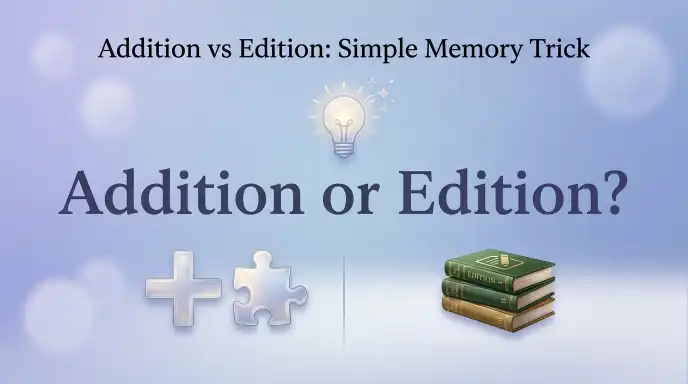
If you often confuse these words, remember two short rules.
Addition = Add
The word addition contains add in its first three letters.
Think:
add → addition
We added a new room.
The room is an addition.
Edition = Edit
The word edition starts with an edit in a related word family.
Think:
edit → edition
The editor changed the book.
The new version is an edition.
This is not a complete spelling rule. It is simply a useful memory aid.
Key Takeaways
- Addition and edition are both correct English words.
- Addition means something that is added.
- Addition also means the mathematical process of adding numbers.
- Edition means a particular version or published form.
- Books, newspapers, and magazines commonly have editions.
- A new person, feature, or object can be an addition.
- In addition to means as well as.
- British and American English spell both words the same way.
- In US building terms, addition can mean a new part of a building.
- The easiest memory rule is add → addition and edit → edition.
FAQs
Q1. What is the difference between addition and edition?
Addition means something that is added or the process of adding numbers. Edition means a particular version or form of a published work. For example, a new employee is an addition to a team, while a revised textbook is a new edition. The two words look similar but have different meanings.
Q2. Is it an addition or an edition of a book?
Use edition when talking about a book’s version. For example, say “the second edition of the book.” A new edition may contain corrections, updates, or other changes. Addition would mean something added to the book, such as an extra chapter or feature.
Q3. Is addition or edition correct for a new person?
Use addition. A person who joins a family, team, company, or group can be called a new addition. For example, “The new employee is a welcome addition to the team.” The word edition is not correct in this meaning.
Q4. What does edition mean?
An edition is a particular version or form of a published work. It can describe a book, magazine, newspaper, or broadcast. For example, “the latest edition of the dictionary” means the latest published version. In some US contexts, editions can also describe one event in a series.
Q5. What does addition mean?
Addition has several meanings. It can mean the process of adding numbers, something added to another thing, or a person or thing that joins a group. It also appears in the phrase in addition to, which means as well as.
Q6. Is “in addition to” correct?
Yes. In addition, it is a standard English phrase. It means as well as or besides. For example, “In addition to English, she speaks Spanish.” It is common in everyday, academic, and professional writing.
Q7. Is a new edition the same as a new addition?
No. A new edition is a new version of something, often a book, newspaper, or publication. A new addition is something newly added. For example, a revised textbook can have a new edition, while a new employee can be a new addition to a company.
Q8. Are addition and edition pronounced the same?
No. They have similar sounds, but they are not pronounced exactly the same. Both normally have three syllables, and their middle sounds are similar. The safest way to learn the difference is to connect each pronunciation with its meaning and common examples.
Q9. Is addition used in British and American English?
Yes. Addition is used in both British and American English. The spelling is the same. One regional difference is that American English uses addition for a new part added to a building, while British English commonly uses extension for this meaning.
Q10. How can I remember addition and edition?
Use this simple memory trick: add means addition, while edit relates to edition. If something is being added, use addition. If you mean a particular version of a book, newspaper, or publication, use edition. This quick rule works for most everyday examples.
Conclusion:
Addition or edition is a common English word confusion, but the difference is easy once you focus on meaning. Addition refers to something added, the act of adding numbers, or a person or thing that joins a group. Edition refers to a particular version or published form of a book, newspaper, magazine, broadcast, or similar work.
For example, a new employee is an addition to a company. A revised textbook is a new edition. A math problem can involve addition, while a newspaper can have a morning edition.
The spelling is the same in British and American English. Some related usage can differ by region, such as addition for a building extension in US English.
The easiest memory trick is simple: add → addition and edit → edition.
When you are unsure, ask one question: Am I talking about something added or a particular version? That answer will usually give you the correct word.

I’m Nora Ellis, an English language writer passionate about making grammar, spelling, and confusing words easy to understand. I share clear explanations and practical examples to help readers improve their English and use words with confidence.







4 thoughts on “Addition or Edition: Meaning, Difference & Examples ”