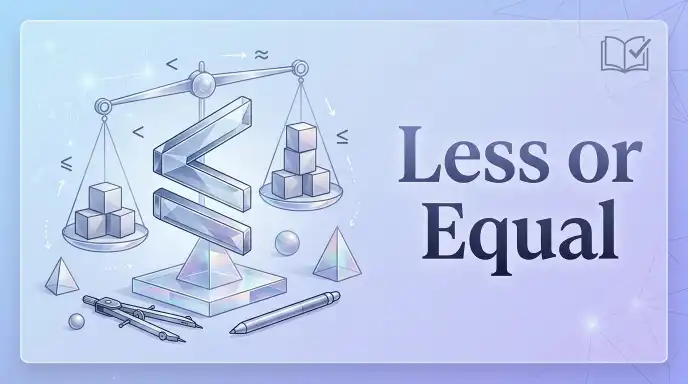
“Less or equal” and “less than or equal to” can look similar, but they are not equally natural in standard English. Less than or equal to is the standard phrase used in mathematics and formal writing.
The phrase less or equal is often understood because the meaning is clear. However, it leaves out then and to form the usual expression. This can make it sound incomplete in formal English.
For example, you can write:
5 ≤ 10
You can read this as “5 is less than or equal to 10.”
The statement is true because 5 is less than 10. The same rule also allows equality. For example, 10 ≤ 10 is true because the two numbers are equal.
This difference matters in schoolwork, math writing, programming, technical documents, and everyday explanations. Choosing the standard phrase makes your writing clearer and easier to understand.
This guide explains less or equal and less than or equal to. You will learn their meanings, correct usage, examples, common mistakes, and the role of the symbol ≤.
Less or Equal vs Less Than or Equal to: Featured Snippet Answer
Less than or equal to is the standard English phrase for the mathematical symbol ≤. It means that one value can be smaller than another value or the same as it. Less or equal is sometimes used as a shortened form, especially in informal or technical contexts, but less than or equal to is the clearer choice in standard writing.
Less or Equal : Quick Answer
The standard phrase is less than or equal to.
Less or equal can be understood, but it is not the usual full phrase in standard English.
Compare these examples:
- 5 ≤ 8 = 5 is less than or equal to 8.
- 8 ≤ 8 = 8 is less than or equal to 8.
- 10 ≤ 8 = 10 is not less than or equal to 8.
The phrase includes two possible conditions:
- The first value is less than the second.
- The first value is equal to the second.
That is why the symbol is ≤. It combines the ideas of less than and equal to.
For formal writing, schoolwork, and academic work, use less than or equal to.
What Does Less or Equal Mean?
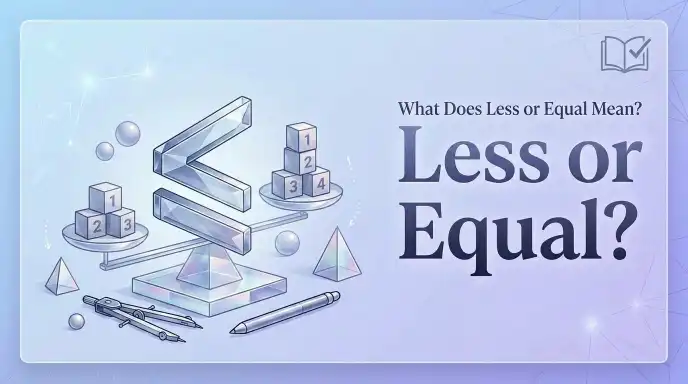
Less or equal is a shortened form of less than or equal to.
It is usually used when the writer wants to describe the mathematical relationship represented by ≤. The intended meaning is often easy to understand from the context.
For example:
x ≤ 20
The standard way to read this is:
x is less than or equal to 20.
This means that x can be any value below 20 or exactly 20.
For example, 18 works. So does 19.9. The value 20 also works.
The phrase less or equal removes some words from the standard expression. The result may sound less natural in normal English.
The standard form
Less than or equal to is the preferred full phrase.
It follows the normal pattern:
less than + value + or + equal to + value
For example:
7 is less than or equal to 12.
The shortened form
You may see:
7 is less or equal to 12.
The meaning is usually clear, but the sentence does not follow the standard phrasing used in formal English.
For clear writing, choose less than or equal to.
The Origin of Less Than or Equal To
The phrase less than or equal combines two basic mathematical ideas.
The first is less than. The second is equal to.
The symbol < represents “less than.” The symbol represents equality. The combined symbol ≤ represents “less than or equal to.” Cambridge sources use ≤ with this meaning in mathematical examples.
The modern symbol makes mathematical statements shorter.
Instead of writing:
x is less than or equal to 10
you can write:
x ≤ 10
This notation is useful in mathematics, science, statistics, computer programming, and technical writing.
The phrase itself does not have a special British or American spelling. The main issue is word choice and sentence form, not regional spelling.
British English vs American English
British and American English use the same standard phrase:
less than or equal to
There is no major spelling difference between the two varieties.
| British English | American English | Example |
| less than or equal to | less than or equal to | 4 is less than or equal to 9. |
| ≤ | ≤ | x ≤ 15 |
| less than | less than | 3 is less than 7. |
| equal to | equal to | 8 is equal to 8. |
The mathematical symbol ≤ also has the same meaning in both forms of English.
You may see shortened wording in software, programming, notes, or technical material. However, formal English still favors the complete phrase.
For school assignments, reports, articles, and educational content, less than or equal to is the safest choice.
Which Version Should You Use?
Your choice can depend on the setting, but less than or equal to works well in almost every formal situation.
United States
Use less than or equal to in schoolwork, business documents, technical writing, and formal explanations.
Example:
The temperature must be less than or equal to 30°C.
United Kingdom
Use the same standard phrase.
Example:
The final score must be less than or equal to 50.
Canada
Less than or equal to is also the clear choice in formal Canadian English.
Australia
Use less than or equal to for formal and educational writing.
International writing
For an international audience, avoid unnecessary shortened forms.
Less than or equal to is clear and widely understood.
Academic writing
Academic writing should favor the complete phrase.
Example:
Values less than or equal to 100 were included in the study.
Business writing
Use the full form when explaining rules, limits, or conditions.
Example:
Orders less than or equal to $500 do not require additional approval.
Common Mistakes Less or Equal
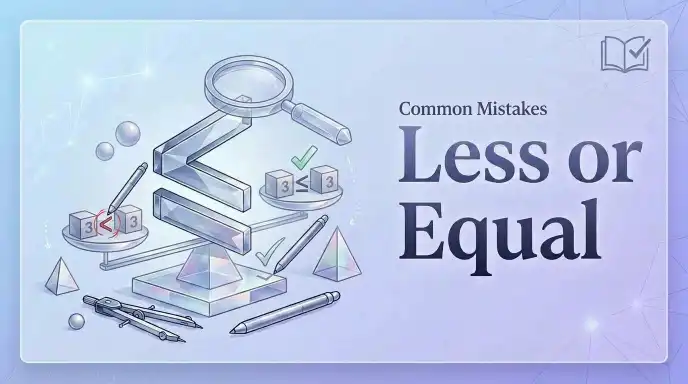
The main problem is usually leaving out words from the standard phrase.
Using “less or equal” in formal writing
Incorrect or less standard:
The value must be less or equal to 50.
Better:
The value must be less than or equal to 50.
The second version follows the standard English expression.
Memory tip: Remember the complete pattern: less than or equal to.
Forgetting “to”
Less natural:
The number is less than or equal 20.
Correct:
The number is less than or equal to 20.
The phrase equal to needs to before the value.
Confusing “less than” with “less than or equal to”
These expressions are not the same.
Less than:
x < 10
Here, x must be below 10. It cannot be 10.
Less than or equal to:
x ≤ 10
Here, x can be below 10 or exactly 10.
This small difference can change the meaning of a mathematical rule.
Thinking “equal” means only equal
The phrase less than or equal to allows two possibilities.
The value can be:
- smaller
- exactly the same
For example:
5 ≤ 5
This statement is true because both sides are equal.
Everyday Examples
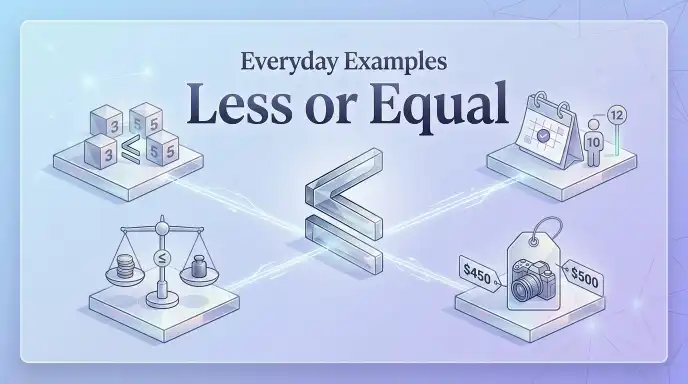
The phrase less than or equal to appears in many types of writing.
Emails
Please keep the file size less than or equal to 10 MB.
This wording is clear in a work email.
Business Writing
The discount applies to orders less than or equal to $1,000.
The phrase clearly sets a limit.
News Headlines
A headline may use the shorter mathematical symbol:
The new rule applies to businesses with 50 or fewer employees.
In a mathematical context, the same limit could be written as:
Employees ≤ 50
Blogs
Choose a password length less than or equal to 20 characters.
This gives readers a clear maximum value.
Social Media
Informal posts may shorten mathematical language.
For example:
Keep the value ≤ 100.
The symbol is often easier to read in a short post.
Academic Writing
The researchers included participants aged 18 years or older.
When a numerical limit is involved, academic writing often uses either words or mathematical symbols, depending on the field.
Daily Conversation
People usually say:
It must be 20 or less.
This sounds natural in everyday speech.
You would be less likely to say:
It must be less than or equal to 20.
The longer phrase is more common when precision matters.
Google Trends & Modern Usage
People may search for less or equal because they see the phrase in notes, code, formulas, worksheets, or online discussions.
The search can also come from learners who want to know if less or equal is grammatically correct.
The mathematical symbol ≤ is widely used to express the same relationship. It provides a short way to represent “less than or equal to.”
In programming and technical contexts, shortened forms can appear more often. For example, programming languages commonly use comparison operators such as <= for “less than or equal to.” Cambridge’s programming material lists <= with this meaning.
However, programming syntax is different from normal English.
When writing a sentence for readers, less than or equal to is clearer.
There is no need to claim that one wording is more popular without reliable search data. Usage can also vary by field.
Quick Comparison Table
| Version | Meaning | Correct? | Region | Example |
| less than or equal to | Smaller than or the same as | Yes | International | 5 is less than or equal to 10. |
| less or equal | Shortened form of the same idea | Understandable, but less standard | Various contexts | The value is less or equal to 10. |
| less than | Smaller than | Yes | International | 5 is less than 10. |
| equal to | The same in value | Yes | International | 10 is equal to 10. |
| ≤ | Less than or equal to | Yes | Mathematical notation | x ≤ 10 |
| <= | Less than or equal to in many programming contexts | Yes in supported programming contexts | Technical | x <= 10 |
The symbol ≤ is the standard mathematical symbol for “less than or equal to.”
Key Takeaways
- Less than or equal to is the standard full phrase.
- Less or equal is a shortened form that readers may understand.
- Use less than or equal to in formal English.
- The symbol ≤ means less than or equal to.
- A value can be smaller than the other value.
- A value can also be exactly equal to the other value.
- Do not confuse < with ≤.
- Programming may use <= for the same comparison.
- British and American English use the same standard phrase.
- For clear writing, choose less than or equal to.
FAQs
Q1. Is “less or equal” grammatically correct?
Less or equal can be understood, but it is not the standard full English phrase. In formal writing, use less than or equal to. This form clearly expresses the mathematical relationship and follows normal English usage. It is the better choice for schoolwork, academic writing, business documents, and general explanations.
Q2. What is the correct phrase, less or equal or less than or equal to?
The standard phrase is less than or equal to. It describes a value that is either smaller than another value or exactly the same. Less or equal is often used as a shortened form, but it is less natural in standard English. For formal writing, choose the complete phrase.
Q3. What does ≤ mean?
The symbol ≤ means less than or equal to. It allows two possibilities. The value on the left can be smaller than the value on the right, or both values can be equal. For example, 5 ≤ 10 is true, and 10 ≤ 10 is also true.
Q4. Is “less than or equal” correct?
The usual complete phrase is less than or equal to. The word to should appear before the value or comparison target. For example, write “x is less than or equal to 10.” This form is clear and standard in mathematical English.
Q5. What is the difference between < and ≤?
The symbol < means less than. The symbol ≤ means less than or equal to. With <, the two values cannot be equal. With ≤, equality is allowed. For example, 5 < 10 is true, and 10 ≤ 10 is also true.
Q6. Can I use “less or equal” in formal writing?
It is better to avoid less or equal in formal writing. Choose less than or equal to instead. The full phrase is clearer and more natural. This is especially useful in academic papers, school assignments, business documents, and educational articles where precise language matters.
Q7. Is “less or equal” used in programming?
Programming languages may use shortened operators instead of full English phrases. A common operator is <=, which represents a less-than-or-equal comparison in many programming languages. This programming syntax should not be confused with normal English. In prose, less than or equal to remains the clearer wording.
Q8. Is “less than or equal to” the same in British and American English?
Yes. British and American English use less than or equal to in the same way. The mathematical symbol ≤ also has the same meaning. There is no major regional spelling difference here. The main concern is choosing the complete phrase instead of the shortened less or equal.
Q9. What is an easy way to remember “less than or equal to”?
Think of the phrase as two ideas joined together: less than and equal to. The word or connects them. This gives you less than or equal to. The symbol ≤ also combines the ideas of < and =, which makes the rule easier to remember.
Q10. Should I use “less or equal” or “less than or equal to”?
For most writing, choose less than or equal to. It is complete, clear, and easy to understand. You may see less or equal in informal notes or shortened technical language, but the longer form is safer for formal English, education, and professional writing.
Conclusion:
The main difference between less or equal and less than or equal to is not the intended mathematical meaning. Both can point readers toward the same idea. The key difference is that less than or equal to is the standard and complete English expression.
Use less than or equal to when you want clear, formal writing. It works well in school assignments, academic papers, business documents, technical explanations, and general educational content.
The symbol ≤ gives you a shorter mathematical option. For example, x ≤ 10 means that x can be 10 or any value below 10.
You should also remember the difference between < and ≤. The first means “less than,” while the second allows equality as well.
If you see less or equal, do not assume the writer means something different. It is often a shortened expression. However, when you are writing for a broad audience, the complete phrase is clearer.
Simple rule: When in doubt, write “less than or equal to.”

I’m Nora Ellis, an English language writer passionate about making grammar, spelling, and confusing words easy to understand. I share clear explanations and practical examples to help readers improve their English and use words with confidence.