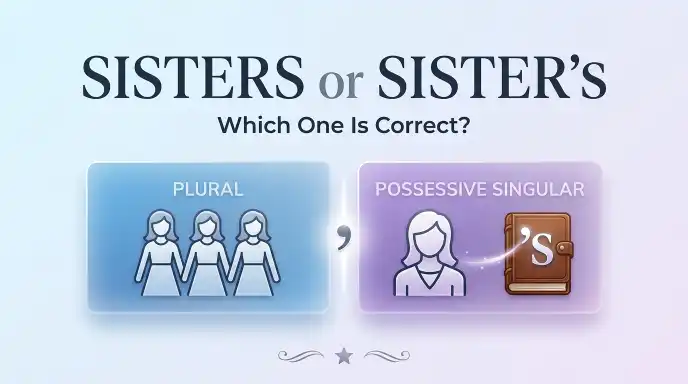
If you are unsure if to write sisters or sister’s, the answer depends on what you mean. Sisters is the plural form of sister, while sister’s is usually the possessive form of the singular noun sister.
For example, “I have two sisters” means you have more than one sister, while “This is my sister’s bag” means the bag belongs to one sister.
This small apostrophe can change the meaning of a sentence. That is why learners, students, and writers often search for sisters or sisters when checking their grammar. The confusion is even greater because English also has a third form, sisters’, which shows possession by more than one sister.
The good news is that the rule is simple once you focus on two questions: How many sisters are there? and does something belong to them? This guide explains the difference between sisters, sister’s, and sisters’, with clear rules and everyday examples. It will also show you which form to use in emails, academic writing, business writing, and casual conversation.
Sisters or Sister’s: Quick Answer
Sisters means more than one sister.
Sister’s shows that something belongs to one sister.
Sisters’ shows that something belongs to more than one sister.
For example:
- Sisters: I have two sisters.
- Sister’s: This is my sister’s bag.
- Sisters’: These are my sisters’ bags.
- Sisters = plural
My sisters live nearby. - Sister’s = singular possessive
My sister’s phone is on the table. - Sisters’ = plural possessive
My sisters’ phones are on the table.
The apostrophe is important. It does not simply make a word plural. English uses an apostrophe with ‘s to show possession after a singular noun, while a regular plural normally takes -s without an apostrophe.
What Does Sisters or Sisters Mean?
The word sister is a noun. It commonly means a girl or woman who has one or both parents in common with another person. Cambridge gives this as a primary meaning of sister.
Sisters
Sisters is the plural form.
It means two or more sisters.
Anna and Maria are sisters.
I have three sisters.
My sisters live in different cities.
Merriam-Webster also identifies sisters as the plural of sister.
Sister’s
Sister’s is normally the singular possessive form.
It shows that something belongs to, comes from, or is closely related to one sister.
My sister’s car is new.
I borrowed my sister’s book.
This is my sister’s idea.
There is another possible use of sister’s. It can also be a contraction in some sentences, although this is less common in everyday examples involving the noun sister.
For example:
My sister’s coming tonight.
Here, sister’s can mean sister is.
Cambridge notes that ‘s can represent is or has in contractions.
Sisters’
Sisters’ is the plural possessive form.
My sisters’ room is upstairs.
This means the room belongs to more than one sister.
The key difference is the position of the apostrophe:
- sister’s = one sister owns or relates to something
- sisters’ = several sisters own or relate to something
The Origin of Sisters or Sister’s
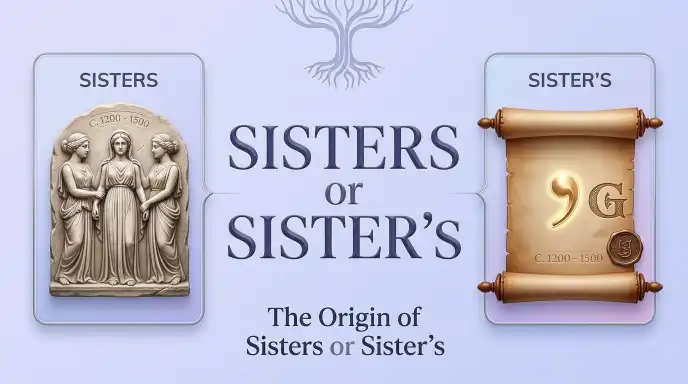
The word sister has a very old history. Merriam-Webster traces it through Middle English forms such as sister and sister, with connections to Old English sweostor and Old Norse systir. Its recorded use in English goes back to before the 12th century.
The modern plural sisters developed through the normal English plural pattern of adding -s.
The possessive form developed differently. English uses an apostrophe to mark possession, so the singular noun becomes:
sister + ‘s = sister’s
For a regular plural noun that already ends in -s, the apostrophe normally comes after the plural ending:
sisters + ‘ = sisters’
This gives us the three forms:
| Form | Grammar | Basic meaning |
| sister | Singular | One sister |
| sisters | Plural | More than one sister |
| sister’s | Singular possessive | Belonging to one sister |
| sisters’ | Plural possessive | Belonging to several sisters |
This distinction follows the wider rule for regular nouns. Cambridge explains that singular nouns generally take ‘s for possession, while plural nouns ending in -s take an apostrophe after the s.
British English vs American English
There is no major difference between British and American English in the basic rule for sisters, sister’s, and sisters’.
Both varieties use:
- sisters for the plural
- sisters for singular possession
- sisters’ for plural possession
The apostrophe rule is therefore much more stable across English varieties than some spelling differences such as colour/color or organise/organize.
| British English | American English | Example |
| sisters | sisters | My sisters are visiting. |
| sister’s | sister’s | My sister’s car is outside. |
| sisters’ | sisters’ | My sisters’ cars are outside. |
| sister | sister | My sister lives nearby. |
Both British and American readers understand these forms in the same way.
The main style point is consistency. If you are writing for an international audience, there is no need to change sisters or sisters simply because your readers use British or American English.
Which Version Should You Use?
Choose the form based on meaning, not nationality.
United States
American English uses the same basic forms:
Sisters: I have two sisters.
Sister’s: This is my sister’s room.
Sisters’: This is my sisters’ room.
United Kingdom
British English follows the same pattern:
Sisters: My sisters are students.
Sister’s: My sister’s room is upstairs.
Sisters’: My sisters’ rooms are upstairs.
Canada
Canadian English also uses the standard plural and possessive forms. Follow the same grammar rule.
Australia
Australian English follows the same core rule. The Australian Government Style Manual states that singular nouns take ‘s for possession, while plural nouns ending in s take an apostrophe after the s.
International Writing
For international readers, use the form that matches your meaning. Do not add an apostrophe just because a word is plural.
Academic Writing
Be precise.
The study examined the sisters’ responses.
This means the responses came from more than one sister.
If the study involved one sister:
The study examined the sister’s response.
Business Writing
The same rule applies in professional documents.
We reviewed the sister’s application.
One sister.
We reviewed the sisters’ applications.
More than one sister.
Common Mistakes
Using Sisters for a Plural
Incorrect:
I have two sisters.
Correct:
I have two sisters.
Why?
You are talking about more than one sister, not ownership.
Memory tip:
If you can replace the word with two or more, you normally need sisters, not sisters.
Using Sisters for Possession
Incorrect:
My sister’s car is red.
Correct:
My sister’s car is red.
Why?
One sister owns the car, so use the singular possessive form.
Memory tip:
One owner = ‘s.
Using Sisters for Several Sisters
Incorrect:
My sister’s room is shared by three sisters.
If the room belongs to three sisters, write:
My sisters’ room is shared by three sisters.
Why?
The owners are plural, so the apostrophe comes after the plural s.
Memory tip:
Several owners = sisters’.
Adding an Apostrophe Just to Make a Plural
Incorrect:
The sisters are coming.
Correct:
The sisters are coming.
An apostrophe is not normally used to form a regular plural. The Australian Government Style Manual also warns against using apostrophes simply to make nouns plural.
Everyday Examples
The difference becomes much easier when you see it in real sentences.
Emails
My sister’s appointment is at 10 a.m.
One sister has an appointment.
My sisters will attend the meeting.
More than one sister will attend.
Business Writing
We received the sister’s signed form.
One sister signed the form.
We received the sisters’ signed forms.
Several sisters signed forms.
News Headlines
Two sisters open a new community center.
Here, sisters means two women who are sisters.
The sister’s statement attracted attention.
Here, the statement belongs to one sister.
Blogs
My sisters and I love traveling.
The word is plural.
My sister’s travel tips helped me plan the trip.
The tips came from one sister.
Social Media
Spending the weekend with my sisters! ❤️
More than one sister.
Borrowed my sister’s hoodie again!
The hoodie belongs to one sister.
Academic Writing
The researchers studied the sisters’ responses.
The responses came from several sisters.
The researcher studied the sister’s response.
Only one sister gave the response.
Daily Conversation
How many sisters do you have?
Sister’s: My sister’s name is Emma.
Sisters: My sisters live nearby.
Sisters’: My sisters’ children are visiting.
These examples show how the apostrophe changes the relationship between the words.
Google Trends & Modern Usage
People search for sisters or sisters because the three forms look very similar but perform different grammatical jobs. The confusion is especially common among English learners, students, and writers who are unsure when an apostrophe should be used.
Google Trends allows users to compare search terms and explore interest by location and time. However, Google notes that Trends does not provide results for every spelling variation, plural, or singular form in the same way.
For that reason, it would be misleading to give an exact worldwide ranking for sisters versus sisters without a specific Google Trends comparison, time range, location, and search setting.
The broader usage pattern is clear from grammar references:
- sisters is the regular plural.
- sister’s is usually singular possessive.
- sisters’ is plural possessive.
- Apostrophes are used for possession, not simply to make regular nouns plural.
This is why search queries often include phrases such as “sisters vs sister’s,” “sister plural,” “sister’s meaning,” and “when to use apostrophe with sister.”
Quick Comparison Table
| Version | Meaning | Correct? | Region | Example |
| sister | One female sibling | Yes | All English varieties | My sister is here. |
| sisters | More than one female sibling | Yes | All English varieties | My sisters are here. |
| sister’s | Belonging to one sister | Yes | All English varieties | My sister’s bag is blue. |
| sisters’ | Belonging to several sisters | Yes | All English varieties | My sisters’ bags are blue. |
The fastest way to choose the right form is to ask:
Key Takeaways
- Sisters is the plural of sister.
- Sister’s usually show possession by one sister.
- Sisters’ shows possession by more than one sister.
- Do not use an apostrophe just to make sister plural.
- Sister’s can sometimes mean sister is or sister has in a contraction.
- British and American English use the same basic rules for these forms.
- Always check if you mean number or possession.
- The apostrophe position changes the meaning, so use it carefully.
FAQs About Sisters or Sister’s
Q1. Are sisters or sisters correct?
Both sisters and sisters are correct, but they have different meanings. Sisters is the plural form and means more than one sister. Sister’s is usually the singular possessive form and shows that something belongs to one sister.
For example, “I have two sisters” and “That is my sister’s phone” are both correct.
Q2. What is the plural of sister?
The plural of sister is sisters. You add -s without an apostrophe. For example, “She has two sisters.” Do not write “two sister’s” because the apostrophe is not needed to form a regular plural. The apostrophe is used when you need to show possession or create certain contractions.
Q3. When should I use sister’s?
Use sister’s when one sister owns something or has a close relationship with something. For example, “My sister’s laptop is new” means the laptop belongs to one sister. Sisters can also appear as a contraction for “sister is” or “sister has,” depending on the sentence.
Q4. What is the difference between sister’s and sisters’?
Sister’s shows possession by one sister. Sisters’ shows possession by two or more sisters. Compare “my sister’s room” with “my sisters’ room.” The first room belongs to one sister.
The second room belongs to several sisters. The apostrophe comes before s for singular possession and after plural s for regular plural possession.
Q5. Is sisters’ grammatically correct?
Yes. Sisters’ is grammatically correct when something belongs to more than one sister. For example, “The sisters’ house is large” means the house belongs to several sisters.
Because sisters is already a regular plural ending in s, you normally add only an apostrophe to show possession.
Q6. Should I write my sister’s or my sisters?
It depends on your meaning. Write my sister’s when you mean something belonging to one sister, such as “my sister’s car.” Write my sisters when you mean more than one sister, such as “my sisters are teachers.” The number of sisters and the idea of possession determine the correct form.
Q7. Is sister’s always possessive?
No. Sister’s is usually possessive, but it can also be a contraction. In “My sister’s car,” it means the car belongs to one sister. In “My sister’s coming,” it can mean “My sister is coming.”
Context tells you which meaning applies. Cambridge confirms that ‘s can represent is or has in contractions.
Q8. Is’ sisters’ or sisters correct for two sisters?
For two sisters sharing ownership, use sisters’. For example, “The sisters’ bedroom is upstairs.” If only one sister owns the bedroom, use sister’s. If you are simply talking about two sisters without showing ownership, use sisters, as in “The sisters are upstairs.”
Q9. Do I need an apostrophe in sisters?
Not when sisters is simply a plural noun. Write “I have three sisters,” not “I have three sister’s.” Add an apostrophe only when you need to show possession, as in “My sisters’ house.”
This follows the standard rule that regular plural nouns do not need an apostrophe merely because they are plural.
Q10. Are sisters, sister’s, and sisters’ pronounced differently?
In most normal speech, the forms are distinguished mainly by grammar and the sounds around the ending, not by a completely different pronunciation of the word.
The safest way to identify the correct form in writing is to check the meaning. Ask if you mean several sisters, one sister’s possession, or several sisters’ possession.
Conclusion:
Understanding sisters or sisters is mainly about knowing the difference between a plural noun and a possessive noun. Sisters means more than one sister, with no apostrophe. Sister’s usually means that something belongs to one sister. When something belongs to several sisters, the correct form is sisters’.
These rules work in both British and American English. They also apply in academic writing, business communication, emails, blogs, social media, and everyday conversation. The key is not the variety of English you use. The key is the meaning you want to express.
When you are unsure, ask two simple questions: How many sisters are there? and does something belong to them? One sister with possession gives you sister’s. Several sisters without possession gives you sisters. Several sisters with possession give you sisters’.
Once you learn this pattern, the apostrophe becomes much easier to use correctly.

I’m Nora Ellis, an English language writer passionate about making grammar, spelling, and confusing words easy to understand. I share clear explanations and practical examples to help readers improve their English and use words with confidence.






7 thoughts on “Sisters or Sister’s: What’s the Difference?”