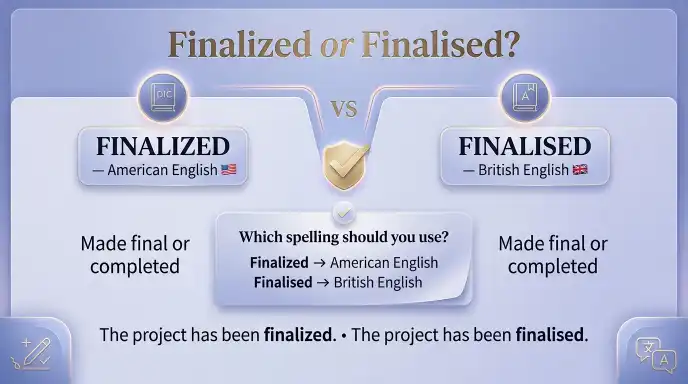
Have you ever stopped while writing and wondered if finalized or finalised is the correct spelling? You are not alone. This is a common question in emails, school work, business documents, websites, and professional writing. The good news is simple: both finalized and finalised are correct. The difference is mainly based on the variety of English you use.
Finalized is the usual spelling in American English, while finalised is commonly preferred in British English and is also widely used in other Commonwealth varieties. Both forms mean the same thing: to complete something, settle the details, or make something final.
This guide explains the difference between finalized or finalised, where these spellings came from, which one you should use, and how to avoid common mistakes. If you are writing for an international audience, you will also learn how to choose one spelling and keep your writing consistent.
Finalized or Finalised – Quick Answer
Finalized and finalised have the same meaning. They are different regional spellings of the same word.
- Finalized → preferred in American English
- Finalised → usually preferred in British English
- Meaning → completed, settled, or made final
For example:
- US: The manager finalized the report.
- UK: The manager finalised the report.
Both sentences are correct. The spelling changes, but the meaning does not. Cambridge lists finalise as the usual UK form and finalize as the US form.
Quick Comparison
| Form | Main variety | Example |
| Finalized | American English | We finalized the plan. |
| Finalised | British English | We finalised the plan. |
| Finalize | American English | Please finalize the details. |
| Finalise | British English | Please finalise the details. |
| Finalizing | American English | We are finalizing the deal. |
| Finalising | British English | We are finalising the deal. |
The Origin of Finalized or Finalised
The word comes from final, which is related to the idea of an end or last stage. The verb finalize was formed with the suffix -ize. Etymological sources trace finalize to final + -ize, with the verb recorded in the 19th century.
The deeper root of final goes back through French to Latin finalis, meaning “of or pertaining to an end.” The ending -ize has a much older history and is connected to Greek -izein through Latin and French forms.
So, finalise is not a completely different word. It is a spelling variant of finalize.
The difference between -ize and -ise developed over a long period of English history. British English came to use -ise widely, while American English strongly favored -ize. This pattern can also be seen in words such as:
- organize / organise
- recognize / recognise
- realize / realise
- apologize / apologise
Importantly, the -ize spelling did not originate in America. It has a long history in English. American English simply made the -ize pattern its standard choice more consistently.
British English vs American English Spelling
The main difference is the verb ending:
British English → -ise
American English → -ize
Therefore:
- finalised → British English
- finalized → American English
The same pattern often appears in related forms.
| Meaning | British English | American English |
| Base verb | finalise | finalize |
| Past tense | finalised | finalized |
| -ing form | finalising | finalizing |
| Noun | finalisation | finalization |
| Similar verb | organise | organize |
| Similar verb | recognise | recognize |
| Similar verb | realise | realize |
| Similar verb | apologise | apologize |
However, British spelling is not always as simple as “use -ise for every word.” Some words naturally use -ise in both major varieties, such as advertise, exercise, and surprise. So, spelling should be checked word by word when you are unsure.
For finalized or finalised, though, the regional rule is straightforward.
Which Spelling Should You Use?
The best spelling depends on your audience and your chosen style of English.
For American Readers
Use finalized if your audience is mainly in the United States.
Example:
The team finalized the project schedule yesterday.
This matches common American spelling conventions.
For British Readers
Use finalised when writing mainly for readers in the United Kingdom.
Example:
The team finalized the project schedule yesterday.
Cambridge and Collins both recognize finalise as a British form of finalize.
For Commonwealth Audiences
British-style spelling is common in many Commonwealth settings. Depending on the local style guide, finalised may be the more natural choice.
For Global Websites
If your website serves readers from many countries, either spelling can work. The important thing is consistency.
For example, do not write:
The contract was finalized, and the finalised report was sent.
Choose one style and keep it throughout the page or website.
Common Mistakes with Finalized or Finalised
Thinking One Spelling Is Wrong
A common mistake is assuming that one form is incorrect.
Incorrect assumption:
Finalised is wrong because finalized is the correct spelling.
Better understanding:
Both are correct. The preferred spelling depends on the variety of English.
Mixing British and American Spelling
Avoid switching styles in the same document without a reason.
For example:
The company finalized the project and organized the meeting.
This mixes British finalised with American organized.
If you use British English, write:
The company finalized the project and organised the meeting.
If you use American English, write:
The company finalized the project and organized the meeting.
Using “Finalized” for Every Audience
Finalized is widely understood around the world, but that does not mean it is always the best editorial choice.
If your publication follows British English, use finalised to match its style.
Confusing the Verb and Noun
The verb is:
- finalize
- finalise
The noun is:
- finalization
- finalisation
For example:
We need to finalize the agreement.
But:
The finalization of the agreement took two weeks.
Adding an Extra Letter
Do not write:
- finalizzed ❌
- finalyzed ❌
- finaliseded ❌
Correct forms are:
- finalized ✅
- finalised ✅
Finalized or Finalised in Everyday Examples
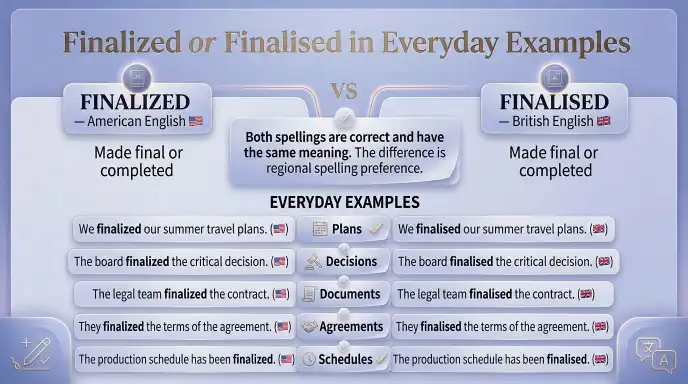
These words appear often when people talk about plans, agreements, reports, schedules, and decisions.
In Emails
American English:
The meeting details have been finalized. Please review the attached schedule.
British English:
The meeting details have been finalized. Please review the attached schedule.
Both versions are professional.
In Business Writing
US style:
The company finalized the contract after several rounds of discussion.
UK style:
The company finalized the contract after several rounds of discussion.
The word is especially common when describing agreements, plans, and negotiations. Collins defines finalize as completing arrangements or discussions so that something is settled.
In News Writing
News articles may use either spelling depending on the publication’s style.
For example:
Officials said the agreement was finalized on Monday.
A British publication may instead write:
Officials said the agreement was finalised on Monday.
On Social Media
Social media users may write either form:
Finally finalized the wedding plans! 🎉
or:
Finally finalized the wedding plans! 🎉
For casual posts, either is understandable. Your audience and personal spelling style can guide your choice.
In Formal Writing
Both forms are suitable for formal writing when they match the chosen style guide.
For example:
The committee finalized the recommendations.
or:
The committee finalised the recommendations.
The key is to maintain one spelling system throughout the document.
Finalized or Finalised – Google Trends & Usage Data
Search interest can vary by country because English spelling also varies by region. Users in the United States are more likely to search for and use finalized, while users in the United Kingdom and some other Commonwealth countries commonly use finalised.
A usage comparison published by Sapling shows a strong regional pattern: its data reports finalized as dominant in the US, while finalised is stronger in the UK and Australia. It also shows more mixed usage in countries such as India and Canada.
This matters for because searchers may type the version they normally see in their own variety of English.
For example:
| Region | More common form |
| United States | finalized |
| United Kingdom | finalised |
| Australia | finalised |
| New Zealand | finalised |
| Canada | Mixed usage |
| India | Mixed usage |
These patterns are useful as a general guide, not as a fixed rule. Language use changes by industry, publication, education, and audience.
For , you can naturally mention both spellings on a page. That helps the article answer searches such as “finalized or finalised,” “finalised vs finalized,” and “is finalized correct?” without awkward keyword repetition.
Finalized vs Finalised: Side-by-Side Comparison
| Feature | Finalized | Finalised |
| Spelling system | American English | British English |
| Base form | finalize | finalise |
| Past form | finalized | finalised |
| Meaning | To complete or make final | To complete or make final |
| Pronunciation | Same | Same |
| Main difference | -ize | -ise |
| US usage | Preferred | Less common |
| UK usage | Used, but less common | Preferred |
| Formal writing | Correct | Correct |
| use | Valid | Valid |
The most important point is simple: the meaning does not change.
FAQs About Finalized or Finalised
Q1. Is finalized or finalised correct?
Both are correct. Finalized is preferred in American English, while finalised is usually preferred in British English.
Q2. Is it American or British?
Finalized is the standard American spelling. British English can use finalized, but finalised is the usual British form.
Q3. Is British English finalised?
Yes. Finalised is the usual British spelling of finalized. It is also used in other varieties that follow British spelling conventions.
Q4. Do finalized and finalised have the same meaning?
Yes. Both mean to complete something, settle its details, or make it final.
Q5. Should I use finalized or finalised in a formal email?
Use the spelling that matches your audience or organization. For a US audience, choose finalized. For a UK audience, choose finalised.
Q6. Is “finalised” a spelling mistake?
No. Finalised is a correct spelling in British English and other varieties that use British spelling conventions.
Q7. Can I use both spellings in one article?
You can, but it is usually better to choose one main spelling and remain consistent. You can mention the alternative spelling naturally when explaining the difference.
Conclusion:
The choice between finalized or finalized is much easier once you know the main rule. Both words are correct, and both have exactly the same meaning. The difference is regional spelling.
Use finalized when writing in American English. Use finalised when following British English. The same pattern appears in words such as organize/organise, recognize/recognise, and realize/realise.
Neither form is less professional. What matters most is choosing the spelling that fits your audience and using it consistently. This is especially important in business emails, academic writing, websites, reports, and professional documents.
If you write for a global audience, you do not need to worry about one form being universally correct. Simply choose a clear style and follow it throughout your content. Understanding this small spelling difference can help you write with greater confidence and avoid unnecessary corrections.

I’m Nora Ellis, an English language writer passionate about making grammar, spelling, and confusing words easy to understand. I share clear explanations and practical examples to help readers improve their English and use words with confidence.





3 thoughts on “Finalized or Finalised: Which Spelling Is Correct?”