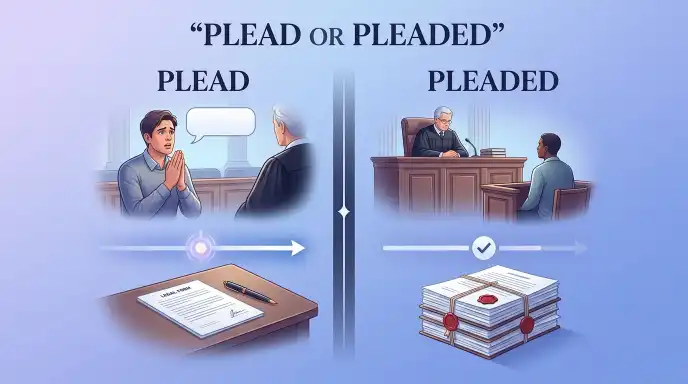
When choosing between plead or pleaded, the correct form depends on the tense and context, but pleaded is the standard past tense and past participle of plead in modern English.
The verb plead means to make an urgent request, ask for something strongly, or state a formal response to a criminal charge in court. The confusion often comes from the fact that English has more than one historical past-tense form for this verb, including pled and pleaded.
Today, both pleaded and plead can be found in dictionaries and real English use, but they are not equally common in every setting. Pleaded is the clearest choice for general writing, while pled is also established, especially in legal language and some varieties of American English.
This guide explains when to use plead, pleaded, and pled. It also covers British and American usage, common grammar mistakes, formal and everyday examples, modern usage patterns, and practical advice for students, writers, and ESL learners.
Plead or Pleaded: Featured Snippet & AI Overview
Plead is the base form of the verb, while pleaded is its standard past tense and past participle. Pled is also an accepted past form, especially in legal contexts. Use plead for present or base-form constructions and pleaded for past actions when you want the clearest general-English choice.
Plead or Pleaded: Quick Answer
The main difference is verb tense.
- Plead is the base form.
- Pleaded is a standard past-tense form.
- Pled is also a recognized past-tense form.
- Pleaded is usually the safest choice in general writing.
Examples
Present:
They plead for more time.
Past:
They pleaded for more time.
Past with the alternative form:
They pled for more time.
In legal writing, you may see:
The defendant pleaded guilty.
You may also see:
The defendant pled guilty.
Both forms are established, but pleaded is often easier for a broad international audience to understand.
The key point is that plead and pleaded are not competing spellings of the same form. They serve different grammatical roles.
What Does Plead or Pleaded Mean?
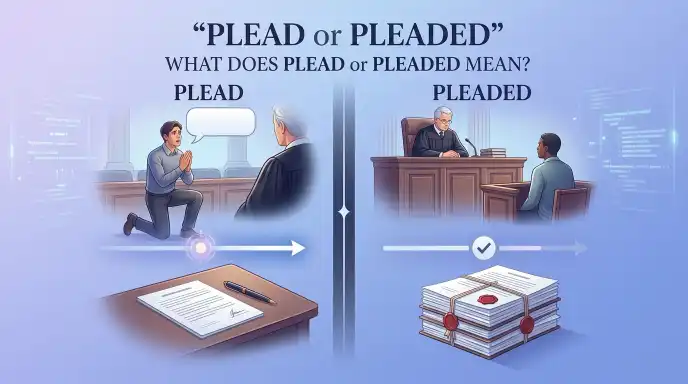
The word plead is a verb with several related meanings.
It can mean to make an urgent request, to beg, or to make a formal statement in court.
Plead as a Request
When someone strongly asks for something, they can plead for it.
For example:
She pleaded for another chance.
Here, the person is making an emotional or urgent request.
Other examples include:
He pleaded with his parents to let him go.
The child pleaded for more time.
They plead for help.
Plead in Law
In legal English, plead has a more specific meaning.
A person accused of a crime can formally state if they are guilty or not guilty.
For example:
The defendant pleaded guilty.
The defendant pleaded not guilty.
In this context, plead is a formal legal verb.
Plead vs Pleaded
The difference can be seen clearly in these examples:
| Form | Grammar | Example |
| plead | Base/present form | They plead for help. |
| pleaded | Past tense | They pleaded for help. |
| pleaded | Past participle | They have pleaded for help. |
| pled | Alternative past form | They pled guilty. |
So, if you are describing something that already happened, pleaded is usually the simplest choice.
The Origin of Plead or Pleaded
The verb plead has a long history in English and is closely connected with legal language.
It entered English through Anglo-French and Old French, ultimately tracing back to Latin legal language related to a plea or legal action. Over time, plead developed both legal and general meanings.
The word became strongly associated with court proceedings. From there, its meaning also developed into the everyday sense of making an urgent or emotional request.
The past tense has an interesting history. English speakers have used both pleaded and pled.
Pleaded follows a familiar English pattern in which a verb takes the -ed ending:
plead → pleaded
Pled is a shorter historical form that developed through English verb patterns and became established in usage.
Both forms are recognized in modern dictionaries. However, their frequency and preferred contexts can differ by region, publication, and writing style.
For writers who want the most straightforward general-English form, pleaded is a strong choice.
British English vs American English
British and American English both use plead, pleaded, and pled, but preferences can vary.
Pleaded is widely understood in both varieties. Pled is also established, particularly in American legal and news writing.
| Feature | British English | American English | Example |
| Base form | plead | plead | They plead for help. |
| Common past form | pleaded | pleaded | He pleaded for mercy. |
| Alternative past form | pled | pled | He pled guilty. |
| Legal use | Both forms occur | Both forms occur | She pleaded guilty. |
| General writing | pleaded is clear | pleaded is clear | They pleaded with him. |
There is therefore no simple rule saying that pleaded is British and pled is American.
Both forms appear across English varieties.
What About Legal Style?
Legal writing can have its own preferences. Court reports, legal documents, and news reports may use pled or pleaded depending on the publication and jurisdiction.
If you are writing for a specific court, institution, or legal publication, follow its style guide.
For general readers, pleaded is often the least confusing choice.
Which Version Should You Use?
Your choice depends on your audience and the sentence.
United States
In American English, both pleaded and pled are established.
For general writing:
She pleaded for another chance.
In legal contexts, you may also see:
The defendant pled guilty.
United Kingdom
British English also uses both forms.
For general readers, pleaded is a clear and natural choice.
He pleaded with the judge for leniency.
Canada
Canadian English can use both pleaded and pled. Follow the style of the publication or legal institution when writing formally.
Australia
Australian English also recognizes pleaded and pled. In ordinary writing, pleaded is a safe and transparent form.
International Writing
For international readers, pleaded is usually the easiest form to understand.
It clearly shows the past tense without relying on familiarity with the shorter form pled.
Academic Writing
Academic writers should choose the form that fits the source, quotation, or subject.
For ordinary prose:
The witness pleaded for protection.
For a quotation or legal discussion, preserve the original wording when necessary.
Business Writing
In business writing, use pleaded when describing a past request.
The customer pleaded for an extension.
However, a more neutral business phrase may be better:
The customer strongly requested an extension.
Common Mistakes with Plead or Pleaded

Using Plead for a Past Action
Incorrect:
She plead with him yesterday.
Correct:
She pleaded with him yesterday.
The word yesterday clearly places the action in the past.
Assuming Pled Is Wrong
Incorrect assumption:
“Pled is always incorrect.”
Better understanding:
Pled is an accepted past form of plead.
However, pleaded is often the clearer general-purpose choice.
Confusing Plead With Pleading
Incorrect:
He pleaded for help right now.
Better:
He is pleading for help right now.
Use pleading with a form of be when describing an action happening now.
Using Pleaded After Will
Incorrect:
She will pleaded for mercy.
Correct:
She will plead for mercy.
After will, use the base form of the verb.
Memory Tip
Remember this simple pattern:
Today:
I plead.
Yesterday:
I pleaded.
Alternative past form:
I pleaded.
After will:
I will plead.
Plead or Pleaded in Everyday Examples
The verb appears in many types of writing.
Emails
I plead with you to reconsider the decision.
For a professional email, this may sound very emotional. A calmer alternative could be:
I respectfully ask you to reconsider the decision.
Business Writing
The company pleaded with suppliers to extend the payment deadline.
A more neutral business style could be:
The company requested an extension from its suppliers.
News Headlines
Defendant Pleads Not Guilty in Court
News headlines often use the present tense to describe a recent event.
In the article itself:
The defendant pleaded not guilty in court.
Blogs
I pleaded with my friend to give the plan one more chance.
The informal and emotional meaning works naturally in a personal blog.
Social Media
I pleaded with my brother not to post that photo!
This use is casual and often humorous.
Academic Writing
The witness pleaded for additional protection.
Academic writing can use pleaded when the word accurately describes the event.
Daily Conversation
I pleaded with him to wait.
They plead for more time every year.

The first sentence describes a past action. The second uses the present tense.
Plead or Pleaded : Google Trends & Modern Usage
People searching plead or pleaded are often trying to solve a grammar or verb-form question.
The confusion is understandable because plead does not follow the pattern of many common English verbs in an obvious way. Writers may also encounter both pleaded and pled, especially in legal news.
Modern English uses all three forms in appropriate contexts:
- plead as the base or present form
- pleaded as a past and past participle form
- pled as an alternative past and past participle form
Search interest can also come from legal phrases such as pleaded guilty, pleaded not guilty, and pled guilty.
Exact Google Trends results can change by date, country, search term, and search category. Without a specific live Trends dataset, it would be misleading to give exact popularity figures.
The broader usage pattern is clear: pleaded remains an important standard form, while pled continues to appear in legal, journalistic, and regional usage.
For a general audience, pleaded is usually the easiest choice.
Quick Comparison Table
| Version | Meaning | Correct? | Region | Example |
| plead | Base or present form | Yes | All major varieties | They plead for help. |
| pleaded | Past/past participle | Yes | International | They pleaded for help. |
| pled | Alternative past/past participle | Yes | Especially common in some legal and US contexts | He pled guilty. |
| pleading | Present participle | Yes | International | She is pleading for help. |
The important distinction is grammatical rather than simply regional.
Plead is not the normal past form when describing a completed action. For that purpose, use pleaded or pled.
Key Takeaways
- Plead is the base form of the verb.
- Pleaded is a standard past tense and past participle form.
- Pled is also an accepted past form.
- Pleaded is a clear choice for general and international writing.
- Plead is used for present or base-form constructions.
- Use pleaded after a completed past action.
- Pled is common in some legal and American English contexts.
- Follow a specific publication or legal style guide when one applies.
FAQs About Plead or Pleaded
Q1. Is it plead or pleaded?
Both plead and pleaded are correct, but they have different grammatical roles. Plead is the base or present form, while pleaded is a past tense and past participle form. For example, “They plead for help” is present, while “They pleaded for help” describes a past action.
Q2. Is pleaded the past tense of plead?
Yes. Pleaded is a standard past tense of plead. For example, “She pleaded with him yesterday” is grammatically correct. Pled is also an accepted past form, so you may see both pleaded and pled in modern English.
Q3. Is pled or pleaded correct?
Both pled and pleaded are correct past forms of plead. Pleaded is often the clearer choice in general writing, while pled appears frequently in legal and journalistic contexts. Your choice can depend on regional usage and the style guide you follow.
Q4. Should I say pleaded guilty or pled guilty?
Both pleaded guilty and pled guilty are established expressions. Pleaded guilty is widely understood and is a safe choice for general international writing. Pled guilty is also common, particularly in American legal and news usage.
Q5. What is the difference between plead and pleaded?
Plead is the base form, while pleaded normally describes a completed past action. For example, “They plead for help” describes a present action, while “They pleaded for help” describes something that happened in the past.
Q6. Is plead a regular or irregular verb?
Plead has more than one accepted past form. Pleaded follows the regular -ed pattern, while pled is a shorter alternative form. This is why dictionaries may list both forms even though their use can vary by region and context.
Q7. Can I use pled in formal writing?
Yes. Pled is an established English form and can appear in formal and legal writing. However, if your audience is international or you want maximum clarity, pleaded may be easier to recognize. Always follow a required house or legal style guide.
Q8. Which is more common, pleaded or pled?
The answer depends on the region, context, and type of writing. Pleaded is a broadly familiar form and works well in general English. Pled is also well established and is especially noticeable in legal and news contexts.
Q9. Is “I plead yesterday” correct?
No. When yesterday refers to a completed past action, the usual form is pleaded or pled. For example, “I pleaded with him yesterday” is correct. “I plead yesterday” uses the base form where a past form is needed.
Q10. What should ESL learners use: pleaded or pled?
For most general writing, pleaded is a useful choice because its meaning and tense are easy to recognize. ESL learners should also understand pled, since they may encounter it in legal reports, news articles, books, or conversations.
Conclusion:
The choice between plead or pleaded becomes simple once you separate the verb forms. Plead is the base form, while pleaded is a standard past tense and past participle form. Pled is also an accepted alternative past form.
For everyday and international writing, pleaded is often the clearest choice when you are describing something that already happened. In legal and journalistic writing, you may also see pled, especially in phrases such as pled guilty. Neither form should automatically be treated as wrong.
The main rule is grammatical. Use plead for the base or present form, and use pleaded or pled for the past. Choose according to your audience, context, and any style guide you need to follow.
If you are writing for a broad audience and want the safest, clearest option, pleaded is a strong choice.
Remember: Plead is the base form, pleaded is the clear past form, and pled is an accepted alternative.

I’m Nora Ellis, an English language writer passionate about making grammar, spelling, and confusing words easy to understand. I share clear explanations and practical examples to help readers improve their English and use words with confidence.