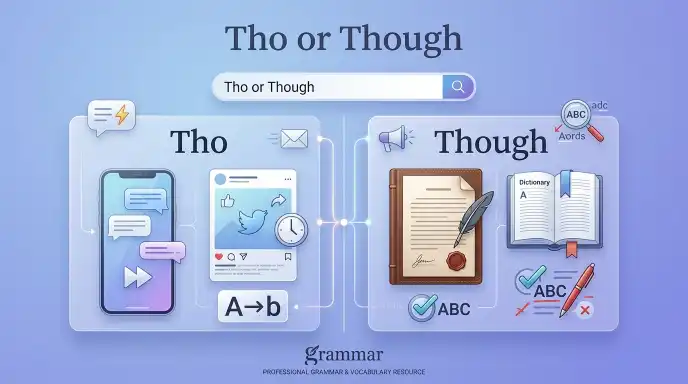
Tho or though? The correct standard spelling is though, while tho is an informal short form used mainly in texts, chats, and social media. Both forms are understood, but they do not have the same level of formality.
People often search for “tho or though” because they see tho online and wonder if it is a spelling mistake. The confusion is common because tho sounds the same as though when spoken. In standard English, though is the normal spelling used in school, work, academic writing, and formal communication. Tho is a shortened internet form that is common in casual digital communication.
The word though can work as a conjunction, adverb, or conversational marker. It can mean “although,” “however,” or “despite this.” The short form tho usually keeps the same meaning but has a casual tone.
Understanding the difference helps you choose the right form for each situation.
Tho or Though : Quick Answer
Though is the correct standard spelling. Tho is an informal shortened form often used in texting, online chats, comments, and social media.
Examples:
- Though: I liked the movie, though it was too long.
- Tho: I liked the movie, tho it was too long.
For formal writing, use “though.” For casual digital messages, “tho” may be acceptable.
Definition and Meaning of Tho or Though
Though is a standard English word with several common uses.
It can introduce a contrast:
Though it was raining, we went outside.
Here, though means “although.”
It can also appear at the end of a sentence to show contrast:
The restaurant was expensive. The food was good, though.
In this sentence, though is similar to “however” or “nevertheless.”
What Does “Tho” Mean?
Tho is an informal shortened spelling of though. It is mainly used in casual digital communication.
For example:
That was a great movie, tho.
The meaning is the same as “though,” but the spelling gives the sentence a more relaxed and conversational style.
Is “Tho” a Word?
Tho is recognized as an informal spelling of though, but it is not normally used in standard formal writing.
It is common in:
- Text messages
- Social media
- Online comments
- Chat messages
- Informal conversations
For essays, reports, applications, business documents, and academic work, though is the safer choice.
The Origin of Tho or Though
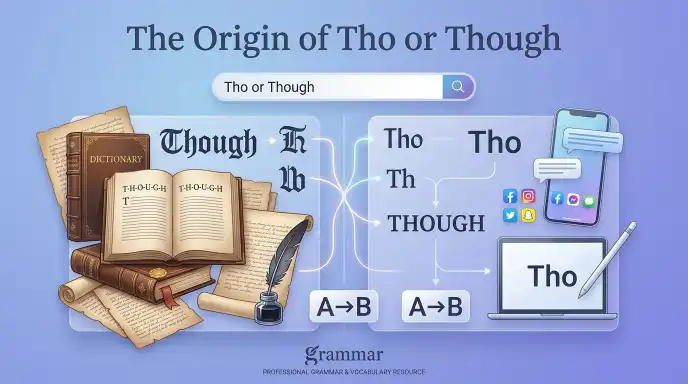
The word though has a long history in English.
It comes from Old English, where related forms were used to express ideas such as “although,” “even if,” or “despite the fact that.” Over time, its spelling changed as English developed.
The spelling though became established in standard written English. Its pronunciation also changed over the centuries.
The shorter form tho developed much later as an informal spelling. It became especially common with the growth of text messaging, internet forums, social media, and online chat.
The main reason for the difference is simple:
- Though = traditional standard spelling
- Tho = shortened informal spelling
The short spelling reflects casual writing and the way people often shorten words when communicating online.
British English vs American English Spelling
There is no major British-versus-American spelling difference for though.
Both British English and American English use though as the standard spelling.
| English Variety | Standard Spelling | Informal Short Form | Example |
| British English | though | tho | It was hard, though. |
| American English | though | tho | It was hard, though. |
| Canadian English | though | tho | It was hard, though. |
| Australian English | though | tho | It was hard, though. |
| Formal international English | though | Usually avoid tho | Though it was late, we continued. |
The important point is that “tho” is not a US-only spelling. It can appear in informal writing across English-speaking communities.
However, it remains the standard form in both British and American English.
Which Spelling Should You Use?
Your choice depends mainly on the type of writing and your audience.
For US English
Use though in formal and professional writing.
Example:
Though the results were positive, more research is needed.
In texting or casual social media posts, tho can be used.
For UK and Commonwealth English
The same general rule applies.
Use though in standard writing and tho only when a casual tone is intended.
For Global English
If your readers come from different countries, though is the best choice.
It is clear, standard, and widely accepted.
Simple Rule
Use “though” when in doubt.
It works in both formal and informal writing. Tho is mainly useful when you intentionally want a casual online style.
Common Mistakes with Tho or Though
The most common mistake is using tho in writing that requires standard English.
| Incorrect or Less Suitable | Better Choice | Reason |
| Tho the weather was bad, we left. | Though the weather was bad, we left. | Formal standard spelling |
| I enjoyed it tho. | I enjoyed it though. | Use standard spelling in formal writing |
| I though it was good. | I thought it was good. | Thought is a different word |
| Even tho it rained, we went out. | Even though it rained, we went out. | Standard spelling |
| Tho difficult, the task was useful. | Though difficult, the task was useful. | Formal writing needs the standard form |
Tho vs Though vs Thought
These words can be confusing because they look and sound similar.
Though means although or however.
Though it was late, we continued.
Thought is the past tense of think.
I thought you were coming.
Tho is an informal short form of though.
It was expensive, tho.
Remember: tho = informal though, while thought = past tense of think.
Tho or Though in Everyday Examples
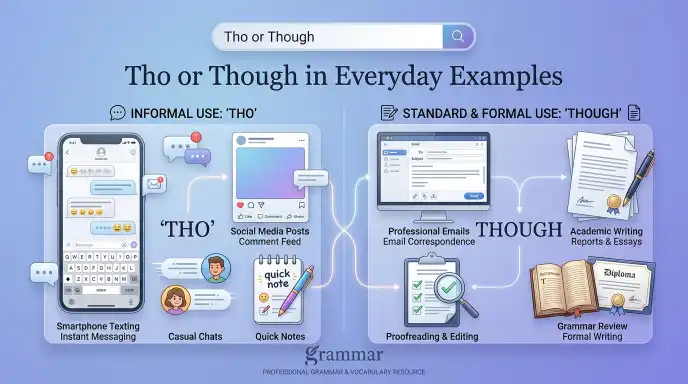
Both forms can appear in everyday communication, but their use depends on the situation.
In Emails
For professional emails, use though.
I agree with your suggestion, though we may need more time.
Avoid tho in formal business emails because it can look too casual.
In News Writing
News articles normally use it though.
The team lost the match, though it played well in the second half.
This would be unusual in standard news writing.
On Social Media
Tho is common in casual posts and comments.
That outfit is expensive tho.
It can make the message sound relaxed and conversational.
In Text Messages
People often use tho in quick messages.
I can come later tho.
This is understandable in casual communication.
In Formal Writing
Use though.
Though the evidence is limited, the findings are important.
Academic papers, reports, applications, and official documents should normally use the standard form.
Tho or Though : Google Trends & Usage Data
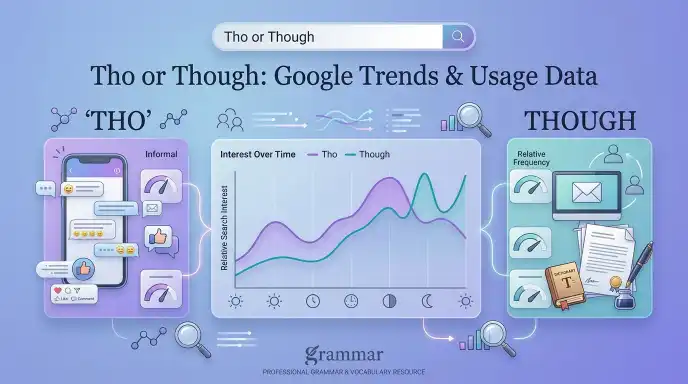
Search interest for tho and though can vary depending on the country, age group, and type of communication.
Though has a much broader role in standard English because it is used in books, articles, education, business writing, and everyday speech.
Tho is more closely linked with informal internet language. Its use is especially associated with text messages, comments, social media, and online conversations.
Search behavior can also vary because people may search “tho or though” when they want to know if the shorter form is acceptable.
Google Trends data should be interpreted carefully. Search interest does not directly measure how often a word is used in everyday speech or writing. Trends can also change over time and differ between countries.
For standard English, the practical rule remains simple: though is the standard spelling, while tho is informal.
Tho or Though: Comparison Table
| Feature | Though | Tho |
| Standard spelling | Yes | No |
| Informal spelling | Sometimes | Yes |
| Meaning | Although / however | Same as though |
| Formal writing | Recommended | Avoid |
| Academic writing | Recommended | Avoid |
| Business writing | Recommended | Avoid |
| Text messages | Common | Common |
| Social media | Common | Common |
| Online comments | Common | Common |
| Pronunciation | Same in most contexts | Same |
| Best general choice | Yes | Only for casual style |
Frequently Asked Questions About Tho or Though
Q1. Is “tho” correct spelling?
Tho is an informal shortened form of though. It is common in texting and online communication, but is the standard spelling for formal English.
Q2. Is “tho” acceptable in formal writing?
No, “tho” is generally not recommended in formal writing. Use though in academic papers, professional emails, reports, applications, and official documents.
Q3. Is “tho” the same as “though”?
Yes. Tho usually has the same meaning as though. The main difference is the level of formality.
Q4. Is “though” British or American?
Though is used in both British and American English. There is no standard British-American spelling difference for this word.
Q5. Can I use “tho” in a text message?
Yes. Tho is common in casual text messages, chats, and social media posts. It gives the message a relaxed and informal tone.
Q6. What is the difference between “tho” and “thought”?
Tho is an informal form of though. Thought is the past tense of think.
- I liked it, tho.
- I thought it was good.
Q7. Which one should I use in an essay, “tho” or “though”?
Use though. It is the standard spelling and is suitable for essays, academic assignments, reports, and other formal writing.
Conclusion:
Though is the correct standard spelling, while tho is an informal shortened form used mainly in digital communication. Both forms usually have the same meaning, but they suit different writing styles.
Use though when you are writing an essay, report, professional email, application, article, or other formal text. It is accepted in both British and American English, so you do not need to change it based on the variety of English you use.
Use tho when you want a casual and conversational style. It is common in texts, chats, comments, and social media posts. However, it may look too informal in professional writing.
Also remember that though and thought are different words. Though can mean “although” or “however,” while thought is the past tense of think.
The easiest rule is this: when you are unsure, choose “though.” It is standard, clear, and suitable for almost every situation.

I’m Nora Ellis, an English language writer passionate about making grammar, spelling, and confusing words easy to understand. I share clear explanations and practical examples to help readers improve their English and use words with confidence.