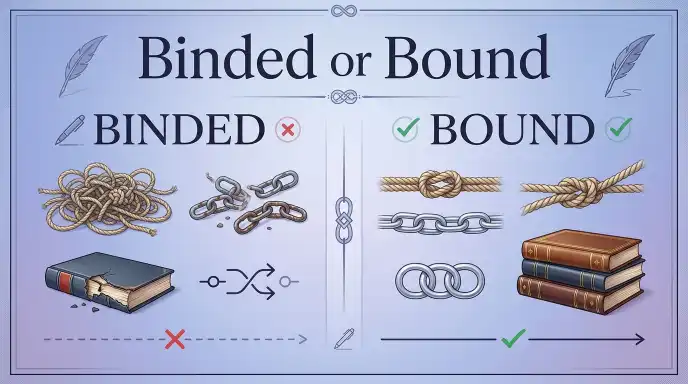
Bound is the correct past tense and past participle of bind, while binded is not the standard form in modern English. The verb bind means to tie, join, fasten, or hold things together. Its three main forms are bind, bound, bound.
Many people search for binded or bound because English has two common ways to form past-tense verbs. Regular verbs usually take -ed, such as walk → walked and call → called. However, bind belongs to the group of irregular verbs. It changes its form instead of taking -ed.
For example, you should say, “She bound the papers together,” rather than “She binded the papers together.” You should also say, “He has bound the documents,” rather than “He has binded the documents.”
This difference matters in schoolwork, emails, business writing, academic papers, and everyday English. Once you remember the pattern bind → bound → bound, the choice becomes simple.
This guide explains the meaning, history, correct forms, common mistakes, examples, and practical usage of binded or bound.
Binded or Bound : Quick Answer
Bound is the correct past tense and past participle of bind. In standard modern English, use bound, not binded.
| Verb Form | Correct Form | Example |
| Base form | bind | Please bind these pages. |
| Past tense | bound | She bound the pages yesterday. |
| Past participle | bound | She has bound the pages. |
| -ing form | binding | He is binding the book. |
Correct Examples
She bound the documents together.
The publisher has bound the book.
Incorrect Examples
She binded the documents together.
The publisher has binded the book.
The easiest rule to remember is:
Bind → Bound → Bound
Definition and Meaning of Binded or Bound
The verb bind means to tie, fasten, connect, or hold something together. It can describe physical objects as well as agreements, duties, relationships, and ideas.
Bind as a Present-Tense Verb
Use bind for an action that happens now or regularly.
Workers bind the pages together.
This agreement binds both parties.
Bound as a Past-Tense Verb
Use bound when the action happened in the past.
She bound the papers with a ribbon.
The editor bound the pages into a book.
Bound as a Past Participle
Use bound with helping verbs such as has, have, had, is, was, and were.
He has bound the documents.
They had bound the papers before lunch.
The pages were bound together.
Other Meanings of Bound
Bound can also have meanings that do not come from the past form of bind.
For example:
The train is bound for London.
Here, bound for means traveling toward a place.
Another example is:
We are bound by the contract.
Here, bound by means required to follow an agreement, rule, or duty.
The sentence usually makes the intended meaning clear.
The Origin of Binded or Bound
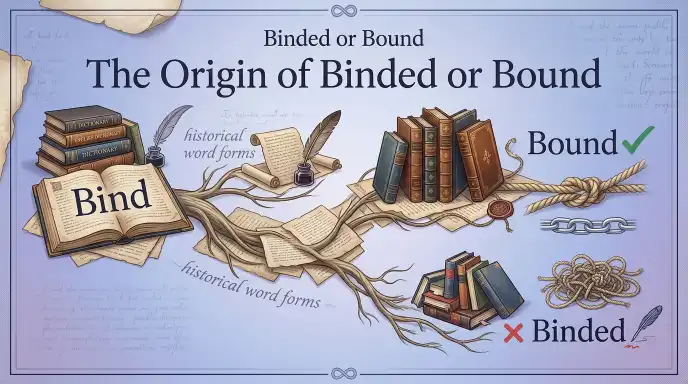
The difference between binded and bound comes from the history of English.
Bind comes from an old Germanic verb family. English speakers have used changing vowel patterns to form the past tense of many old Germanic verbs. Over time, bind developed the past form bound.
This pattern still appears in several common English verbs:
- find → found
- wind → wound
- sing → sang
- ring → rang
- drink → drank
- begin → began
These verbs are called irregular verbs because they do not simply add -ed to form the past tense.
The form binded may look natural because English has many regular verbs. However, standard modern English follows the older irregular pattern:
bind → bound → bound
That pattern remains the accepted form in normal English writing and speech.
British English vs American English Spelling
British English and American English use the same forms for this verb.
There is no standard spelling difference between the two varieties. Writers in both forms of English use bind → bound → bound.
| English Variety | Present | Past | Past Participle |
| British English | bind | bound | bound |
| American English | bind | bound | bound |
| Canadian English | bind | bound | bound |
| Australian English | bind | bound | bound |
| International English | bind | bound | bound |
British English Example
The printer bound the report.
American English Example
The printer bound the report.
Both sentences use the same verb form.
So, unlike words such as colour/color or centre/center, bound does not change between British and American English.
Which Spelling Should You Use?
Use bound whenever you need the past tense or past participle of bind.
For US English
American writers should use:
She bound the documents together.
For UK and Commonwealth English
British and Commonwealth writers should also use:
She bound the documents together.
For Academic Writing
Students and researchers should choose bound in essays, papers, reports, and assignments.
The researcher bound the pages into one volume.
For Business Writing
Use bound in emails, reports, contracts, and professional documents.
We bound the final copies before the meeting.
For International Readers
Bound works across major English varieties. It is the safest standard choice when you want clear and professional English.
The main rule remains:
Use bound, not binded.
Common Mistakes with Binded or Bound
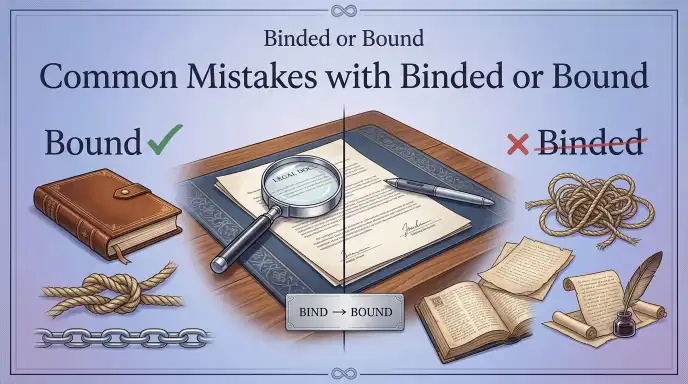
The most common error comes from treating bind like a regular verb.
Using Binded for the Past Tense
❌ She binded the papers.
✅ She bound the papers.
Using Binded After Have
❌ He has binded the documents.
✅ He has bound the documents.
Using Binded in a Passive Sentence
❌ The books were binded together.
✅ The books were bound together.
Forgetting the Irregular Pattern
Some writers remember:
walk → walked
and then apply the same pattern to bind.
That creates binded, but English does not use that form as the standard past tense.
Remember:
bind → bound → bound
| Incorrect Form | Correct Form |
| binded | bound |
| has binded | has bound |
| had binded | had bound |
| was binded | was bound |
| were binded | were bound |
Binded or Bound in Everyday Examples
Seeing the correct form in different situations can make the rule easier to remember.
In Emails
I bound the documents and placed them on your desk.
We have bound the final copies for the meeting.
In News Writing
The publisher bound the collection in a hard cover.
The company bound the reports together for the archive.
In Social Media
Finally bound my notes into one book!
I bound all my study pages together today.
In Formal Writing
The editor bound the separate sections into one volume.
The library staff bound the damaged pages together.
In Everyday Conversation
I bound the papers with string.
She bound the flowers with a ribbon.
With Has, Have, or Had
She has bound the documents.
They have bound the pages together.
We had bound the papers before the meeting.
These examples show why bound works as both the past tense and past participle of bind.
Binded or Bound : Google Trends & Usage Data
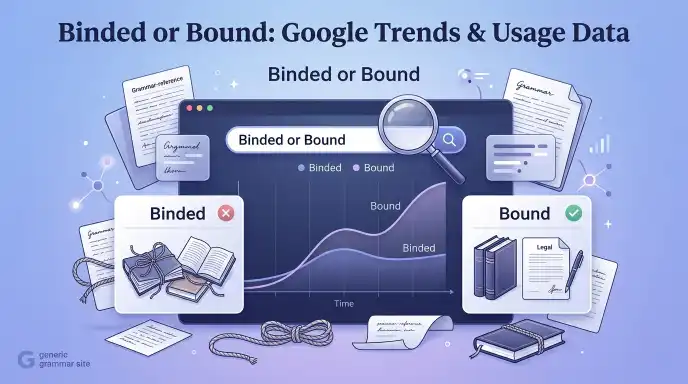
People search for binded or bound mainly because they want to check the correct past form of bind. The question often appears when someone is writing an essay, email, report, or other English text.
Search interest does not determine if a word follows standard grammar. A frequently searched form can still be nonstandard.
For that reason, search volume for binded should not serve as proof that the form is correct. The standard form remains bound.
Usage can also vary by context. Students may search for the answer while checking grammar, while writers and editors may encounter the question during proofreading.
The practical forms are:
- bind = base form
- bound = past tense
- bound = past participle
- binding = -ing form
- binded = nonstandard in ordinary modern English
Country-level search interest can change over time, so Google Trends should serve as a guide to search behavior, not as a grammar authority.
For standard writing, the clear choice remains bound.
Binded vs Bound: Comparison Table
| Feature | Binded | Bound |
| Standard past tense | ❌ No | ✅ Yes |
| Standard past participle | ❌ No | ✅ Yes |
| Base form | ❌ No | ❌ No |
| Used with has/have/had | ❌ | ✅ |
| Used in formal writing | ❌ | ✅ |
| Used in academic writing | ❌ | ✅ |
| British English | ❌ | ✅ |
| American English | ❌ | ✅ |
| Standard modern usage | ❌ | ✅ |
Correct Verb Pattern
Bind → Bound → Bound
This pattern is the main point to remember.
Frequently Asked Questions About Binded or Bound
Q1. Is binded correct English?
Binded is not the standard past tense or past participle of bind in modern English. Use bound instead.
Q2. Is it binded or bound?
The correct form is bound.
She bound the pages together.
Use bound when you describe a past action involving bind.
Q3. What is the past tense of bind?
The past tense of bind is bound.
Present: She binds the pages.
Past: She bound the pages.
Q4. What is the past participle of bind?
The past participle is also bound.
He has bound the documents.
The complete pattern is bind → bound → bound.
Q5. Do British and American English use bound?
Yes. Both British English and American English use bound as the standard past tense and past participle of bind.
Q6. Why do people say binded?
People may choose binded because many regular English verbs form the past tense with -ed. However, bind is an irregular verb, so its standard past form is bound.
Q7. Can I use binded in formal writing?
For standard formal writing, choose bound.
The documents were bound together.
This form works well in academic, business, and professional writing.
Conclusion:
The correct choice between binded or bound is bound. Standard English uses bound as both the past tense and past participle of bind.
The verb bind means to tie, fasten, join, or hold something together. Its main forms are bind, bound, bound. The form binded may look logical because many English verbs use -ed, but bind follows an irregular pattern.
This rule stays the same across British English, American English, Canadian English, and Australian English. You do not need a different spelling for different English-speaking countries.
Use bound in essays, emails, reports, academic work, business writing, and everyday conversation. For example, you can write, “She bound the papers together,” or “He has bound the documents.”
When you remember the simple pattern bind → bound → bound, you can avoid the most common mistake with this verb. If you are unsure, choose bound for standard modern English.

I’m Nora Ellis, an English language writer passionate about making grammar, spelling, and confusing words easy to understand. I share clear explanations and practical examples to help readers improve their English and use words with confidence.